
Managing stock effectively represents one of the most critical operational challenges facing businesses today. Whether you operate a small retail outlet or manage a complex supply chain, understanding how to track, organize, and optimize your stock can mean the difference between profitability and significant losses. Effective inventory management ensures you maintain the right products in the right quantities at the right time, minimizing waste while meeting customer demand consistently.
Understanding Inventory Management Fundamentals
Inventory management encompasses the complete process of ordering, storing, tracking, and controlling stock throughout its lifecycle. This systematic approach helps businesses maintain optimal inventory levels, reduce carrying costs, and ensure product availability when customers need them.
The foundation of successful inventory management rests on several key principles. First, accurate tracking provides visibility into what you have, where it's located, and how quickly it moves. Second, demand forecasting helps predict future needs based on historical data and market trends. Third, reorder point calculations ensure you replenish stock before running out.
Modern inventory management extends beyond simple counting. It integrates with purchasing, sales, warehousing, and financial systems to create a comprehensive view of your supply chain. This integration allows businesses to make data-driven decisions that impact everything from cash flow to customer satisfaction.

Essential Components of Effective Inventory Systems
A robust inventory management system comprises several interconnected elements that work together to maintain control over stock levels and movement.
Stock Tracking and Visibility
Real-time visibility into inventory levels forms the cornerstone of effective management. Knowing exactly what you have at any moment prevents stockouts, reduces excess inventory, and improves order fulfillment accuracy. Many businesses struggle with inventory blind spots where stock exists but remains unaccounted for in their systems.
Serial number tracking adds another layer of precision, particularly for high-value items or products requiring warranty management. Each item receives a unique identifier that follows it through the supply chain, from receipt to sale or service.
Demand Forecasting Methods
Predicting future demand requires analyzing historical sales data, seasonal trends, market conditions, and business growth projections. Accurate forecasting reduces the risk of overstocking slow-moving items while ensuring popular products remain available.
Statistical methods range from simple moving averages to complex algorithms that account for multiple variables. The right approach depends on your industry, product variety, and sales patterns. Implementing proven best practices for inventory management significantly improves forecasting accuracy.
Reorder Points and Safety Stock
Setting appropriate reorder points ensures you initiate purchase orders before inventory runs critically low. This calculation considers lead time, average daily sales, and desired safety stock levels. Safety stock acts as a buffer against unexpected demand spikes or supply delays.
The formula balances the cost of holding extra inventory against the risk and cost of stockouts. Too much safety stock ties up capital and storage space, while too little creates service disruptions and lost sales opportunities.
Inventory Management Strategies and Methodologies
Different strategies suit different business models and product types. Understanding these approaches helps you select the most effective method for your operation.
Just-in-Time Inventory Approach
Just-in-time (JIT) inventory minimizes holding costs by receiving goods only as needed for production or sale. This strategy reduces storage requirements and decreases the risk of obsolescence, but requires reliable suppliers and accurate demand forecasting.
JIT works exceptionally well for businesses with predictable demand patterns and strong supplier relationships. However, it leaves little room for error and can create vulnerabilities when supply chains face disruptions.
ABC Analysis for Prioritization
ABC analysis categorizes inventory into three tiers based on value and importance. Category A items represent high-value products that require close monitoring despite comprising a small percentage of total inventory. Category B items fall in the middle range, while Category C includes numerous low-value items.
This classification helps businesses allocate resources efficiently, applying rigorous controls to high-value items while using simpler management methods for less critical stock. The approach aligns perfectly with the Pareto principle, where roughly 20 percent of items typically account for 80 percent of inventory value.
| Category | Percentage of Items | Percentage of Value | Management Approach |
|---|---|---|---|
| A | 10-20% | 70-80% | Tight control, frequent review, precise records |
| B | 30-40% | 15-25% | Moderate control, regular review, good records |
| C | 40-50% | 5-10% | Simple controls, periodic review, basic records |
Economic Order Quantity
Economic order quantity (EOQ) calculates the optimal order size that minimizes total inventory costs, including ordering costs and holding costs. This mathematical model helps businesses determine how much to order each time rather than relying on guesswork or arbitrary quantities.
The EOQ formula considers annual demand, cost per order, and annual holding cost per unit. While the classic model makes several assumptions that may not perfectly match real-world conditions, it provides a valuable starting point for optimization. Advanced simulation-optimization approaches can further refine inventory decisions under uncertain demand conditions.

Technology Solutions for Inventory Control
Modern software transforms inventory management from a manual, error-prone process into an automated system that provides real-time insights and control.
Core Software Capabilities
Inventory management software centralizes data, automates routine tasks, and generates actionable reports. Essential features include barcode scanning, automated reordering, multi-location tracking, and integration with accounting and sales systems.
Cloud-based solutions offer accessibility from anywhere, automatic updates, and scalability as your business grows. These platforms eliminate the need for on-premises servers while providing robust security and data backup.
Serialized Inventory and Service Tracking
For businesses managing equipment, machinery, or high-value assets, serialized inventory tracking becomes essential. Each item receives a unique identifier that captures its complete history, including purchase date, warranty information, service records, and current condition.
Brytend's approach to inventory management includes powerful capabilities for businesses requiring detailed asset tracking and service management. The Brytend Service Module enables companies to register serialized inventory, schedule preventive maintenance, automate service reminders, and generate comprehensive service certificates. This level of control proves invaluable for organizations managing equipment fleets, medical devices, or any assets requiring regular servicing and compliance documentation.

Integration with Business Systems
Standalone inventory systems create data silos that require manual reconciliation and duplicate entry. Integrated platforms connect inventory management with purchasing, sales, accounting, and customer relationship management systems to create a unified business ecosystem.
This integration ensures inventory updates flow automatically when sales occur, purchase orders generate based on reorder points, and financial reports reflect current inventory values. The result is improved accuracy, reduced administrative overhead, and better decision-making across departments. Learn more about integrated business solutions at Brytend.
Best Practices for Operational Excellence
Implementing proven best practices transforms inventory management from a reactive challenge into a strategic advantage.
Regular Physical Counts and Cycle Counting
- Establish a regular cycle counting schedule that audits different inventory sections throughout the year rather than conducting one massive annual count.
- Prioritize high-value items and fast-moving products for more frequent counts.
- Investigate and resolve discrepancies immediately to maintain system accuracy.
- Use physical counts to validate system data and identify process improvements.
- Document count procedures to ensure consistency across different staff members.
Cycle counting distributes the workload evenly while maintaining ongoing accuracy. This approach identifies issues quickly rather than discovering major discrepancies months after they occur. Inventory control best practices emphasize the importance of regular physical verification.
Standard Operating Procedures
Documented procedures ensure consistency regardless of which team member handles inventory tasks. Create detailed instructions for receiving shipments, putting away stock, picking orders, and conducting counts. These procedures reduce errors, speed up training, and maintain quality standards.
Standard operating procedures should cover exception handling, such as damaged goods, returns, and discrepancies. Clear protocols prevent confusion and ensure everyone follows the same process.
Key Performance Indicators
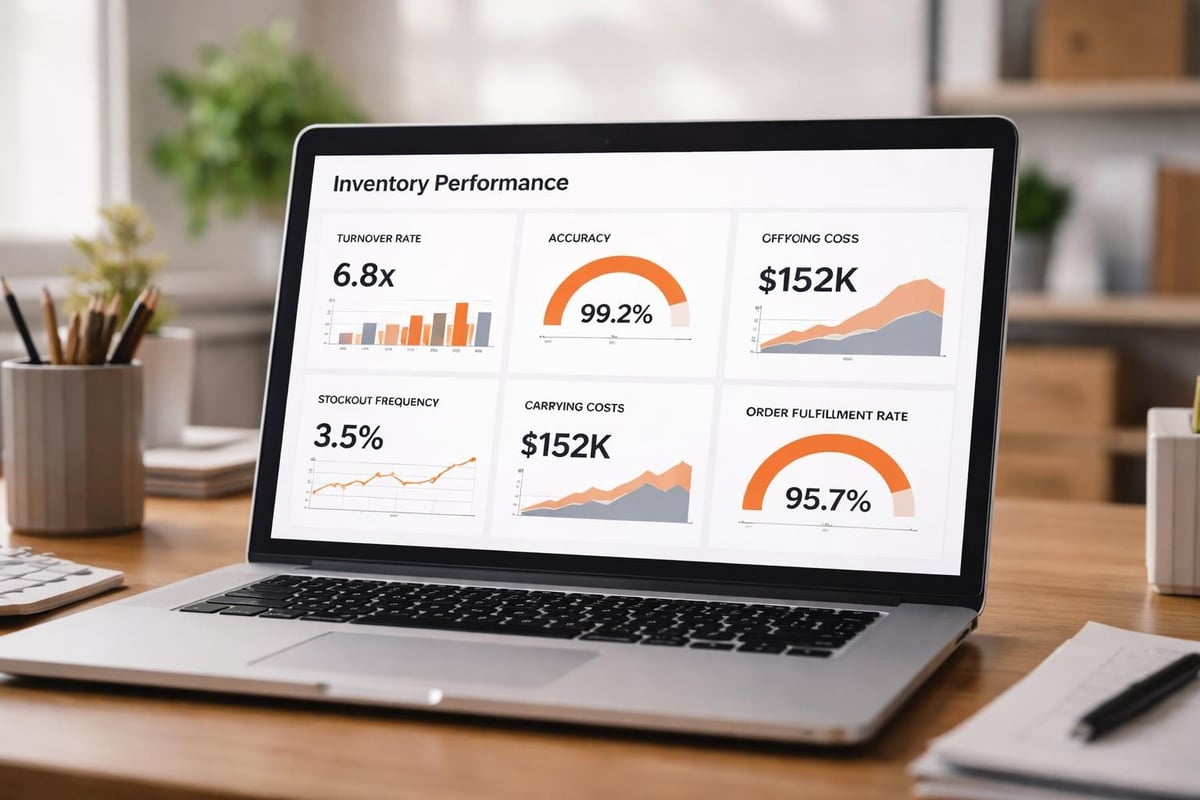
- Inventory turnover ratio measures how quickly you sell and replace stock.
- Inventory accuracy compares system records to physical counts.
- Stockout rate tracks how often items are unavailable when customers want them.
- Carrying cost of inventory calculates the total expense of holding stock.
- Order fulfillment rate measures the percentage of orders completed without backorders.
- Lead time tracking monitors how long suppliers take to deliver.
- Obsolete inventory percentage identifies slow-moving or outdated stock.
These metrics provide objective measures of inventory management effectiveness. Track them consistently and set improvement targets. Applying key performance indicators helps measure efficiency and identify areas requiring attention.
Advanced Optimization Techniques
As businesses mature, more sophisticated approaches can deliver additional improvements in inventory performance and profitability.
Machine Learning and Artificial Intelligence
Advanced algorithms analyze vast amounts of historical data to identify patterns humans might miss. Machine learning models adapt to changing conditions, improving forecast accuracy over time. These systems can predict demand fluctuations based on weather, economic indicators, promotional activities, and other variables.
Deep reinforcement learning applications demonstrate how artificial intelligence can optimize inventory policies across diverse scenarios. While implementing these technologies requires expertise, the potential benefits include significantly reduced stockouts and lower carrying costs.
Multi-Location Inventory Management
Businesses operating multiple warehouses or retail locations face additional complexity in inventory management. Stock must be distributed appropriately across locations based on local demand patterns while maintaining the ability to transfer inventory where needed.
Centralized visibility across all locations enables better decision-making about stock allocation and transfers. The system should track inventory by location while providing an aggregate view of total availability.
Vendor-Managed Inventory
In vendor-managed inventory arrangements, suppliers monitor your stock levels and automatically replenish items as needed. This approach shifts responsibility to vendors who have better visibility into product availability and production schedules.
The arrangement reduces your administrative burden and can improve stock availability. However, it requires strong supplier relationships, clear agreements on inventory levels, and systems that provide vendors with real-time consumption data.
Industry-Specific Considerations
Different industries face unique inventory management challenges requiring specialized approaches and solutions.
Perishable Goods Management
Businesses handling food, pharmaceuticals, or other time-sensitive products must implement first-in-first-out (FIFO) or first-expired-first-out (FEFO) rotation. Expiration date tracking becomes critical to minimize waste and ensure customer safety.
Temperature monitoring, batch tracking, and rapid turnover strategies help manage perishable inventory effectively. The costs of spoilage and obsolescence significantly impact profitability in these industries.
Manufacturing and Raw Materials
Manufacturers manage multiple inventory types simultaneously: raw materials, work-in-process, and finished goods. Each category requires different handling and tracking methods. Material requirements planning (MRP) systems calculate component needs based on production schedules and bills of materials.
Coordination between production planning and inventory management ensures materials arrive when needed without excessive stockpiling. Just-in-time principles often work well in manufacturing environments with stable supplier relationships.
Retail and Seasonal Demand
Retailers face constantly changing inventory needs driven by fashion trends, seasonal patterns, and promotional activities. Effective planning for peak seasons prevents stockouts during high-demand periods while avoiding excessive inventory when demand subsides.
Markdown strategies and clearance processes help move seasonal merchandise before it becomes obsolete. Analytics identify which products sell consistently versus those with limited seasonal appeal.
Common Challenges and Solutions
Even well-designed inventory management systems encounter obstacles that require thoughtful solutions and ongoing attention.
Inaccurate Data and Record Keeping
- Implement barcode scanning or RFID technology to reduce manual entry errors.
- Conduct regular cycle counts to identify and correct discrepancies promptly.
- Train staff on proper procedures for recording receipts, movements, and sales.
- Restrict system access to authorized personnel with appropriate permissions.
- Establish accountability for inventory accuracy at the individual and team level.
Data accuracy forms the foundation of effective inventory management. Even small errors compound over time, leading to significant discrepancies that undermine decision-making.
Supplier Reliability Issues
Unreliable suppliers create uncertainty that forces businesses to carry excess safety stock. Building relationships with multiple suppliers provides alternatives when primary sources face disruptions. Regular supplier performance evaluation identifies chronic issues requiring attention or vendor changes.
Long-term contracts with performance guarantees help ensure consistent delivery. Communication about upcoming demand changes gives suppliers time to prepare, reducing the likelihood of shortages.
Balancing Cost and Service Level
Every business must balance the cost of holding inventory against the service level provided to customers. Higher inventory levels improve product availability but increase carrying costs and tie up capital. Lower inventory reduces costs but risks stockouts and lost sales.
The optimal balance depends on your industry, customer expectations, and competitive positioning. Premium brands often maintain higher inventory to ensure immediate availability, while cost-focused retailers might accept occasional stockouts to minimize carrying costs. IT inventory management best practices emphasize applying 'what if' models to test different scenarios.
| Challenge | Impact | Solution |
|---|---|---|
| Manual processes | Errors, inefficiency, delayed updates | Automation and software implementation |
| Poor forecasting | Stockouts or excess inventory | Advanced analytics and demand planning |
| Lack of visibility | Blind spots, lost inventory | Real-time tracking systems |
| Supplier delays | Production disruptions, lost sales | Multiple suppliers, safety stock |
| Obsolescence | Write-offs, storage waste | Regular review, clearance strategies |
Implementation and Change Management
Successfully implementing improved inventory management practices requires careful planning and attention to the human factors involved in organizational change.
Assessment and Planning
- Evaluate current processes to identify pain points and improvement opportunities.
- Define clear objectives with measurable success criteria.
- Research solutions that address your specific needs and budget constraints.
- Develop a phased implementation plan that minimizes business disruption.
- Allocate sufficient resources for technology, training, and process redesign.
Rushing implementation without proper planning often leads to poor adoption and suboptimal results. Take time to understand your requirements and involve stakeholders from different departments.
Training and Adoption
New systems and processes only deliver value when people use them correctly and consistently. Comprehensive training ensures staff understand not just how to use new tools, but why the changes matter. Hands-on practice during training builds confidence and competence.
Ongoing support during the transition period addresses questions and resolves issues quickly. Designate super-users or champions who can assist colleagues and provide feedback to management about challenges and opportunities.
Continuous Improvement
Inventory management should evolve as your business grows and markets change. Regular reviews of performance metrics identify areas requiring adjustment. Solicit feedback from staff who work with the system daily, as they often have valuable insights about practical improvements.
Stay informed about emerging technologies and methodologies. Continuous learning and adaptation ensure your inventory management practices remain competitive and effective.
Frequently Asked Questions
What is inventory management and why does it matter?
Inventory management is the systematic process of ordering, storing, tracking, and controlling stock throughout its lifecycle. It matters because effective inventory management directly impacts cash flow, customer satisfaction, and profitability by ensuring you have the right products available when needed while minimizing carrying costs and waste.
How do I calculate the right amount of safety stock?
Safety stock calculation considers lead time variability, demand variability, and desired service level. A common formula multiplies the Z-score for your target service level by the standard deviation of lead time demand. For example, a 95 percent service level requires approximately 1.65 times the standard deviation in safety stock.
What is the difference between inventory management and inventory control?
Inventory management encompasses the broader strategic oversight of inventory, including forecasting, planning, and optimization. Inventory control focuses on the tactical execution of managing physical stock, including receiving, storing, tracking, and issuing items. Control is a subset of the larger management function.
How often should I conduct physical inventory counts?
The frequency depends on inventory value, turnover rate, and accuracy requirements. Implement cycle counting programs that audit different sections throughout the year rather than annual wall-to-wall counts. High-value items might be counted monthly, moderate-value items quarterly, and low-value items annually.
Can small businesses benefit from inventory management software?
Absolutely. Even small businesses gain significant advantages from inventory management software, including improved accuracy, time savings, better decision-making, and scalability for growth. Many affordable cloud-based solutions cater specifically to small business needs and budgets.
What is the best inventory management method for my business?
The best method depends on your industry, product types, demand patterns, and operational capabilities. Retailers often use ABC analysis combined with reorder point systems. Manufacturers might implement JIT or MRP approaches. Evaluate multiple methods and consider hybrid approaches that combine different techniques for different product categories.
How does custom software improve inventory management?
Custom software addresses specific business requirements that off-the-shelf solutions cannot accommodate. Tailored systems integrate seamlessly with existing processes, support unique workflows, and scale precisely to your needs. Custom development eliminates workarounds and compromises required by generic software, improving efficiency and user adoption.
Effective inventory management requires the right combination of strategy, processes, and technology working together to optimize stock levels and operational efficiency. As your business grows and evolves, having systems that adapt to your specific needs becomes increasingly important. Brytend specializes in developing custom software solutions that address unique inventory management challenges, creating tailored systems that integrate seamlessly with your existing operations and support your long-term business objectives.


