Managing a rental business requires juggling multiple complex processes simultaneously. From inventory tracking and reservation management to billing and customer communication, the operational demands can quickly overwhelm manual systems. Rental business software has emerged as an essential tool for companies seeking to streamline operations, reduce errors, and scale efficiently. Whether you're renting equipment, properties, vehicles, or any other assets, the right software solution can transform how you operate and serve customers.
Understanding Rental Business Software Fundamentals
Rental business software refers to specialized platforms designed to manage the complete lifecycle of rental operations. These systems centralize critical business functions into a unified interface, eliminating the need for disconnected spreadsheets, paper records, and fragmented communication channels.
Modern rental management platforms address the unique challenges rental businesses face. Unlike traditional retail or service businesses, rental companies must track asset availability in real-time, manage complex pricing structures based on rental duration, and handle the logistics of asset check-in and check-out. The software automates these processes while providing visibility into every aspect of operations.
Core Components Every System Should Include
The foundation of effective rental business software rests on several critical components that work together seamlessly:
- Inventory Management: Real-time tracking of all rental assets, including availability status, location, condition, and maintenance schedules
- Reservation System: Calendar-based booking interface that prevents double-bookings and manages reservation workflows
- Customer Database: Centralized customer information including rental history, preferences, and communication records
- Billing and Invoicing: Automated invoice generation, payment processing, and financial reporting
- Contract Management: Digital contract creation, electronic signatures, and document storage
- Reporting and Analytics: Data-driven insights into business performance, utilization rates, and revenue trends
These components must integrate smoothly to create a cohesive operational ecosystem. When properly implemented, rental inventory software helps businesses maintain accurate asset tracking while reducing administrative overhead.

Key Features That Drive Operational Efficiency
Beyond basic functionality, advanced rental business software includes features that significantly enhance operational efficiency and customer satisfaction. Understanding these capabilities helps businesses select solutions that align with their specific needs.
Automated Workflow Management
Automation eliminates repetitive manual tasks that consume valuable staff time. Modern platforms automatically send reservation confirmations, payment reminders, and return notifications. They trigger maintenance schedules based on usage hours or calendar intervals, ensuring assets remain in optimal condition.
The software can also automate pricing adjustments based on seasonal demand, rental duration, or customer segments. Dynamic pricing strategies maximize revenue without requiring constant manual intervention.
Asset Lifecycle Tracking
Comprehensive asset tracking extends beyond simple availability status. Professional-grade systems maintain complete histories for each item, including:
- Acquisition date and cost
- Maintenance and repair records
- Utilization metrics and revenue generation
- Depreciation calculations
- Insurance and warranty information
This detailed tracking enables data-driven decisions about asset replacement, identifies underperforming inventory, and supports accurate financial reporting. Businesses can drive operational efficiency and growth by leveraging these insights to optimize their fleet composition.
Mobile Accessibility and Field Operations
Mobile-enabled rental business software empowers field teams to manage operations from any location. Technicians can check equipment in and out directly from customer sites, update asset conditions, capture digital signatures, and process payments without returning to the office.
This mobility dramatically reduces turnaround times between rentals and improves customer experience. Real-time synchronization ensures office staff always have current information, eliminating communication gaps that lead to errors.
Integration Capabilities and Technical Considerations
Rental business software rarely operates in isolation. The most effective solutions integrate seamlessly with other business systems to create a comprehensive operational infrastructure.
Essential Integration Points
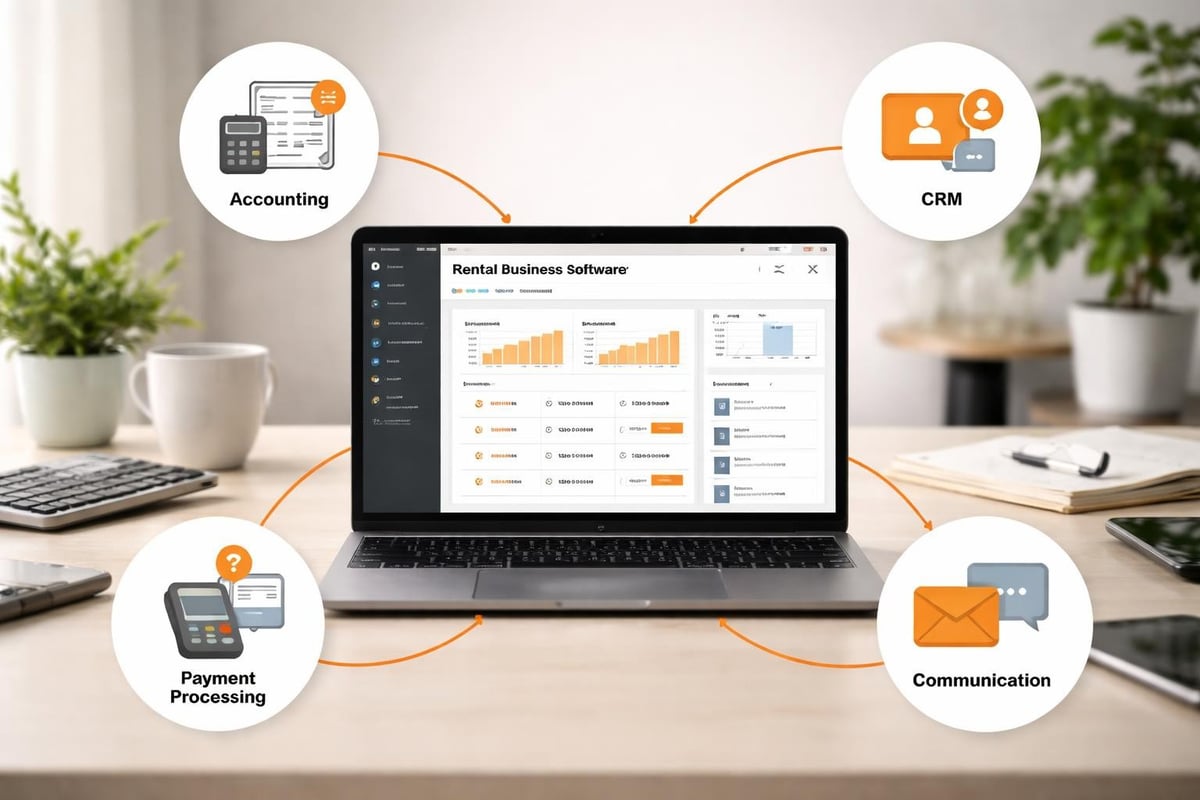
Modern platforms should connect with accounting software to automatically sync invoices, payments, and financial data. This eliminates duplicate data entry and ensures financial records remain accurate and current. Integration with payment gateways enables secure online payments and automatic reconciliation.
Customer relationship management (CRM) integration creates a unified view of customer interactions across sales, service, and support touchpoints. Marketing automation platforms can leverage rental data to create targeted campaigns based on customer behavior and preferences.
| Integration Type | Business Benefit | Implementation Priority |
|---|---|---|
| Accounting Systems | Automated financial reconciliation | High |
| Payment Gateways | Secure online transactions | High |
| CRM Platforms | Unified customer view | Medium |
| Marketing Automation | Targeted campaign execution | Medium |
| Email Systems | Automated communication | High |
| Analytics Tools | Advanced reporting capabilities | Low |
Technical Architecture and Scalability
The underlying technology architecture determines how well rental business software adapts to growing business needs. Cloud-based solutions offer superior scalability, allowing businesses to add users, locations, and inventory without infrastructure investments.
API availability enables custom integrations and future extensibility. Businesses with unique requirements benefit from platforms that support customization without compromising core functionality. Database performance becomes critical as inventory and transaction volumes grow.
Implementation Strategies for Maximum Success
Selecting rental business software represents only the first step. Successful implementation requires careful planning, adequate resources, and organizational commitment to change management.
Planning and Requirements Analysis
Begin by documenting current workflows and identifying pain points that software should address. Involve team members from all departments to ensure the selected solution meets diverse operational needs. Create a prioritized list of must-have features versus nice-to-have capabilities.
Establish clear success metrics before implementation begins. These might include reduced reservation processing time, improved asset utilization rates, decreased billing errors, or enhanced customer satisfaction scores. Measurable objectives keep the project focused and enable post-implementation evaluation.
Data Migration and System Configuration
Migrating existing data into new rental business software requires meticulous attention to detail. Clean and validate data before migration to prevent transferring errors into the new system. Customer records, inventory details, and historical transaction data all require careful mapping to appropriate fields.
System configuration should reflect your specific business processes rather than forcing operations to conform to software defaults. Configure pricing rules, rental terms, tax rates, and workflow automation to match your established practices. Most platforms offer extensive customization options that support unique business requirements.
Training and Change Management
Comprehensive user training determines whether staff embrace or resist new rental business software. Develop role-specific training programs that focus on tasks each team member performs daily. Hands-on practice sessions prove more effective than passive demonstrations.
The Brytend Service Module offers a complete and structured way to manage all service-related activities, particularly valuable for rental businesses managing equipment maintenance. It helps track equipment lifecycles, schedule preventive maintenance, and document service work with accuracy and ease, giving each asset a unique identity for complete lifecycle monitoring.

Designate internal champions who receive advanced training and provide peer support during the transition period. These advocates help colleagues overcome challenges and discover features that improve their daily work. Continuous learning opportunities ensure users maximize software capabilities as they become more proficient.
- Conduct department-specific training sessions
- Create quick-reference guides for common tasks
- Establish a help desk or support channel
- Schedule follow-up training after initial launch
- Gather user feedback regularly
- Celebrate early wins to build momentum
Industry-Specific Considerations and Customization
Different rental sectors have unique requirements that influence software selection and configuration. Understanding industry-specific needs ensures the chosen platform supports specialized workflows effectively.
Equipment Rental Operations
Equipment rental businesses require robust maintenance tracking and scheduling capabilities. The software must handle complex rate structures based on hourly, daily, weekly, or monthly rental periods. GPS tracking integration helps locate assets across multiple job sites.
Damage documentation features with photo capture and cost estimation streamline the returns process. Equipment-specific fields track technical specifications, operating manuals, and certification requirements. Compliance management ensures proper licensing and inspection records.
Property Rental Management
Property rental software emphasizes lease management, tenant screening, and maintenance request tracking. Automated rent collection and late fee assessment reduce administrative burden. Integration with background check services streamlines tenant approval workflows.
Property management software solutions have evolved to include tenant portals for self-service payment, maintenance requests, and document access. Vacancy tracking and marketing automation help minimize unoccupied periods.
Vehicle and Fleet Rental
Vehicle rental operations depend on reservation systems that manage complex availability across multiple locations. Mileage tracking, fuel management, and vehicle condition reporting at check-in and check-out prevent disputes. Integration with GPS telematics provides real-time location data and usage monitoring.
Rate management must accommodate various pricing factors including vehicle class, rental duration, insurance options, and add-on services. Loyalty program integration rewards repeat customers and encourages direct bookings.
Comparison of equipment rental workflows versus property rental workflows versus vehicle rental workflows, highlighting unique process requirements for each sector
Cost Analysis and Return on Investment
Investing in rental business software requires careful financial evaluation. Understanding both direct costs and expected returns helps justify the investment and select the appropriate solution tier.
Pricing Models and Total Cost of Ownership
Rental business software typically follows subscription-based pricing models with monthly or annual payments. Costs vary based on user count, inventory volume, and feature sets. Entry-level solutions may start around a few hundred dollars monthly, while enterprise platforms exceed several thousand.
Beyond subscription fees, consider implementation costs including data migration, customization, integration development, and training. Ongoing expenses encompass support fees, software updates, and potential integration maintenance. Cloud-based solutions generally offer lower total cost of ownership than on-premise installations.
| Cost Component | Typical Range | Frequency |
|---|---|---|
| Monthly Subscription | $200 – $2,000+ | Monthly |
| Implementation Services | $2,000 – $20,000+ | One-time |
| Training Programs | $500 – $5,000 | One-time |
| Custom Integration | $3,000 – $15,000 | As needed |
| Annual Support | 15-20% of license | Yearly |
Measuring Return on Investment
Calculate ROI by quantifying efficiency gains and revenue improvements. Rental business software typically reduces administrative time by automating manual processes, potentially saving dozens of staff hours weekly. Improved asset utilization through better scheduling and availability management directly increases revenue.
Reduced errors in billing and contract management decrease revenue leakage and customer disputes. Enhanced customer experience leads to higher retention rates and increased repeat business. Data-driven decision-making optimizes inventory investment and pricing strategies.
Most businesses achieve positive ROI within 12 to 18 months of implementation. The timeline accelerates for companies experiencing rapid growth or those replacing multiple fragmented systems.
Security, Compliance, and Data Protection
Rental businesses handle sensitive customer information and financial data, making security a critical software selection criterion. Understanding security features and compliance capabilities protects both the business and its customers.
Data Security Measures
Professional rental business software employs multiple security layers to protect information. Encryption secures data both in transit and at rest, preventing unauthorized access. Role-based access controls ensure users only view information relevant to their responsibilities.
Regular security audits and penetration testing identify vulnerabilities before exploitation. Automatic backup systems protect against data loss from hardware failures or cyberattacks. Disaster recovery plans ensure business continuity during unexpected events.
Regulatory Compliance and Industry Standards
Businesses must comply with various regulations depending on their location and rental sector. Payment Card Industry Data Security Standard (PCI DSS) compliance is mandatory for processing credit card transactions. General Data Protection Regulation (GDPR) requirements affect businesses serving European customers.
Audit trails track all system changes and data access, supporting compliance verification and fraud investigation. Document retention policies ensure legal requirements are met while managing storage costs. The software should generate compliance reports demonstrating adherence to relevant regulations.
- Verify PCI DSS compliance for payment processing
- Confirm GDPR features for international operations
- Review audit trail capabilities
- Assess data backup and recovery procedures
- Evaluate vendor security certifications
- Understand data ownership and portability
Advanced Analytics and Business Intelligence
Data represents one of the most valuable assets within rental business software. Advanced analytics capabilities transform raw operational data into actionable business intelligence that drives strategic decisions.
Performance Metrics and KPI Tracking
Comprehensive dashboards provide real-time visibility into critical performance indicators. Asset utilization rates reveal which inventory generates revenue versus sitting idle. Revenue per asset calculations identify the most profitable items in the fleet.
Customer lifetime value metrics guide marketing investment and customer service priorities. Reservation conversion rates measure booking funnel effectiveness. Average rental duration and pricing data inform inventory planning and rate optimization strategies.
| Key Metric | Business Value | Benchmark Target |
|---|---|---|
| Asset Utilization | Revenue optimization | 65-75% |
| On-Time Return Rate | Customer behavior insight | 85-90% |
| Reservation Conversion | Sales effectiveness | 30-40% |
| Customer Retention | Relationship strength | 70-80% |
| Revenue per Asset | Profitability analysis | Varies by industry |
Predictive Analytics and Forecasting
Advanced rental business software incorporates predictive analytics that forecast demand patterns based on historical data and external factors. Seasonal trends, local events, and market conditions all influence rental demand. Accurate forecasting optimizes inventory levels and staffing requirements.
Maintenance prediction algorithms identify assets likely to require service based on usage patterns and historical reliability data. Proactive maintenance reduces unexpected downtime and extends asset lifespan. Churn prediction models flag at-risk customers, enabling retention interventions before relationships end.
Frequently Asked Questions
What is rental business software and who needs it?
Rental business software is a specialized management platform that automates and streamlines operations for companies that rent assets to customers. Any business renting equipment, properties, vehicles, party supplies, or other items benefits from these systems. Companies managing even a modest inventory find that software dramatically reduces administrative burden while improving accuracy and customer service.
How much does rental business software typically cost?
Pricing varies significantly based on features, user count, and inventory size. Small business solutions start around $200 monthly, while mid-market platforms range from $500 to $2,000 monthly. Enterprise solutions exceed $2,000 monthly and may involve custom pricing. Implementation costs, training, and integration development add one-time expenses ranging from $2,000 to $20,000 or more depending on complexity.
Can rental business software integrate with existing accounting systems?
Most modern rental business software offers integration capabilities with popular accounting platforms including QuickBooks, Xero, and Sage. These integrations automatically synchronize invoices, payments, and financial data, eliminating duplicate entry and ensuring accurate records. Some platforms provide native integrations while others require third-party middleware or custom API development. Verify integration availability during software evaluation.
How long does it take to implement rental business software?
Implementation timelines range from a few weeks for simple deployments to several months for complex, multi-location operations. Factors affecting duration include data migration volume, customization requirements, integration complexity, and team availability for training. Small businesses with straightforward needs often complete implementation in 4-6 weeks, while larger organizations may require 3-6 months for comprehensive rollouts.
Is rental business software suitable for small businesses?
Absolutely. Many rental business software solutions specifically target small businesses with affordable pricing, simplified interfaces, and quick implementation. Even small operations benefit from automated reservation management, digital contracts, and professional invoicing. Cloud-based solutions eliminate infrastructure costs and technical expertise requirements, making sophisticated capabilities accessible to businesses of all sizes.
What happens to our data if we switch rental business software providers?
Reputable rental business software providers support data export in standard formats, enabling migration to alternative platforms. Most systems allow exporting customer records, inventory data, and transaction history. Review data ownership clauses in service agreements before commitment. Plan adequate transition time for data extraction, cleaning, and migration to minimize operational disruption during provider changes.
How does rental business software improve customer experience?
Rental business software enhances customer experience through multiple touchpoints. Online reservation systems provide 24/7 booking convenience without phone calls. Automated confirmations and reminders reduce customer uncertainty. Digital contracts eliminate paperwork hassles. Multiple payment options increase flexibility. Real-time availability information prevents disappointment from double-bookings. Customer portals enable self-service account management, creating transparency and control.
Rental business software transforms operational chaos into streamlined efficiency, enabling businesses to scale without proportional increases in administrative complexity. The right platform centralizes critical functions, automates repetitive tasks, and provides data-driven insights that drive strategic growth. Whether you need a turnkey solution or specialized functionality that addresses unique business requirements, Brytend creates custom software solutions tailored to your specific operational needs and business goals. Our experienced development team delivers rental management systems that integrate seamlessly with your existing infrastructure while supporting future growth.


