
The retail industry faces unprecedented challenges in 2026, from managing omnichannel customer experiences to optimizing inventory across multiple locations. Off-the-shelf software often falls short, forcing businesses to adapt their operations to rigid systems rather than the other way around. Custom retail software development offers a strategic alternative, enabling retailers to build solutions that align perfectly with their unique workflows, customer expectations, and growth objectives.
Why Retailers Need Custom Software Solutions
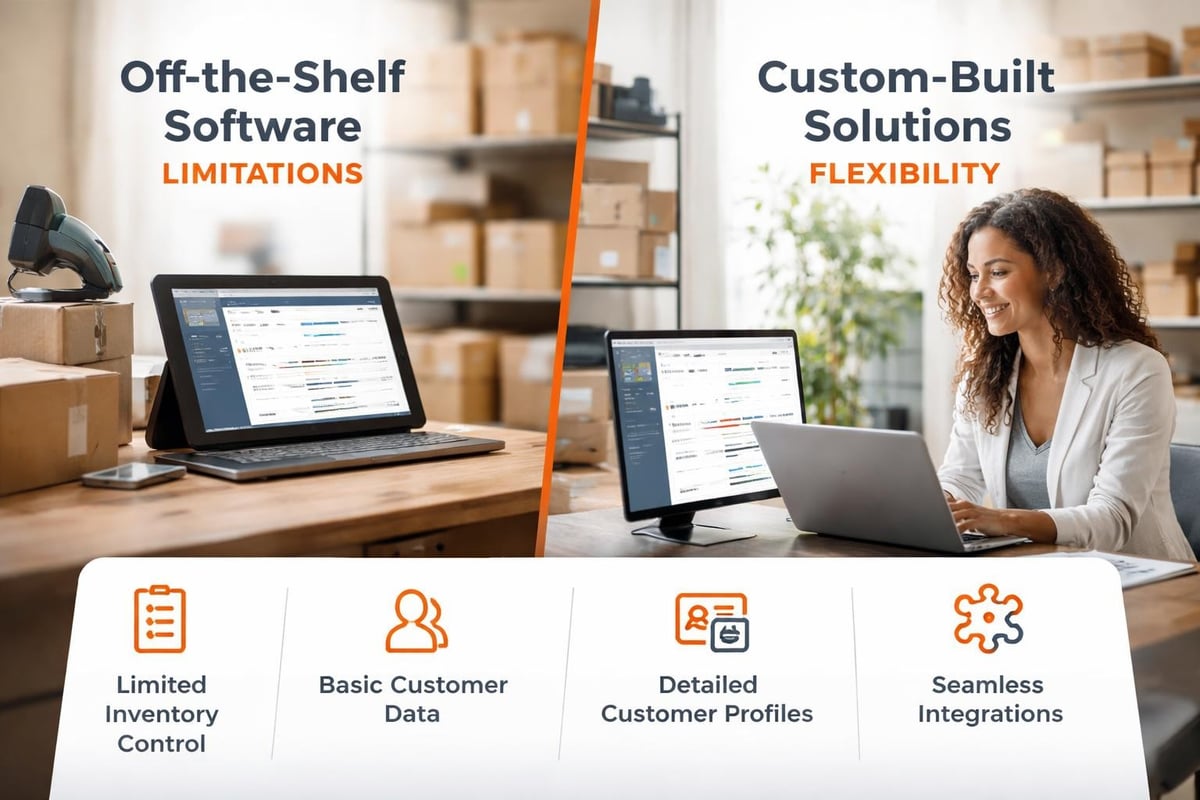
Generic retail management platforms promise universal solutions, but they rarely deliver on that promise. Every retail business operates differently, with unique supplier relationships, customer segments, pricing strategies, and fulfillment processes. When you invest in custom retail software development, you're creating technology that reflects your specific operational reality rather than forcing your team to work around someone else's assumptions.
The Competitive Advantage of Tailored Technology
Retailers using custom software development solutions report significant improvements in operational efficiency and customer satisfaction. Custom systems eliminate the friction points that plague generic platforms, such as:
- Disconnected data sources requiring manual reconciliation between POS, inventory, and accounting systems
- Inflexible pricing rules that can't accommodate complex promotional strategies or dynamic pricing models
- Limited integration capabilities preventing seamless connections with suppliers, payment processors, or logistics partners
- Generic customer interfaces that fail to differentiate your brand or meet specific audience needs
- Scalability constraints that become apparent only after substantial investment in a platform
The investment in custom retail software development pays dividends through improved margins, reduced labor costs, and enhanced customer loyalty. When your technology works exactly as your business requires, employees spend less time on workarounds and more time serving customers.
Core Components of Retail Software Systems
Successful custom retail software development addresses multiple functional areas that work together as an integrated ecosystem. Understanding these components helps retailers prioritize development efforts and maximize return on investment.
Point-of-Sale and Transaction Management
Modern POS systems extend far beyond simple cash registers. Custom POS solutions integrate payment processing, inventory updates, customer profile management, and promotional logic into a single seamless experience. For retailers with unique checkout requirements, such as specialized payment plans, membership discounts, or complex bundling rules, custom retail software solutions provide the flexibility that packaged systems cannot match.
Inventory and Supply Chain Optimization
Inventory management represents one of the most critical functions in retail operations. Custom systems can incorporate sophisticated forecasting algorithms that consider seasonal trends, promotional calendars, supplier lead times, and local demand patterns. Real-time inventory visibility across all channels prevents stockouts and overstock situations that erode profitability.
| Inventory Feature | Off-the-Shelf Solution | Custom Development |
|---|---|---|
| Multi-location tracking | Basic synchronization | Real-time updates with custom rules |
| Demand forecasting | Generic algorithms | AI models trained on your data |
| Supplier integration | Limited API options | Direct integration with any system |
| Serial number tracking | Additional cost module | Built into core system |
Custom inventory systems also enable advanced capabilities like automated reordering based on predictive models, lot tracking for perishable goods, and integration with warehouse management systems that optimize picking routes and packing processes.
Customer Relationship Management
Customer data represents one of retail's most valuable assets, yet many retailers struggle to leverage it effectively. Custom CRM development allows you to capture exactly the information that matters for your business model, from purchase history and product preferences to communication preferences and lifetime value calculations.
For businesses managing complex customer relationships, implementing a robust Brytend CRM enables you to track interactions across all touchpoints, automate personalized marketing campaigns, and provide customer service teams with comprehensive account histories. This level of integration and customization transforms customer data from static records into actionable intelligence that drives revenue growth.
Implementation Strategies for Retail Software Projects
Approaching custom retail software development with a clear strategy prevents common pitfalls and ensures successful outcomes. The following steps provide a framework for retailers embarking on custom development initiatives.
Requirements Discovery and Business Analysis
- Document current workflows including pain points, bottlenecks, and manual processes that consume excessive time
- Identify integration requirements by mapping all existing systems that must communicate with new software
- Define success metrics establishing clear, measurable objectives for the new system
- Gather stakeholder input from employees who will use the system daily, not just management
- Prioritize features distinguishing between must-have core functionality and nice-to-have enhancements
This discovery phase often reveals opportunities for process improvement beyond simple automation. Working with experienced developers who understand retail operations, like those at Brytend, helps identify these opportunities early in the planning process.
Technology Stack Selection
The technologies underlying your custom retail software significantly impact long-term performance, scalability, and maintenance costs. Modern retail systems typically leverage cloud infrastructure for reliability and scalability, but the specific frameworks, databases, and integration middleware require careful consideration based on your requirements.
Factors influencing technology decisions include:
- Transaction volume determining database architecture and caching strategies
- Real-time requirements influencing whether to use synchronous or asynchronous processing
- Mobile access needs affecting front-end framework selection and API design
- Integration complexity determining middleware and API gateway requirements
- Security and compliance mandating specific encryption, authentication, and audit logging capabilities
Retailers should engage development teams with proven expertise in retail software development to navigate these technical decisions effectively.
Development Methodology and Timeline
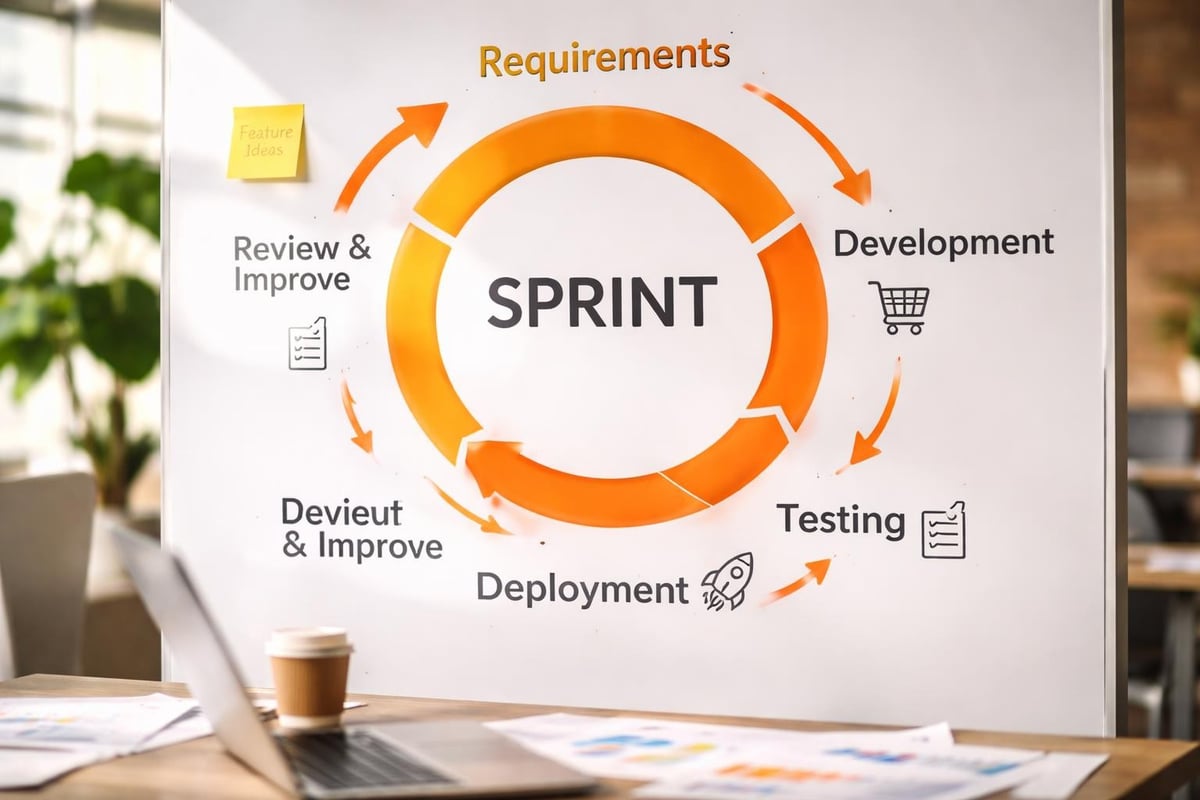
Agile development methodologies work particularly well for custom retail software development because they allow for iterative refinement based on user feedback. Rather than waiting months for a complete system, retailers can deploy core functionality quickly and enhance it based on real-world usage patterns.
A typical timeline for comprehensive retail software development spans three to nine months, depending on scope and complexity:
| Project Phase | Timeline | Key Activities |
|---|---|---|
| Discovery and planning | 2-4 weeks | Requirements gathering, technical design, project roadmap |
| MVP development | 8-12 weeks | Core feature implementation, basic integrations, initial testing |
| User testing and refinement | 4-6 weeks | Beta deployment, feedback collection, bug fixes, optimization |
| Full deployment | 2-4 weeks | Data migration, training, phased rollout, monitoring |
| Enhancement cycles | Ongoing | Feature additions, performance tuning, new integrations |
This phased approach minimizes risk and ensures that the final system meets actual business needs rather than theoretical requirements.
Advanced Capabilities Driving Retail Innovation
Forward-thinking retailers use custom retail software development to implement advanced capabilities that create sustainable competitive advantages. These technologies move beyond operational efficiency to enable entirely new business models and customer experiences.
Artificial Intelligence and Machine Learning
AI-powered retail applications transform raw data into actionable insights and automated decisions. Custom AI retail solutions enable capabilities such as:
- Dynamic pricing optimization adjusting prices in real-time based on demand, competitor pricing, and inventory levels
- Personalized product recommendations increasing average order value through intelligent cross-selling and upselling
- Demand forecasting predicting future sales patterns with greater accuracy than traditional statistical methods
- Fraud detection identifying suspicious transactions and preventing losses from criminal activity
- Visual search allowing customers to find products by uploading images rather than text descriptions
Implementing these AI capabilities requires custom development because they must train on your specific data, integrate with your existing systems, and align with your business rules and strategies.
Omnichannel Integration and Unified Commerce
Customers expect seamless experiences across all touchpoints, from mobile apps to physical stores to social media platforms. Custom retail software development enables true unified commerce where inventory, pricing, promotions, and customer data remain consistent regardless of where the transaction occurs.
Comprehensive retail software solutions support complex omnichannel scenarios like buy-online-pickup-in-store (BOPIS), reserve-in-store-ship-to-home, and endless aisle capabilities that allow store associates to order out-of-stock items for customers during the shopping visit.
Mobile and Progressive Web Applications
Custom mobile applications provide branded experiences that generic e-commerce platforms cannot match. Whether developing native iOS and Android apps or progressive web applications accessible through browsers, custom development allows complete control over user interface, functionality, and performance.
Mobile retail applications extend beyond simple shopping carts to include features like:
- Location-based promotions triggering offers when customers are near physical stores
- Augmented reality product visualization allowing customers to see how furniture looks in their homes or how cosmetics appear on their skin
- Mobile payment integration supporting digital wallets, contactless payments, and loyalty program redemption
- Appointment scheduling for services, personal shopping sessions, or curbside pickup
- Barcode scanning enabling price checks, product information lookup, and self-checkout
Security and Compliance Considerations
Retail systems handle sensitive customer information and financial transactions, making security a critical concern. Custom retail software development must incorporate robust security measures from the ground up rather than bolting them on as an afterthought.
Data Protection and Privacy
Compliance with regulations like GDPR, CCPA, and PCI-DSS requires careful attention to how customer data is collected, stored, processed, and shared. Custom systems can implement privacy by design principles, ensuring that:
- Data collection is limited to what's actually necessary for business purposes
- Consent management clearly communicates data usage and provides easy opt-out mechanisms
- Access controls restrict employee access to customer information based on role and necessity
- Encryption protects data both in transit and at rest using current standards
- Audit logging creates comprehensive records of data access and modifications for compliance reporting
Retail software development services that incorporate security expertise help retailers navigate these complex requirements while maintaining system usability.

Payment Processing and PCI Compliance
Handling credit card information requires compliance with Payment Card Industry Data Security Standards (PCI-DSS). Custom development allows retailers to minimize PCI scope by implementing tokenization strategies where sensitive card data never touches your systems, instead being handled directly by payment processors.
This approach reduces compliance burden and security risk while maintaining the flexibility to support multiple payment methods, including emerging options like cryptocurrency, buy-now-pay-later services, and digital wallets.
Ongoing Support and System Evolution
Custom retail software development doesn't end at deployment. Successful implementations include ongoing support, maintenance, and continuous improvement to adapt to changing business needs and market conditions.
Maintenance and Updates
Regular maintenance ensures system reliability and security through:
- Security patching addressing vulnerabilities as they're discovered
- Performance monitoring identifying and resolving bottlenecks before they impact operations
- Database optimization maintaining query performance as data volumes grow
- Infrastructure updates keeping underlying servers, frameworks, and dependencies current
- Bug fixes resolving issues reported by users quickly to minimize operational disruption
Development teams should provide clear service level agreements defining response times for different severity levels and regular maintenance windows for updates.
Feature Enhancement and Scalability
Business requirements evolve constantly. The retail landscape in 2026 looks dramatically different from even three years ago, and similar transformation will continue. Custom systems must accommodate growth and change through:
- Modular architecture allowing new features to be added without disrupting existing functionality
- API-first design enabling easy integration with future technologies and platforms
- Scalable infrastructure that grows seamlessly with transaction volume and user base
- Feature flags allowing gradual rollout of new capabilities and easy rollback if issues arise
- Regular enhancement cycles incorporating user feedback and new requirements systematically
Measuring Return on Investment
Justifying the investment in custom retail software development requires demonstrating concrete business value. Establishing baseline metrics before development begins and tracking them consistently after deployment provides clear evidence of impact.
Key Performance Indicators
Different retail operations prioritize different metrics, but common KPIs for evaluating custom software include:
| Metric Category | Specific Measurements | Target Impact |
|---|---|---|
| Operational efficiency | Transaction processing time, employee hours per task | 30-50% reduction |
| Inventory management | Stock-out rate, overstock holding costs, shrinkage | 20-40% improvement |
| Customer experience | Net Promoter Score, customer retention rate, cart abandonment | 15-25% improvement |
| Revenue growth | Average order value, conversion rate, customer lifetime value | 10-30% increase |
| Cost reduction | System maintenance costs, integration expenses, manual processing labor | 25-45% decrease |
These improvements compound over time, with the most significant returns typically appearing 12-18 months after full deployment as users fully adopt new capabilities and processes optimize around the system.
Total Cost of Ownership
Comparing custom development costs to subscription-based platforms requires considering total cost of ownership over a five-year horizon. While custom development involves higher upfront investment, it eliminates ongoing licensing fees, per-user charges, and transaction-based pricing that can add up substantially.
Custom-built retail solutions also provide ownership and control, allowing businesses to modify, extend, or migrate systems without vendor dependency or platform lock-in concerns.
Frequently Asked Questions
What is the typical cost of custom retail software development?
Custom retail software development costs vary significantly based on scope, complexity, and features required. Basic POS and inventory systems typically range from $50,000 to $150,000, while comprehensive enterprise platforms with advanced features like AI-powered analytics, omnichannel integration, and custom mobile applications can cost $250,000 to $750,000 or more. The investment should be evaluated against total cost of ownership for commercial alternatives over a five-year period, factoring in licensing fees, per-user costs, and customization limitations.
How long does it take to develop custom retail software?
Development timelines depend on project scope and complexity. A minimum viable product with core functionality typically takes 3-4 months from initial requirements gathering to deployment. More comprehensive systems with multiple integrations, advanced features, and custom mobile applications generally require 6-9 months for initial release. Using agile methodologies allows businesses to deploy core functionality faster and add enhancements iteratively rather than waiting for a complete system.
Can custom retail software integrate with existing systems?
Integration capability represents one of the primary advantages of custom retail software development. Unlike packaged solutions with predetermined integration options, custom systems can connect with virtually any platform through APIs, file transfers, database connections, or middleware. Common integration points include accounting systems, payment processors, supplier portals, shipping carriers, marketing automation platforms, and legacy databases. Experienced development teams assess integration requirements during planning and architect systems specifically to support necessary data flows.
Is custom software more secure than commercial retail platforms?
Security depends more on implementation quality than whether software is custom or commercial. Custom development allows security requirements to be built into the foundation rather than configured afterward, and eliminates vulnerabilities present in widely-used commercial platforms that attract broad-based attacks. However, custom systems require ongoing security maintenance, including regular updates, penetration testing, and vulnerability assessments. Working with experienced development teams that prioritize security throughout the development lifecycle ensures robust protection for customer data and business operations.
What happens if the development team is no longer available?
Well-structured custom software projects include comprehensive documentation, clean code architecture, and knowledge transfer to prevent vendor lock-in. Businesses should require complete source code ownership, detailed technical documentation, and architecture diagrams as project deliverables. With these assets, any qualified development team can maintain and enhance the system. Many businesses establish ongoing support relationships with their original development partners but retain the flexibility to change providers if needed.
How do custom retail systems handle peak traffic periods?
Custom retail software development allows infrastructure and architecture decisions tailored to specific traffic patterns and scaling requirements. Cloud-based deployments can automatically scale computing resources during peak periods like holiday shopping seasons, then reduce capacity during slower times to control costs. Load balancing, caching strategies, and database optimization ensure consistent performance regardless of traffic volume. Development teams should conduct load testing simulating peak scenarios to validate system capacity before major sales events.
Can custom software adapt to future retail trends and technologies?
Adaptability represents a core advantage of custom retail software development. Unlike commercial platforms that update on the vendor's schedule with features designed for the broadest possible market, custom systems evolve based on your specific business needs. Modern architecture patterns like microservices, API-first design, and modular components allow new capabilities to be added without disrupting existing functionality. As new technologies emerge, such as voice commerce, blockchain-based supply chains, or advanced AI applications, custom systems can incorporate them strategically rather than waiting for commercial vendors to build and release new features.
Custom retail software development delivers transformative results for businesses ready to move beyond generic platforms and create technology aligned with their unique operations and customer expectations. The investment in tailored solutions pays dividends through improved efficiency, enhanced customer experiences, and competitive capabilities that off-the-shelf software cannot provide. Whether you're looking to optimize inventory management, create seamless omnichannel experiences, or implement advanced AI-powered features, Brytend brings the technical expertise and retail industry understanding to transform your vision into reality. Contact us today to discuss how custom software can drive your retail business forward.