Gas Detection Service Software for Distributors

TL;DR

  • Gas detection service software for distributors is a platform that centralizes device calibration scheduling, service protocols, certificate generation, and customer communication for every unit sold or serviced.
  • The system automatically identifies devices approaching their calibration due date and sends service reminders directly to end customers, converting manual follow-up into a recurring, automated workflow.
  • Manufacturer-agnostic device registration lets distributors service and track mixed equipment fleets without restricting operations to a single brand.
  • Rental and loan-out management extends the same registration system to track equipment reservations, consignment stock, and customer-owned inventory.
  • An integrated CRM module tracks appointments, service tasks, and customer communications from a single dashboard, with AI-assisted tools supporting day-to-day administrative work.

Gas detection service software for distributors is a platform that manages device registration, calibration scheduling, certificate generation, and customer communication for organizations that sell, service, or rent gas detection equipment.

What Is Gas Detection Service Software for Distributors

Gas detection service software for distributors is a centralized platform that connects device registration, calibration scheduling, service history, and customer communication into a single operational system, replacing spreadsheets and disconnected records across sales, service, and support teams. This distributor-focused platform extends the same core capabilities described in the general gas detection software overview, applied specifically to multi-customer service operations.

Distributors use this software differently than end-user facilities. Instead of monitoring gas concentrations directly, distributors manage the equipment lifecycle for many customers simultaneously, spanning multiple manufacturers, device types, and service contracts. Three operational areas define daily distributor use:

  • Device lifecycle management: Registration, calibration protocol assignment, and service history tracking for every serialized unit
  • Customer relationship management: Contact records, appointment scheduling, and communication history per customer and site
  • Commercial operations: Rental scheduling, loan-out tracking, pricelist management, and inventory control

Distributors servicing equipment from multiple manufacturers require registration systems that do not favor one brand over another. Manufacturer-agnostic platforms document device details, service history, and compliance status regardless of the original equipment supplier.

Distributor operations involve a consistent set of terms across registration, service, and rental workflows:

  • Serialized registration: Recording a device by its unique serial number rather than by product model alone, enabling individual service history tracking
  • Service protocol: A defined checklist and calibration procedure assigned to a specific device or gas type
  • Consignment stock: Inventory physically held by a distributor but owned by another party, requiring separate tracking from distributor-owned equipment
  • Contractor layer: The chain of relationships between manufacturer, distributor, contractor, and end user for a given device
  • Escalation rule: A configured action, such as a secondary notification, that triggers when a customer does not respond to an initial service reminder

Consistent use of these terms across sales, service, and rental teams reduces confusion when a device changes hands between departments or moves from service into rental use.

How Does Gas Detection Service Software Change Daily Operations for Distributors

Gas detection service software changes daily operations for distributors by replacing manual tracking tasks with automated workflows triggered directly by device data, removing the need for staff to check spreadsheets or call customers individually.

The operational shift affects specific daily tasks:

  • Calibration review: A manual morning check of spreadsheets for upcoming deadlines becomes an automated dashboard showing every device approaching its due date
  • Customer follow-up: Individual phone calls to remind customers about service become automated multi-channel reminders sent on a configured schedule
  • Certificate drafting: Manual document creation after each service becomes automatic generation triggered by service completion
  • Technician preparation: Searching for a device’s service history before a site visit becomes immediate access through the registration record
  • Rental inventory checks: Manually confirming equipment availability becomes real-time status visibility across the fleet

These changes compound across a distributor’s full customer base. A distributor managing service for several hundred devices experiences the accumulated time savings across every calibration cycle, not just individual transactions.

Gas detection service software for distributors daily operations dashboard

How Does Automated Service Reminder Scheduling Work

Automated service reminder scheduling works by monitoring each registered device’s calibration due date and triggering a notification to the customer before the deadline, without requiring manual review by distributor staff.

  1. Device is registered with its serial number, gas type, manufacturer, and calibration interval
  2. The system calculates the next calibration due date automatically based on the registered interval
  3. Configurable reminder rules trigger notifications a set number of days before the deadline, commonly at 60, 30, and 7 days
  4. The reminder delivers to the customer through their preferred channel: email, SMS, or in-app message
  5. If the customer does not respond or schedule a bring-in appointment, an escalation notification routes to the distributor’s own service team
  6. Once the device is serviced, certificate generation triggers automatically and the next calibration cycle’s due date recalculates

This workflow converts a task that many distributors previously handled inconsistently, or not at all, into a structured, recurring process. Devices that would otherwise go unnoticed until a customer requests service instead generate their own follow-up automatically. Repeating reminder cycles apply without requiring staff to manually re-trigger each notification, since the system recalculates the next due date immediately after service completion.

What Features Should Distributors Look for in Gas Detection Service Software

Distributors should evaluate gas detection service software based on device registration flexibility, automated reminder configuration, certificate generation, and integration with rental and CRM functions.

Device Registration and Service

  • Manufacturer-agnostic registration supporting mixed equipment fleets
  • Bulk import capability for pricelists and existing customer device records
  • Instrument-specific service protocols assigned by device and gas type
  • Service history logging accessible to technicians before site visits

Certificate Generation

  • Automated certificate creation immediately after service completion
  • Custom branding and template alignment for calibration reports, inspection records, and service confirmations
  • Downloadable certificate library accessible to customers on request

Reminder and Notification Configuration

  • Configurable reminder timing and escalation rules
  • Multi-channel delivery, including email, SMS, and in-app messaging
  • Repeating reminder cycles tied directly to each device’s calibration interval

Organizations managing devices from multiple manufacturers benefit from registration systems that document contractor relationships, end-user locations, and device history without restricting service to a single brand. This flexibility matters most for distributors who inherited mixed equipment fleets through customer relationships built over many years.

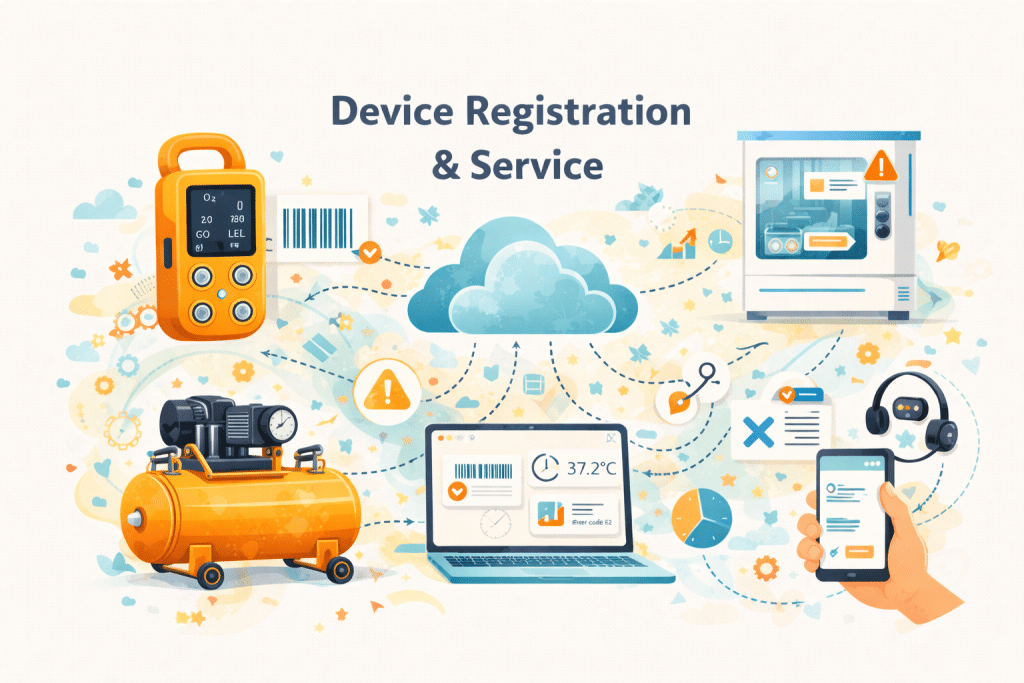
Brytend Device Registration and Service module for distributors

How Do Distributors Implement Gas Detection Service Software

Distributors implement gas detection service software through a structured process that imports existing records, configures service and reminder rules, and trains staff before full rollout.

  1. Import existing customer and device records, including serial numbers and calibration history
  2. Define service protocols by device type and gas category
  3. Configure reminder timing rules and escalation paths for unresponsive customers
  4. Set up certificate templates matching existing branding and compliance requirements
  5. Connect rental and loan-out inventory if the distributor offers equipment rental
  6. Train service and customer-facing staff on the CRM dashboard and reporting tools
  7. Run a pilot cycle with a subset of customers before full rollout

Distributors with several hundred devices under service contracts typically complete data import and configuration within four to eight weeks. Larger distributors managing thousands of devices across multiple manufacturers require additional time for data cleansing, since legacy records often contain duplicate customer entries and inconsistent device naming.

Data migration deserves particular attention, since distributor records frequently accumulate inconsistencies over years of manual entry across different staff members:

  • Duplicate customer records: The same customer entered separately by sales and service teams, often with different contact details
  • Inconsistent device naming: The same equipment model recorded under different names or abbreviations across records
  • Missing calibration history: Devices serviced before the distributor adopted digital record-keeping, requiring manual backfill or acceptance of an incomplete history
  • Unclear ownership records: Consignment or contractor-owned equipment recorded ambiguously alongside distributor-owned inventory

Distributors that address data quality issues before import experience fewer configuration corrections after go-live. Attempting to clean records after the system is already in daily use creates disruption for service and sales staff relying on accurate customer and device data.

What Are the Common Challenges Distributors Face Without Centralized Service Software

Common challenges distributors face without centralized service software include missed calibration deadlines, fragmented customer records, delayed certificate delivery, and disconnected rental inventory tracking.

  • Missed calibration deadlines: Without automated tracking, overdue devices generate no alert until a customer contacts the distributor directly, resulting in lost service revenue and safety compliance gaps for the end customer
  • Fragmented customer records: Sales, service, and support teams often maintain separate records for the same customer, creating inconsistent communication and duplicated data entry
  • Delayed certificate delivery: Manually drafting calibration certificates after each service visit delays customer delivery and increases the risk of transcription errors
  • Disconnected rental tracking: Equipment used for both service and rental purposes, tracked in separate systems, creates inventory blind spots and double-booking risk
  • No fleet-wide visibility: Distributors managing hundreds of devices across many customers cannot easily identify which accounts are overdue without consolidating records into one system
  • Inconsistent multi-tier tracking: When equipment passes through a contractor before reaching an end user, distributors relying on manual records often lose visibility into who currently holds the device and who should receive service reminders

Common mistakes distributors make when managing service operations manually:

  1. Relying on annual spreadsheet reviews instead of continuous automated monitoring
  2. Tracking rental equipment separately from serviced equipment
  3. Creating certificates individually rather than from a standardized template
  4. Splitting customer records across departmental systems
  5. Delaying reminder follow-up until a customer’s device fails inspection

How Can Distributors Optimize Certificate and Compliance Documentation

Distributors optimize certificate and compliance documentation by standardizing templates across device and gas types, reviewing escalation timing regularly, and maintaining manufacturer-agnostic registration records.

  • Standardize certificate templates across device and gas types to maintain consistent branding and regulatory alignment
  • Review reminder escalation timing quarterly to reduce missed follow-ups based on actual response data
  • Maintain manufacturer-agnostic registration to avoid re-entering data when a customer switches equipment brands
  • Audit reminder delivery success rates by channel to identify whether email, SMS, or in-app messages produce better customer response
  • Document contractor and end-user relationships for each device to maintain traceability across ownership changes

Distributors that treat certificate generation as a byproduct of service completion, rather than a separate administrative task, reduce the delay between service visit and customer delivery. Automatic generation immediately after service logging removes the dependency on staff availability to draft documents.

Gas detection calibration certificate generation workflow

How Does Rental and Loan-Out Management Fit Into Distributor Operations

Rental and loan-out management fits into distributor operations by extending the same device registration system to track equipment reservations, availability, and return condition alongside service records.

  • Register rental units with a unique serial number using the same registration workflow as serviced equipment
  • Reserve equipment in advance and plan around peak demand periods
  • Assign a service protocol before loan-out to confirm calibration status prior to customer handoff
  • Process bulk returns and fast check-ins using barcode or QR code scanning
  • Manage consignment stock and customer-owned inventory within the same system as distributor-owned equipment
  • Apply automated reminders and contract enforcement for overdue returns

Distributors who track rental inventory separately from serviced equipment often encounter double-booking, since neither system reflects the other’s real-time status. Unifying rental and service records in one platform prevents a device from being simultaneously scheduled for calibration and reserved for loan-out.

How Does AI-Driven CRM Support Distributor Customer Relationships

An AI-driven CRM supports distributor customer relationships by centralizing appointment scheduling, service task tracking, and customer communication history into a single dashboard, with AI-assisted tools supporting day-to-day administrative tasks.

  • Appointment scheduling and service task tracking accessible to sales and service teams from one interface
  • Complete communication history logged per customer and per site, reducing duplicated outreach
  • AI-assisted drafting support for customer forms, follow-up messages, and service documentation
  • Integration with fulfillment providers and analytics platforms, such as Power BI, for reporting across inventory and service operations

Distributors managing both direct end-user relationships and multi-tier contractor networks benefit from CRM records that document the full relationship chain: which contractor sold the device, which end user operates it, and which service history applies. This visibility supports accurate service reminders even when equipment changes hands between distributor, contractor, and end customer.

AI-assisted tools within the CRM reduce time spent on repetitive administrative work, such as drafting standard follow-up messages or populating service intake forms from existing customer data. These tools support staff rather than replace the judgment required for account management, pricing decisions, or customer escalations, which remain staff-driven tasks within the platform.

What Types of Distributors Use Gas Detection Service Software

Gas detection service software applies to distributors across several business models, including manufacturer-authorized service centers, independent multi-brand distributors, and rental-focused equipment providers.

Manufacturer-Authorized Service Centers

Distributors authorized to service specific manufacturer brands require certificate templates and service protocols that meet manufacturer certification requirements. Registration systems for this segment typically track warranty status alongside calibration history, often aligned with standards such as those published by the International Safety Equipment Association.

Independent Multi-Brand Distributors

Distributors servicing equipment from multiple manufacturers without formal brand authorization benefit most from manufacturer-agnostic registration, since their customer base often includes mixed equipment fleets accumulated over years of service relationships.

Rental-Focused Equipment Providers

Distributors whose business model centers on short-term equipment rental, such as providers supplying gas detectors for confined space entry or turnaround projects, require tight integration between calibration status and rental availability, since equipment cannot be loaned out with an expired calibration.

Trade Show and Event Distribution

Distributors demonstrating or distributing equipment at industry events require quick registration workflows to capture new customer contacts and device interest without disrupting ongoing service operations for existing accounts.

Manual Distributor Operations vs Gas Detection Service Software

AspectManual ProcessGas Detection Service Software
Calibration TrackingSpreadsheets reviewed periodically per customerCentralized registry with automated due-date calculation
Customer Follow-UpIndividual phone calls, inconsistent timingAutomated multi-channel reminders on a fixed schedule
Certificate CreationManually drafted per service visitAutomatically generated at service completion
Rental TrackingSeparate system or paper logUnified with service records in one platform
Customer RecordsSplit across sales, service, and support teamsSingle CRM dashboard shared across departments
Service Revenue CaptureDependent on staff remembering to follow upRecurring automated reminders reduce missed cycles
Distributor rental and CRM dashboard for gas detection equipment

Case Example: Unifying Service, Rental, and CRM for a Regional Distributor

A regional gas detection distributor serviced approximately 900 devices across 150 customer accounts using an annual spreadsheet review and individual technician phone calls to schedule calibration. Roughly 30 percent of overdue devices were never brought in for calibration within the required window. Certificates were drafted manually in a word processor, averaging 20 minutes per device. Rental equipment was tracked on a separate paper log, which caused repeated double-booking between service and loan-out use.

The distributor implemented Brytend’s Device Registration & Service module together with the Rental Assets and CRM modules to unify these workflows into one system.

Results after implementation:

  • Automated 60, 30, and 7-day reminders reduced overdue devices from 30 percent to under 8 percent
  • Certificate generation time dropped from 20 minutes of manual drafting to automatic creation at service completion
  • Rental double-booking incidents were eliminated by unifying inventory across service and rental use
  • The service team gained a single dashboard view of upcoming calibration deadlines across all 900 devices

This case reflects a pattern common among distributors handling both service and rental operations: separate systems for each function create blind spots that a unified registration platform removes without requiring separate reconciliation between departments.

The distributor also reported a secondary benefit not captured in the initial rollout goals: sales staff gained visibility into which customers had equipment approaching end-of-life or requiring upgrade, since the same registration data used for calibration reminders also surfaced replacement opportunities. This connected sales and service teams around shared customer data rather than separate departmental records.

How Brytend Supports Distributor Operations

Distributors managing gas detection equipment across many customer accounts benefit most when device registration, calibration reminders, certificate generation, rental tracking, and customer relationship management operate as one connected system rather than separate spreadsheets and standalone tools.

Brytend’s platform combines the Device Registration & Service module, Rental Assets management, and an integrated CRM into a single system built around a distributor’s daily service and sales workflow. Calibration deadlines become automated customer touchpoints rather than manual follow-up tasks. Certificates generate immediately after service logging rather than requiring separate drafting. Rental and loan-out equipment share the same registration records as serviced devices, removing the blind spots that separate tracking systems create.

Distributors evaluating their current operations should identify which of these functions still depend on manual staff follow-up: calibration reminders, certificate creation, rental availability checks, or customer record consolidation. Each manual dependency represents a specific point where a connected system replaces inconsistent, staff-dependent processes with a repeatable, automated workflow.

FAQs

What is gas detection service software for distributors?

Gas detection service software for distributors is a centralized platform that manages device registration, calibration scheduling, service history, and customer communication. This software replaces disconnected records and spreadsheets, streamlining operations for distributors servicing multiple manufacturers.

How does gas detection service software improve distributor operations?

Gas detection service software improves distributor operations by automating manual tasks like tracking calibration deadlines and customer follow-ups. This automation reduces time spent on administrative work and enhances efficiency across the distributor's customer base.

What features should distributors look for in gas detection service software?

Distributors should look for features like manufacturer-agnostic registration, automated reminder configuration, certificate generation, and integration with rental and CRM functions. These features ensure flexibility and efficiency in managing diverse equipment fleets.

Can distributors manage multiple manufacturers with gas detection service software?

Yes, distributors can manage multiple manufacturers with gas detection service software. The manufacturer-agnostic registration allows tracking of various device types and service histories without favoring a single brand.

How long does it take to implement gas detection service software?

Implementing gas detection service software typically takes four to eight weeks for distributors with several hundred devices. Larger distributors may require additional time for data cleansing and configuration.

What are the common challenges without centralized service software?

Common challenges without centralized service software include missed calibration deadlines, fragmented customer records, delayed certificate delivery, and disconnected rental inventory tracking. These issues can lead to lost revenue and compliance gaps.

How can distributors optimize certificate and compliance documentation?

Distributors can optimize certificate and compliance documentation by standardizing templates, reviewing reminder timing regularly, and maintaining accurate registration records. This ensures timely delivery and regulatory compliance.

Scroll to Top