
Managing customer relationships effectively requires more than intuition and spreadsheets. Modern businesses leverage customer satisfaction CRM systems to track interactions, measure sentiment, and deliver experiences that turn first-time buyers into loyal advocates. These platforms consolidate customer data, automate follow-ups, and provide actionable insights that drive retention and revenue growth. For custom software development firms and service-based businesses, understanding how to implement and optimize a customer satisfaction CRM can mean the difference between reactive firefighting and proactive relationship building.
Understanding Customer Satisfaction CRM Systems
A customer satisfaction CRM represents the intersection of relationship management technology and experience optimization. Unlike traditional CRM platforms that focus primarily on sales pipeline management, a customer satisfaction CRM prioritizes the quality of interactions and the emotional response customers have to your business. According to research on customer satisfaction methodologies, satisfied customers demonstrate higher lifetime value, lower churn rates, and increased referral activity.

Core Components of Effective Systems
Modern customer satisfaction CRM platforms integrate several essential capabilities that work together to create a comprehensive view of customer health:
-
Interaction Tracking: Every email, call, support ticket, and meeting gets logged automatically, creating a complete history of the customer journey.
-
Satisfaction Metrics Collection: Tools for gathering Net Promoter Scores (NPS), Customer Satisfaction Scores (CSAT), and Customer Effort Scores (CES) at critical touchpoints.
-
Sentiment Analysis: Natural language processing evaluates customer communications to detect frustration, satisfaction, or confusion in real time.
-
Automated Alert Systems: Notifications trigger when satisfaction scores drop below thresholds or when customers exhibit churn signals.
-
Reporting Dashboards: Visual representations of satisfaction trends across segments, time periods, and customer lifecycle stages.
-
Integration Capabilities: Connections with support systems, billing platforms, and communication channels to centralize data collection.
The customer-focused approach within CRM systems ensures that every business activity aligns with customer needs rather than internal convenience. This alignment creates consistency across departments and prevents the fragmented experiences that erode satisfaction.
Why Traditional CRM Falls Short
Standard CRM systems excel at managing sales opportunities and tracking revenue metrics, but they often lack the specialized features required for satisfaction management. They treat customers as transactions rather than relationships requiring ongoing nurturing. A dedicated customer satisfaction CRM addresses this gap by making experience quality a measurable, manageable business metric rather than an abstract goal.
Implementing Customer Satisfaction CRM in Your Organization
Successful implementation requires strategic planning rather than simply purchasing software and hoping for adoption. The process involves assessing current capabilities, defining satisfaction objectives, selecting appropriate technology, and creating workflows that support consistent measurement.
Assessment and Planning Phase
Begin by auditing your current customer data landscape. Identify where customer information lives today, which systems contain satisfaction signals, and where gaps exist in your understanding of customer sentiment. Document the touchpoints where customers interact with your business, from initial inquiry through contract renewal and ongoing support.
| Assessment Area | Key Questions | Data Sources |
|---|---|---|
| Current Data Collection | What satisfaction data do we capture today? | Support tickets, surveys, reviews |
| Touchpoint Inventory | Where do customers interact with us? | Sales calls, onboarding, support, billing |
| Team Readiness | Who will use the system and how? | Sales, support, account management |
| Integration Requirements | Which systems must connect? | Email, phone, billing, project management |
Define specific, measurable objectives for your customer satisfaction CRM implementation. Rather than vague goals like "improve satisfaction," establish targets such as "increase average CSAT score from 7.2 to 8.5 within six months" or "reduce response time to negative feedback from 48 hours to 4 hours."
System Selection Criteria
Choosing the right customer satisfaction CRM requires evaluating platforms against your specific requirements and operational context. Reviews of platforms like HubSpot CRM highlight user-friendly interfaces and satisfaction tracking tools, while Microsoft Dynamics 365 CRM reviews emphasize enterprise integration capabilities.
Consider these evaluation factors:
-
Customization Flexibility: Can the system adapt to your unique satisfaction metrics and business processes?
-
Automation Capabilities: What workflows can run automatically to capture and respond to satisfaction signals?
-
Reporting Depth: Does the platform provide the analytical depth you need to understand satisfaction drivers?
-
User Adoption Potential: Will your team actually use this system, or will complexity create resistance?
-
Scalability: Can the platform grow with your business as customer volume increases?
-
Support and Training: What resources does the vendor provide for implementation and ongoing optimization?
For custom software development businesses like those serving complex B2B relationships, the ability to tailor satisfaction measurement to project-specific contexts becomes particularly important.
Measuring Customer Satisfaction Through CRM
Effective measurement transforms abstract satisfaction into concrete, actionable data. A robust customer satisfaction CRM doesn't just collect scores; it contextualizes them within the broader relationship and identifies specific improvement opportunities.
Essential Satisfaction Metrics
Different metrics reveal different aspects of the customer experience. Methods for measuring customer satisfaction using CRM tools emphasize the importance of combining quantitative scores with qualitative feedback to gain complete insight.
Net Promoter Score (NPS) measures customer loyalty by asking how likely customers are to recommend your business. Responses categorize customers as promoters (9-10), passives (7-8), or detractors (0-6). The final score subtracts the percentage of detractors from promoters, providing a benchmark that ranges from negative 100 to positive 100.
Customer Satisfaction Score (CSAT) captures immediate reactions to specific interactions. The significance of CSAT in improving customer service lies in its ability to pinpoint exactly which touchpoints succeed or fail. Typically measured on a 1-5 or 1-10 scale, CSAT surveys ask customers to rate their satisfaction with a particular experience immediately after it occurs.
Customer Effort Score (CES) evaluates how easy or difficult customers found a specific interaction. Lower effort correlates strongly with higher loyalty, making CES particularly valuable for identifying friction points in processes like onboarding, support resolution, or feature adoption.
Survey Design and Distribution
Creating effective customer satisfaction surveys requires balancing the desire for comprehensive data with respect for customer time. Keep surveys brief, focused on specific experiences, and deployed at moments when feedback is most relevant.
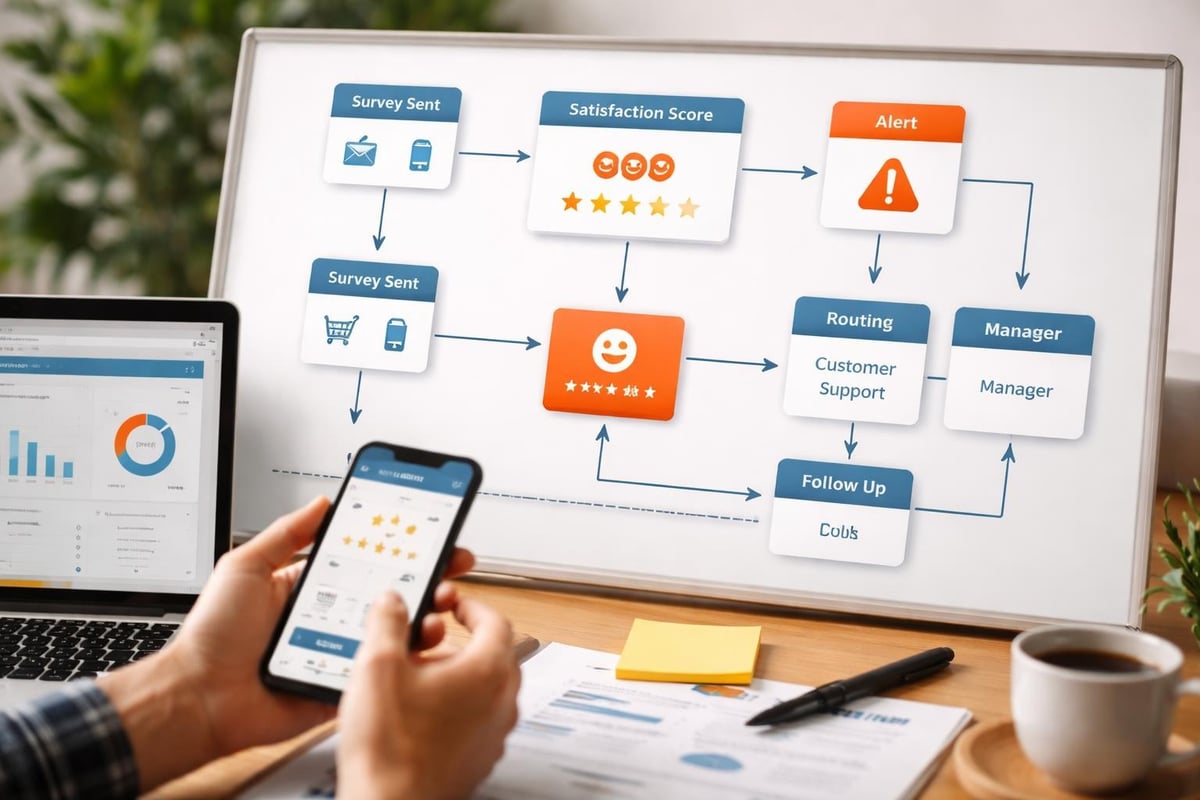
Your customer satisfaction CRM should automate survey distribution based on triggers such as:
- Transaction Completion: After a purchase, project milestone, or service delivery
- Support Interaction Closure: When a ticket resolves or a call ends
- Milestone Timing: At regular intervals during long-term relationships
- Behavioral Signals: When usage patterns suggest satisfaction issues
The Brytend CRM provides comprehensive features for managing customer interactions and tracking satisfaction metrics across the entire relationship lifecycle. By centralizing communication history, project details, and feedback scores, teams gain the context needed to interpret satisfaction data accurately and respond appropriately.

Analyzing Satisfaction Trends
Raw scores provide limited value without analysis that reveals patterns and drivers. Your customer satisfaction CRM should segment satisfaction data across multiple dimensions:
| Segmentation Dimension | Insight Provided | Action Enabled |
|---|---|---|
| Customer Lifecycle Stage | Are new customers more satisfied than long-term clients? | Adjust onboarding or renewal processes |
| Product/Service Type | Which offerings generate the highest satisfaction? | Allocate resources to strengths |
| Team Member | Do certain employees drive better experiences? | Share best practices and coach |
| Issue Category | What types of problems create the most frustration? | Prioritize process improvements |
| Time Period | Are satisfaction trends moving positively or negatively? | Validate strategy effectiveness |
The CRM customer satisfaction rate metric definition explains how to calculate this crucial KPI and use it to guide strategic decisions. Regular analysis sessions where teams review satisfaction data together create accountability and ensure insights translate into action.
Turning Satisfaction Data Into Action
Collecting satisfaction data accomplishes nothing unless it drives meaningful change. The true value of a customer satisfaction CRM emerges when insights trigger responsive actions that improve experiences and strengthen relationships.
Automated Response Workflows
Configure your customer satisfaction CRM to execute predefined workflows when satisfaction signals appear. These automated responses ensure no dissatisfied customer falls through the cracks while freeing your team to focus on complex relationship management.
When negative feedback arrives, your system should immediately:
-
Alert the Appropriate Team Member: Route the feedback to whoever owns that customer relationship or can resolve the specific issue.
-
Create a Follow-Up Task: Ensure someone contacts the customer within a defined timeframe, with context about their concern.
-
Escalate If Necessary: If feedback indicates severe dissatisfaction or high-value customer risk, elevate the issue to management.
-
Track Resolution Status: Monitor whether and how quickly the team addresses the concern until the customer confirms satisfaction.
For positive feedback, automation should thank customers, request testimonials or referrals, and identify expansion opportunities where satisfaction indicates readiness for additional services.
Personalization Based on Satisfaction
Customer satisfaction CRM data enables sophisticated personalization that makes interactions more relevant and valuable. When you understand what satisfies each customer, you can tailor communications, recommendations, and service delivery to match their preferences.
High-satisfaction customers might receive invitations to beta programs, referral incentive offers, or opportunities to provide input on product direction. They've demonstrated confidence in your business, making them ideal candidates for deeper engagement.
Customers showing satisfaction decline require different treatment. Proactive outreach, additional support resources, executive attention, or customized solutions demonstrate your commitment to their success before they reach the decision point of leaving.
Team Training and Accountability
Share satisfaction data broadly across your organization rather than restricting it to management. When every team member understands how their work impacts customer experience, they make better decisions and take greater ownership of outcomes.
Establish regular reviews where teams examine satisfaction trends, celebrate improvements, and problem-solve around persistent issues. The comprehensive overview of customer satisfaction strategies emphasizes creating a customer-centric culture where satisfaction drives priorities across departments.
Connect individual performance evaluations to satisfaction metrics for roles that directly impact customer experience. When compensation and recognition partially depend on customer satisfaction CRM data, teams maintain consistent focus on experience quality rather than treating it as secondary to other objectives.
Advanced Customer Satisfaction CRM Strategies
Once basic satisfaction measurement operates smoothly, sophisticated strategies unlock additional value from your customer satisfaction CRM investment. These approaches require mature processes and clean data but deliver significant competitive advantages.
Predictive Satisfaction Modeling
Machine learning algorithms can analyze historical patterns to predict future satisfaction issues before they manifest in survey responses. By identifying customers at risk of dissatisfaction based on behavioral signals, your team can intervene proactively.
Predictive models consider factors including:
- Engagement Decline: Reduced usage frequency, feature adoption, or communication responsiveness
- Support Pattern Changes: Increased ticket volume, escalations, or unresolved issues
- Billing Issues: Payment delays, disputes, or pricing concerns
- Competitive Activity: Industry events or competitor actions that might influence satisfaction
- Relationship Tenure: Points in the customer lifecycle where churn risk naturally increases
These predictions enable resource allocation focused on customers with the greatest need and highest value, maximizing the impact of your satisfaction improvement efforts.
Cross-Functional Satisfaction Initiatives
Customer satisfaction CRM data reveals opportunities that require coordinated action across multiple departments. Product teams need satisfaction feedback to guide development priorities. Marketing teams use satisfaction segments to refine messaging and targeting. Finance teams connect satisfaction metrics to retention economics and customer lifetime value calculations.
Create cross-functional working groups that review satisfaction data quarterly and develop initiatives addressing systemic issues. This collaborative approach ensures satisfaction improvement becomes a shared organizational priority rather than a siloed function.
Benchmarking and Industry Comparison
While your internal satisfaction trends provide valuable guidance, understanding how your performance compares to competitors and industry standards adds crucial context. Your customer satisfaction CRM should track not just your scores but also how they position you within your market.
Participate in industry benchmarking studies, track publicly available satisfaction data for competitors, and survey customers about their experiences with alternative providers. This competitive intelligence helps set realistic targets and identify differentiation opportunities where superior satisfaction creates market advantage.
Frequently Asked Questions
What is the difference between CRM and customer satisfaction CRM?
Traditional CRM systems focus primarily on managing sales pipelines, tracking opportunities, and organizing customer contact information. Customer satisfaction CRM extends these capabilities by adding specialized tools for measuring, analyzing, and improving the quality of customer experiences. While standard CRM helps you manage what you sell and to whom, customer satisfaction CRM helps you understand how customers feel about those interactions and what drives their loyalty or dissatisfaction.
How often should we survey customers about satisfaction?
Survey frequency depends on your relationship model and interaction cadence. For transactional relationships with frequent purchases, brief satisfaction surveys after each transaction work well. For long-term service relationships like custom software development, quarterly relationship surveys combined with touchpoint-specific feedback after major milestones provide sufficient data without survey fatigue. The key is balancing your need for current data with respect for customer time.
Can small businesses benefit from customer satisfaction CRM?
Absolutely. Small businesses often have closer customer relationships, making satisfaction measurement even more critical. Many customer satisfaction CRM platforms offer scaled pricing and simplified features appropriate for smaller organizations. The insights gained help small businesses compete against larger competitors by delivering superior experiences that build loyalty and generate referrals. Starting with basic satisfaction tracking and expanding as you grow creates a foundation for sustainable relationship management.
Which satisfaction metric should we prioritize?
Each metric serves different purposes. NPS predicts long-term loyalty and referral potential, CSAT measures immediate satisfaction with specific interactions, and CES identifies friction points in processes. Rather than choosing one, implement all three and use them in appropriate contexts. NPS for quarterly relationship health checks, CSAT for touchpoint feedback, and CES for process improvement initiatives creates comprehensive satisfaction visibility.
How do we improve low customer satisfaction scores?
Start by analyzing the data to understand what drives dissatisfaction. Segment low scores by customer type, issue category, and touchpoint to identify patterns. Contact dissatisfied customers directly to understand their concerns and demonstrate responsiveness. Implement quick wins that address common complaints while planning longer-term improvements for systemic issues. Track whether interventions move satisfaction scores positively and adjust your approach based on results.
What integration capabilities matter most for customer satisfaction CRM?
Prioritize integrations with systems containing customer interaction data. Email platforms, support ticketing systems, billing software, and communication tools should all feed your customer satisfaction CRM. For software development businesses, integration with project management systems provides crucial context about delivery timelines, scope changes, and milestone completion. The more complete your data integration, the more accurately you can assess satisfaction drivers and respond effectively.
How long does customer satisfaction CRM implementation take?
Implementation timelines vary based on complexity, customization requirements, and organizational size. Basic systems can launch in four to six weeks, while enterprise implementations with extensive customization and integration may require three to six months. The key phases include requirements definition, system configuration, data migration, team training, pilot testing, and full rollout. Starting with a pilot program among a subset of customers and users reduces risk and allows refinement before organization-wide deployment.
Customer satisfaction CRM systems transform abstract experience quality into measurable, manageable business metrics that drive retention and growth. By implementing structured satisfaction measurement, automated response workflows, and data-driven improvement initiatives, businesses create competitive advantages through superior relationship management. Brytend specializes in developing custom CRM solutions tailored to your specific satisfaction measurement needs, integration requirements, and business processes. Whether you need to enhance an existing platform or build a completely customized system, our experienced development team delivers solutions that turn customer feedback into strategic advantage.