
Customer service has evolved from a simple support function into a strategic differentiator that directly impacts business growth and customer retention. Organizations across industries recognize that the ability to enhance customer service determines competitive positioning and long-term success. For software development companies and technology-focused businesses, delivering exceptional customer experiences requires sophisticated tools, streamlined processes, and dedicated teams working in harmony. The challenge lies not just in responding to customer inquiries, but in creating systems that anticipate needs, resolve issues efficiently, and build lasting relationships through every interaction.
Understanding the Foundation of Exceptional Service
Modern customer service extends far beyond answering phone calls or responding to emails. It encompasses every touchpoint where customers interact with your organization, from initial inquiry through ongoing support and maintenance. To truly enhance customer service, businesses must first understand what customers value most: speed, accuracy, personalization, and consistent follow-through.
Research shows that customers prioritize quick resolution times and knowledgeable support staff who can address complex technical issues without requiring multiple escalations. For custom software development firms like Brytend, this means having teams who understand both the technical architecture of solutions and the business context in which clients operate. The foundation starts with building a customer-centric culture that values every interaction as an opportunity to demonstrate expertise and commitment.

Mapping the Customer Journey
Every customer follows a journey from awareness through purchase, implementation, and ongoing support. Identifying pain points along this journey reveals opportunities to enhance customer service through targeted interventions. Documentation gaps, unclear communication channels, or slow response times at critical moments can undermine even the most technically excellent solutions.
Successful service enhancement begins with journey mapping that identifies all customer touchpoints, measures current performance at each stage, and prioritizes improvements based on impact. This analytical approach ensures resources focus where they matter most to customer satisfaction and business outcomes.
Strategic Approaches to Service Enhancement
Organizations seeking to enhance customer service must develop comprehensive strategies that address people, processes, and technology simultaneously. Isolated improvements rarely deliver sustainable results because customer service operates as an interconnected system where each component influences overall effectiveness.
Investing in Team Development
- Comprehensive Technical Training: Customer service representatives need deep understanding of your products, services, and underlying technologies to provide accurate, confident support.
- Communication Skills Enhancement: Technical knowledge alone doesn’t ensure positive customer interactions; teams must excel at explaining complex concepts in accessible language.
- Empathy and Active Listening: Understanding customer needs through empathy creates connections that transform transactional support into meaningful relationships.
- Continuous Learning Programs: Technology evolves rapidly, requiring ongoing education to keep teams current with new features, best practices, and customer expectations.
- Cross-Functional Collaboration: Service teams that understand development, sales, and project management perspectives provide more comprehensive support.
Implementing Process Improvements
Standardized processes create consistency while allowing flexibility for unique situations. Document common scenarios, establish clear escalation paths, and create knowledge bases that teams can reference during customer interactions. Process documentation should evolve based on real-world use, incorporating lessons learned from challenging situations.
| Process Element | Impact on Service | Implementation Priority |
|---|---|---|
| Response Time Standards | Immediate improvement in satisfaction | High |
| Ticket Categorization | Better resource allocation | High |
| Knowledge Base | Faster resolution, self-service options | Medium |
| Feedback Loops | Continuous improvement insights | Medium |
| Quality Assurance | Consistent service delivery | Low |
Regular process audits identify bottlenecks, redundancies, or gaps that hinder service effectiveness. Proven strategies for improving customer service emphasize operational efficiency through systematic process optimization.
Technology Solutions That Transform Service Delivery
Custom software solutions offer unprecedented opportunities to enhance customer service through automation, integration, and intelligent assistance. The right technology stack empowers teams to work more efficiently while providing customers with seamless, responsive experiences.
Centralized Customer Information Systems
Fragmented customer data creates frustration for both service teams and customers who must repeat information across interactions. Centralized systems that aggregate customer history, preferences, technical configurations, and previous support tickets enable personalized, context-aware service. When representatives access complete customer profiles instantly, they can resolve issues faster and provide proactive recommendations based on usage patterns.
For businesses managing complex technical implementations, tracking configuration details, customization history, and integration specifications becomes critical for effective support. Custom CRM solutions tailored to specific business needs provide advantages over generic platforms by incorporating industry-specific workflows and data structures.

Automation for Efficiency and Consistency
Intelligent automation handles routine tasks, freeing service teams to focus on complex issues requiring human expertise and judgment. Automated systems can acknowledge inquiries, route tickets to appropriate specialists, provide status updates, and even resolve common technical questions through guided troubleshooting.
- Ticket Routing and Prioritization: Automatically assign incoming requests based on content, urgency, customer tier, and team availability.
- Response Templates and Knowledge Bases: Provide teams with pre-approved language for common scenarios while maintaining personalization.
- Scheduled Follow-ups: Ensure no customer inquiry falls through cracks by automating reminder systems and progress checks.
- Performance Analytics: Track key metrics automatically to identify trends, measure team effectiveness, and spot improvement opportunities.
- Integration with Development Tools: Connect service systems with project management and development platforms for seamless issue tracking and resolution.
The Brytend Service Module offers a complete and structured way to manage all service-related activities, helping organizations track equipment, schedule maintenance, and document work with accuracy and ease. By giving each asset a unique identity, businesses can monitor full lifecycles including service history, condition, warranty details, and upcoming tasks.

Real-Time Communication Channels
Real-time support and personalized interactions have become standard customer expectations rather than premium features. Live chat, video conferencing, and screen-sharing capabilities enable service teams to diagnose issues quickly and guide customers through solutions interactively. These channels reduce resolution times dramatically compared to asynchronous email exchanges.
For technical support scenarios involving custom software, visual communication proves invaluable. Representatives can see exactly what customers experience, identify configuration issues immediately, and provide step-by-step guidance through complex procedures. Integration between communication tools and customer databases ensures conversations maintain context from previous interactions.
Measuring and Optimizing Service Performance
Organizations cannot enhance customer service without clear metrics that quantify current performance and track improvement over time. Effective measurement systems balance quantitative indicators with qualitative feedback to provide comprehensive service quality insights.
Essential Service Metrics
| Metric | What It Measures | Target Range |
|---|---|---|
| First Response Time | Speed of initial acknowledgment | Under 1 hour |
| Resolution Time | Total time to solve issues | Varies by complexity |
| Customer Satisfaction Score | Post-interaction ratings | Above 4.5/5.0 |
| Net Promoter Score | Likelihood to recommend | Above 50 |
| First Contact Resolution | Issues solved without escalation | Above 70% |
| Ticket Backlog | Pending unresolved issues | Trending downward |
Regular analysis of these metrics reveals patterns that inform strategic decisions. Spikes in resolution time might indicate training gaps, while declining satisfaction scores could signal process problems or resource constraints. The key lies in acting on insights rather than simply collecting data.
Customer Feedback Integration
Quantitative metrics tell part of the story; qualitative feedback provides context and nuance. Structured feedback collection through surveys, interviews, and review monitoring captures customer perspectives on service quality. Improving customer experience requires understanding not just what problems customers encounter, but how interactions make them feel.
Advanced organizations analyze feedback systematically to identify recurring themes, prioritize improvements, and measure the impact of service enhancements. Sentiment analysis tools can process large volumes of customer communications to detect emerging issues before they escalate into widespread problems.
Building Scalable Service Infrastructure
As businesses grow, customer service systems must scale proportionally without sacrificing quality or efficiency. Planning for scalability from the outset prevents the disruptive transitions that occur when organizations outgrow inadequate systems.
Modular System Architecture
- Core Platform Selection: Choose foundational systems that support growth through APIs, integrations, and customization capabilities.
- Integration Capabilities: Ensure service platforms connect seamlessly with other business systems including sales, billing, and project management.
- Cloud Infrastructure: Leverage cloud computing for flexibility, reliability, and the ability to scale resources dynamically based on demand.
- Documentation Standards: Maintain comprehensive documentation that enables new team members to become productive quickly as teams expand.
- Knowledge Management: Implement systems that capture and organize institutional knowledge, preventing information loss as teams grow.
Custom software solutions provide advantages over off-the-shelf platforms by adapting to specific workflows, terminology, and business rules. Organizations can enhance customer service more effectively when systems align precisely with operational realities rather than forcing processes into generic templates.
Team Structure and Specialization
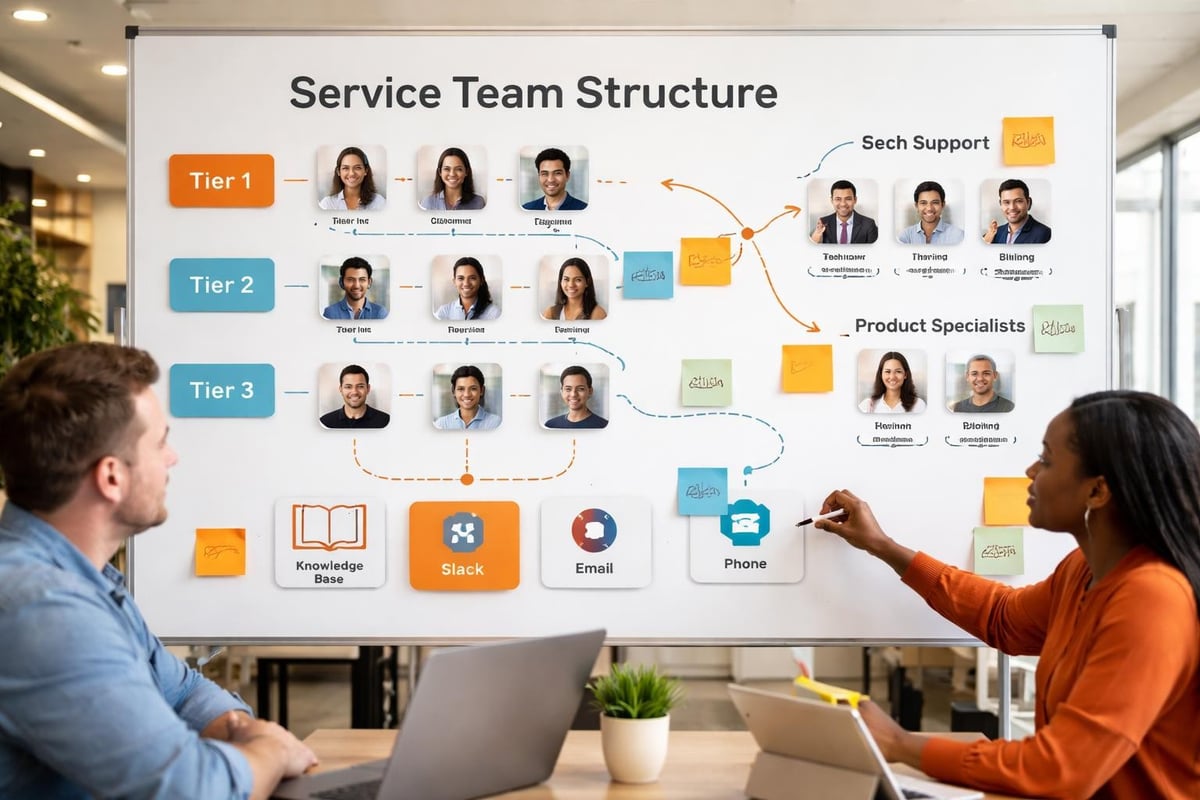
Growing service organizations benefit from appropriate specialization that balances efficiency with comprehensive coverage. Tiered support models route inquiries to representatives with appropriate expertise levels, ensuring complex technical issues reach specialists while routine questions receive immediate resolution.
Effective team structures maintain clear communication pathways, prevent knowledge silos, and enable collaboration when issues require multiple perspectives. Regular team meetings, shared documentation systems, and cross-training programs keep everyone aligned and capable of supporting colleagues during high-demand periods.
Proactive Service Strategies
Reactive support addresses problems as they arise; proactive service prevents issues before customers experience them. Organizations that enhance customer service most effectively shift from purely reactive models toward anticipatory approaches that demonstrate genuine partnership.
Predictive Issue Identification
Data analysis reveals patterns that indicate potential problems before they manifest as support tickets. Monitoring system performance, tracking usage patterns, and analyzing error logs enable teams to identify and address issues proactively. When customers receive notifications about potential problems along with pre-emptive solutions, satisfaction increases dramatically.
For custom software implementations, proactive monitoring might track API performance, database query times, integration health, or user activity patterns. Automated alerts notify support teams when metrics deviate from normal ranges, triggering investigation before customers notice degraded performance.
Educational Content and Self-Service
Effective ways to improve customer service include comprehensive self-service resources that empower customers to find answers independently. Video tutorials, searchable knowledge bases, interactive guides, and community forums reduce support volume while improving customer confidence and competence.
High-quality educational content requires ongoing investment in creation, updating, and organization. Content should address common questions, walk through complex procedures step-by-step, and provide troubleshooting guidance for typical issues. Analytics reveal which resources customers use most, informing content strategy and highlighting gaps in documentation.
Personalization at Scale
Generic, one-size-fits-all service fails to meet modern customer expectations. Personalization creates experiences that acknowledge customer history, preferences, and unique circumstances. Technology enables personalization at scale that would be impossible through manual approaches.
Customer Segmentation
Different customer segments have distinct needs, preferences, and communication styles. Enterprise clients expect dedicated account management and customized service level agreements, while smaller customers might prefer self-service options with responsive backup support. Segmentation enables appropriate service delivery models that balance customer expectations with resource efficiency.
Segmentation criteria might include customer size, industry, technical sophistication, product usage intensity, or contract value. Each segment receives service tailored to its characteristics, from communication frequency and channel preferences to escalation procedures and proactive outreach strategies.
Contextual Communication
Every customer interaction should build on previous conversations rather than starting from scratch. Systems that surface relevant history, previous issues, customization details, and stated preferences enable representatives to provide contextual service that demonstrates attention and care.
Personalization extends to communication timing, channel selection, and content relevance. Some customers prefer detailed technical explanations; others want concise summaries focused on business impact. Effective service teams adapt their approach based on individual customer communication styles and preferences.
Frequently Asked Questions
How can small development teams enhance customer service without large support departments?
Small teams can leverage automation, comprehensive documentation, and strategic communication to provide excellent service efficiently. Focus on preventing common issues through robust testing and clear user guidance, implement help desk software that organizes inquiries systematically, and schedule dedicated support hours when technical experts are available for complex questions. Building strong relationships with clients creates understanding when response times extend slightly during busy periods.
What metrics matter most for measuring customer service improvement?
Customer Satisfaction Score (CSAT) and Net Promoter Score (NPS) provide direct feedback on service quality and customer loyalty. First Response Time and Average Resolution Time measure operational efficiency, while First Contact Resolution Rate indicates how effectively representatives solve problems without escalation. Track these core metrics consistently over time to identify trends and measure the impact of service enhancement initiatives.
How do you balance automation with personal service in technical support?
Use automation for routine tasks like ticket routing, status updates, and common troubleshooting steps while reserving human interaction for complex issues requiring judgment, empathy, or creative problem-solving. Customers appreciate quick automated acknowledgments followed by personalized responses from knowledgeable representatives. Automation should enhance rather than replace human service, freeing teams to focus where they add most value.
What role does custom software play in service enhancement?
Custom software solutions address specific business workflows, integrate with existing systems seamlessly, and adapt as requirements evolve. Generic platforms force organizations to conform to predetermined structures, while custom solutions align precisely with operational realities. For businesses with unique service requirements or complex technical support needs, custom software provides significant advantages in efficiency, user experience, and scalability.
How often should service processes be reviewed and updated?
Conduct formal process reviews quarterly to assess effectiveness, identify bottlenecks, and incorporate lessons from recent experiences. Minor adjustments can occur more frequently based on team feedback or customer complaints. Major process overhauls should align with significant business changes like product launches, team expansions, or technology platform transitions. Continuous improvement mindset keeps processes relevant without constant disruption.
What training investment delivers the best service improvement results?
Combined technical and soft skills training produces the strongest results. Representatives need deep product knowledge to diagnose issues accurately, but communication skills determine how effectively they convey solutions and build customer relationships. Best practices for improving customer service emphasize ongoing training programs that develop both dimensions, typically requiring 10-15% of work time dedicated to skill development.
How can you enhance customer service during rapid business growth?
Scale service infrastructure before demand overwhelms capacity by implementing robust systems, comprehensive documentation, and clear processes early. Hire and train new team members proactively rather than reactively, establish knowledge management systems that prevent information silos, and use tiered support models that route inquiries efficiently. Consider fractional or contract resources during transition periods to maintain service quality while permanent teams expand.
You Might Also Be Interested in the Next Articles
Organizations that successfully enhance customer service gain competitive advantages through improved retention, stronger referrals, and increased customer lifetime value. The strategies outlined above require commitment, investment, and ongoing refinement, but the returns justify the effort through measurable business results. Brytend specializes in creating custom software solutions that streamline service operations, integrate disparate systems, and provide the technical foundation for exceptional customer experiences tailored to your specific business requirements.