
Understanding how to measure patient satisfaction in healthcare has become essential for medical organizations seeking to improve care quality and operational efficiency. As healthcare providers face increasing pressure to deliver exceptional patient experiences, implementing effective measurement systems helps identify gaps, track improvements, and maintain competitive advantage. Modern healthcare facilities rely on sophisticated data collection methods and analytical tools to capture meaningful insights about patient perceptions, preferences, and outcomes.
The Strategic Importance of Patient Satisfaction Metrics
Patient satisfaction measurement serves multiple critical functions within healthcare organizations. It provides actionable feedback for quality improvement initiatives, influences reimbursement rates under value-based care models, and directly impacts patient retention and referral patterns.
Healthcare providers who master how to measure patient satisfaction in healthcare gain competitive intelligence that drives strategic decision-making. These metrics reveal which aspects of care delivery resonate positively with patients and which areas require immediate attention. The Donabedian model provides a comprehensive framework for evaluating healthcare quality across structure, process, and outcomes dimensions.
Financial implications also drive measurement priorities. Insurance providers and government programs increasingly tie reimbursement to patient satisfaction scores, making measurement accuracy a revenue consideration. Organizations that implement robust measurement systems can demonstrate value to payers while identifying cost-saving opportunities through operational improvements.
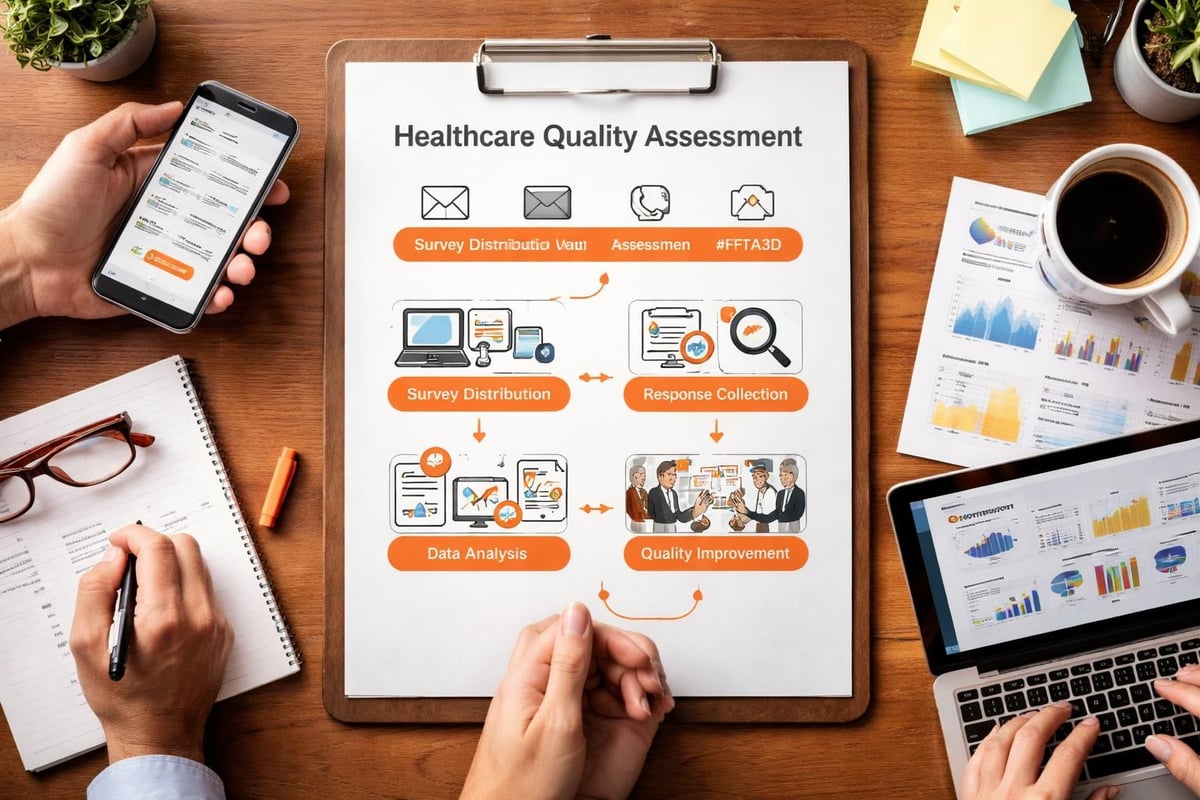
Validated Survey Instruments and Methodologies
Selecting appropriate measurement tools represents the foundation of effective patient satisfaction assessment. Several standardized instruments have demonstrated reliability and validity across healthcare settings.
CAHPS Survey Family
The Consumer Assessment of Healthcare Providers and Systems surveys represent the gold standard for measuring patient experiences. These standardized tools assess communication quality, access to care, provider responsiveness, and overall satisfaction. Healthcare organizations implement CAHPS instruments to benchmark performance against national standards and identify specific improvement opportunities.
CAHPS surveys focus on patient-reported experiences rather than satisfaction ratings alone. This distinction captures actionable information about actual interactions and processes that influence patient perceptions.
SERVQUAL Adaptation
The SERVQUAL framework measures service quality across five dimensions: reliability, assurance, tangibles, empathy, and responsiveness. Healthcare organizations adapt this model to evaluate patient expectations versus perceived service delivery. Gap analysis reveals discrepancies between patient expectations and actual experiences, highlighting priority improvement areas.
| Dimension | Healthcare Application | Measurement Focus |
|---|---|---|
| Reliability | Consistent care delivery | Appointment punctuality, treatment accuracy |
| Assurance | Professional competence | Staff knowledge, trust-building |
| Tangibles | Physical environment | Facility cleanliness, equipment condition |
| Empathy | Individualized attention | Personalized care, emotional support |
| Responsiveness | Timely service | Wait times, staff availability |
Custom Survey Development
Organizations developing proprietary instruments must ensure valid and reliable measurement tools that capture relevant dimensions of patient experience. Custom surveys address specific organizational priorities, clinical specialties, or patient populations.
Survey design requires careful attention to question clarity, response scale consistency, and length optimization. Research indicates that shorter surveys generate higher response rates while maintaining measurement validity.
Digital Collection Platforms and Technologies
Modern healthcare organizations leverage technology platforms to streamline how to measure patient satisfaction in healthcare. Digital solutions enhance response rates, accelerate data collection, and enable real-time feedback analysis.
Multi-Channel Distribution Strategies
Effective measurement programs deploy surveys through multiple channels to maximize participation across diverse patient populations. Distribution methods include:
- Email surveys sent immediately following appointments or discharge
- SMS text message links for mobile-first respondents
- Patient portal integration for secure, authenticated feedback
- Tablet stations in waiting areas for immediate post-visit surveys
- Interactive voice response systems for telephone-based collection
- QR codes on printed materials linking to digital surveys
Channel selection should reflect patient demographic characteristics and technology preferences. Younger populations typically prefer mobile-based collection, while older patients may respond better to traditional methods.
Real-Time Feedback Systems
Organizations implementing real-time measurement capture patient perceptions during active care episodes rather than retrospectively. Point-of-care feedback enables immediate service recovery when negative experiences occur.
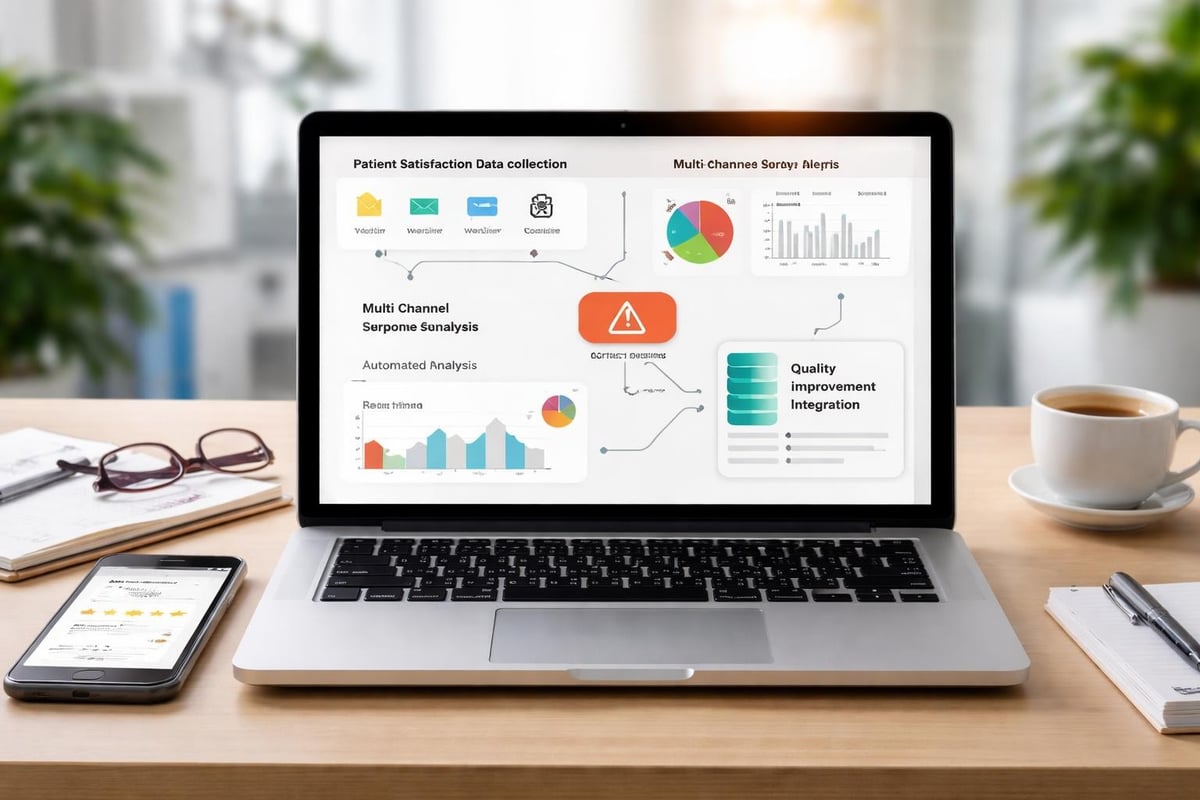
Digital platforms automate alert triggers when patients report dissatisfaction, notifying managers to intervene before patients leave the facility. This proactive approach prevents negative reviews and demonstrates organizational responsiveness.
Key Performance Indicators and Metrics
Defining appropriate metrics ensures measurement efforts generate actionable insights rather than vanity statistics. Healthcare organizations tracking how to measure patient satisfaction in healthcare focus on indicators that correlate with clinical outcomes and operational performance.
Net Promoter Score
Net Promoter Score measures patient willingness to recommend the healthcare provider to others. This single-question metric provides a straightforward loyalty indicator that predicts patient retention and referral generation.
Organizations calculate NPS by subtracting the percentage of detractors from promoters. Scores above 50 indicate strong patient loyalty, while negative scores signal significant experience problems requiring immediate attention.
Domain-Specific Satisfaction Scores
Comprehensive measurement programs evaluate satisfaction across distinct care delivery dimensions rather than relying on overall ratings alone. Domain-specific metrics include:
- Communication effectiveness scores measuring provider explanation clarity
- Access metrics tracking appointment availability and wait times
- Care coordination ratings assessing information sharing between providers
- Facility environment scores evaluating cleanliness and comfort
- Administrative efficiency measuring billing and scheduling processes
These granular metrics enable targeted improvements addressing specific operational weaknesses rather than broad, unfocused initiatives.
Response Rate Calculations
Survey response rates directly impact data reliability and representativeness. Low response rates introduce selection bias, as patients with extremely positive or negative experiences respond disproportionately.
| Response Rate | Data Reliability | Recommended Actions |
|---|---|---|
| Below 20% | Low confidence | Redesign distribution strategy |
| 20-40% | Moderate confidence | Implement reminder sequences |
| 40-60% | Good confidence | Optimize survey length |
| Above 60% | High confidence | Maintain current approach |
Organizations should monitor response rates across patient segments to identify demographic groups requiring targeted outreach strategies.
Data Analysis and Insight Generation
Collecting satisfaction data represents only the first step in measurement effectiveness. Sophisticated analysis transforms raw responses into actionable intelligence that drives quality improvement.
Statistical Analysis Methods
Healthcare organizations apply various analytical techniques to extract meaningful patterns from satisfaction data. Trend analysis reveals whether improvement initiatives produce measurable results over time. Correlation studies identify relationships between specific operational changes and satisfaction score movements.
Regression modeling determines which satisfaction dimensions most strongly predict overall ratings and patient loyalty. This prioritization helps organizations allocate improvement resources to high-impact areas.
Benchmarking Comparisons
External benchmarking contextualizes organizational performance against peer institutions and national standards. Best practices for measuring patient satisfaction emphasize establishing meaningful comparison groups based on facility size, patient demographics, and service offerings.
Internal benchmarking compares performance across departments, locations, or provider teams within the same organization. These comparisons foster healthy competition and knowledge sharing about effective practices.
Qualitative Feedback Analysis
Open-ended survey responses provide rich contextual information explaining quantitative ratings. Text analytics software identifies recurring themes, sentiment patterns, and specific improvement suggestions within narrative comments.
Organizations categorize qualitative feedback into actionable themes such as staff behavior, wait times, facility conditions, or communication gaps. This categorization enables targeted improvement planning based on patient-identified priorities.
Implementing Continuous Improvement Cycles
Measurement programs achieve maximum value when integrated into systematic improvement processes. Understanding how to measure patient satisfaction in healthcare requires closing the feedback loop between data collection and operational changes.
Action Planning Frameworks
Effective organizations establish formal processes translating satisfaction data into improvement initiatives. Action planning begins with prioritizing issues based on impact severity, frequency, and feasibility of resolution.
Cross-functional teams develop specific improvement plans addressing identified gaps. These plans include clear objectives, assigned responsibilities, implementation timelines, and success metrics. Regular progress monitoring ensures accountability and enables course corrections.
Staff Engagement Strategies
Frontline staff represent critical partners in satisfaction improvement efforts. Sharing measurement results with care teams builds awareness of patient perceptions and motivates behavior changes.
Organizations recognize high-performing individuals and departments through formal acknowledgment programs. This positive reinforcement encourages continued excellence while providing role models for peers.
Training programs address skill gaps revealed through satisfaction feedback. Communication workshops, customer service training, and empathy development initiatives build staff capabilities aligned with patient expectations.
Continuous quality improvement process for healthcare showing data collection, analysis and reporting, action planning, implementation of changes, staff training, and remeasurement to track progress
Technology Solutions for Measurement Automation
Healthcare organizations increasingly rely on sophisticated software platforms to manage measurement programs at scale. These solutions automate survey distribution, data collection, analysis, and reporting functions.
Survey Platform Selection Criteria
Choosing appropriate technology requires evaluating platforms against specific organizational requirements. Key selection factors include:
- Integration capabilities with existing electronic health record systems
- Multi-channel distribution support across email, SMS, and web
- Real-time reporting dashboards with customizable visualizations
- Automated alert systems for immediate issue notification
- Security features ensuring HIPAA compliance and data protection
- Scalability supporting organizational growth and survey volume increases
Modern platforms leverage artificial intelligence to identify emerging satisfaction trends before they become widespread problems. Predictive analytics forecast future satisfaction levels based on current operational metrics.
Custom Development Considerations
Organizations with unique measurement requirements may benefit from custom software solutions. Brytend specializes in developing tailored applications that integrate seamlessly with existing healthcare IT infrastructure. Custom platforms enable precise alignment between measurement processes and organizational workflows.
The Brytend Survey Module provides healthcare organizations with powerful tools for creating customized patient satisfaction instruments. This flexible platform supports unlimited form creation, template libraries for common healthcare surveys, and advanced reporting capabilities that transform raw data into actionable insights. Organizations can design surveys that capture exactly the information needed to drive quality improvements while maintaining consistency with industry standards and compliance requirements.

Integration With Clinical Systems
Maximum measurement value emerges when satisfaction data integrates with clinical quality metrics and operational performance indicators. Unified dashboards displaying patient satisfaction alongside readmission rates, infection rates, and efficiency metrics enable comprehensive quality assessment.
API connections between survey platforms and electronic health records enable automated survey triggering based on clinical events such as discharge, procedure completion, or appointment attendance. This automation ensures timely feedback collection while reducing administrative burden.
Regulatory Compliance and Reporting Requirements
Healthcare organizations must navigate complex regulatory landscapes when implementing satisfaction measurement programs. Understanding compliance requirements prevents legal issues while ensuring data usability for required reporting.
HIPAA Considerations
Patient satisfaction surveys collecting personally identifiable health information require strict privacy protections. Organizations implement technical safeguards including data encryption, secure transmission protocols, and access controls limiting information availability to authorized personnel.
De-identification procedures remove protected health information from satisfaction data before analysis or reporting. This approach enables broader data sharing for quality improvement purposes while maintaining compliance.
Value-Based Care Reporting
Medicare and Medicaid programs incorporate patient satisfaction metrics into quality reporting frameworks affecting reimbursement. Organizations participating in value-based care models must submit satisfaction data through specified channels meeting technical formatting requirements.
Regular validation ensures submitted data accuracy and completeness. Errors in satisfaction reporting can trigger audits, payment adjustments, or program exclusion penalties.
Advanced Measurement Approaches
Organizations seeking competitive advantage explore emerging measurement methodologies that provide deeper insights into patient experiences beyond traditional surveys.
Behavioral Observation Technologies
Recent innovations enable objective assessment of patient-provider interactions through automated analysis. Technologies like CommSense use wearable sensors and computational frameworks to evaluate communication effectiveness in clinical settings. These tools provide real-time feedback on interaction quality, complementing patient-reported satisfaction measures.
Behavioral observation removes recall bias and social desirability effects that sometimes skew traditional survey responses. Objective measurement creates opportunities for targeted coaching and skill development.
Sentiment Analysis of Digital Interactions
Healthcare organizations monitor online reviews, social media mentions, and patient portal messages to capture unsolicited satisfaction feedback. Natural language processing algorithms analyze sentiment polarity and identify emerging issues before they appear in formal survey responses.
Social listening provides early warning signals about reputation risks while revealing patient concerns that standard surveys might miss. This proactive monitoring enables rapid response to negative feedback and public acknowledgment of positive experiences.
Longitudinal Patient Journey Mapping
Traditional satisfaction surveys capture snapshots of specific care episodes. Journey mapping tracks satisfaction across multiple touchpoints throughout extended care relationships. This approach reveals how experiences accumulate and interact to shape overall patient loyalty.
Organizations identify critical moments of truth where satisfaction significantly influences patient decisions. Targeted improvements at these high-impact touchpoints generate disproportionate satisfaction gains.
Frequently Asked Questions
What is the most effective way to measure patient satisfaction in healthcare?
The most effective approach combines standardized instruments like CAHPS surveys with custom questions addressing organization-specific priorities. Multi-channel distribution through email, SMS, and patient portals maximizes response rates across diverse patient populations. Real-time feedback collection enables immediate service recovery while longitudinal tracking reveals trend patterns. Organizations should focus on actionable metrics that correlate with clinical outcomes rather than vanity statistics.
How often should healthcare organizations survey patients for satisfaction?
Survey frequency depends on care episode length and patient interaction patterns. Outpatient facilities typically survey after each visit or procedure, while hospitals collect feedback at discharge and 30-day follow-up. Primary care practices often implement quarterly or annual relationship surveys supplemented by transactional surveys after specific encounters. Balance measurement frequency against survey fatigue to maintain response rates and data quality.
What response rate should healthcare organizations target for patient satisfaction surveys?
Industry benchmarks suggest targeting response rates above 40% for reliable data representation. Rates below 20% introduce significant selection bias, as only patients with extreme experiences respond. Organizations improve response rates through survey length optimization, multi-channel distribution, reminder sequences, and incentive programs. Mobile-optimized surveys generate higher completion rates among younger demographics while traditional methods reach older populations effectively.
How do patient satisfaction scores impact healthcare reimbursement?
Value-based care programs from Medicare, Medicaid, and commercial insurers increasingly tie reimbursement to patient satisfaction performance. Hospital Value-Based Purchasing programs adjust Medicare payments based on HCAHPS scores, with top performers receiving bonuses and low scorers facing penalties. Accountable care organizations include satisfaction metrics in shared savings calculations. Understanding these financial linkages helps organizations prioritize measurement accuracy and improvement initiatives.
What are the most important questions to include in patient satisfaction surveys?
Essential questions assess communication effectiveness, staff responsiveness, wait times, facility cleanliness, and likelihood to recommend. Effective survey development emphasizes clarity, relevance, and brevity. Include domain-specific questions about care coordination, pain management, medication explanations, and discharge instructions. Balance standardized benchmarking questions with custom items addressing organizational improvement priorities.
How can healthcare organizations improve patient satisfaction scores?
Improvement begins with analyzing satisfaction data to identify specific gaps between patient expectations and delivered experiences. Prioritize high-impact areas where changes generate measurable results. Implement staff training addressing communication skills, empathy development, and customer service excellence. Reduce wait times through operational efficiency improvements and appointment scheduling optimization. Engage frontline staff in solution development and recognize high performers publicly. Close the feedback loop by communicating improvement actions to patients.
What technology platforms best support patient satisfaction measurement?
Leading platforms integrate survey distribution, data collection, analysis, and reporting within unified systems. Essential features include multi-channel distribution, real-time dashboards, automated alerting, EHR integration, and HIPAA compliance. Cloud-based solutions offer scalability and accessibility advantages over on-premise systems. Organizations with unique requirements benefit from custom development that aligns precisely with workflows and reporting needs. Evaluate platforms based on integration capabilities, user experience, analytics sophistication, and vendor support quality.
You Might Also Be Interested in These Articles
- Brytend Service Module – Comprehensive Service Management
- Custom Survey Solutions for Data Collection
- Brytend Homepage – Custom Software Development Services
- Healthcare Technology Solutions and Innovations
- Brytend Blog – Latest Industry Insights
Measuring patient satisfaction in healthcare requires systematic approaches combining validated instruments, digital collection platforms, sophisticated analytics, and continuous improvement processes. Organizations that master these measurement techniques gain actionable insights driving quality enhancements, competitive differentiation, and financial performance. If your healthcare organization needs custom software solutions to streamline satisfaction measurement, automate data collection, or integrate feedback systems with existing clinical platforms, Brytend delivers tailored applications that transform measurement capabilities and accelerate improvement initiatives.