
Modern businesses face increasing pressure to deliver products faster, more accurately, and more cost-effectively than ever before. The backbone of this operational efficiency lies in robust order fulfillment systems that coordinate inventory, warehouse operations, shipping, and customer communication. Whether you operate a small e-commerce store or manage a multinational distribution network, understanding how these systems work and how to optimize them can dramatically impact your bottom line and customer satisfaction scores.
Understanding Order Fulfillment Systems
Order fulfillment systems represent integrated software solutions designed to manage the entire journey of a product from the moment a customer places an order until it arrives at their doorstep. These systems coordinate multiple business functions including inventory management, warehouse operations, shipping logistics, and customer notifications.
At their core, order fulfillment systems automate what would otherwise be manual, error-prone processes. They eliminate the need for paper-based tracking, reduce human errors in picking and packing, and provide real-time visibility into every stage of the fulfillment process. This automation extends beyond simple task completion to include intelligent decision-making about routing, carrier selection, and inventory allocation.
The sophistication of modern systems varies considerably. Some businesses require basic functionality that simply tracks orders through standard workflows. Others need advanced capabilities like multi-warehouse coordination, complex routing rules, or integration with warehouse execution systems that manage physical warehouse operations in real time.
Core Components That Drive Efficiency
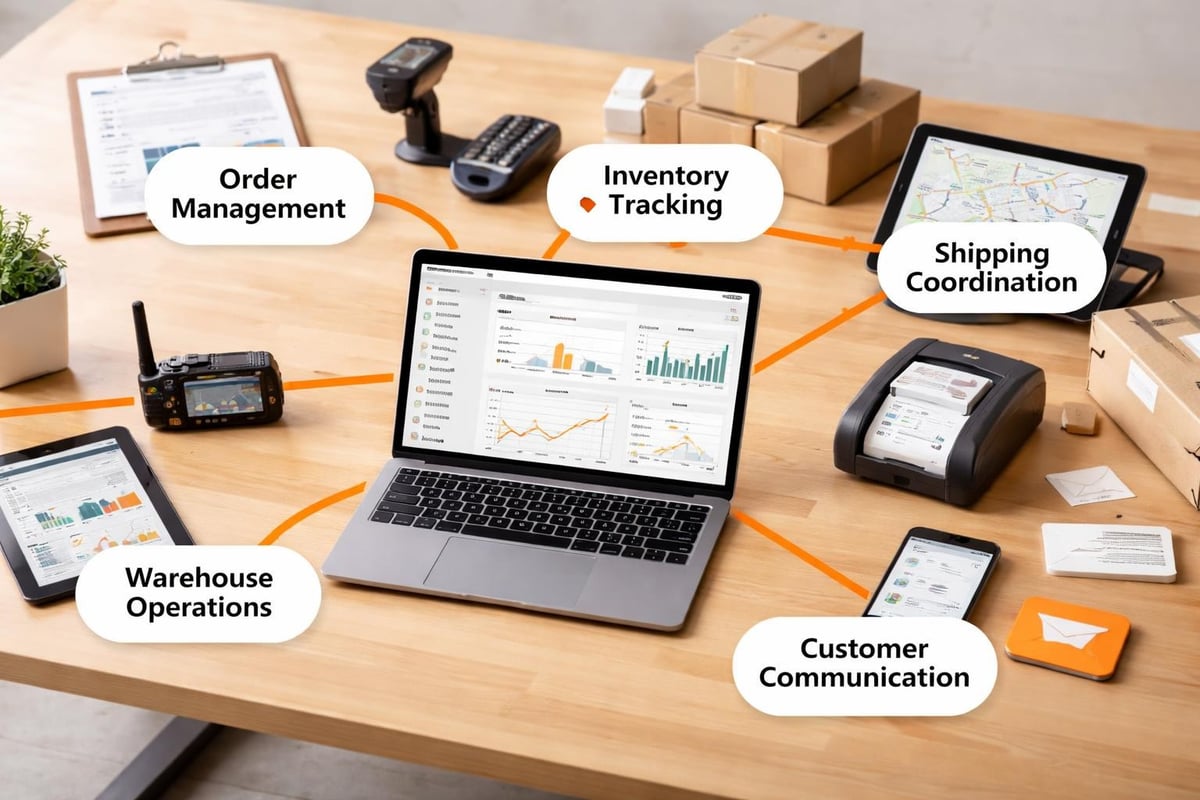
Every effective order fulfillment system contains several essential components that work together seamlessly:
-
Order Management Interface: This central hub receives orders from all sales channels, validates customer information, checks inventory availability, and initiates the fulfillment process.
-
Inventory Tracking Module: Real-time inventory visibility across all locations prevents overselling and enables accurate promise dates for customers.
-
Warehouse Management Integration: Coordination with warehouse systems ensures efficient picking, packing, and staging of orders for shipment.
-
Shipping and Carrier Integration: Automated carrier selection, label generation, and tracking number assignment streamline the shipping process.
-
Customer Communication System: Customer Communication System: Automated notifications keep customers informed about order status, shipping updates, and delivery confirmations.
-
Returns Processing: Efficient handling of returns and exchanges maintains customer satisfaction while managing reverse logistics.
-
Analytics and Reporting: Performance metrics help identify bottlenecks, optimize processes, and make data-driven decisions.
These components must communicate flawlessly to maintain operational efficiency. Integration challenges often create the biggest obstacles for businesses implementing new systems, particularly when connecting legacy platforms with modern cloud-based solutions.
Technology Foundations and Architecture
The technical architecture of order fulfillment systems has evolved significantly over the past decade. Traditional on-premises solutions required substantial infrastructure investments and ongoing maintenance commitments. Today's cloud-based platforms offer greater flexibility, scalability, and lower upfront costs.
Modern systems typically employ a microservices architecture where individual components operate independently but communicate through well-defined APIs. This modular approach allows businesses to upgrade or replace specific functionality without disrupting the entire system. It also facilitates integration with third-party tools and services.
| Architecture Type | Advantages | Disadvantages | Best For |
|---|---|---|---|
| Cloud-Based SaaS | Lower upfront costs, automatic updates, scalability | Less customization, subscription costs | Small to medium businesses |
| On-Premises | Full control, deep customization, one-time cost | High initial investment, maintenance burden | Large enterprises with IT resources |
| Hybrid | Flexibility, gradual migration, best of both | Complex integration, higher total cost | Businesses in transition |
Database architecture plays a crucial role in system performance. High-volume operations require databases capable of handling thousands of concurrent transactions while maintaining data integrity. NoSQL databases have gained popularity for certain fulfillment functions due to their horizontal scalability and flexibility with varying data structures.
Integration Capabilities
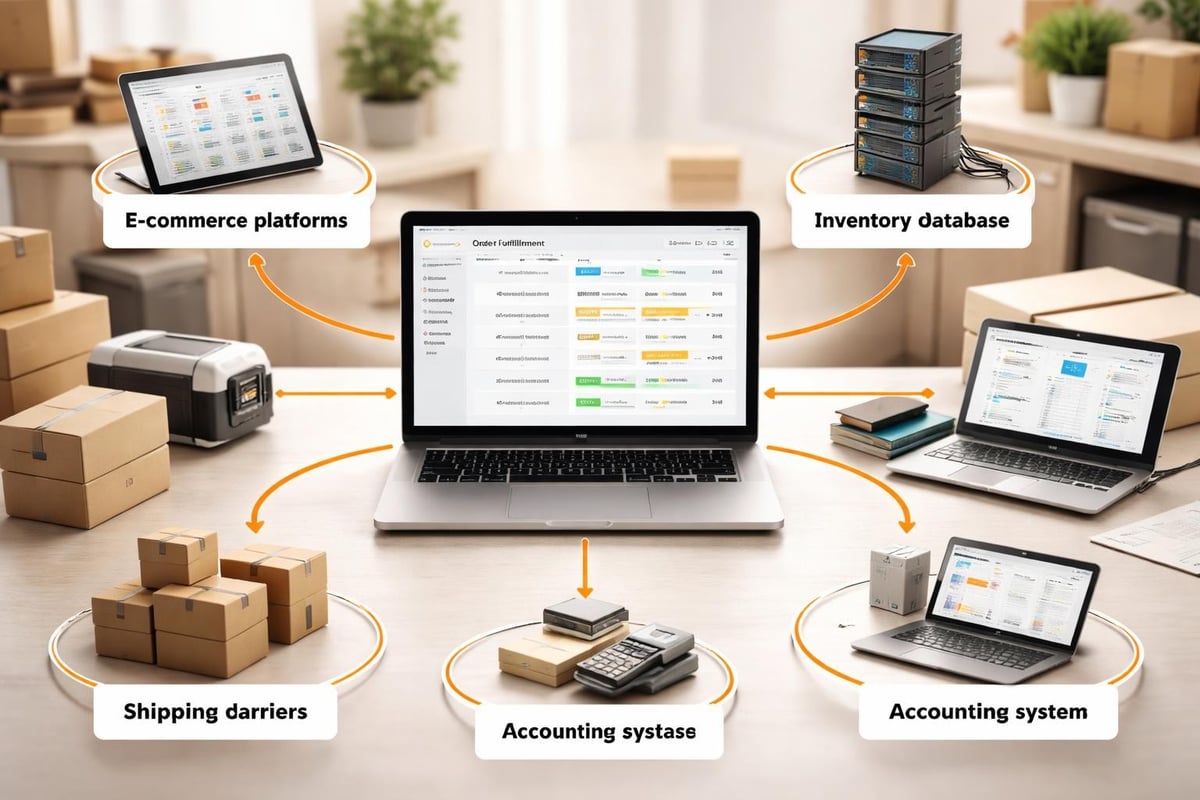
Integration determines whether an order fulfillment system becomes a central nervous system for your business or an isolated data silo. The most valuable systems connect seamlessly with e-commerce platforms, accounting software, customer relationship management tools, and shipping carriers.
API-first design has become the standard for modern platforms. RESTful APIs enable straightforward integration with virtually any system that supports standard web protocols. Webhook support allows real-time notifications when order statuses change, eliminating the need for constant polling and reducing system overhead.
Many businesses find that order fulfillment software solutions with pre-built connectors dramatically reduce implementation time and complexity. These connectors handle authentication, error handling, and data mapping automatically, allowing businesses to focus on configuration rather than custom development.
Operational Benefits and Performance Metrics
Implementing comprehensive order fulfillment systems delivers measurable improvements across multiple operational dimensions. Organizations typically see reductions in order processing time ranging from thirty to seventy percent depending on their starting point and implementation quality.
Accuracy improvements represent another significant benefit. Manual order processing typically achieves ninety-five to ninety-seven percent accuracy rates. Automated systems routinely exceed ninety-nine percent accuracy, dramatically reducing costly shipping errors, returns, and customer service interventions.
Labor cost optimization occurs through multiple mechanisms. Automated systems eliminate redundant data entry, optimize picking routes within warehouses, and reduce time spent resolving errors. Many organizations redeploy staff from routine processing tasks to higher-value activities like customer service or process improvement.
Key Performance Indicators
Effective measurement drives continuous improvement in fulfillment operations. Organizations should track these essential metrics:
-
Order Cycle Time: Total duration from order placement to shipment, with targets varying by industry but typically ranging from twenty-four to seventy-two hours.
-
Perfect Order Rate: Percentage of orders delivered on time, complete, damage-free, and with accurate documentation.
-
Inventory Turnover: Frequency of complete inventory cycles, indicating efficiency in stock management.
-
Shipping Cost per Order: Average shipping expense, including carrier fees and packaging materials.
-
Return Rate: Percentage of orders returned, indicating product satisfaction and fulfillment accuracy.
-
Warehouse Productivity: Units processed per labor hour, measuring operational efficiency.
-
Customer Satisfaction Score: Direct feedback on the entire fulfillment experience.
These metrics provide insights into both operational efficiency and customer experience. Advanced systems generate automated dashboards that visualize trends and flag potential issues before they escalate into serious problems.
Automation Strategies and Technologies
Automation represents the primary value driver in modern order fulfillment systems. Strategic automation eliminates bottlenecks, reduces errors, and enables businesses to scale operations without proportional increases in labor costs.
Waveless order fulfillment approaches have gained traction by continuously processing orders as they arrive rather than batching them into discrete waves. This methodology reduces order cycle times and simplifies warehouse operations by eliminating artificial constraints on when orders can be processed.
Robotic Process Automation (RPA) handles repetitive tasks like data entry, order validation, and status updates. These software robots work alongside human employees, handling high-volume routine tasks while escalating exceptions for human review. RPA implementation typically requires less technical investment than physical warehouse automation while delivering substantial efficiency gains.
Physical warehouse automation ranges from simple conveyor systems to sophisticated robotic picking solutions. The appropriate level depends on order volumes, product characteristics, and available capital. Many businesses start with software automation and layer in physical automation as volumes justify the investment.
Intelligent Decision-Making
Modern systems incorporate machine learning algorithms that optimize fulfillment decisions in real time. These algorithms consider multiple factors simultaneously:
-
Inventory Location: Selecting the optimal warehouse or distribution center based on proximity to customer, current inventory levels, and shipping costs.
-
Carrier Selection: Choosing the best shipping method based on delivery time requirements, package dimensions, destination, and cost constraints.
-
Order Batching: Grouping orders intelligently to maximize picking efficiency while meeting delivery commitments.
-
Demand Forecasting: Predicting future order patterns to optimize inventory positioning and staffing levels.
-
Dynamic Routing: Adjusting fulfillment plans in response to weather disruptions, carrier delays, or inventory shortages.
Brytend specializes in building custom software solutions that incorporate these intelligent capabilities tailored to your specific operational requirements and business rules. The Brytend CRM platform can integrate seamlessly with order fulfillment workflows, ensuring customer data flows smoothly between sales, service, and fulfillment operations.

Implementation Considerations and Best Practices
Successful implementation requires careful planning and realistic expectations. Organizations should expect three to six months for basic implementations and up to eighteen months for complex enterprise rollouts involving multiple warehouses and legacy system integration.
Requirements gathering forms the foundation of successful projects. Document current processes thoroughly, identifying pain points and inefficiencies. Involve stakeholders from warehouse operations, customer service, IT, and finance to ensure the system meets cross-functional needs.
Data migration presents significant challenges. Order history, customer information, inventory records, and product catalogs must transfer accurately to the new system. Plan for extensive data cleansing before migration and allocate time for validation after cutover.
| Implementation Phase | Duration | Critical Success Factors |
|---|---|---|
| Requirements & Planning | 4-8 weeks | Stakeholder alignment, clear objectives |
| System Configuration | 6-12 weeks | Experienced implementation partner, thorough testing |
| Data Migration | 2-4 weeks | Data quality, validation processes |
| Integration Development | 4-8 weeks | API documentation, technical expertise |
| Testing & Training | 4-6 weeks | Comprehensive test scenarios, hands-on practice |
| Go-Live & Stabilization | 2-4 weeks | Support resources, rollback plan |
Change management deserves equal attention to technical implementation. Staff members comfortable with existing processes may resist new systems regardless of their benefits. Invest in comprehensive training programs and designate power users who can assist colleagues during the transition period.
Customization Versus Configuration
Most modern platforms offer extensive configuration options that address common business requirements without custom development. Configure settings for shipping rules, notification templates, and workflow automation through administrative interfaces.
Custom development becomes necessary when standard features cannot accommodate unique business requirements. Examples include proprietary pricing algorithms, complex regulatory compliance requirements, or specialized integrations with niche industry systems. Working with experienced developers like the Brytend team ensures custom components integrate properly and maintain supportability over time.
Balance customization carefully against long-term maintenance costs. Heavy customization can complicate future upgrades and increase technical debt. Evaluate whether business process changes might eliminate the need for custom development while still achieving desired outcomes.
Scaling and Growth Considerations
Order fulfillment systems must accommodate growth without requiring complete replacement every few years. Evaluate platforms based on their ability to handle increasing order volumes, additional sales channels, and geographic expansion.
Multi-warehouse capabilities become essential as businesses expand beyond single-location operations. Advanced systems provide centralized visibility across all locations while enabling location-specific rules and processes. Intelligent order routing ensures customers receive products from the optimal location considering inventory availability, shipping costs, and delivery time requirements.
International expansion introduces additional complexity around customs documentation, international shipping carriers, currency conversion, and localized customer communications. Systems designed for global operations handle these requirements natively rather than requiring extensive customization.
Peak season planning requires systems that can flex capacity during high-volume periods. Cloud-based platforms typically handle this scaling automatically, allocating additional computing resources during busy seasons and scaling back during slower periods. On-premises systems may require capacity planning and infrastructure investments to handle peak loads.
Technology Evolution and Future-Proofing
The fulfillment technology landscape continues evolving rapidly. Emerging capabilities include:
-
Artificial Intelligence for Demand Prediction: Advanced forecasting that considers multiple data sources including social media trends, weather patterns, and economic indicators.
-
Autonomous Delivery Integration: Coordination with drone delivery services and autonomous vehicle networks as these technologies mature.
-
Blockchain for Supply Chain Transparency: Immutable records tracking products from manufacturing through delivery, enabling unprecedented visibility and authentication.
-
Augmented Reality for Warehouse Operations: AR-enabled picking glasses that display optimal routes and product locations, reducing training time and improving accuracy.
-
Voice-Activated Fulfillment: Hands-free order processing using natural language interfaces and voice confirmation.
Selecting platforms with active development roadmaps and strong vendor commitment to innovation helps ensure your investment remains relevant as technology advances.
Security and Compliance Requirements
Order fulfillment systems handle sensitive customer information including names, addresses, payment details, and purchase history. Robust security measures protect this data from unauthorized access and comply with regulatory requirements.
Data encryption at rest and in transit represents baseline security. Systems should encrypt sensitive information in databases and during transmission between components. Regular security audits identify vulnerabilities before malicious actors can exploit them.
Access controls ensure employees only view information necessary for their roles. Warehouse staff need access to picking information but should not see payment details. Customer service representatives require order history but may not need access to warehouse operations.
Compliance requirements vary by industry and geography. Retailers handling credit card information must comply with PCI DSS standards. Healthcare product fulfillment requires HIPAA compliance. European customers trigger GDPR requirements regarding data storage, processing, and deletion rights.
Frequently Asked Questions
What is the difference between an order management system and an order fulfillment system?
An order management system (OMS) focuses primarily on capturing, tracking, and managing customer orders across sales channels. It handles order entry, payment processing, and basic inventory checks. Order fulfillment systems extend beyond order management to coordinate warehouse operations, shipping logistics, and delivery tracking. Many modern platforms combine both capabilities into integrated solutions that manage the entire order-to-delivery process.
How long does it take to implement an order fulfillment system?
Implementation timelines vary significantly based on business complexity and existing infrastructure. Basic implementations for small businesses with straightforward requirements typically take six to twelve weeks. Mid-sized businesses with multiple sales channels and moderate customization needs should expect three to six months. Large enterprises with multiple warehouses, complex integration requirements, and extensive customization may require twelve to eighteen months for complete implementation.
Can order fulfillment systems integrate with existing e-commerce platforms?
Modern order fulfillment systems provide robust integration capabilities with major e-commerce platforms including Shopify, Magento, WooCommerce, BigCommerce, and others. Most platforms offer pre-built connectors that simplify integration, while API-first architectures enable custom integration with proprietary or niche platforms. Integration capabilities should be thoroughly evaluated during platform selection to ensure compatibility with your existing technology stack.
What are the typical costs associated with order fulfillment systems?
Costs vary widely based on platform type, business size, and feature requirements. Cloud-based SaaS solutions typically charge monthly subscription fees ranging from two hundred to five thousand dollars per month for small to medium businesses, with enterprise solutions costing significantly more. On-premises systems require substantial upfront licensing fees ranging from twenty thousand to several hundred thousand dollars plus ongoing maintenance costs. Implementation services, customization, training, and integration development represent additional expenses that can equal or exceed software costs.
How do order fulfillment systems improve customer satisfaction?
These systems enhance customer satisfaction through faster order processing, more accurate deliveries, and improved communication. Automated order processing reduces fulfillment time from days to hours, enabling same-day or next-day shipping. Accuracy improvements minimize wrong items, incorrect quantities, and shipping errors that frustrate customers. Real-time tracking notifications keep customers informed throughout the delivery process, reducing anxiety and support inquiries. The cumulative effect of these improvements typically increases customer satisfaction scores by ten to twenty percentage points.
What warehouse technologies work best with order fulfillment systems?
Order fulfillment systems integrate with various warehouse technologies depending on operation scale and complexity. Barcode scanning systems provide affordable accuracy improvements for most operations. Radio frequency identification (RFID) enables hands-free inventory tracking and automated receiving. Warehouse control systems direct real-time activities within warehouses to maximize efficiency. Automated storage and retrieval systems (AS/RS) handle high-volume operations with minimal labor. Voice-directed picking reduces errors while keeping hands free. The optimal combination depends on order volumes, product characteristics, and available capital.
How do custom-built order fulfillment systems compare to commercial platforms?
Commercial platforms offer faster implementation, lower upfront costs, proven functionality, and regular updates from vendors. They work well for businesses with standard fulfillment requirements that align with platform capabilities. Custom-built systems provide unlimited flexibility, optimized workflows for unique business processes, and competitive advantages through proprietary capabilities. They make sense for businesses with distinctive requirements that commercial platforms cannot accommodate or when fulfillment processes represent core competitive differentiators. Many organizations adopt hybrid approaches, using commercial platforms as foundations while adding custom components for specialized needs.
Order fulfillment systems have evolved from simple tracking tools into sophisticated platforms that orchestrate complex operations and drive competitive advantage. The right system reduces costs, improves accuracy, and enhances customer satisfaction while positioning your business for sustainable growth. Whether you need to implement a commercial platform, develop custom functionality, or integrate existing systems, Brytend brings the technical expertise and industry knowledge to deliver solutions aligned with your specific operational requirements and business objectives.


