

Healthcare organizations that continue relying on paper-based feedback collection or sporadic patient satisfaction measurements face mounting risks that extend far beyond simple inefficiency. The absence of systematic patient satisfaction survey software creates cascading problems that impact quality metrics, reimbursement rates, and competitive positioning. Manual survey processes introduce human error at multiple touchpoints, from distribution inconsistencies to data entry mistakes that corrupt the very insights healthcare leaders need to make informed decisions. When patient feedback arrives weeks after a visit, the opportunity to address concerns and prevent negative online reviews has already passed, leaving organizations reactive rather than proactive in their quality improvement efforts.
The Hidden Costs of Manual Patient Feedback Collection
Healthcare providers operating without dedicated patient satisfaction survey software typically underestimate the true cost of their manual processes. Beyond the obvious expenses of printing, postage, and staff hours spent managing paper surveys, organizations face significant opportunity costs from delayed insights and incomplete response patterns. A nurse spending fifteen minutes per shift distributing paper surveys represents hundreds of hours annually that could be allocated to direct patient care, while incomplete or illegible handwritten responses render substantial portions of collected feedback unusable for meaningful analysis.
The compliance dimension adds another layer of risk that many organizations discover only when facing auditor scrutiny or accreditation reviews. Manual tracking systems struggle to demonstrate consistent survey distribution protocols, documented response rates across demographic groups, and secure handling of patient feedback containing potentially sensitive information. When regulatory bodies or insurance networks request evidence of systematic quality monitoring, organizations scrambling to compile scattered spreadsheets and paper files face both credibility concerns and potential penalties for inadequate documentation. The utilizing point-of-care patient satisfaction surveys approach demonstrates how structured systems enable practice improvements that manual methods cannot support.
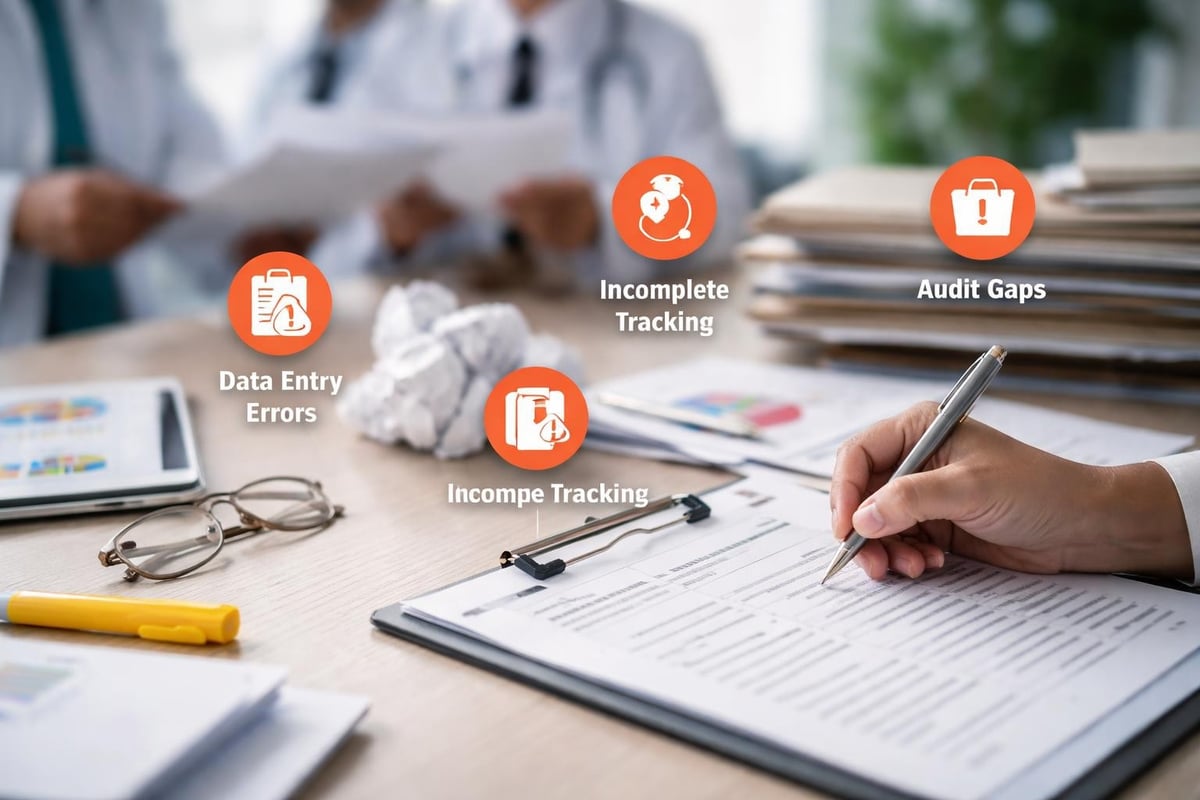
Data integrity represents perhaps the most critical vulnerability in manual patient feedback systems. When staff members manually transfer handwritten responses into spreadsheets, even a small error rate of two to three percent corrupts hundreds of data points annually in a moderate-sized practice. These errors compound when aggregating data for trend analysis, potentially leading administrators to invest resources addressing problems that don’t exist while overlooking actual patient concerns. Furthermore, manual systems provide no audit trail showing who entered data, when modifications occurred, or whether responses were accurately transcribed, creating liability exposure when quality metrics influence financial decisions or legal proceedings.
Revenue Impact Through Quality Metric Dependencies
Healthcare reimbursement models increasingly tie financial performance to patient satisfaction scores, making survey software a revenue-critical infrastructure component rather than a nice-to-have administrative tool. Medicare’s Hospital Value-Based Purchasing Program adjusts payments based partially on HCAHPS scores derived from patient surveys, while private insurers implement similar quality-linked reimbursement structures. Organizations without robust patient satisfaction survey software struggle to identify specific service gaps driving down their scores, missing opportunities to implement targeted improvements before the next measurement period.
The timing dimension of feedback collection directly influences both response rates and revenue protection. Creating concise patient satisfaction surveys that maximize response rates becomes exponentially more challenging when relying on manual distribution and follow-up processes. Patients who receive survey requests weeks after their visit demonstrate significantly lower completion rates than those contacted within 24-48 hours, yet manual systems rarely achieve this rapid turnaround. Each percentage point decline in response rates reduces statistical confidence in results and may trigger compliance concerns about representative sampling across patient populations.
| Financial Impact Area | Manual Process Risk | Automated Software Benefit |
|---|---|---|
| Value-Based Payments | Delayed insights prevent timely improvements | Real-time alerts identify service gaps immediately |
| Patient Retention | Missed opportunities to address concerns | Automated follow-up captures at-risk patients |
| Operational Efficiency | Staff hours diverted to survey administration | Automated distribution and data collection |
| Compliance Penalties | Inadequate documentation of quality monitoring | Complete audit trails and reporting capabilities |
Market positioning suffers when organizations cannot demonstrate commitment to patient experience through systematic measurement and visible response to feedback. Prospective patients researching providers increasingly expect transparency around satisfaction metrics and evidence of continuous quality improvement. Healthcare organizations struggling to compile basic satisfaction statistics from manual systems appear less credible than competitors showcasing real-time dashboards and documented response protocols enabled by dedicated patient satisfaction survey software.
Integration Failures That Fracture Patient Insights
Healthcare technology ecosystems become increasingly complex as organizations adopt electronic health records, practice management systems, patient portals, and communication platforms. When patient satisfaction survey software operates as a disconnected island rather than an integrated component, valuable opportunities for correlation analysis and automated workflows disappear. Staff members manually cross-referencing satisfaction scores against appointment types, provider schedules, or clinical outcomes invest significant time while still missing patterns that automated systems would immediately surface.
The missed opportunity for closed-loop feedback represents one of the most significant strategic failures in disconnected survey approaches. When a patient reports a concerning experience through a satisfaction survey, the optimal response window measures in hours rather than days. Manual survey processes typically introduce delays of one to two weeks before feedback reaches relevant staff members, by which time the patient may have already shared their negative experience through online reviews or switched to a competing provider. Integrated patient satisfaction survey software can automatically route specific concern types to appropriate department heads or patient relations specialists, enabling immediate intervention while recovery remains possible.

Custom software development approaches enable healthcare organizations to build integration pathways that align with their specific operational workflows and data architecture. Rather than forcing staff to adapt processes around rigid commercial software limitations, customized solutions from experienced development teams can accommodate existing systems while adding sophisticated survey capabilities. Organizations pursuing this approach gain both the advanced functionality of dedicated patient satisfaction survey software and the seamless integration that manual or standalone systems cannot provide.
Survey Design Mistakes That Invalidate Results
Healthcare organizations without access to sophisticated patient satisfaction survey software frequently make fundamental design mistakes that compromise data validity. Survey instruments containing leading questions, ambiguous rating scales, or excessive length produce unreliable results that mislead rather than inform quality improvement initiatives. A poorly constructed survey asking patients to rate “overall satisfaction” without specifying distinct service dimensions provides no actionable guidance about whether problems lie in appointment scheduling, clinical care, facility cleanliness, or administrative processes.
Question sequencing represents a subtle but significant factor that manual survey creators often overlook. Research demonstrates that early questions influence responses to later items, while survey fatigue causes declining attention and response quality as instruments progress. Organizations designing surveys without access to behavioral research insights or A/B testing capabilities embedded in advanced patient satisfaction survey software risk implementing measurement tools that systematically bias results. The consequence extends beyond wasted effort to include misallocated improvement resources addressing symptoms rather than root causes.
Standardized scales and actionable feedback mechanisms become particularly important when healthcare organizations need to benchmark performance against industry standards or track progress over time. Manual survey processes rarely maintain sufficient consistency in question wording, scale definitions, or distribution protocols to enable valid longitudinal comparisons. When leadership asks whether patient satisfaction has improved since implementing a new initiative, organizations without systematic measurement infrastructure can only offer anecdotal impressions rather than statistical evidence.
| Survey Design Element | Common Manual Process Error | Risk to Data Validity |
|---|---|---|
| Question Clarity | Ambiguous wording open to interpretation | Responses measure different constructs across patients |
| Scale Consistency | Varying rating systems across survey versions | Trend analysis becomes impossible |
| Survey Length | Excessive questions causing fatigue | Declining response quality and completion rates |
| Distribution Timing | Inconsistent intervals after patient visits | Results biased by recall limitations |
Response rate patterns often reveal survey design problems that organizations miss without analytical tools provided by dedicated patient satisfaction survey software. When certain demographic groups, appointment types, or service locations demonstrate consistently lower completion rates, the survey instrument or distribution method likely contains barriers specific to those populations. Manual tracking systems rarely surface these patterns until response disparities become severe enough to trigger compliance concerns or statistical validity questions.
The Brytend Survey Module
provides healthcare organizations with the flexibility to design custom patient satisfaction instruments that align precisely with their service delivery model and quality priorities. Rather than forcing providers into generic templates, this approach enables creation of specialized surveys for different departments, visit types, or patient populations while maintaining consistent data architecture for enterprise-level analysis.

Competitive Disadvantage in Patient Experience Markets
Healthcare markets have shifted dramatically toward consumer-oriented service models where patient experience directly influences market share and revenue growth. Organizations without sophisticated patient satisfaction survey software face increasing disadvantage as competitors leverage feedback systems to identify service differentiators and respond rapidly to emerging patient preferences. When potential patients research providers online, they increasingly expect to see evidence of systematic quality monitoring and responsiveness to patient input that manual survey processes cannot credibly demonstrate.
The public reporting dimension adds urgency to systematic patient satisfaction measurement. Comparing leading patient satisfaction survey platforms helps organizations understand how various software solutions address reporting requirements and competitive transparency demands. Healthcare systems that cannot quickly generate polished satisfaction reports for public consumption appear less sophisticated than competitors showcasing real-time dashboards and trend graphics enabled by advanced survey platforms.
Referral relationship management represents another area where inadequate patient satisfaction survey software creates competitive vulnerability. Physicians considering which specialists to recommend patients or healthcare systems evaluating partnership opportunities increasingly request satisfaction metrics as part of their evaluation criteria. Organizations scrambling to compile basic statistics from manual tracking systems project less credibility than those presenting comprehensive performance dashboards with drill-down capabilities across multiple service dimensions and time periods.
Staff recruitment and retention also connect to patient satisfaction survey infrastructure in ways many organizations underestimate. Healthcare professionals increasingly seek employers demonstrating commitment to quality through systematic measurement and evidence-based improvement processes. Top candidates evaluating practice opportunities may interpret the absence of sophisticated patient satisfaction survey software as indicating either resource constraints or insufficient commitment to patient-centered care, both of which raise concerns about long-term career prospects with that organization.
Regulatory Compliance Gaps and Accreditation Risks
Accreditation bodies and regulatory agencies expect healthcare organizations to demonstrate systematic patient feedback collection aligned with standardized protocols and documentation requirements. Manual survey processes struggle to maintain the consistency and audit trails that these external evaluators increasingly demand. When accreditation surveyors request evidence of patient satisfaction monitoring covering specific time periods, patient populations, or service categories, organizations dependent on paper-based tracking frequently discover gaps or inconsistencies that trigger compliance findings.
The documentation burden extends beyond simply collecting patient feedback to include demonstrating how organizations analyze results and implement responsive improvements. Patient satisfaction survey software typically includes built-in reporting templates and analytics tools that help organizations document their quality improvement cycles, while manual processes require staff to create custom reports for each audit or review. This documentation gap creates risk during Joint Commission surveys, state health department inspections, or insurance network credentialing processes where organizations must prove systematic quality monitoring.

Privacy and security requirements add another compliance dimension that manual patient satisfaction survey processes often inadequately address. Paper surveys containing patient identifiers may not receive the secure handling that HIPAA requires, while manual data entry creates additional exposure points where protected health information could be compromised. Patient satisfaction survey software designed for healthcare environments typically includes role-based access controls, encryption protocols, and audit logging that manual processes cannot replicate, reducing both actual security risks and potential liability exposure.
Multi-Location Coordination Challenges
Healthcare organizations operating across multiple sites face exponentially greater complexity when attempting to manage patient satisfaction surveys without dedicated software infrastructure. Ensuring consistent survey distribution protocols, maintaining standardized question sets, and aggregating results for system-wide analysis become nearly impossible through manual coordination. Individual clinic managers developing their own survey approaches may believe they’re demonstrating initiative, but this fragmentation prevents the organization from identifying systemic patterns or implementing enterprise-level quality improvements.
The benchmarking dimension represents a critical strategic capability that multi-location organizations forfeit without centralized patient satisfaction survey software. When each site uses different survey instruments, distribution methods, or rating scales, comparing performance across locations becomes meaningless. Leadership cannot identify high-performing sites to study their practices or target support to struggling locations because inconsistent measurement prevents valid comparisons. This missed opportunity extends to specialty-specific or service-line analysis where aggregating sufficient sample sizes requires combining data across multiple locations using consistent methodology.
Staff turnover creates particular vulnerability in multi-location organizations relying on manual survey processes. When the individual who managed patient satisfaction surveys at a particular clinic departs, their institutional knowledge about survey timing, distribution protocols, and data compilation often leaves with them. The replacement staff member may implement different approaches, creating discontinuity in the data stream that invalidates trend analysis. Patient satisfaction survey software embeds survey protocols and analytical methodologies in the system itself, making these processes resilient to staff turnover while maintaining consistency across locations and time periods.
Real-time alerting capabilities that sophisticated patient satisfaction survey software provides become especially valuable in multi-location healthcare systems. When a particular site experiences a sudden decline in satisfaction scores or receives multiple negative responses about a specific service dimension, immediate notification enables rapid investigation and intervention. Manual survey processes typically aggregate results monthly or quarterly, delaying awareness of emerging problems until patterns become entrenched and patient relationships have deteriorated beyond recovery.
Strategic Decision-Making Handicapped by Inadequate Data
Healthcare executives making strategic decisions about service expansion, facility investments, or care model innovations need reliable patient satisfaction data to inform their choices. Organizations without robust patient satisfaction survey software operate with significant information disadvantages that increase the risk of misallocated capital and failed initiatives. When leadership considers whether to invest in extended hours, add specialized services, or renovate facilities, patient satisfaction data should provide evidence about which improvements would most impact patient experience and competitive positioning.
The correlation analysis capabilities that advanced survey platforms enable allow healthcare organizations to identify which operational factors most strongly influence overall patient satisfaction. Manual survey processes rarely support the statistical sophistication required to determine whether appointment wait times, provider communication quality, or facility amenities most significantly drive patient perceptions. Without these insights, organizations often default to assumptions or imitate competitors rather than making evidence-based decisions aligned with their specific patient population’s priorities.
Longitudinal analysis represents another critical capability that inadequate patient satisfaction survey software undermines. Understanding whether satisfaction trends are improving, declining, or remaining stable requires consistent measurement methodology maintained over extended periods. Manual survey approaches frequently introduce methodology changes that break trend continuity, leaving organizations uncertain whether observed changes reflect actual patient experience shifts or simply measurement artifacts.
Navigating effective patient satisfaction survey systems helps organizations establish feedback loops that inform not only operational adjustments but also strategic planning cycles. The most sophisticated healthcare systems integrate patient satisfaction insights into annual strategic planning, service line development, and capital allocation processes, while organizations lacking systematic survey infrastructure make these high-stakes decisions with incomplete information about patient preferences and competitive positioning.
Implementation Missteps That Waste Resources
Healthcare organizations recognizing the need for patient satisfaction survey software often make implementation mistakes that undermine potential benefits and waste both financial resources and staff goodwill. Selecting software based primarily on price rather than functional fit typically leads to purchasing platforms that lack critical capabilities or require extensive customization to support the organization’s specific needs. The apparent cost savings from choosing a budget option evaporate when organizations discover they must supplement the software with manual processes or eventually migrate to a more capable platform.
Insufficient stakeholder engagement during software selection and implementation represents another common mistake that reduces adoption and effectiveness. When IT departments or administrative leaders select patient satisfaction survey software without input from clinical staff, patient relations teams, and quality improvement specialists, the chosen platform may not align with actual workflow requirements or analytical priorities. Frontline staff presented with survey tools they had no role in selecting often resist adoption or find workarounds that undermine data consistency.
The change management dimension deserves far greater attention than most healthcare organizations allocate during patient satisfaction survey software implementation. Staff members comfortable with existing processes, even inefficient manual approaches, require training, support, and clear communication about both the operational changes and the strategic rationale behind the new system. Organizations that treat software implementation as purely a technical project rather than an organizational change initiative experience prolonged adoption struggles and fail to realize expected benefits.
Integration planning failures create particularly frustrating outcomes when organizations implement patient satisfaction survey software as a standalone system despite having electronic health records, practice management platforms, and patient communication tools that could enable powerful synergies. The incremental effort required to establish system integrations during initial implementation pays dividends through automated workflows and enhanced analytics, while attempting to add integrations later introduces technical complexity and often proves cost-prohibitive.
Healthcare organizations cannot afford the operational inefficiencies, compliance risks, and competitive disadvantages created by inadequate patient satisfaction measurement infrastructure. The transition from manual survey processes to sophisticated software platforms protects revenue streams tied to quality metrics while enabling the strategic insights that drive continuous improvement and market differentiation. Brytend specializes in developing custom software solutions that integrate seamlessly with existing healthcare technology ecosystems, delivering the functionality of specialized patient satisfaction survey software while maintaining the flexibility to adapt as organizational needs evolve. Connect with our experienced development team to explore how custom survey solutions can transform your patient feedback processes into strategic competitive advantages.
Frequently Asked Questions
How quickly should healthcare organizations expect to see ROI from patient satisfaction survey software?
Return on investment timelines vary significantly based on organizational size, current process inefficiency, and value-based reimbursement exposure. Healthcare systems with significant Medicare populations or commercial contracts linking payments to satisfaction scores may recoup software costs within six to twelve months through improved quality metric performance. Organizations primarily pursuing operational improvements typically experience ROI through staff efficiency gains and patient retention over eighteen to twenty-four months. The most significant ROI often comes from avoided costs, including prevented patient defections, reduced compliance penalties, and eliminated manual data processing labor that may not appear on traditional financial analyses.
What happens to historical patient satisfaction data when transitioning from manual to automated survey systems?
Historical data migration presents both technical and analytical challenges that organizations should address proactively during implementation planning. Most patient satisfaction survey software platforms can import historical data if it exists in structured digital formats, though data from paper surveys may require manual entry or optical character recognition processing. The greater challenge involves reconciling methodological inconsistencies between old and new survey instruments, making direct trend comparisons statistically questionable. Organizations often establish the software implementation date as a baseline for future trend analysis while preserving historical data separately for reference purposes rather than attempting to force continuity across incompatible measurement approaches.
Can patient satisfaction survey software accommodate different languages for diverse patient populations?
Modern survey platforms typically include multi-language capabilities, though implementation quality varies significantly across vendors. Basic translation features may simply convert survey text into target languages without accounting for cultural nuances that influence response patterns, while sophisticated systems allow separate question phrasing and scale definitions optimized for different cultural contexts. Healthcare organizations serving diverse populations should evaluate language capabilities during software selection, including whether the platform supports both survey presentation and results reporting in multiple languages, how translation quality is maintained across survey versions, and whether the system can identify response pattern differences across language groups that may indicate translation or cultural interpretation issues.
How do patient satisfaction survey software platforms handle situations where patients lack email addresses or technology access?
Comprehensive survey platforms support multiple distribution channels specifically to address technology access disparities that could bias results toward more digitally connected patient populations. Effective solutions include options for paper surveys with optical scanning for data capture, tablet-based surveys administered in waiting areas, SMS text message surveys for patients with mobile phones but limited internet access, and telephone survey capabilities for populations uncomfortable with written formats. The most sophisticated systems coordinate across these channels to prevent duplicate survey delivery while tracking response rates by distribution method to identify potential access barriers requiring accommodation.
What specific security features should healthcare organizations require in patient satisfaction survey software to ensure HIPAA compliance?
HIPAA compliance requires patient satisfaction survey software to implement multiple technical safeguards protecting electronic protected health information. Essential security features include encryption for data both in transit and at rest, role-based access controls limiting staff access to appropriate data subsets, comprehensive audit logging tracking all system access and data modifications, secure user authentication including multi-factor options for administrative access, and business associate agreements from software vendors accepting HIPAA liability. Organizations should also evaluate whether the platform supports de-identification workflows allowing satisfaction analysis without retaining patient identifiers, how long the system retains survey responses, and whether data residency options exist for organizations preferring on-premise hosting over cloud-based solutions.
How can healthcare organizations ensure survey fatigue doesn’t reduce response rates when implementing systematic patient satisfaction measurement?
Survey fatigue represents a legitimate concern that requires thoughtful survey design and distribution protocols rather than simply limiting measurement frequency. Effective strategies include keeping individual surveys concise by focusing on specific service dimensions rather than comprehensive assessments, varying survey content based on visit type so patients don’t repeatedly answer identical questions, implementing intelligent distribution logic that spaces surveys appropriately when patients have multiple encounters, and demonstrating responsiveness to previous feedback so patients see tangible improvements resulting from their input. Organizations should monitor response rates continuously and investigate declines promptly, as falling completion rates may indicate survey fatigue, distribution timing problems, or content issues requiring adjustment.
What analytical capabilities should healthcare organizations prioritize when evaluating patient satisfaction survey software options?
Analytical functionality varies dramatically across survey platforms, from basic response tabulation to sophisticated statistical modeling. Healthcare organizations should prioritize capabilities including real-time dashboard visualization showing current satisfaction levels and trends, drill-down functionality allowing exploration of results by provider, location, service line, or demographic group, statistical comparison tools identifying significant performance differences rather than random variation, text analytics for open-ended response interpretation, and correlation analysis revealing relationships between specific service dimensions and overall satisfaction. Advanced organizations may also value predictive analytics identifying patients at risk for defection, sentiment analysis tracking emotional tone across feedback, and integration with business intelligence platforms enabling custom analytical workflows beyond the survey software’s native capabilities.
Validated Survey Methodologies and the Metrics That Actually Matter
Not all patient satisfaction data carries equal weight, and the instrument used to collect it matters as much as the software behind it. The CAHPS (Consumer Assessment of Healthcare Providers and Systems) family of surveys remains the standard against which many accreditation and reimbursement programs benchmark patient experience, and organizations that build custom surveys without reference to CAHPS structure often end up with data that cannot be compared against industry norms. A SERVQUAL-adapted approach, which measures the gap between expected and perceived service quality across dimensions like reliability, responsiveness, and empathy, complements CAHPS for organizations wanting a more diagnostic view of where experience is breaking down.
Whichever instrument a survey program is built on, a small set of key performance indicators tends to matter most in practice: overall satisfaction score trended over time, Net Promoter Score for referral likelihood, response rate as a proxy for data reliability, and time-to-resolution on any negative feedback flagged for follow-up. A survey platform that reports on these consistently, rather than producing a one-off snapshot per distribution, is what turns patient feedback into an operational management tool instead of a compliance exercise.
Avoiding Response Bias and the Limits of Generic Survey Tools
A survey program can be technically well-built and still produce misleading conclusions if the response population does not represent the full patient base. Low response rates skew results toward patients with unusually strong positive or negative experiences, and fragmented survey infrastructure across departments or locations compounds the problem by making it impossible to see whether a low score is a system-wide issue or isolated to one unit. Distribution strategy, not just question design, determines whether the resulting data can be trusted.
Generic, off-the-shelf survey tools built for retail or general customer feedback frequently fall short in healthcare settings because they lack the compliance controls, risk stratification, and closed-loop follow-up workflows that patient experience programs require. A survey solution purpose-built for healthcare, integrated directly with the rest of the operational platform rather than run as a disconnected tool, avoids the data silos and manual reconciliation that undermine confidence in the results.