

Portable gas detection devices protect workers from exposure to toxic gases, oxygen deficiency, and explosive atmospheres across industrial environments. Organizations operating these safety-critical instruments must implement structured service programs that ensure accuracy, regulatory compliance, and operational reliability. A comprehensive portable gas detection service encompasses scheduled calibration, preventive maintenance, bump testing, documentation management, and lifecycle tracking. Industries including oil and gas, manufacturing, wastewater treatment, mining, and confined space operations depend on these service protocols to maintain worker safety and meet regulatory requirements.
What is portable gas detection service and why does it matter
Portable gas detection service includes all planned activities required to maintain gas detection instruments in accurate, reliable operating condition. This encompasses calibration verification, functional testing, sensor replacement, firmware updates, documentation, and compliance tracking. Service programs follow manufacturer specifications, industry standards such as OSHA regulations, and site-specific safety protocols.
The purpose of systematic service is to prevent detector failures that could expose workers to undetected hazards. Regular maintenance and calibration ensure sensors respond correctly to target gases within specified concentration ranges and timeframes. Without structured service, drift in sensor readings, battery failures, or blocked sampling systems can render devices ineffective.
Organizations must track each detector as a unique asset with its own service history, calibration dates, and performance records. This serialized approach enables compliance auditing, warranty management, and informed replacement decisions. A portable gas detection service program transforms reactive equipment management into a proactive safety system.
Core components of a service program
Every effective service program includes these essential elements:
- Bump testing: Daily functional verification using known gas concentrations to confirm sensor response
- Calibration: Periodic adjustment of sensor output to match certified reference standards
- Preventive maintenance: Scheduled inspection, cleaning, and component replacement
- Documentation: Complete records of all service activities, test results, and corrective actions
- Inventory management: Tracking of device assignments, locations, calibration due dates, and service status
- Training: Ensuring personnel understand proper testing procedures and recordkeeping requirements
Service intervals vary by manufacturer recommendations, regulatory requirements, and operating conditions. High-exposure environments or critical applications may require more frequent service than office or occasional-use scenarios.
How often should portable gas detectors be calibrated and tested
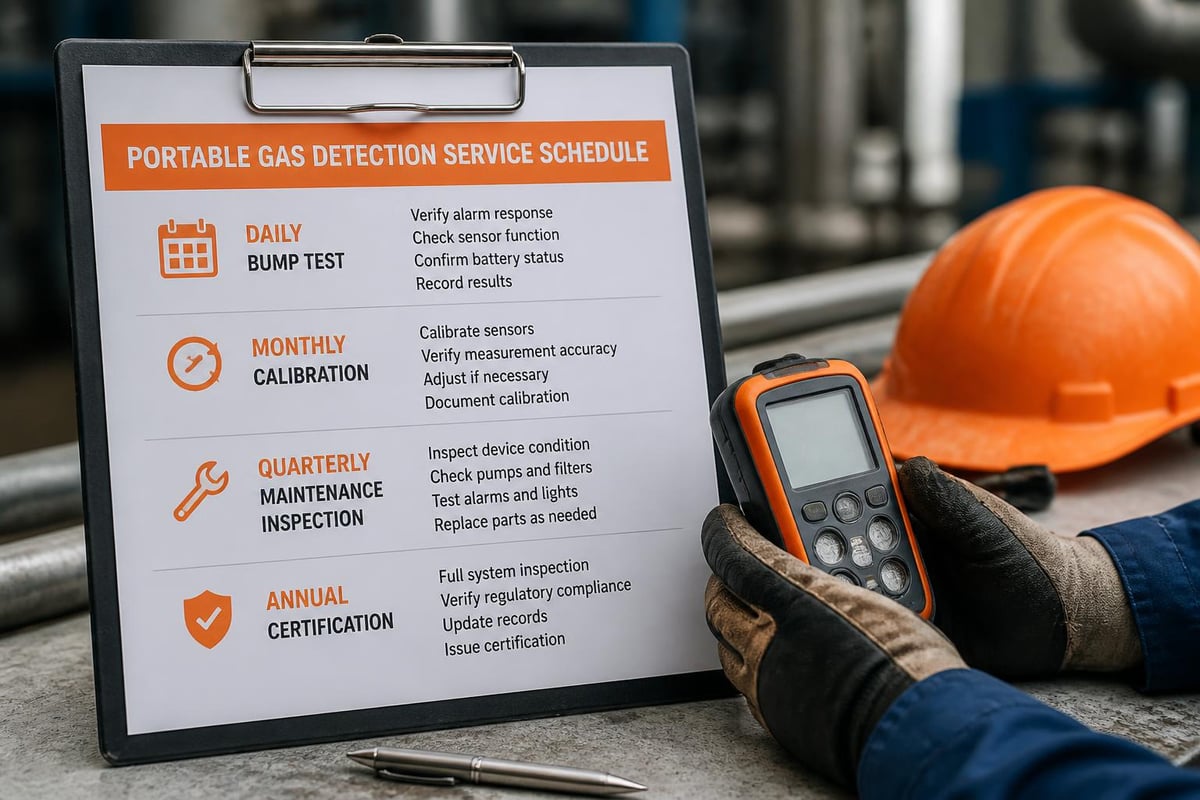
Bump testing must occur before each day of use to verify sensor functionality and alarm operation. This functional check exposes the detector to a known gas concentration and confirms the device responds within acceptable parameters. Daily bump tests represent the front-line defense against undetected sensor failures or environmental damage.
Full calibration typically occurs monthly, quarterly, or semi-annually depending on manufacturer specifications and operating conditions. Calibration adjusts sensor output to match certified gas standards, compensating for drift that occurs naturally over time. The specific interval depends on several factors:
Interval determination factors:
- Manufacturer recommendations in technical documentation
- Regulatory requirements for the specific industry and jurisdiction
- Operating environment exposure levels and contamination risk
- Historical performance data showing drift patterns
- Criticality of application and consequences of failure
Harsh environments with temperature extremes, high humidity, or chemical contamination may require more frequent calibration. Devices that consistently fail bump tests between calibrations need shortened intervals or sensor replacement.
Documentation requirements for compliance
Regulatory agencies and safety auditors require complete records of all testing and maintenance activities. Documentation must include:
| Record Type | Required Information | Retention Period |
|---|---|---|
| Bump Test | Date, time, operator, device serial number, gas used, pass/fail result | Minimum 2 years |
| Calibration | Date, technician, serial number, gas concentrations, before/after readings, adjustments | Device lifetime |
| Maintenance | Service performed, parts replaced, technician, next service due date | Device lifetime |
| Failures | Incident description, corrective action, root cause, preventive measures | Permanent |
Organizations operating multiple sites or large detector fleets benefit significantly from centralized digital recordkeeping systems that automate compliance reporting and identify service trends.
What are the essential steps in a calibration procedure
Calibration verification and adjustment follow a standardized sequence that ensures accuracy and repeatability. Technicians must use certified calibration gas with known concentrations traceable to national standards and verify environmental conditions fall within acceptable ranges.
Standard calibration procedure:
- Pre-calibration inspection: Verify physical condition, check battery charge, confirm firmware version, inspect sensors and filters for damage or contamination
- Zero calibration: Expose detector to clean air or zero gas to establish baseline in gas-free environment
- Span calibration: Apply certified test gas at target concentration (typically 25-50% of measurement range) and adjust sensor response to match known value
- Verification test: Apply calibration gas again without adjustment to confirm accuracy within tolerance
- Alarm testing: Verify low and high alarms activate at correct concentration thresholds
- Documentation: Record all readings, adjustments, gas lot numbers, and test results with technician signature
Proper calibration procedures require controlled conditions with stable temperature and humidity. Wind, extreme temperatures, or contaminated environments can affect calibration accuracy. Most manufacturers specify calibration in clean air between 0°C and 40°C with relative humidity below 90%.
Failed calibrations require investigation. If a device cannot be calibrated within tolerance, sensor replacement or device retirement may be necessary. Trending calibration data across multiple cycles reveals sensor degradation patterns and predicts remaining useful life.
Common calibration errors and how to avoid them
Several mistakes compromise calibration validity:
- Using expired calibration gas: Gas concentrations degrade over time; always verify expiration dates and storage conditions
- Inadequate gas flow duration: Sensors require sufficient exposure time to stabilize; rushing the process causes inaccurate adjustments
- Environmental interference: Performing calibration in contaminated areas or extreme conditions invalidates results
- Incorrect gas selection: Using wrong gas type or concentration for specific sensor technology produces invalid calibration
- Skipping zero calibration: Span adjustments without proper zero baseline compound errors
Technicians must follow manufacturer-specific procedures exactly. Generic calibration approaches fail to account for unique sensor technologies, sampling methods, or measurement algorithms.
How should organizations structure preventive maintenance schedules
Preventive maintenance extends detector lifespan, prevents unexpected failures, and ensures consistent performance between calibrations. Maintenance activities are categorized by frequency and complexity, with some tasks performed by operators and others requiring trained technicians.
Daily maintenance tasks
Operators perform these checks before each shift:
- Visual inspection for physical damage, cracks, or loose components
- Battery charge verification and replacement if below threshold
- Bump test execution and result documentation
- Filter and inlet inspection for blockages or contamination
- Alarm functionality test (audible, visual, vibration)
These rapid checks identify obvious problems before workers enter hazardous areas. Any failure triggers removal from service and escalation to qualified technicians.
Monthly maintenance activities
Designated personnel conduct more thorough examinations monthly:
- Full calibration verification and adjustment
- Detailed sensor inspection for corrosion or degradation
- Battery contact cleaning and connection verification
- Housing seal integrity check
- Firmware update review and application if available
- Comprehensive functional testing of all operating modes
Monthly maintenance provides opportunity to identify developing issues before they cause failures. Trending performance data from monthly checks enables predictive maintenance and optimized replacement scheduling.
Quarterly and annual inspections
Intensive service occurs less frequently but addresses wear items and detailed diagnostics:
Quarterly tasks:
- Sensor replacement according to manufacturer lifespan specifications
- Complete disassembly, cleaning, and reassembly
- Replacement of filters, tubing, and sampling components
- Comprehensive alarm and display testing
- Firmware validation and update
- Peer comparison testing against reference instruments
Annual certification:
- Factory-level recalibration and certification
- Complete sensor suite replacement
- Battery replacement regardless of apparent condition
- Physical inspection for internal corrosion or moisture damage
- Load testing under simulated field conditions
- Compliance audit and documentation review

Organizations must balance maintenance costs against safety requirements and regulatory compliance. Cutting corners on scheduled service creates liability exposure and endangers workers.
What role does software play in managing portable gas detection service
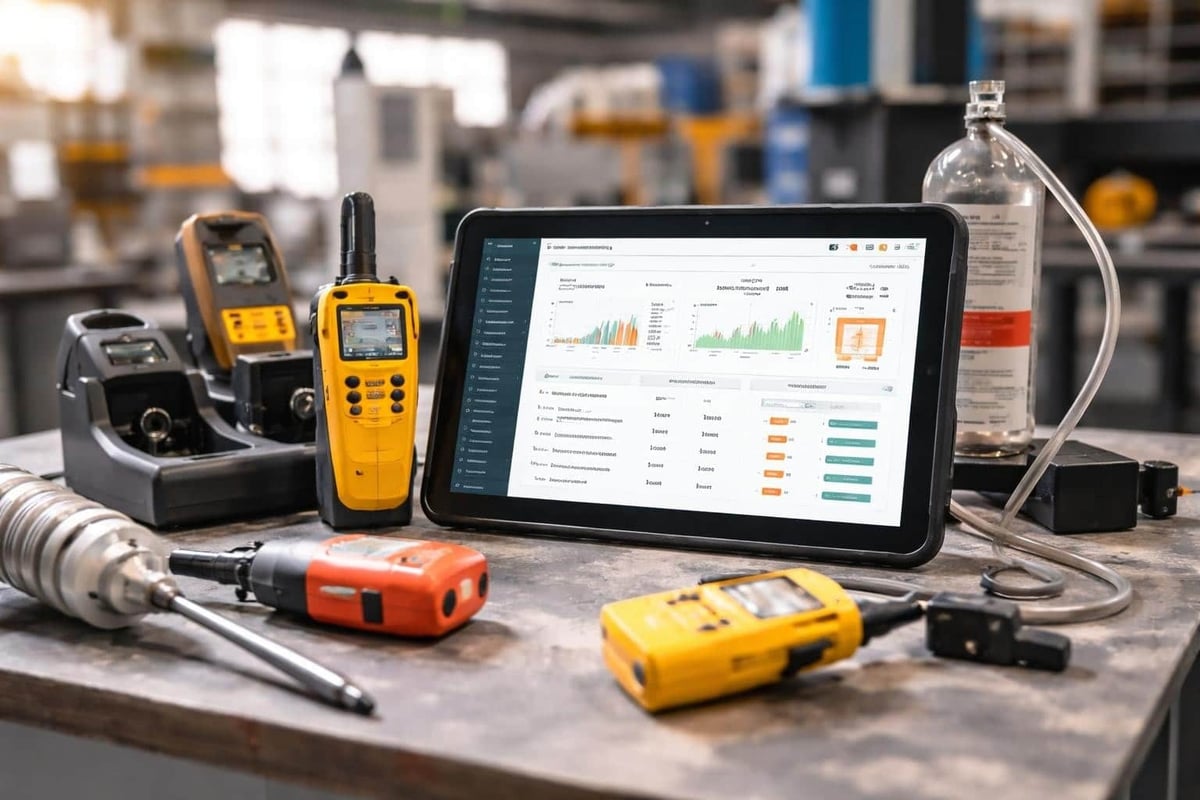
Modern portable gas detection service relies on specialized software systems to track assets, schedule maintenance, document compliance, and analyze performance trends. Digital platforms replace error-prone manual recordkeeping with automated workflows and centralized data repositories.
Asset tracking and inventory management
Software systems assign unique identifiers to each detector and maintain comprehensive profiles including:
- Serial number, model, manufacturer, and purchase date
- Sensor configuration and technology types
- Calibration history with before/after readings
- Maintenance activities and parts replacements
- Current assignment and location
- Warranty status and expiration dates
- Service due dates and automated alerts
This serialized tracking enables organizations to answer critical questions instantly: Which devices require calibration this week? How many detectors are overdue for service? What is the average sensor lifespan across our fleet?
Proper software implementation eliminates situations where detectors slip through service intervals or calibration due dates pass unnoticed. Automated reminders ensure technicians receive advance notice of upcoming requirements.
Brytend’s service module provides exactly this capability, registering serialized inventory with custom service definitions and automated reminder systems that ensure no device misses scheduled maintenance or calibration cycles.
Compliance documentation and audit trails
Regulatory compliance requires complete, tamper-proof records of all service activities. Software platforms generate comprehensive documentation including:
| Documentation Output | Purpose | Typical Recipients |
|---|---|---|
| Calibration certificates | Proof of accuracy for specific date/time | Auditors, safety managers, regulatory inspectors |
| Service history reports | Complete lifecycle documentation | Asset managers, compliance officers |
| Bump test logs | Daily functional verification records | Site supervisors, safety committees |
| Trend analysis reports | Performance patterns and degradation indicators | Maintenance planners, procurement |
| Compliance dashboards | Real-time status of entire fleet | Executive management, safety directors |
These outputs must be readily accessible during safety audits, incident investigations, or regulatory inspections. Software-generated documentation provides verifiable proof that organizations maintain equipment according to standards and manufacturer specifications.
Integration with field operations
Advanced platforms integrate portable gas detection service with broader operational workflows:
- Pre-work permit systems: Verify detector calibration status before issuing confined space or hot work permits
- Technician dispatch: Route calibration and maintenance work to qualified personnel based on location and skill
- Parts inventory: Track calibration gas, replacement sensors, batteries, and consumables with automatic reordering
- Training management: Link detector assignments to operator certification and training currency
- Incident response: Correlate detector alarm events with service history during investigations
This integration transforms isolated service activities into components of comprehensive safety management systems. Organizations gain visibility into connections between equipment condition, maintenance quality, and safety outcomes.
How can organizations optimize portable gas detection service costs
Service programs represent significant ongoing expenses including labor, calibration materials, replacement parts, and administrative overhead. Strategic optimization reduces costs while maintaining safety and compliance standards.
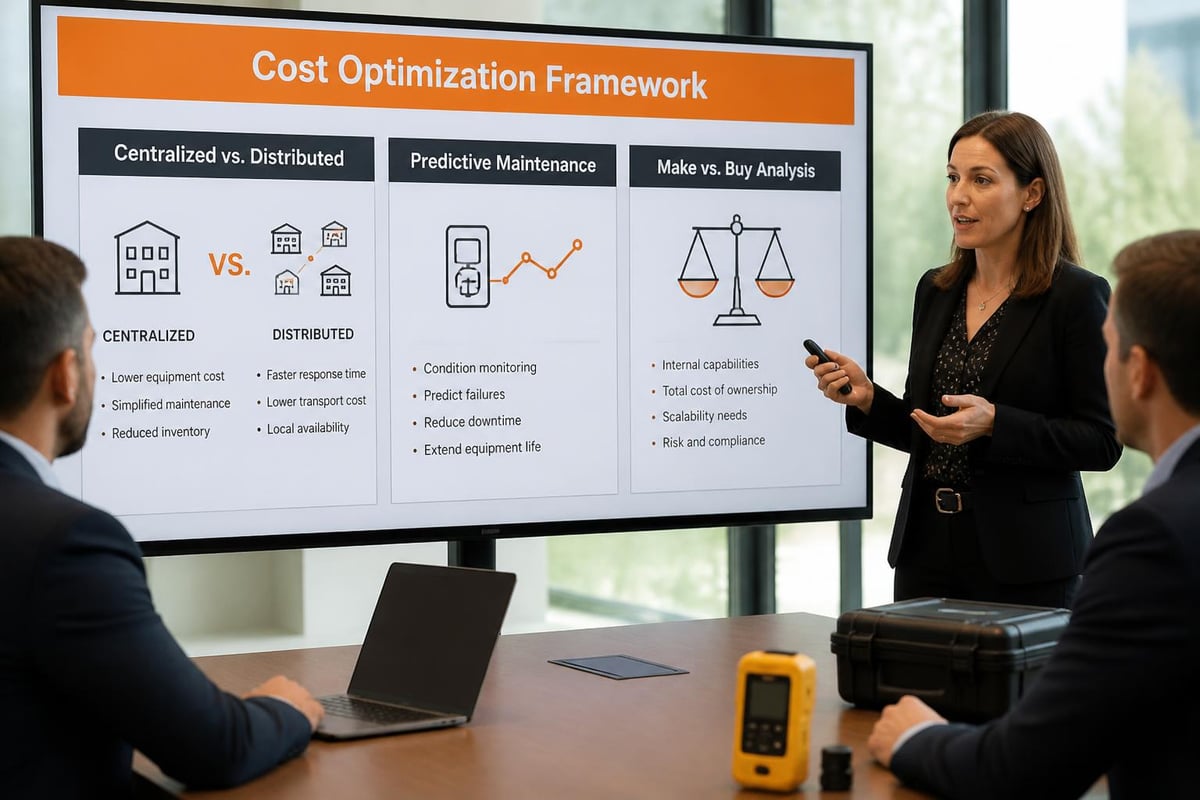
Centralized versus distributed service models
Organizations must decide between centralized service facilities and distributed field capabilities:
Centralized model:
- Dedicated calibration and maintenance facility with controlled environment
- Specialized technicians with focused expertise
- Inventory concentration reduces duplicate stock
- Economies of scale for high-volume operations
- Requires rotation of spare devices to maintain field coverage
Distributed model:
- Service performed at operating locations
- Reduces device transportation and rotation logistics
- Enables faster response to urgent needs
- Requires equipment and trained personnel at each site
- Higher overall inventory and training costs
Most organizations employ hybrid approaches, maintaining central facilities for major service while distributing calibration capabilities to high-volume or remote locations. The optimal balance depends on fleet size, geographic distribution, and operational tempo.
Predictive maintenance strategies
Data-driven maintenance replaces fixed schedules with condition-based service intervals. By analyzing historical performance:
- Extend calibration intervals for devices showing minimal drift patterns
- Identify sensors requiring premature replacement before failures occur
- Optimize parts inventory based on actual consumption patterns
- Target training interventions where operator errors cluster
- Eliminate redundant testing that provides no safety value
Predictive approaches require robust data collection and analysis capabilities. Organizations beginning this journey should start with simple metrics like calibration drift trends before advancing to complex predictive algorithms.
Make versus buy service decisions
Organizations must evaluate internal service capabilities against outsourced options:
Internal service advantages:
- Complete control over scheduling and priorities
- Immediate response to urgent needs
- Detailed knowledge of specific applications
- Lower per-unit costs at sufficient scale
Outsourced service advantages:
- No capital investment in calibration equipment
- Access to manufacturer-trained specialists
- Reduced administrative burden
- Consistent service quality across fleet
The decision depends on fleet size, technical capability, and strategic priorities. Fleets exceeding 50-100 devices typically justify internal programs, while smaller operations benefit from outsourcing.
What are the most common service mistakes and their consequences
Even well-intentioned organizations make errors that compromise detector reliability and create safety gaps. Understanding these patterns enables preventive action.
Inadequate bump testing discipline
Mistake: Treating bump tests as optional or performing them inconsistently
Bump testing verifies that sensors function correctly before workers enter hazardous areas. Skipping this critical step means failures go undetected until exposure occurs. Organizations that make bump testing optional or allow exceptions create conditions for serious incidents.
Consequence: Workers carrying non-functional detectors enter hazardous atmospheres with false confidence in their protection. Sensor failures, dead batteries, or blocked inlets prevent alarms during actual exposures.
Prevention: Implement strict policy requiring documented bump tests before each use with no exceptions. Utilize automated docking stations that prevent detector checkout without successful test completion.
Calibration with improper gas standards
Mistake: Using incorrect gas types, concentrations, or expired cylinders
Calibration validity depends entirely on gas standard accuracy. Using expired gas, wrong concentrations, or inappropriate gas types produces detectors calibrated to incorrect baselines. This error is particularly dangerous because calibrated devices appear functional while providing inaccurate readings.
Consequence: Detectors underreport or overreport actual gas concentrations. Underreporting creates exposure risk while overreporting causes false alarms that erode confidence and encourage circumvention.
Prevention: Implement strict inventory controls for calibration gas with automated expiration tracking. Require lot number documentation for every calibration linking results to specific gas standards. Verify gas types and concentrations against manufacturer specifications before each use.
Neglecting environmental factors
Mistake: Performing calibration or maintenance in unsuitable conditions
Temperature extremes, high humidity, contaminated air, or excessive vibration during service invalidate results. Calibrating detectors in the same environments they monitor introduces contamination that prevents accurate zero baselines.
Consequence: Calibrations fail to establish correct sensor responses. Devices placed in service may show immediate drift or fail bump tests despite recent calibration.
Prevention: Establish dedicated service areas meeting manufacturer environmental specifications. Document environmental conditions during calibration and reject attempts performed outside acceptable ranges.
Incomplete documentation practices
Mistake: Failing to record complete information for each service activity
Incomplete records prevent trend analysis, compliance verification, and informed decision-making. Missing information about technicians, calibration gases, or test results creates gaps that auditors and investigators cannot overlook.
Consequence: Organizations cannot demonstrate compliance during regulatory inspections. Incident investigations lack data necessary to determine whether equipment failures contributed to exposures. Warranty claims fail due to inadequate service documentation.
Prevention: Implement standardized forms or digital systems that require complete data entry before task completion. Regular audits should verify documentation quality and completeness.
Real-world example of comprehensive service implementation
A regional wastewater treatment authority operates 47 facilities with 280 portable gas detectors monitoring hydrogen sulfide, methane, oxygen, and volatile organic compounds. Prior to 2024, the organization relied on decentralized recordkeeping with paper logs and inconsistent service intervals.
Initial challenges:
- 23% of detectors overdue for calibration at any given time
- No centralized visibility into device status or service history
- Three safety incidents involving detectors that failed bump tests
- Audit findings citing inadequate documentation
- Average detector lifespan of 3.2 years versus manufacturer expectation of 5+ years
Service program redesign:
The organization implemented a centralized management system with the following components:
- Serialized asset registry: Every detector entered into database with complete specifications and service requirements
- Automated scheduling: Monthly calibration windows and quarterly maintenance intervals with automated reminders
- Standardized procedures: Detailed work instructions for bump testing, calibration, and maintenance at each frequency
- Centralized calibration facility: Dedicated laboratory with controlled environment and specialized equipment
- Field bump test stations: Automated docking stations at high-volume locations enabling daily testing without manual documentation
- Mobile technician dispatch: Service technicians with portable calibration equipment for remote facilities
Results after 18 months:
| Metric | Before | After | Improvement |
|---|---|---|---|
| Calibration compliance rate | 77% | 99.2% | +22.2% |
| Devices overdue for service | 23% | 1.8% | -21.2% |
| Average detector lifespan | 3.2 years | 4.7 years (projected) | +47% |
| Safety incidents involving detector failures | 3 per year | 0 | 100% reduction |
| Labor hours per calibration | 45 minutes | 28 minutes | 38% reduction |
| Documentation audit findings | Multiple per inspection | Zero | 100% improvement |
The organization achieved these results through systematic process improvement, appropriate technology deployment, and unwavering management commitment to service discipline. The initial software investment and process redesign costs were recovered within 14 months through extended device lifespans and reduced incident costs.
How does portable gas detection service integrate with broader safety programs
Effective detector service does not exist in isolation but connects to comprehensive occupational health and safety management systems. Organizations must align service protocols with permit systems, training programs, and incident response procedures.
Permit-required confined space entry
Confined space entry permits require verification of atmospheric testing equipment functionality. Software integrations enable permit systems to query detector databases and confirm:
- Device calibration occurred within acceptable window
- Successful bump test completion on entry date
- Appropriate gas sensors configured for identified hazards
- Trained operator assigned to specific detector
Permit systems should reject entry authorization when detector service requirements are not met. This automated enforcement prevents permit approvers from making exceptions that introduce risk.
Hot work and hazardous area access
Similar verification processes apply to hot work permits and hazardous area access. Organizations should implement digital workflows where service status automatically populates permit applications and prevents approvals for out-of-service equipment.
Incident investigation protocols
When detector alarms occur or exposure incidents happen, investigation teams require complete equipment service history. Quick access to calibration records, maintenance activities, and recent test results enables investigators to determine whether equipment performance contributed to incidents.
Documentation systems should facilitate rapid retrieval of device-specific information by serial number, location, or date range. This capability proves essential during regulatory investigations where inspectors request immediate evidence of equipment maintenance.
Frequently asked questions about portable gas detection service
How long do gas detector sensors typically last?
Electrochemical sensors typically last 18-36 months depending on exposure levels and environmental conditions. Catalytic bead combustible gas sensors may function for 3-5 years. Photoionization detector (PID) lamps require replacement every 1-2 years. Manufacturer specifications provide expected lifespans, but actual performance varies with usage intensity and contamination exposure. Organizations should track sensor age and plan replacements proactively rather than waiting for failures.
Can calibration intervals be extended if bump tests consistently pass?
Calibration intervals should follow manufacturer recommendations regardless of bump test results. Bump tests verify functionality but do not confirm measurement accuracy across the full concentration range. Extending calibration intervals without manufacturer approval may violate regulatory requirements and create liability exposure. Organizations seeking interval extensions should consult manufacturers and regulatory authorities with supporting data demonstrating consistent performance.
What temperature and humidity conditions are required for accurate calibration?
Most manufacturers specify calibration between 0°C and 40°C (32°F to 104°F) with relative humidity below 90% non-condensing. Extreme temperatures affect sensor response and gas behavior, producing inaccurate calibrations. High humidity can contaminate sensors or cause condensation in sampling systems. Organizations should establish dedicated calibration areas maintaining these conditions year-round rather than attempting service in field environments.
How should calibration gas cylinders be stored and managed?
Calibration gas requires cool, dry storage away from direct sunlight and temperature extremes. Cylinders should remain vertical and secured to prevent tipping. Regulators and fittings must be kept clean and free from contamination. Proper storage practices extend gas shelf life and maintain concentration accuracy. Organizations should implement first-in-first-out inventory rotation and strict expiration date tracking to prevent use of degraded standards.
What qualifications should calibration technicians possess?
Technicians performing calibration should complete manufacturer-specific training for each detector model and understand gas detection principles, sensor technologies, and safety hazards. Many organizations require certification through programs offered by equipment manufacturers or industry associations. Technicians must demonstrate competency through supervised practice and written examinations. Regular refresher training ensures techniques remain current with equipment updates and evolving best practices.
How can organizations verify calibration quality and technician competency?
Implement peer verification programs where experienced technicians periodically observe and validate colleague performance. Conduct blind audits using devices with known calibration needs to test whether technicians correctly identify and address issues. Trend analysis comparing results across technicians reveals outliers requiring additional training. Quality control samples with certified reference instruments provide objective performance benchmarks. These verification methods ensure consistent service quality across the organization.
What should organizations do when detectors repeatedly fail calibration?
Repeated calibration failures indicate sensor degradation, contamination, or fundamental device problems. Organizations should remove devices from service immediately and escalate to manufacturer technical support or authorized service centers. Attempting repeated calibrations on failing devices wastes resources and delays proper resolution. Document failure patterns and root causes to identify whether environmental exposures, improper storage, or usage errors contribute to premature degradation. This information guides preventive measures and procurement decisions.
Implementing structured portable gas detection service requires systematic processes, appropriate technology, and organizational commitment to equipment reliability. Organizations that treat service as a compliance checkbox rather than a safety imperative expose workers to preventable hazards and regulatory violations. Brytend develops custom software solutions that transform manual service workflows into automated systems with serialized tracking, compliance documentation, and predictive maintenance capabilities. Contact Brytend to discuss how tailored service management platforms can enhance your safety equipment programs and operational efficiency.