

Customer orders represent the operational backbone of manufacturing, distribution, and service businesses. A customer order is a formal request from a buyer for specific products or services, including quantity, delivery terms, and payment conditions. Effective management of customer orders directly impacts cash flow, inventory turnover, and customer retention rates. Organizations handling customer orders require structured systems that coordinate sales, inventory, production, and logistics functions across multiple departments and external partners.
TL;DR:
- Customer orders are formal buyer requests requiring coordination across sales, inventory, production, and logistics systems
- Order management systems reduce errors by 35-40% and improve fulfillment speed by automating validation, routing, and tracking
- The customer order decoupling point determines which operations execute against forecasts versus actual demand
- High-volume order processing requires batch validation, priority queuing, and real-time inventory synchronization
- Integration between order systems and CRM platforms improves accuracy and enables predictive fulfillment strategies
What Are Customer Orders in Business Operations
A customer order is a documented commitment between a buyer and seller specifying products, quantities, prices, delivery dates, and terms. Customer orders trigger inventory allocation, production scheduling, procurement, and fulfillment workflows.
Every customer order contains core data elements:
- Customer identification: Account number, billing entity, delivery location
- Line items: SKU, description, quantity, unit price, discount terms
- Fulfillment requirements: Delivery date, shipping method, special handling
- Financial terms: Payment method, credit approval, tax jurisdiction
- Status tracking: Order date, confirmation date, expected ship date, actual delivery
Manufacturing businesses distinguish between make-to-stock, make-to-order, and engineer-to-order workflows. The customer order decoupling point defines where customer-specific production begins versus where standardized inventory ends. This boundary determines lead times, inventory investment, and production scheduling complexity.

Service organizations handle customer orders differently than product businesses. A service order references labor, equipment, and materials required to complete work at a customer location. Service orders include appointment scheduling, technician assignment, parts allocation, and completion documentation requirements.
How Do Order Management Systems Process Customer Orders
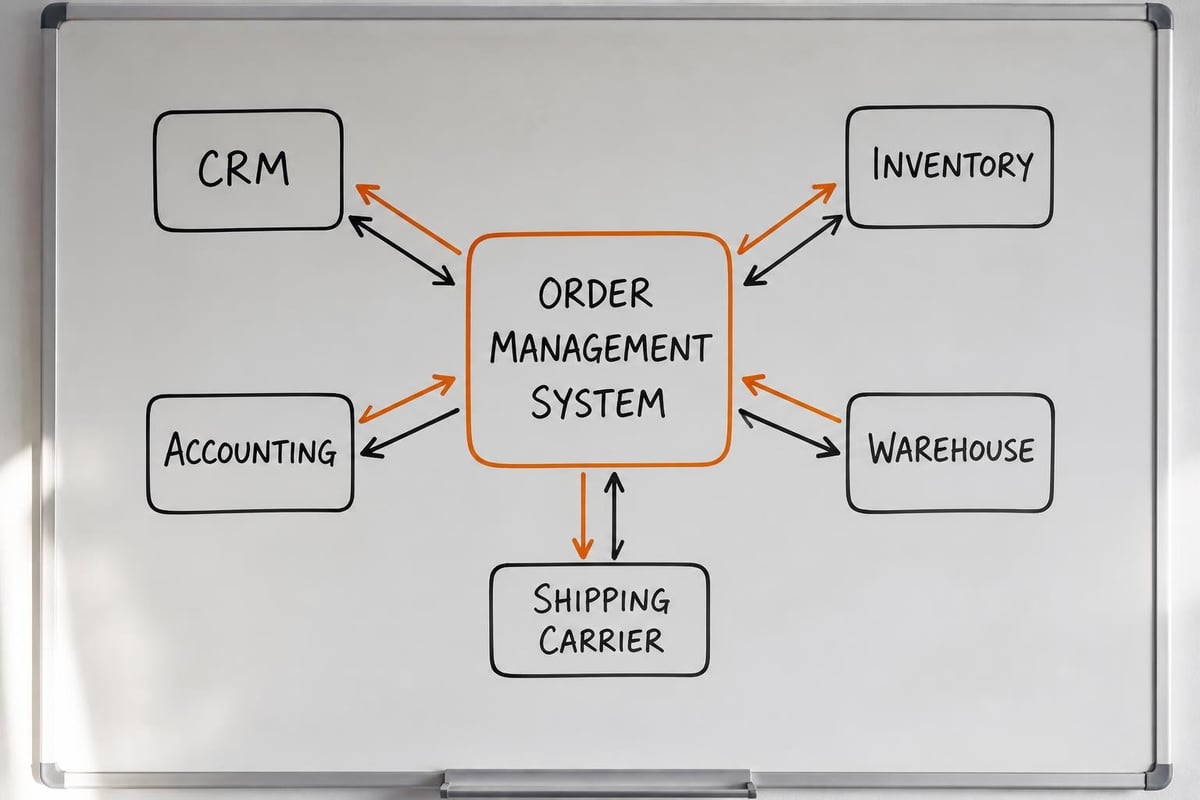
Order management systems automate the capture, validation, fulfillment, and tracking of customer orders across channels. These systems integrate with inventory, accounting, and logistics platforms to maintain data consistency.
The order processing workflow follows a structured sequence:
- Order intake: Capture from web portals, EDI feeds, sales representatives, or API integrations
- Validation: Verify customer credit, product availability, pricing rules, and delivery feasibility
- Allocation: Reserve inventory, assign warehouse locations, schedule production if needed
- Fulfillment: Generate pick lists, pack orders, create shipping labels, update carrier systems
- Confirmation: Send tracking information, update customer records, trigger invoicing
- Exception handling: Manage backorders, substitutions, cancellations, and returns
Modern unified omnichannel order management systems process orders from retail stores, e-commerce platforms, marketplaces, and B2B portals through a single fulfillment engine. This approach prevents inventory fragmentation and enables ship-from-store, buy-online-pickup-in-store, and drop-ship scenarios.
| Order Type | Processing Time | Validation Requirements | Fulfillment Complexity |
|---|---|---|---|
| Standard Stock | 15-30 minutes | Credit, inventory check | Low |
| Configured Product | 2-4 hours | Engineering review, BOM validation | Medium |
| Custom Fabrication | 1-3 days | Design approval, material sourcing | High |
| Service Order | 30-60 minutes | Technician availability, parts check | Medium |
Integration with CRM systems improves order accuracy by pre-populating customer preferences, shipping addresses, and payment methods. Electronic CRM platforms maintain order history that enables predictive recommendations and automated reorder suggestions.
Why Do Businesses Need Structured Customer Order Workflows
Structured customer order workflows reduce errors, accelerate fulfillment, and improve customer satisfaction. Unstructured order handling causes duplicate entries, inventory discrepancies, and missed delivery commitments.
Benefits of formalized order workflows:
- Error reduction: Automated validation catches pricing mistakes, invalid SKUs, and credit limit violations
- Faster processing: Batch operations and parallel workflows reduce order-to-ship time by 40-50%
- Inventory accuracy: Real-time allocation prevents overselling and reduces stockouts
- Compliance: Audit trails document who modified orders, when changes occurred, and approval status
- Scalability: Systems handle volume spikes without proportional staff increases
The Brytend CRM enables businesses to automate lead qualification, quote generation, and order entry through configurable workflows that match specific sales processes. By connecting customer data with order validation rules, organizations eliminate manual data entry and ensure consistent application of pricing policies.

Organizations processing high volumes benefit from established best practices including priority-based queue management, automated exception routing, and predictive inventory positioning. These techniques maintain service levels during seasonal demand peaks or promotional events.
What Are the Key Components of an Order Management System
Order management systems consist of multiple interconnected modules that handle different aspects of the customer order lifecycle. Each component maintains specific data and executes defined business rules.
Order Capture and Entry
The front-end interface collects customer orders from multiple channels. Web portals validate data in real-time using JavaScript validation, API connections verify inventory availability, and EDI parsers translate electronic documents into internal formats. Mobile applications enable field sales representatives to create orders offline with synchronization when connectivity resumes.
Inventory and Allocation Engine
This component tracks available-to-promise quantities across warehouses, retail locations, and supplier networks. The allocation engine applies rules such as proximity to customer, warehouse capacity, and shipping cost optimization when assigning inventory to orders. Reserved quantities prevent multiple orders from claiming the same units.
Workflow and Approval Routing
Complex customer orders require review by credit managers, product engineers, or compliance officers. Workflow engines route orders based on total value, product categories, customer risk scores, or custom business rules. Approval queues display pending items with context for rapid decision-making.
Fulfillment and Shipping
Integration with warehouse management systems generates pick lists organized by location sequence. Packing stations verify contents, print shipping labels, and update carrier systems with tracking numbers. Automated manifesting schedules pickups and transmits customs documentation for international shipments.
Reporting and Analytics
Dashboards display order status, aging reports, fulfillment performance, and exception queues. Analytics identify trends in order volume, average order value, product mix, and delivery performance. Predictive models forecast demand patterns to optimize inventory positioning.
How Can Organizations Optimize High-Volume Order Processing
High-volume customer order processing requires automation, batch operations, and intelligent prioritization to maintain speed and accuracy. Manual processing cannot scale beyond 50-100 orders per day per person without significant error rates.
Optimization strategies for order volume:
- Implement EDI and API integrations for major customers to eliminate manual data entry
- Use batch validation to process hundreds of orders simultaneously checking credit and inventory
- Configure automatic approval for orders meeting defined criteria (established customers, standard products, value under threshold)
- Deploy pick-and-pack automation including barcode scanning, weight verification, and automated labeling
- Enable customer self-service portals for order status, tracking, and invoice access reducing service calls
The order placement process in e-commerce demonstrates how optimized checkout flows reduce cart abandonment and accelerate order confirmation. Techniques include saved payment methods, one-click reordering, and real-time shipping cost calculation.
| Volume Tier | Orders/Day | Recommended Automation | Staff Required |
|---|---|---|---|
| Low | 1-50 | Basic validation, manual pick | 1-2 people |
| Medium | 51-200 | EDI integration, batch processing | 3-5 people |
| High | 201-1000 | API automation, WMS integration | 8-12 people |
| Very High | 1000+ | Full automation, robotics | 15-25 people |
Organizations managing customer orders across multiple fulfillment centers benefit from optimization approaches that dynamically assign orders to locations based on inventory availability, shipping costs, and delivery time commitments. These algorithms reduce split shipments and transportation expenses.
Effective customer order management emphasizes timely fulfillment as the primary driver of repeat purchases. Data shows that 87% of customers consider delivery speed a key factor in vendor selection.
What Challenges Do Businesses Face Managing Customer Orders
Customer order management presents operational, technical, and organizational challenges that impact fulfillment performance. These issues compound as order volumes increase and product complexity grows.
Inventory Synchronization Across Channels
Maintaining accurate available-to-promise quantities across retail stores, warehouses, and e-commerce platforms requires real-time synchronization. Legacy systems update inventory in batch cycles creating windows where overselling occurs. Distributed order management systems provide a unified inventory view but require integration with point-of-sale, warehouse management, and supplier systems.
Handling Order Changes and Cancellations
Customers frequently modify orders after submission, changing quantities, delivery dates, or shipping addresses. Changes made after warehouse processing begins create waste, rework, and delivery delays. Effective systems define change cutoff times, automate partial cancellations, and maintain complete audit trails of modifications.
Managing Backorders and Substitutions
When inventory cannot fulfill an order, businesses must decide whether to backorder, substitute alternative products, or cancel line items. Automated substitution rules consider product compatibility, customer preferences, and price differences. Communication systems notify customers of backorder status and expected availability dates.
Complex Pricing and Promotions
Customer-specific contracts, volume discounts, promotional offers, and seasonal pricing create calculation complexity. Order systems must apply rules in correct sequence, validate manual overrides, and document discount approvals. Price verification during fulfillment prevents shipping products at incorrect amounts.
Common mistakes in order processing:
- Failing to validate credit limits before order confirmation leading to collection issues
- Manual re-entry of data from external systems introducing errors
- Lack of inventory reservation causing allocation conflicts
- Insufficient exception handling leaving problematic orders unresolved
- Poor integration between order and accounting systems creating reconciliation problems
Research on integrating returns and decomposing orders demonstrates how warehouse operations improve when return processing and order picking occur in coordinated workflows rather than separate systems.
How Do Custom Software Solutions Improve Order Management
Custom software development enables businesses to implement order management workflows that match their specific operational requirements. Off-the-shelf systems require process adaptation to software constraints while custom solutions adapt software to existing successful processes.
Advantages of custom order management systems:
- Exact business rule implementation: Configure validation, approval, and routing logic matching actual policies
- Industry-specific functionality: Include compliance requirements, serialization tracking, or batch/lot control for regulated industries
- Legacy system integration: Connect to existing ERP, accounting, and warehouse systems without middleware
- Scalable architecture: Design database structures and processing flows for anticipated growth
- Proprietary workflow support: Automate unique competitive processes that differentiate the business
A custom manufacturing software case: A precision machining company implemented a custom order system integrating CAD file review, material certification tracking, and quality inspection documentation. The system automatically routes customer orders requiring special certifications to engineering review, validates material specifications against customer requirements, and generates certificates of conformity upon shipment completion. This workflow reduced order processing time from 4 hours to 25 minutes while eliminating compliance documentation errors.
| Approach | Implementation Time | Customization Flexibility | Total Cost (5 years) |
|---|---|---|---|
| Off-the-shelf | 2-4 months | Low-Medium | High (licenses + maintenance) |
| Configured platform | 4-8 months | Medium | Medium-High |
| Custom development | 6-12 months | Complete | Medium (development + hosting) |
Brytend specializes in developing custom order management solutions that integrate with existing business systems and automate industry-specific workflows. Their development approach begins with workflow documentation, identifies automation opportunities, and delivers systems that scale with business growth.
Structured customer order workflows reduce fulfillment errors, accelerate processing times, and improve inventory accuracy across channels. Businesses processing more than 50 orders daily benefit from automation, integration, and exception-handling systems. Brytend develops custom software solutions that automate order capture, validation, fulfillment, and tracking workflows tailored to specific operational requirements and industry regulations. Contact their team to discuss how custom order management systems can streamline your operations.