TL;DR:
- A technology solution is a system of software, hardware, and services designed to address a specific business problem or operational challenge
- Effective technology solutions integrate multiple components-databases, APIs, user interfaces, and infrastructure-into a cohesive system
- Implementation follows structured phases: requirements analysis, architecture design, development, testing, deployment, and ongoing maintenance
- Custom technology solutions outperform generic software when business processes are unique or highly specialized
- ROI measurement requires defined KPIs, baseline metrics, and continuous monitoring across operational, financial, and user adoption dimensions
A technology solution is a structured combination of software applications, hardware infrastructure, data systems, and support services engineered to solve a defined business problem or operational requirement.
What Is a Technology Solution in Software Development
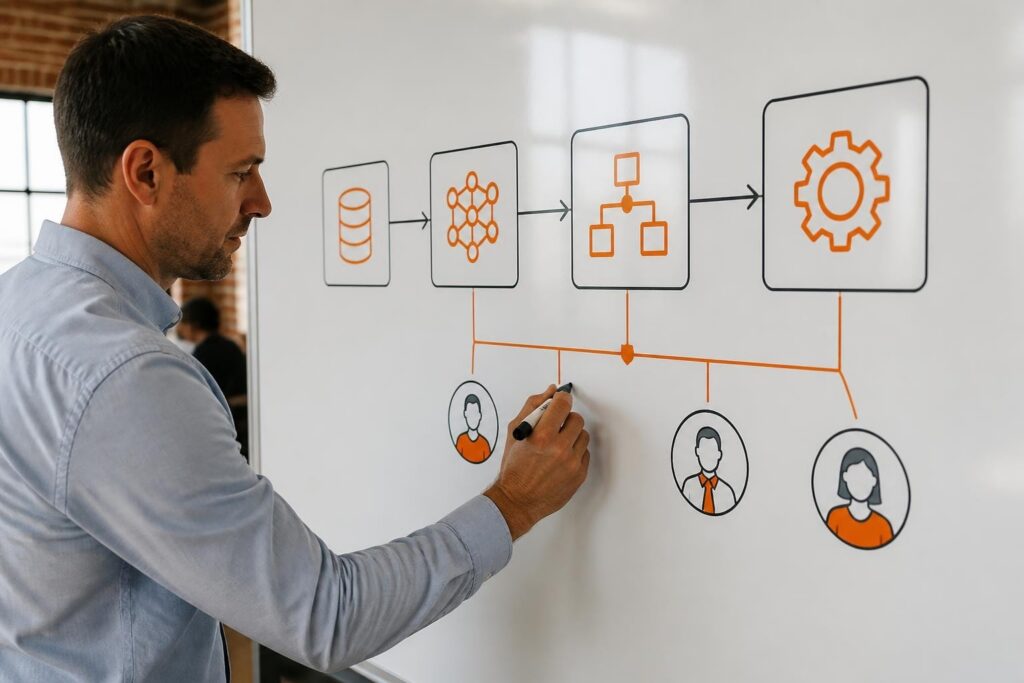
A technology solution addresses specific business challenges through integrated technical components. The system combines application logic, data storage, user interfaces, and external integrations into a functional whole that delivers measurable outcomes.
Core Components of Technology Solutions
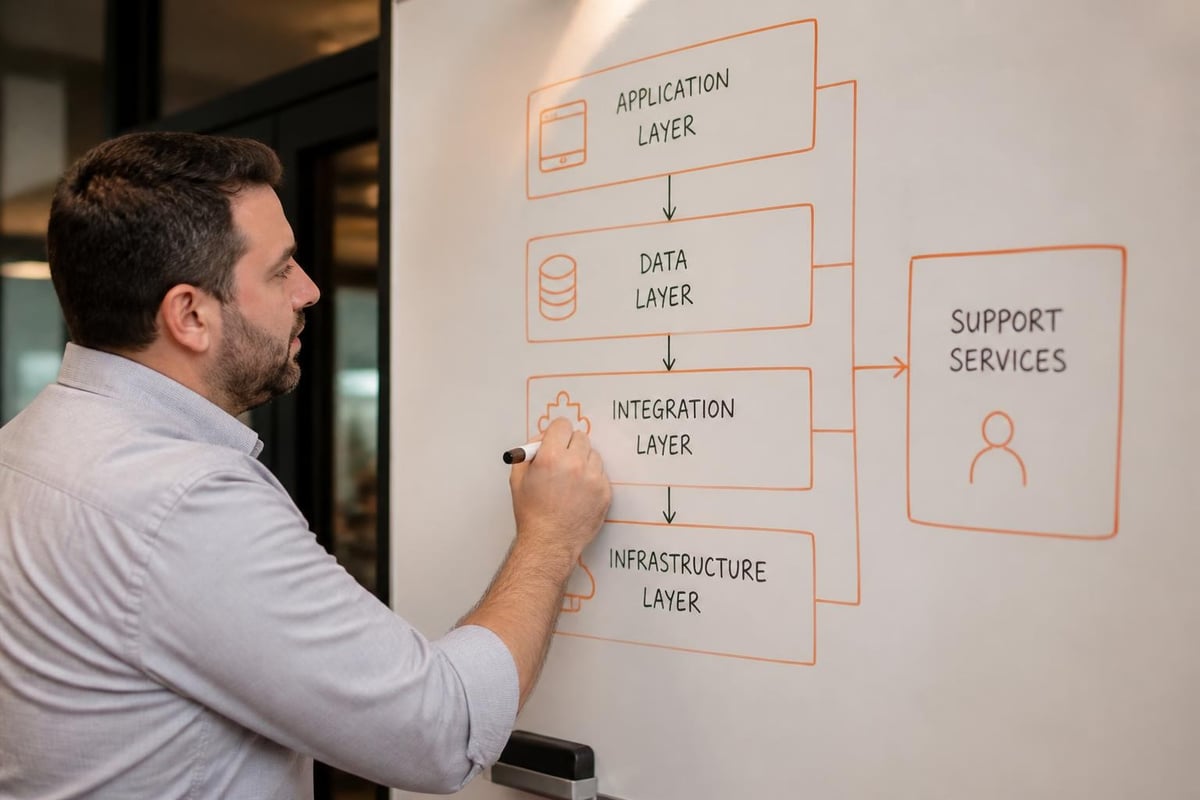
Every technology solution consists of identifiable technical layers that work together:
- Application layer: Custom software code, business logic, and user interface components
- Data layer: Databases, data warehouses, file storage, and data processing pipelines
- Integration layer: APIs, webhooks, message queues, and third-party service connections
- Infrastructure layer: Servers, cloud platforms, networking, security, and monitoring tools
- Support layer: Documentation, training materials, maintenance procedures, and help desk processes
Modern technology solutions rarely exist in isolation. They connect to existing enterprise systems through standardized protocols and data formats. Understanding what technology solutions actually mean requires examining how individual components combine to create business value.
| Component Type | Examples | Primary Function |
|---|---|---|
| Frontend | React, Angular, mobile apps | User interaction and display |
| Backend | Node.js, Python, .NET | Business logic and processing |
| Database | PostgreSQL, MongoDB, SQL Server | Data persistence and retrieval |
| Infrastructure | AWS, Azure, on-premise servers | Hosting and compute resources |
How Technology Solutions Differ From Generic Software Products
A technology solution addresses specific workflows and requirements that generic software cannot accommodate. Custom development allows precise alignment with business processes, industry regulations, and organizational constraints.
Generic products offer broad functionality designed for wide audiences. Technology solutions provide targeted capability sets optimized for particular use cases. A manufacturing company tracking serialized inventory through custom barcodes, service histories, and compliance documentation requires different functionality than a retail point-of-sale system.
When Custom Technology Solutions Deliver Superior Value
Organizations benefit from custom technology solutions when:
- Process complexity: Workflows involve multiple approval stages, conditional logic, or specialized calculations
- Data integration: Systems must synchronize data across legacy platforms, third-party services, and departmental databases
- Compliance requirements: Industry regulations mandate specific audit trails, data retention, or security controls
- Competitive differentiation: Unique capabilities create market advantages that off-the-shelf products cannot provide
- Scale demands: Transaction volumes, user counts, or data processing needs exceed commercial product limits
The decision between generic and custom solutions depends on total cost of ownership, implementation timeline, and strategic importance. Real-world technology case studies demonstrate how organizations evaluate these tradeoffs across industries.
What Are the Essential Steps to Implement a Technology Solution
Technology solution implementation follows a defined sequence of activities that minimize risk and ensure successful delivery.
Phase 1: Requirements Analysis and Documentation
Implementation begins with comprehensive requirements gathering. Stakeholders define functional needs, technical constraints, user roles, data flows, and success metrics. Documentation captures business rules, edge cases, integration points, and non-functional requirements like performance targets and security standards.
Phase 2: Architecture Design and Technology Selection
Solution architects design system components, select technology stacks, and plan infrastructure. Design decisions address scalability, maintainability, security, and cost efficiency. Architecture documentation includes database schemas, API specifications, deployment diagrams, and security models.
Phase 3: Development and Iterative Testing
Development teams build functionality in sprints or phases. Each iteration includes unit testing, integration testing, and user acceptance testing. Continuous integration pipelines automate code quality checks, security scans, and deployment processes.
Phase 4: Deployment and User Enablement
Deployment strategies depend on risk tolerance and system criticality. Phased rollouts limit exposure while gathering real-world feedback. User training, documentation, and support channels prepare stakeholders for production use.
Phase 5: Monitoring and Continuous Improvement
Post-deployment monitoring tracks system performance, user adoption, and business outcomes. Regular maintenance addresses bugs, security patches, and evolving requirements. Performance optimization ensures the technology solution scales with organizational growth.

How Do Organizations Measure Technology Solution Success
Success measurement requires quantifiable metrics aligned with business objectives. Organizations track operational efficiency, cost reduction, revenue impact, and user satisfaction.
Key Performance Indicators for Technology Solutions
Different stakeholder groups require different measurement frameworks:
Operational metrics:
- Transaction processing time reduction
- Error rate decrease
- System uptime percentage
- Resource utilization efficiency
Financial metrics:
- Total cost of ownership
- Return on investment timeframe
- Operational cost savings
- Revenue attribution from new capabilities
User adoption metrics:
- Active user counts and growth trends
- Feature utilization rates
- Support ticket volume and resolution time
- User satisfaction scores
Baseline measurements captured before implementation enable accurate comparison. A chemical processing facility implementing gas detection automation might measure response time from alarm trigger to operator notification before and after deployment.
| Metric Category | Before Solution | After Solution | Improvement |
|---|---|---|---|
| Incident response time | 8.5 minutes | 45 seconds | 91% reduction |
| False alarm rate | 34% | 6% | 82% reduction |
| Compliance report generation | 16 hours | 12 minutes | 99% reduction |
Brytend's approach to custom software development emphasizes measurable outcomes through detailed requirements analysis and iterative validation. The Brytend CRM demonstrates how tailored technology solutions adapt to specific workflow requirements, from AI-driven lead qualification to custom questionnaire integration that matches organizational processes.

What Challenges Do Organizations Face During Technology Solution Deployment
Technology solution projects encounter predictable obstacles that derail timelines, budgets, and expected outcomes.
Common Implementation Barriers
Requirements instability: Stakeholders change specifications during development, increasing scope and delaying delivery. Mitigation requires formal change control processes and stakeholder education about impact.
Legacy system integration: Older platforms lack modern APIs, requiring custom middleware or data synchronization tools. Integration complexity often exceeds initial estimates.
Data migration complexity: Moving data from existing systems to new technology solutions involves cleaning, transformation, validation, and reconciliation. Poor data quality multiplies migration effort.
User resistance: Employees comfortable with existing processes resist new systems. Change management programs addressing training, communication, and incentive alignment improve adoption.
Technical debt accumulation: Rushed development creates maintainability problems. Code reviews, automated testing, and refactoring time prevent long-term degradation.
Risk Mitigation Strategies
Organizations reduce deployment risk through proven practices:
- Phased delivery: Release core functionality first, then add complexity incrementally
- Prototype validation: Build proof-of-concept systems to test assumptions before full development
- Automated testing: Implement continuous integration pipelines that catch defects early
- Stakeholder communication: Regular demos and progress updates maintain alignment and manage expectations
- Fallback planning: Maintain rollback procedures and parallel systems during initial deployment
Technology solutions and their business value depend on successful deployment that accounts for organizational change alongside technical implementation.
How Can Organizations Optimize Technology Solution Performance
Performance optimization extends beyond initial deployment, requiring ongoing monitoring and refinement.
Database and Query Optimization
Database performance directly impacts user experience and operational efficiency. Optimization techniques include:
- Indexing strategies aligned with query patterns
- Query plan analysis and optimization
- Connection pooling and caching layers
- Partitioning large tables for parallel processing
- Archiving historical data to separate storage tiers
A service management system tracking 500,000 serialized assets with 15 years of maintenance history requires careful index design. Queries filtering by asset location, service due date, and equipment type must execute in under 200 milliseconds to support field technician workflows.
Application Architecture Refinement
Application performance improves through architectural changes:
- Asynchronous processing: Move long-running tasks to background job queues
- Microservices separation: Isolate high-load components for independent scaling
- Content delivery networks: Distribute static assets geographically
- Load balancing: Distribute requests across multiple server instances
- Circuit breakers: Prevent cascade failures when external dependencies fail
Infrastructure Scaling Strategies
Cloud infrastructure enables dynamic resource allocation matching demand patterns. Auto-scaling policies add compute capacity during peak periods and reduce costs during low activity. Container orchestration platforms like Kubernetes automate deployment, scaling, and management of application components.

What Best Practices Ensure Long-Term Technology Solution Viability
Sustainable technology solutions require deliberate design choices and operational practices that extend useful life and adaptation capability.
Design for Maintainability
Code quality determines long-term viability. Best practices include:
- Consistent coding standards: Enforce style guides and naming conventions
- Comprehensive documentation: Maintain architecture decisions, API specifications, and deployment procedures
- Modular design: Isolate business logic from infrastructure concerns
- Automated testing: Require test coverage minimums before code acceptance
- Version control: Track all changes with clear commit messages and branching strategies
Security by Design
Security considerations must integrate throughout development:
- Apply principle of least privilege to user access and system permissions
- Encrypt data at rest and in transit using current cryptographic standards
- Implement input validation and sanitization to prevent injection attacks
- Conduct regular security audits and penetration testing
- Maintain vendor patch cycles for all dependencies and frameworks
Common Mistakes to Avoid
Organizations undermine technology solution success through predictable errors:
- Skipping requirements documentation: Verbal agreements create misalignment and scope disputes
- Premature optimization: Optimizing performance before measuring actual bottlenecks wastes effort
- Ignoring scalability: Designing for current load creates expensive rewrites during growth
- Neglecting monitoring: Operating without observability prevents proactive problem detection
- Inadequate backup procedures: Missing backup validation and restoration testing risks data loss
Case Example: Manufacturing Quality Control System
A precision manufacturing company implemented a custom technology solution replacing manual quality inspection logs. The previous system used paper checklists, spreadsheet compilation, and weekly management reports.
Requirements: Track 23 inspection points across 4 production lines, capture digital images of defects, assign corrective actions, and generate real-time quality metrics dashboards.
Implementation: Custom web application with mobile tablet interface, cloud database, image storage, and automated notification system. Development completed in 12 weeks with phased deployment across production lines.
Results: Inspection time per unit decreased 40%, defect detection rate increased 28%, corrective action completion accelerated from 4.2 days to 1.1 days average. Management dashboards eliminated manual reporting effort (16 hours weekly).
The technology solution integrated with existing ERP systems through API connections, automatically updating production records and inventory quality status. This integration eliminated duplicate data entry and improved inventory accuracy.
Technology Solution Comparison: Manual vs Automated Workflows
| Aspect | Manual Process | Technology Solution |
|---|---|---|
| Data entry | Handwritten forms, double entry | Single-point capture, automatic propagation |
| Error rate | 3-8% typical for manual transcription | <0.1% with validation rules |
| Reporting speed | Hours to days for compilation | Real-time dashboard updates |
| Audit trail | Paper archives, difficult retrieval | Automatic versioning, instant search |
| Scalability | Linear staffing increase | Minimal incremental cost |
| Accessibility | Office-bound, business hours | Remote access, 24/7 availability |
Understanding what technology solutions encompass requires examining both technical capabilities and organizational impact. Successful implementations transform business processes while managing change effectively.
Technology solution success depends on aligning technical capabilities with specific business requirements through structured implementation and continuous optimization. Custom solutions deliver maximum value when organizational processes are unique or generic software cannot accommodate specialized workflows. Brytend builds tailored technology solutions that address your specific operational challenges, from initial requirements analysis through ongoing support and enhancement. Contact our experienced development team to discuss how custom software can solve your business problems.
Frequently Asked Questions About Technology Solutions
What is a technology solution?
A technology solution is software, hardware, or a combination of both applied to solve a specific business problem — the term is deliberately broad, covering everything from a single app to a full custom platform, defined by the problem it solves rather than the tools it uses.
What is the difference between a technology solution and technology solutions?
They mean the same thing; “solutions” is simply the plural, often used by vendors describing a portfolio of offerings rather than one specific product.
What is an example of a technical solution?
Examples include a custom CRM built to fix disorganized customer data, an automated scheduling system replacing spreadsheets, or an integration connecting two systems that previously required manual data entry between them.