
Proven software is a system or application that has demonstrated consistent, reliable performance across multiple production environments, validated through documented use cases, established user bases, and measurable operational outcomes. Organizations invest in proven software to reduce implementation risk, minimize downtime, and ensure predictable project timelines. Unlike experimental or newly released solutions, proven software carries verifiable track records of stability, security, and functional completeness in real-world conditions.
TL;DR
- Proven software has documented production deployments, established user communities, and verified performance metrics
- Validation criteria include operational uptime, security audit history, compliance certifications, and reference implementations
- Selection requires evaluating vendor stability, support infrastructure, integration capabilities, and total cost of ownership
- Implementation follows structured methodologies with testing protocols, rollback procedures, and performance benchmarks
- Maintenance depends on vendor release cycles, backward compatibility guarantees, and security patch availability
What Qualifies Software as Proven
Proven software meets specific criteria that distinguish it from unverified or newly developed applications. The qualification process requires evidence of sustained operation in production environments.
Operational Track Record
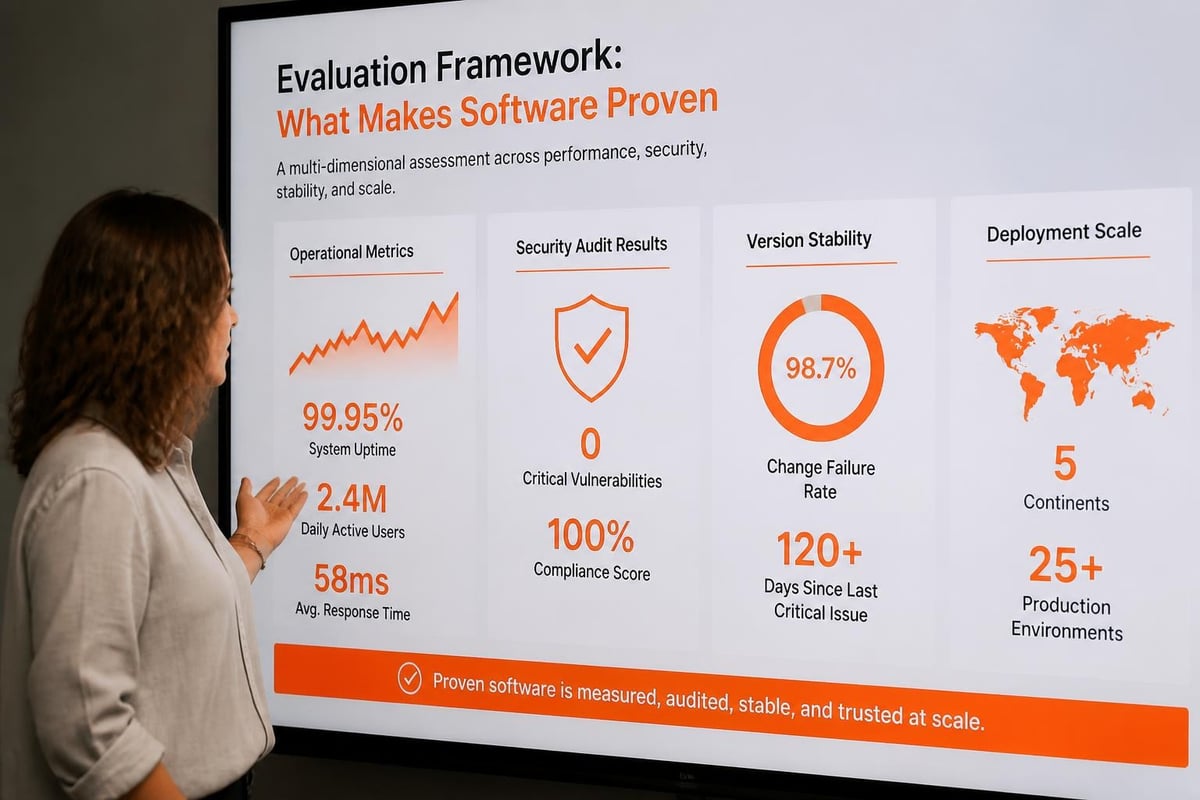
A proven system demonstrates consistent performance across documented deployments. Minimum qualification typically requires 18-24 months of production use across at least three independent organizations. Version stability matters-software with frequent breaking changes or abandoned releases fails this criterion.
Key validation metrics include:
- Uptime percentage measured across customer deployments (target: 99.5% or higher)
- Mean time between failures (MTBF) for core functions
- Support ticket resolution rates and average response times
- Security incident history including disclosed vulnerabilities and patch timelines
Certification and Compliance Documentation
Proven software maintains current compliance certifications relevant to its industry applications. ISO 27001 certification demonstrates information security management. SOC 2 Type II reports verify security, availability, and confidentiality controls. Industry-specific standards like HIPAA for healthcare or PCI DSS for payment processing provide additional validation.
Third-party security audits conducted within the past 12 months indicate active maintenance. Penetration testing reports, vulnerability assessments, and code review summaries provide technical evidence of security practices.
How Organizations Validate Software Before Deployment
Software validation follows structured protocols that assess technical capability, operational fit, and vendor viability. The process combines technical evaluation with business risk assessment.
Technical Evaluation Protocol
- Architecture Review examines system design, data models, integration interfaces, and scalability mechanisms
- Performance Testing measures response times under simulated load conditions matching expected production volume
- Security Assessment reviews authentication methods, encryption standards, access controls, and audit logging
- Integration Testing validates data exchange with existing systems using production-equivalent datasets
- Disaster Recovery Verification confirms backup procedures, recovery time objectives (RTO), and recovery point objectives (RPO)
Reference implementations provide practical validation. Organizations request access to production deployments at similar-scale operations. Site visits reveal actual system usage, customization requirements, and operational workflows.
| Validation Dimension | Assessment Method | Acceptance Criteria |
|---|---|---|
| Functional Completeness | Requirements mapping | ≥95% feature coverage |
| Performance | Load testing | <2 sec response at 80% capacity |
| Security | Vulnerability scan | Zero critical, <5 high-severity findings |
| Integration | API testing | 100% data field compatibility |
| Scalability | Stress testing | Linear performance to 150% current load |
Vendor Stability Assessment
Vendor evaluation focuses on organizational sustainability and support infrastructure. Financial stability indicators include revenue growth, customer retention rates, and funding sources. Companies with 5+ years of continuous operation and positive cash flow present lower risk.
Support infrastructure includes:
- Geographic coverage of support teams across operational time zones
- Escalation procedures with defined response SLAs for severity levels
- Knowledge base depth measured by article count and search effectiveness
- User community size and activity levels in forums or user groups
Software development methodologies employed by the vendor indicate development maturity. Organizations using Agile or DevOps practices typically deliver more responsive updates and faster issue resolution.
Why Proven Software Reduces Implementation Risk
Risk reduction stems from predictable behavior, established integration patterns, and available expertise. Organizations avoid the costs associated with first-generation software issues.
Predictable Total Cost of Ownership
Proven software enables accurate TCO forecasting because implementation patterns are documented. Average deployment timelines, customization requirements, and training durations are known quantities. Hidden costs-unanticipated integrations, performance optimization, or workaround development-decrease significantly.
License models follow established patterns with transparent pricing tiers. Maintenance fees typically range 15-22% of license cost annually. Infrastructure requirements are published with specific CPU, memory, storage, and network specifications.
Established Integration Ecosystems
Mature software products maintain certified integrations with common enterprise systems. Pre-built connectors for ERP platforms, authentication services, data warehouses, and reporting tools eliminate custom development. API documentation includes code examples, error handling patterns, and rate limit specifications.
For businesses managing service operations, proven solutions like Brytend Service Module offer structured approaches to track equipment, schedule maintenance, and document work history. These systems provide serialized inventory tracking, automated service reminders, and certificate generation-capabilities refined through production use across multiple organizations.

Steps to Implement Proven Software in Production Environments
Implementation follows phased deployment methodologies that minimize operational disruption. Structured approaches align with common software development methodologies adapted for enterprise software rollout.
Phase 1: Requirements Mapping and Gap Analysis
Document current workflows, data structures, and integration points. Map existing processes to software capabilities. Identify gaps requiring configuration, customization, or process modification.
Create a requirements traceability matrix linking business needs to system features. Rate each requirement by criticality: must-have, should-have, or nice-to-have. Proven software typically satisfies 90-95% of must-have requirements without customization.
Phase 2: Pilot Deployment with Limited Scope
- Select pilot group representing 5-10% of total users across diverse roles
- Configure test environment mirroring production infrastructure specifications
- Migrate subset of production data following vendor-recommended procedures
- Execute user acceptance testing (UAT) with documented test cases
- Measure performance metrics against baseline requirements
- Collect user feedback through structured surveys and usage analytics
Pilot duration typically runs 4-8 weeks depending on system complexity. Success criteria include <5% critical defects, >80% user satisfaction scores, and performance meeting SLA targets.

Phase 3: Full Production Rollout
Execute deployment in waves based on business unit, geography, or functional area. Each wave follows the pilot validation process at reduced intensity. Maintain parallel operations during transition periods to enable rollback if critical issues emerge.
Deployment activities include:
- Data migration with validation checksums and reconciliation reports
- User training through role-based sessions with hands-on exercises
- Integration activation following tested sequences to maintain system dependencies
- Monitoring setup with alerting thresholds for performance, errors, and usage patterns
Common Challenges in Proven Software Adoption
Despite maturity advantages, proven software presents specific implementation challenges. Recognizing these issues enables proactive mitigation.
Customization Versus Configuration Trade-Offs
Proven software prioritizes configurability over customization to maintain upgrade paths. Organizations accustomed to bespoke solutions face constraints. Excessive customization creates technical debt, complicates upgrades, and increases maintenance costs.
Best practice limits customizations to <10% of system functionality. Configuration options-workflows, field definitions, permissions, reports-should address 90% of requirements. Document all customizations with business justifications and technical specifications.
Legacy System Integration Complexity
Older enterprise systems may lack modern API capabilities. Proven software typically supports REST APIs, webhooks, and standard data formats (JSON, XML). Legacy systems using proprietary protocols or batch file exchanges require middleware or integration platforms.
Integration approaches include:
| Method | Use Case | Complexity | Maintenance |
|---|---|---|---|
| Native API | Real-time data sync | Low | Low |
| Middleware Platform | Multiple system orchestration | Medium | Medium |
| Custom Connector | Proprietary protocols | High | High |
| Scheduled ETL | Batch data transfer | Medium | Low |
User Adoption and Change Management
Technical success does not guarantee user adoption. Proven software often introduces standardized workflows that differ from established practices. Resistance emerges when efficiency gains are not immediately apparent.
Effective change management includes executive sponsorship, early adopter identification, and role-specific value demonstrations. Training programs should emphasize workflow improvements rather than feature lists. Case studies from similar implementations provide peer validation that reduces adoption friction.
How to Optimize Proven Software for Specific Business Needs
Optimization balances standard functionality with organization-specific requirements. The process follows iterative refinement rather than upfront customization.
Performance Tuning Based on Usage Patterns
Monitor system performance during the first 90 days of production use. Identify slow queries, inefficient workflows, and resource bottlenecks. Database indexing, caching strategies, and query optimization address most performance issues without code changes.
Proven software vendors provide performance tuning guides specific to deployment scale. Reference architectures for small (<100 users), medium (100-1,000 users), and large (>1,000 users) deployments specify infrastructure requirements and configuration parameters.
Workflow Configuration Alignment
Map actual user workflows to configured system processes. Identify steps that add no value or create unnecessary friction. Proven software includes workflow engines that support conditional logic, automated actions, and approval routing.
Optimization techniques:
- Eliminate redundant data entry through integration with authoritative systems
- Automate routine decisions using business rules and triggers
- Parallelize independent tasks to reduce cycle times
- Implement role-based views that surface relevant information only
Security Hardening for Industry Requirements
Apply security configurations beyond default settings. Enable multi-factor authentication, implement IP whitelisting, configure session timeouts, and enforce password complexity. Role-based access control (RBAC) should follow least-privilege principles.
Industry-specific requirements demand additional controls. Healthcare applications require HIPAA-compliant audit logging. Financial services need data encryption at rest and in transit. Manufacturing environments may require network segmentation between operational technology (OT) and information technology (IT) systems.
Proven Software Versus Custom Development Trade-Offs
Organizations face build-versus-buy decisions when proven software does not perfectly match requirements. The comparison requires TCO analysis beyond initial acquisition costs.
Development Timeline and Risk Comparison
Custom development timelines range 12-36 months for enterprise applications. Proven software deploys in 3-9 months including configuration and integration. Custom solutions require specification, design, development, testing, and deployment phases-each introducing potential delays and scope changes.
Research on software project success factors indicates that project management practices significantly influence outcomes. Custom projects face higher risk of budget overruns (average 45% over initial estimates) and schedule delays (average 7 months beyond planned timelines).
| Dimension | Proven Software | Custom Development |
|---|---|---|
| Time to Production | 3-9 months | 12-36 months |
| Initial Cost | $50K-$500K | $200K-$2M+ |
| Annual Maintenance | 15-22% license cost | 20-30% development cost |
| Upgrade Path | Vendor-managed | Internal resources |
| Feature Risk | Known limitations | Scope creep |
Long-Term Maintenance Considerations
Proven software vendors provide regular updates, security patches, and feature enhancements. Maintenance costs are predictable and typically decline as a percentage of TCO over time. Custom applications require dedicated development resources for bug fixes, security updates, and compatibility maintenance.
Technology obsolescence affects custom solutions more severely. Frameworks, libraries, and platforms evolve-custom code requires periodic refactoring. Proven software vendors manage these transitions, providing upgrade paths and migration tools.
Case Example: Manufacturing Service Management Implementation
A mid-size equipment manufacturer with 12 service centers implemented proven service management software to replace spreadsheet-based tracking. The deployment covered 450 serialized assets across customer sites, 28 service technicians, and approximately 2,800 service events annually.
Implementation Approach
The organization selected software with documented deployments in similar manufacturing environments. Pilot deployment at two service centers ran for six weeks, processing 180 service events. Configuration included custom service types, preventive maintenance schedules, and integration with existing ERP inventory systems.
Measurable Outcomes
- Service certificate generation time decreased from 45 minutes to 8 minutes per event
- Asset service history retrieval improved from next-day to real-time access
- Preventive maintenance compliance increased from 67% to 94% within six months
- Customer complaint resolution time decreased 31% through faster information access
The proven software approach enabled deployment completion in five months versus 18-month estimates for custom development. Documented integration patterns with the manufacturer's ERP system eliminated three months of custom connector development.
Best Practices for Proven Software Selection and Deployment
Successful implementations follow structured evaluation and deployment practices. These patterns emerge consistently across industries and application types.
Selection Criteria Weighting
Establish weighted selection criteria before vendor evaluation begins. Technical capability typically weights 40-50% of total score. Vendor stability and support infrastructure accounts for 25-30%. Cost considerations including TCO represent 20-25%. User experience and training requirements add final 10-15%.
Conduct proof-of-concept exercises with top two candidates using production-equivalent data volumes. Test core workflows, integration scenarios, and reporting requirements. Allocate 2-4 weeks for meaningful evaluation.
Deployment Governance Structure
Establish a steering committee with executive sponsorship, business stakeholders, IT leadership, and implementation team representation. Weekly meetings during active deployment phases maintain momentum and resolve decisions quickly.
Define clear decision authority for:
- Scope changes requiring business case justification and impact assessment
- Customization approvals limited to documented business-critical requirements
- Go-live criteria with measurable acceptance thresholds
- Issue escalation with severity definitions and response timeframes
Post-Deployment Optimization Cycles
Plan 90-day optimization reviews following production deployment. Collect quantitative metrics (system performance, error rates, usage patterns) and qualitative feedback (user satisfaction, workflow efficiency, pain points).
Implement improvements in monthly release cycles. Prioritize high-impact, low-effort enhancements first. Document all configuration changes with business rationale and technical specifications. Maintain a roadmap of planned enhancements aligned with business objectives.
Proven software delivers the highest value when organizations treat implementation as a continuous improvement process rather than a one-time project. Vendor-provided updates should be evaluated quarterly and deployed based on business value and technical risk assessment.
Selecting and implementing proven software requires systematic evaluation of operational track records, vendor stability, and organizational fit. Organizations that follow structured validation protocols, phased deployment methodologies, and continuous optimization practices achieve measurable improvements in operational efficiency and risk reduction. Brytend specializes in developing custom software solutions when proven options do not address specific business requirements, combining technical expertise across web, mobile, and cloud platforms with ongoing support to ensure reliable production performance.