Sales intelligence tools collect and combine data about companies and people so that a sales team knows who to contact, why and when. They find companies that match your ideal customer, enrich them with details such as size, location and contacts, and watch for buying signals like new vacancies, new locations, public tenders or visits to your website. The best tools connect directly to your CRM, so a signal turns into a follow-up instead of another spreadsheet. For B2B companies in Europe, it also matters that the tool respects the GDPR and works with local sources.
TL;DR:
- Sales intelligence tools help you find the right companies, understand them and contact them at the right moment
- The core features are prospect search, data enrichment, buying signals, website visitor identification and CRM sync
- Buying signals such as vacancies, new sites, certificates, tenders and website visits matter more than large contact databases
- Website visitor identification at company level can work without cookies or storing IP addresses
- Choose a tool on data quality for your region, signal relevance, GDPR compliance and how well it fits your CRM
Sales intelligence is the process of collecting and analysing information about prospects and customers to support B2B sales decisions.
What Are Sales Intelligence Tools?
Sales intelligence tools are software that gathers information about potential and existing customers from many sources and puts it in front of the sales team in a usable form. Instead of a salesperson spending an hour researching one company on its website, LinkedIn and news sites, the tool does it for hundreds of companies and highlights the ones worth a call today.
They answer three questions:
- Who should we sell to? Companies that match our best customers.
- Why would they buy now? Signals that show a need or a change.
- How do we reach them? The right contact person, and a reason to get in touch.
Sales intelligence is different from a CRM. A CRM stores what you already know about your relationships. A sales intelligence tool brings in what you do not know yet, and then hands it to the CRM. You can read a general description of sales intelligence.
What Features Should a Sales Intelligence Tool Have?
| Feature | What it does | Why it matters |
|---|---|---|
| Prospect search | Finds companies by industry, size, region, keywords | Builds a target list in minutes |
| Lookalike search | Finds companies similar to your best customers | Targets proven profiles |
| Data enrichment | Adds contacts, branches, software used, certificates | Better qualification without manual research |
| Buying signals | Tracks vacancies, new locations, news, changes | Tells you when to call |
| Website visitor identification | Shows which companies visited your website | Reveals interest you would not see otherwise |
| Tender tracking | Finds public tenders that match your offer | Opens public sector work |
| Competitor monitoring | Watches competitors and who mentions them | Spots switching opportunities |
| Outreach | Sends personal e-mails with follow-ups | Turns a signal into a conversation |
| CRM sync | Pushes prospects and activity to the CRM | No double entry, no lost leads |
Which Buying Signals Matter Most in B2B Sales?
A buying signal is an event that suggests a company may need what you sell soon. Large contact databases are easy to buy; good signals are what make the difference. For companies that sell equipment, service or software to other businesses, these signals tend to work best:
- Vacancies: a company hiring service technicians, a quality manager or a planner is growing or struggling to keep up
- New locations: a new branch or warehouse needs equipment, service contracts and systems
- Certificates: a company working towards ISO 9001, ISO 27001 or VCA needs processes and software to support it
- Software changes: a company that drops or adds a tool is open to alternatives
- Public tenders: a published tender is a buying signal with a deadline
- Website visits: a company reading your pricing or product pages is already looking
- Competitor mentions: a prospect naming a competitor on its website tells you what it uses today
Signals are most useful when they are combined into a score. One vacancy means little; a vacancy plus a new location plus two visits to your pricing page in one week is a reason to call today.
How Does Website Visitor Identification Work?
Website visitor identification shows which companies visited your website. It usually works by matching the network a visitor comes from to the company that owns it. Larger companies often have their own network ranges, so a visit from that network can be linked to the company, not to a person.
There are two important limits. First, it only works for company networks: someone working from home or on a mobile connection cannot be matched. Second, in Europe you need to be careful with personal data. A privacy-friendly approach identifies companies only, uses no tracking cookies, and does not store visitors’ IP addresses. Ask any supplier exactly what they store and on what legal basis before you install their code.
How Does Tender Tracking Fit Into Sales Intelligence?
Public organisations in the EU publish tenders above certain thresholds on TED (Tenders Electronic Daily), and many countries have their own platforms, such as TenderNed in the Netherlands. Searching these portals by hand is slow. A sales intelligence tool with tender tracking checks them against a profile of what you offer and links each buyer to your prospects or existing customers, so you see straight away whether you already know the organisation.
How Do You Choose a Sales Intelligence Tool?
1. Check data quality for your market
Many well-known tools are strong in North America and thin in Europe. Test with a list of companies you know well in your own region and see how complete and correct the data is.
2. Look at the signals, not the database size
Millions of contacts do not help if the signals do not fit your business. Ask which signals the tool tracks and how often it refreshes them.
3. Check GDPR compliance
Ask what personal data is stored, where, on what legal basis, and how opt-outs and consent are handled. Outreach should always include a clear opt-out.
4. Make sure it fits your CRM
A separate tool that does not sync with your CRM creates double work and lost follow-ups. Prospects, signals and outreach should land where your team already works.
5. Count the real cost
Many tools charge per user plus per credit for contacts or enrichment. Calculate the cost for your team at realistic usage, not the starter plan.
How Does Brytend Growth Intelligence Work?
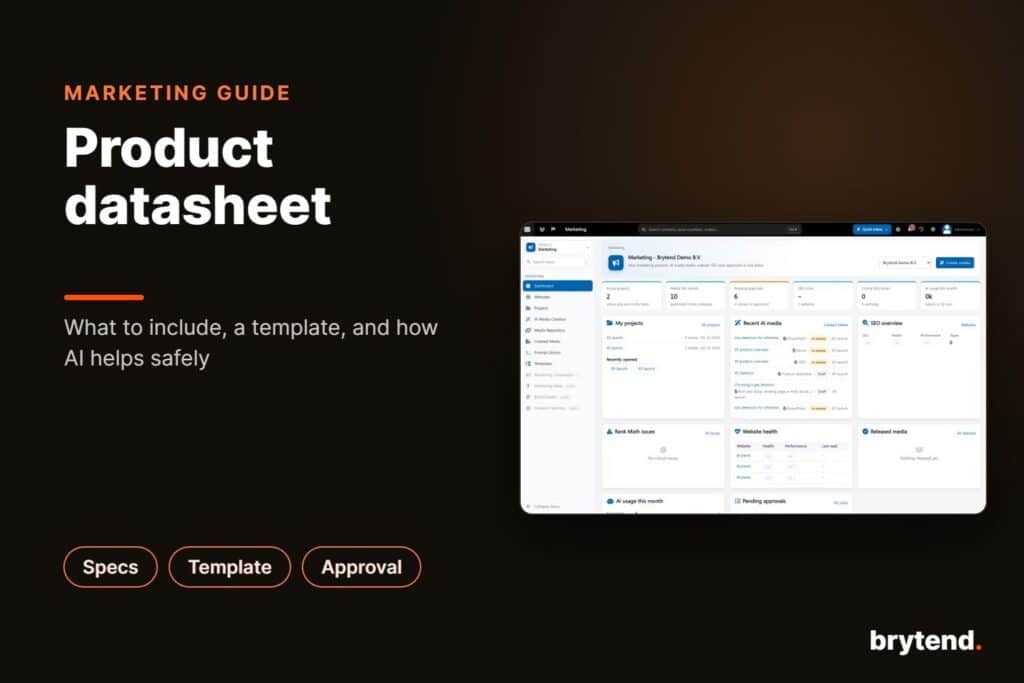
Growth Intelligence is part of the Brytend Marketing module and works on the same database as the Brytend CRM. You describe the companies you are looking for in a sentence, the AI turns it into filters you can check and adjust, and the search runs. You can also ask for companies similar to an existing CRM customer.
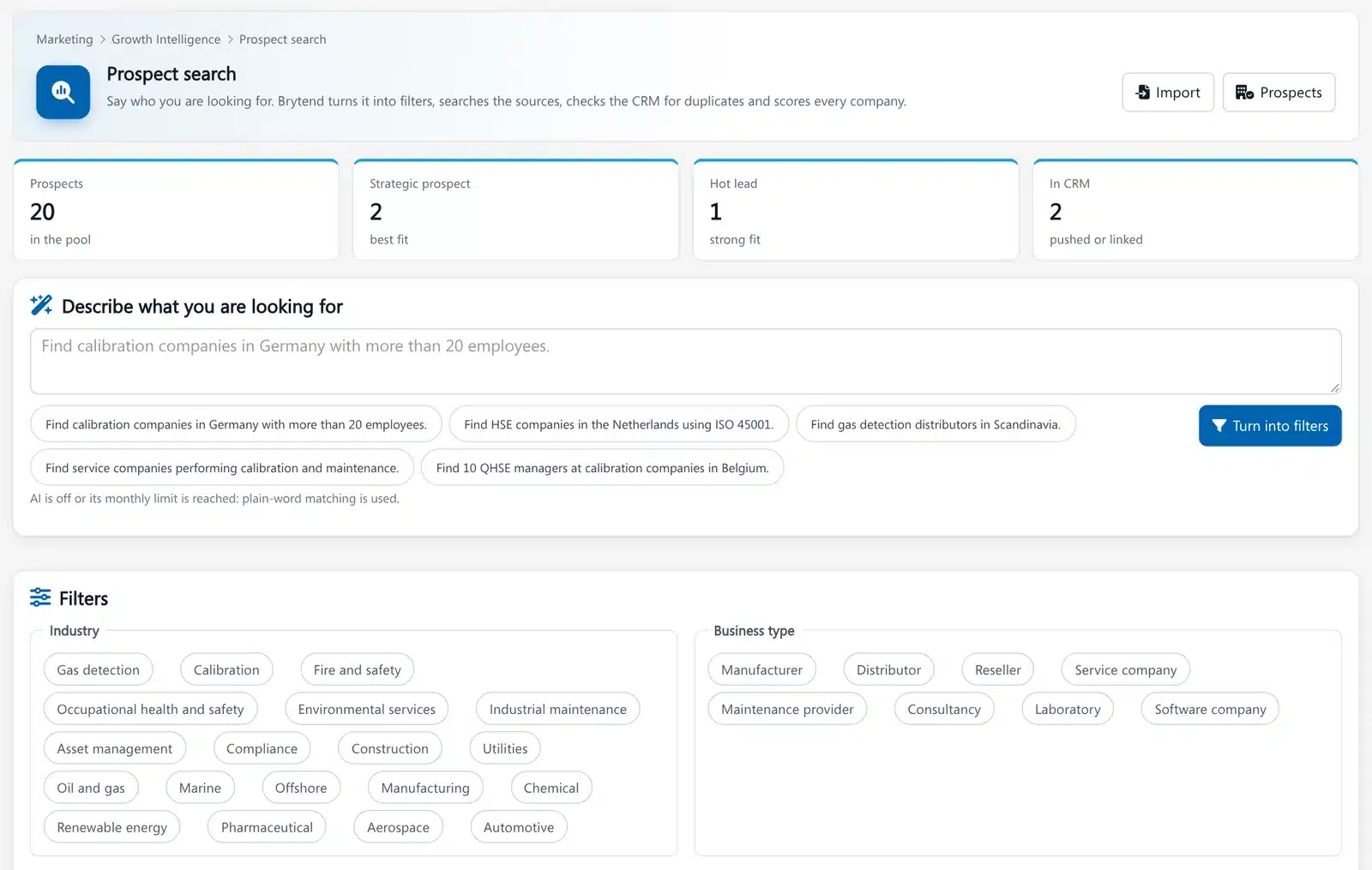
- Prospect pool: every company with a score, the reasons for that score, its signals, software used, people with consent status and whether it is already in the CRM
- Signals timeline: new vacancies, new locations, certificates, software changes, replies, website visits, tenders and competitor changes in one stream
- Website visitors: companies that visited your website, matched to prospects and CRM, using company networks only, with no cookies and no IP addresses kept
- Tenders: public tenders from TED and TenderNed that match your tender profile, with the buyer linked to your prospects or CRM
- Account growth: changes at existing customers, such as new branches or people not yet in your CRM
- Competitors: which prospects and customers mention your competitors, and changes on competitors’ websites
- Outreach: personal e-mails from your own mailbox, with an A/B test, one follow-up and an opt-out link
- Push to CRM: qualified prospects move to the CRM with one click, so sales follow-up happens where it always does
Once a prospect is in the CRM, the normal sales process takes over. The guides on B2B leads and qualified prospects explain how to qualify and follow up.
Frequently Asked Questions About Sales Intelligence Tools
What are sales intelligence tools?
Sales intelligence tools collect and combine data about companies and contacts so sales teams know who to contact, why and when. They offer prospect search, data enrichment, buying signals and a link to the CRM.
What is the difference between sales intelligence and a CRM?
A CRM stores what you already know about your customers and deals. A sales intelligence tool brings in new information about prospects and customers from outside sources and hands it to the CRM.
What are buying signals in B2B sales?
Buying signals are events that suggest a company may need your product soon, such as new vacancies, a new location, a certification project, a software change, a public tender or repeated visits to your website.
How does website visitor identification work?
It matches the network a visitor comes from to the company that owns it. It works for company networks only, and a privacy-friendly tool identifies companies without tracking cookies or storing IP addresses.
Are sales intelligence tools GDPR compliant?
Some are and some are not. Check what personal data the tool stores, where, on what legal basis and how opt-outs work. Company-level data and outreach with a clear opt-out reduce the risk.
How much do sales intelligence tools cost?
Prices vary widely, from tens to hundreds of euros per user per month, often with extra credits for contact data. Calculate the cost for your team at realistic usage before you choose.
What is Brytend Growth Intelligence?
Brytend Growth Intelligence is part of the Brytend Marketing module. It finds prospects from a sentence or a lookalike search, tracks signals, public tenders and website visitors, monitors competitors, sends personal outreach and pushes qualified prospects into the Brytend CRM.
Sales intelligence tools save your team hours of research and help them call the right companies at the right moment. Pick one on data quality in your region, relevant signals, GDPR compliance and a direct link to your CRM, not on database size. Brytend Growth Intelligence finds prospects, tracks signals, tenders and website visitors, and pushes the best ones straight into your CRM. Start a free 90-day trial.