Order fulfillment is the full process of receiving a customer order, picking the items, packing them, shipping them and handling any return. Done well, it gets the right product to the right customer on time with an accurate stock record behind it. For distributors, rental companies and equipment service businesses, the process also has to produce records: which serial number went where, who approved a stock correction and which document triggered the movement.
This article covers the stages, the models, the costs and the controls that keep order fulfillment accurate as order volume grows.
What is order fulfillment?
Order fulfillment is the set of steps between a customer placing an order and the customer holding the product, plus the return path if the product comes back. It includes receiving inventory, storing it, picking and packing orders, shipping, delivery confirmation and returns.
The term sits inside the broader field of logistics but is narrower than it. Logistics covers the whole movement of goods, including inbound freight and distribution network design. Fulfillment covers what happens to one order from the moment it is accepted. Some sources use "logistic fulfillment" for the physical handling part, meaning the warehouse and transport work after an order exists.
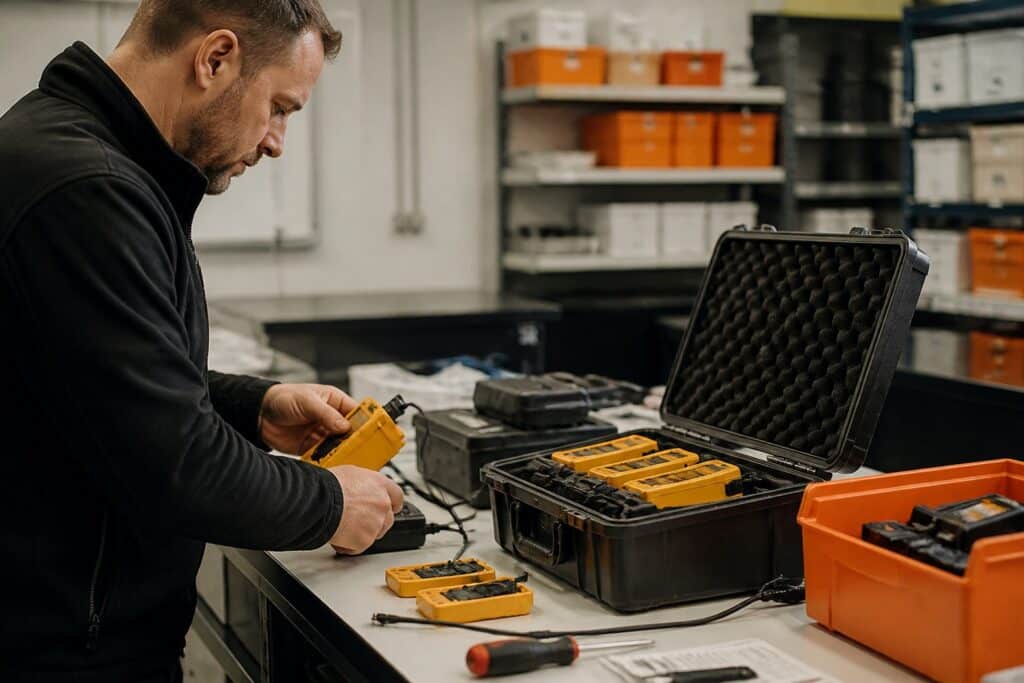
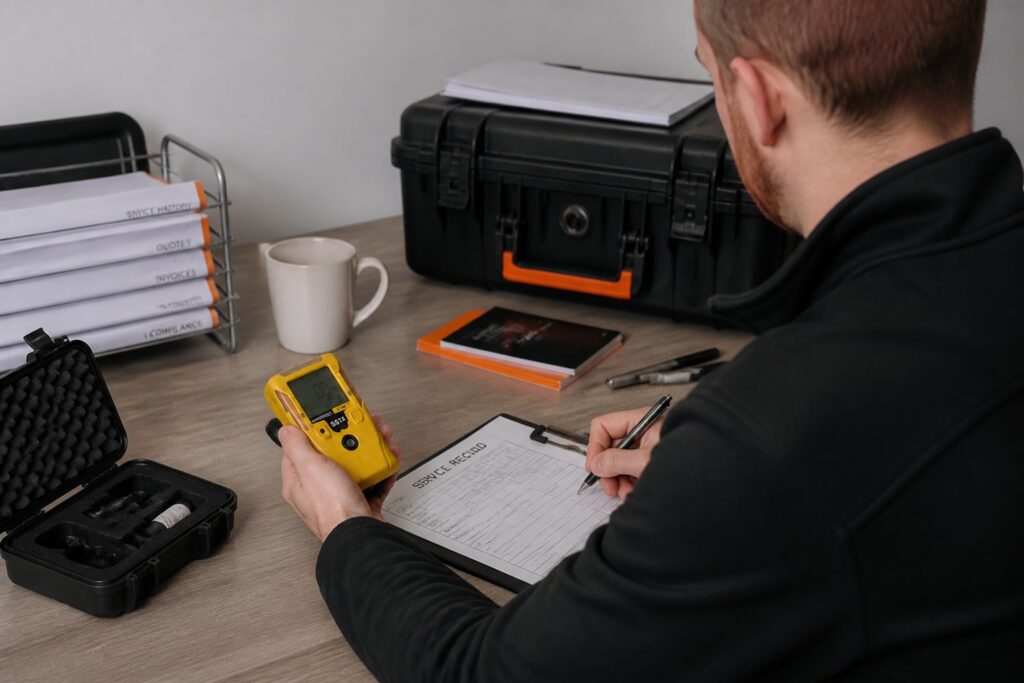
For the audiences this article addresses, an order is often more than a box of goods. A safety-equipment distributor may ship detectors, spare sensors and calibration gas in one order. A rental company may fulfill an order by issuing equipment with a return date. A service company may fulfill an order by returning a calibrated device with a certificate. The mechanics differ, but the same stages apply.
What are the stages of the order fulfillment process?
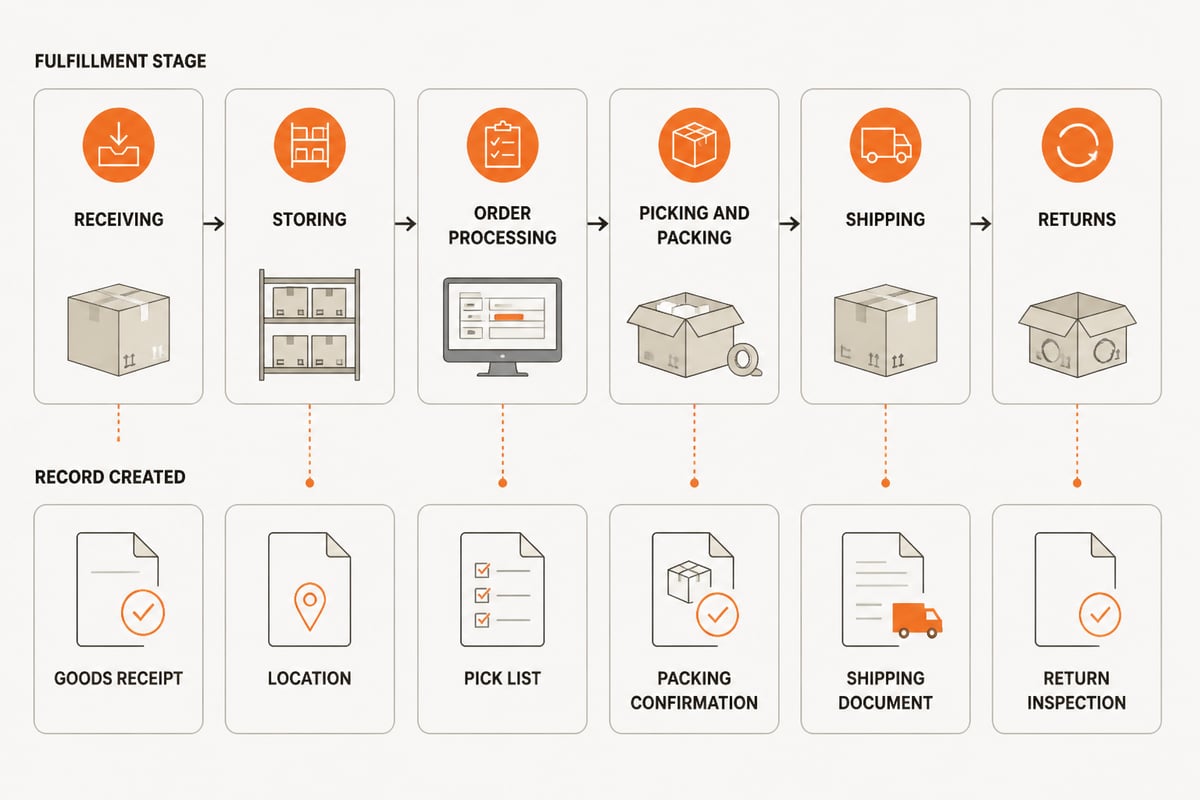
The process has six core stages: receiving, storing, order processing, picking and packing, shipping, and returns. Each stage creates a record that the next stage depends on.
- Receiving. Incoming goods are checked against the purchase order, counted and booked into stock. Errors here carry through every later stage.
- Storing. Items are assigned a location, whether a shelf, a bin or a warehouse. Serialized or batch-tracked items need their serial or lot number recorded at this point.
- Order processing. The order is validated, stock availability is confirmed and a pick instruction is created. Payment terms, customer credit status and export restrictions are checked here.
- Picking and packing. Items are collected from locations, verified against the order and packed. Scanning or serial confirmation reduces wrong-item shipments.
- Shipping. A carrier is selected, labels and shipping documents are produced and the customer receives tracking information. For regulated goods, the documents may include safety data sheets or certificates.
- Returns. The returned item is inspected, then restocked, repaired, recalibrated or written off. The stock record and the invoice both need to reflect the outcome.
How long does warehouse fulfillment take?
Warehouse fulfillment time depends on the model and the product: orders for in-stock, standard items are often picked and shipped the same day or next business day, while orders that need assembly, calibration or special documents take longer. No single figure applies across industries, so measure your own order cycle time from order acceptance to carrier handover.
Order cycle time breaks into parts you can track separately:
- Order processing time: from order entry to a released pick instruction
- Pick and pack time: from release to a sealed, labeled parcel
- Dwell time: how long the parcel waits for carrier collection
- Transit time: carrier delivery, which you influence only through carrier choice
Speed matters to buyers. In a March 2025 survey of 1,000 U.S. consumers, most identified delivery speed and reliability as influential in deciding where to buy, and many cited product availability. For a B2B equipment supplier, availability is usually the larger driver: a customer who cannot get a replacement sensor this week will order elsewhere.
Which order fulfillment model fits your business?
The right model depends on order volume, product handling needs and how much control you need over records. Four models cover most businesses.
| Model | Who handles storage and shipping | Control over stock records | Typical fit |
|---|---|---|---|
| In-house | Your own warehouse and staff | Highest | Regulated or serialized goods, specialist handling |
| Outsourced (3PL) | A third-party logistics provider | Shared, depends on integration | High volume, standard goods, multi-region shipping |
| Dropshipping | The supplier ships directly to the customer | Lowest | Low-risk catalog items, no stock held |
| Hybrid | A mix, such as in-house for core lines and 3PL for overflow | Varies by product line | Growing distributors with seasonal peaks |
In-house fulfillment suits businesses that handle items needing traceability. A company shipping gas detectors, cylinders or SCBA components needs serial numbers, batch references and compliance documents tied to each shipment, which is easier when the warehouse and the records live in the same system.
Outsourcing reduces fixed cost but moves a part of your records to someone else's system. If you outsource, define how stock levels, serial numbers and return outcomes sync back to your own records, and who owns the data.
What does order fulfillment cost?
Order fulfillment cost is the sum of storage, labor, packaging, shipping, software and return handling, divided across the orders you ship. The shares differ by business, so build the figure from your own ledger rather than a published average.
The main cost lines are:
- Storage: rent or per-pallet fees, plus shelving, climate or hazardous-goods requirements
- Labor: receiving, picking, packing and returns processing
- Packaging: boxes, fill material, labels and any regulated-goods packaging
- Shipping: carrier charges, surcharges and insurance
- Technology: warehouse or inventory software, scanners, integrations
- Returns and write-offs: inspection time, restocking, repair and disposal
Returns deserve their own line because they are large in aggregate. The National Retail Federation projected that consumers would return a smaller share of purchases in 2025 than in 2024, with merchandise returns falling from $890 billion in 2024 to $849.9 billion in 2025. Those figures describe consumer retail, not B2B equipment, but they show why the return path belongs in any cost model.
Cash flow is a cost too. Businesses that must buy stock before a large customer order is paid sometimes use purchase order funding to cover the gap between supplier payment and customer payment. Whether that suits you depends on margin and terms.

What goes wrong in order fulfillment, and how do you prevent it?
Most fulfillment failures trace to inaccurate stock records, unclear handoffs between stages and missing audit trails. Growth makes each of these worse. A March 2025 Radial survey of 200 retailers found that many considered managing growth with their existing fulfillment strategy a significant challenge.
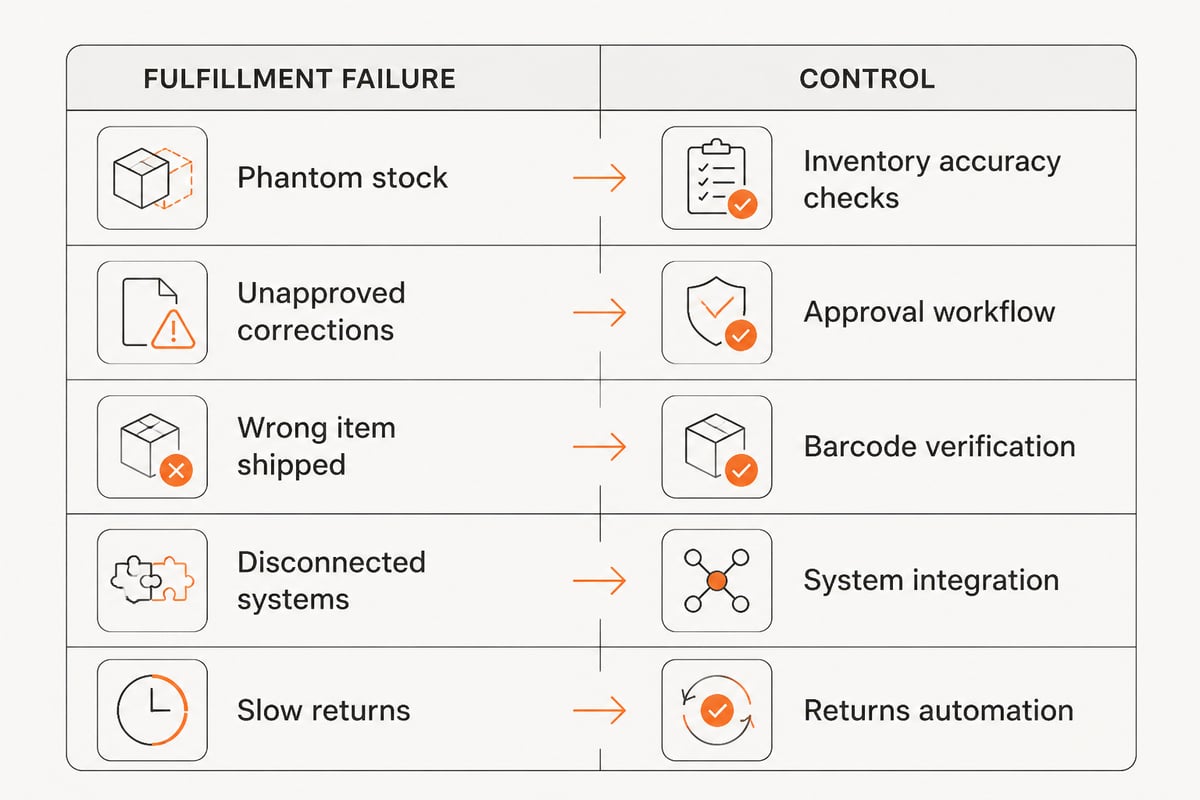
The common failure points and their controls:
- Phantom stock: the system shows items that are not on the shelf. Control it with cycle counts and by recording every stock change with a reason, a user and a source document.
- Unapproved corrections: quiet adjustments hide shrinkage and errors. Require approval for corrections above a set limit.
- Wrong item or wrong serial shipped: scan items at pick and at pack, and confirm serial numbers for tracked goods.
- Disconnected systems: the webshop, the warehouse and accounting each hold a different stock figure. A single platform where customers, devices, documents and stock share one data set removes the reconciliation work.
- Slow returns: returned goods sit uninspected and unsellable. Set a defined inspection step and a clear outcome code: restock, repair, recalibrate or scrap.
How does an equipment service company run order fulfillment?
A service company fulfills an order by receiving customer equipment, servicing it, documenting the work and returning it with the right paperwork and invoice. The same stage logic applies, with extra steps for testing and records.
Here is a realistic workflow for a company servicing portable gas detectors:
- Order intake. A customer places a service order for 12 detectors. The order is linked to the customer record and each device's serial number.
- Receiving. Devices arrive and are booked in against the order. Missing or extra units are flagged on the day of receipt.
- Parts check. The system confirms that replacement sensors and calibration gas are in stock. Shortages trigger a purchase request before work starts.
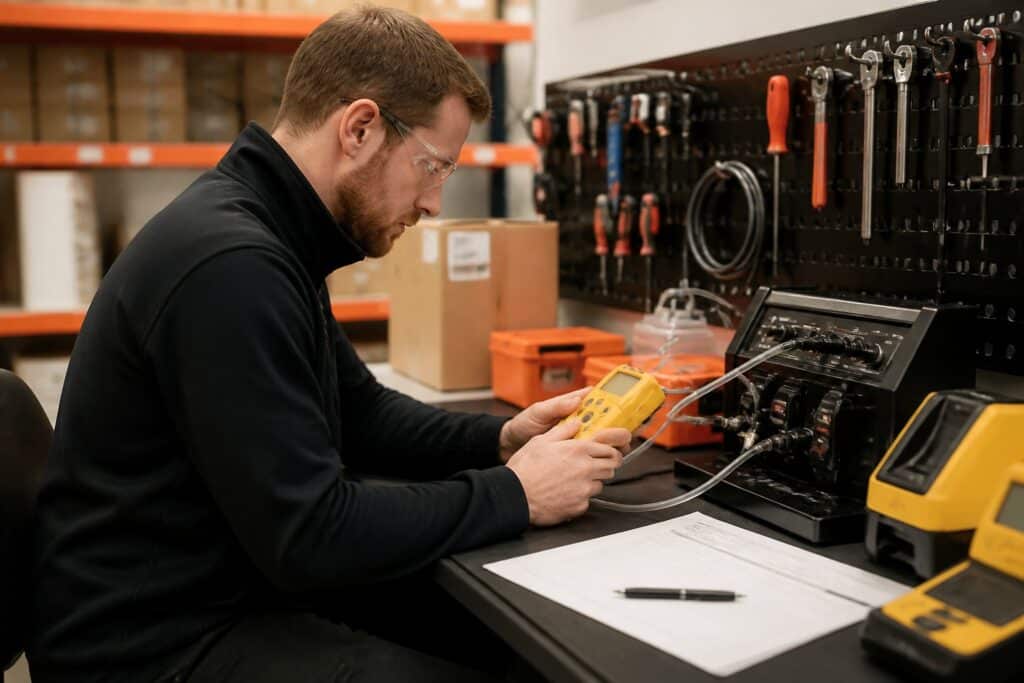
- Service and calibration. Technicians test each device and record the results. Gas tests are checked against your own limits, so a pass or fail is decided by your rules and not by memory.
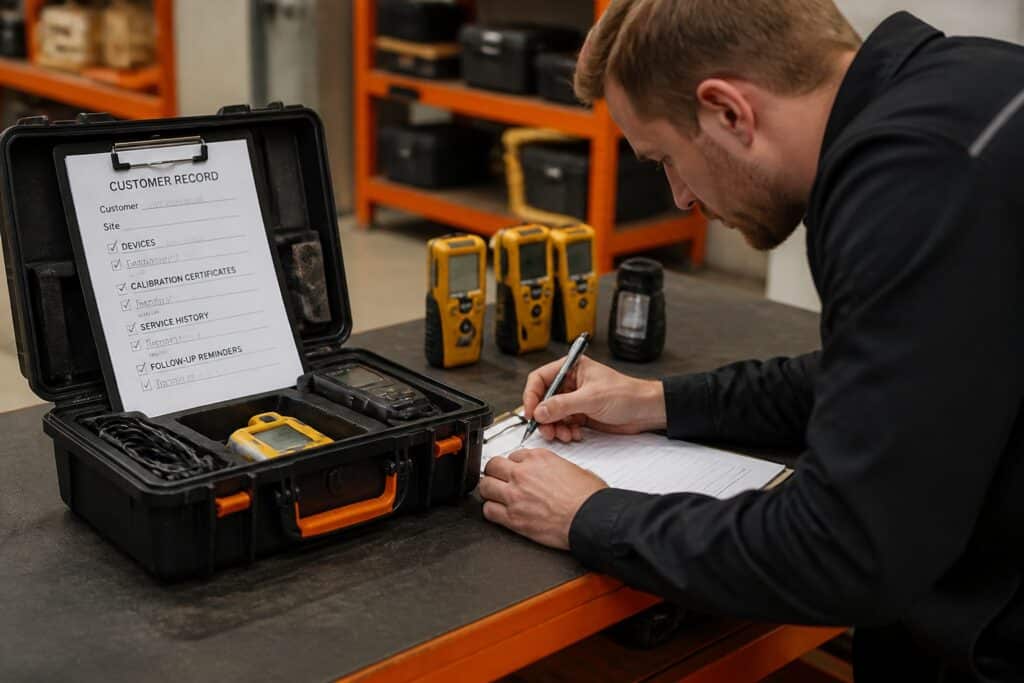
- Documentation. Calibration certificates and service records are attached to each device history.
- Stock consumption. Parts and gas used are deducted from stock, each with a reason, a user and the source work order.
- Shipping. Devices are packed and returned with certificates.
- Invoicing. The invoice is built from the work already registered, so nobody retypes line items. Brytend supports Peppol BIS Billing 3.0 e-invoicing for this step.
Linked modules make this practical: work order management holds the job, calibration management holds the test results, and inventory control holds the stock movements. For gas detection specifically, see portable gas detection service.
What does a fulfillment coordinator do?
A fulfillment coordinator owns the flow of orders from acceptance to delivery and resolves exceptions along the way. The role sits between sales, the warehouse and customer service.
Typical duties:
- Releasing orders to the warehouse and confirming stock is available
- Chasing late inbound goods and back-ordered items
- Selecting carriers and resolving shipping exceptions
- Monitoring order cycle time and flagging delays
- Handling returns, credits and replacement shipments
- Keeping customers informed of status changes
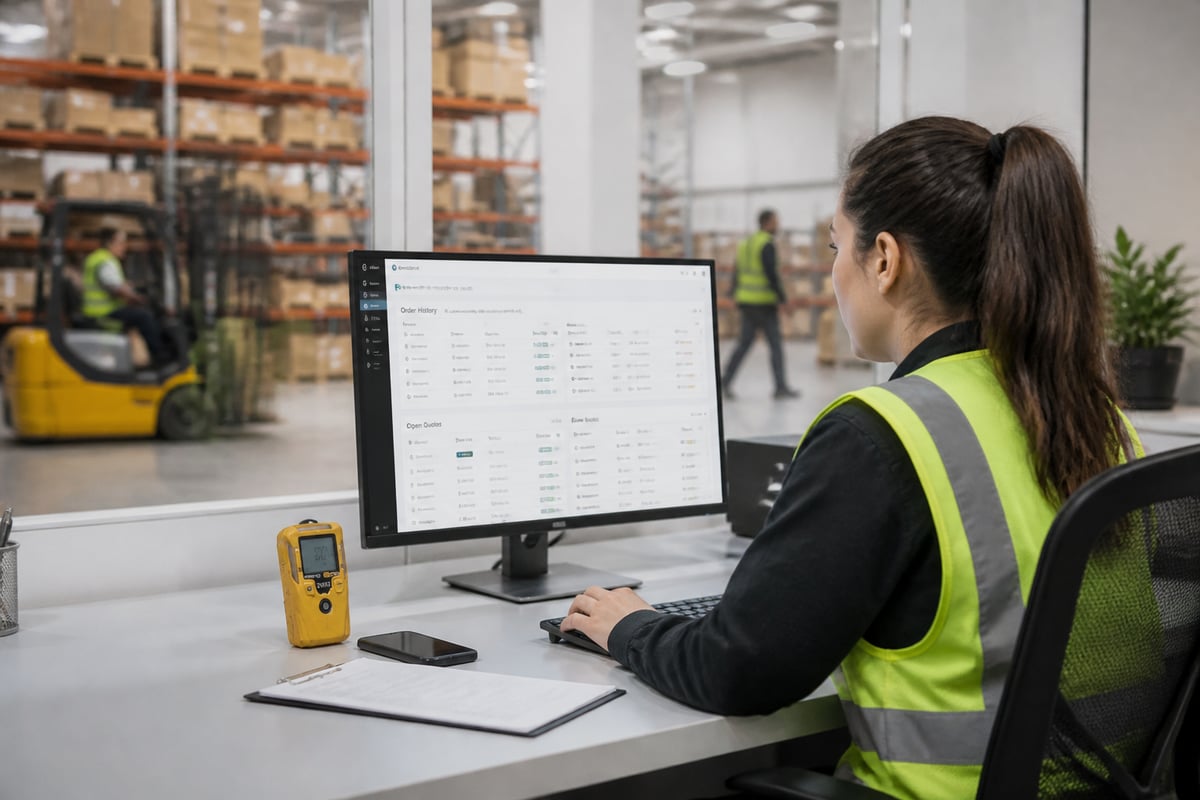
The coordinator is only as effective as the data available. If order status, stock levels and customer history sit in separate tools, most of the day goes to looking things up. A shared customer record helps, and a CRM that ties inquiries, quotes and orders together removes much of that lookup work. Brytend's CRM keeps lead forms, questionnaires and customer history in one place, so the coordinator sees the full context of an order without switching tools.
How do you improve order fulfillment?
Improve order fulfillment by fixing record accuracy first, then speeding up the physical steps, then measuring results. Speed gained on top of bad data only produces faster errors.
- Audit your stock record. Compare system quantities with physical counts by location and note where they diverge and why.
- Require a reason on every stock change. Source document, user and reason make shrinkage and process gaps visible.
- Set approval limits for corrections. Small adjustments proceed, large ones need sign-off.
- Standardize pick and pack. Use scanning, fixed locations and a verification step before sealing the parcel.
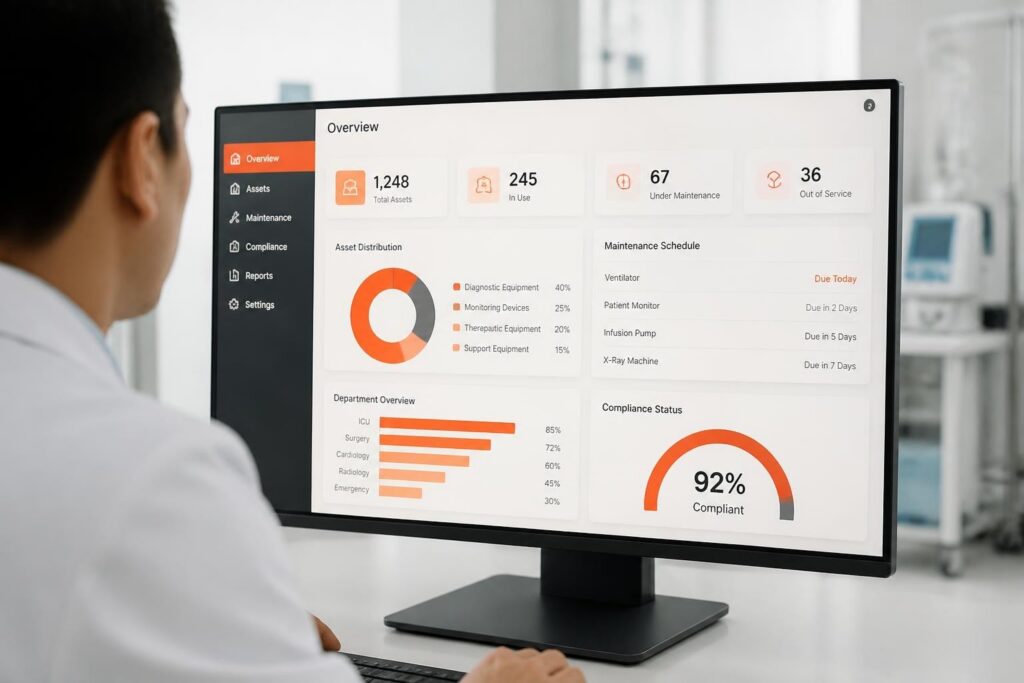
- Connect the systems. Webshop, warehouse, service and invoicing should read from one data set. A warehouse management and inventory management setup that shares customers, devices and documents avoids duplicate entry.
- Define return outcomes. Every returned item gets one of a short list of dispositions, and each disposition updates stock and accounting automatically.
- Track a few metrics. Order cycle time, order accuracy, on-time shipment rate and return rate are enough to start. Review them weekly.
Branded packaging and uniforms also touch the customer experience at the delivery end. If your warehouse and field staff wear company gear, embroidered workwear is one practical way to make staff identifiable on site and at customer premises.
Businesses with custom requirements, such as serialized goods, compliance documents or mixed rental and sales stock, often find off-the-shelf tools stop short. Custom development can close those gaps, and Brytend's software solutions page describes the approach.
FAQ
Is order fulfillment the same as shipping?
No. Shipping is one stage of order fulfillment, the handover of a packed order to a carrier. Fulfillment also includes receiving, storage, order processing, picking, packing and returns.
What is the difference between fulfillment and distribution?
Distribution moves goods in bulk through a supply network, for example from a manufacturer to regional warehouses. Fulfillment handles individual customer orders, from pick to delivery and returns.
Should a small distributor outsource order fulfillment?
Outsource when order volume is steady and products need no special handling or traceability. Keep fulfillment in-house when you ship serialized goods, need compliance records tied to each shipment, or want direct control of stock data.
Start by counting one storage location this week and compare the result with your system, because that gap shows how reliable your fulfillment data is. Brytend builds custom software for service, rental and distribution companies, with stock changes recorded by reason, user and source document, ISO 9001 and ISO 27001 certification, and EU hosting. To see how one platform can connect your orders, stock, service records and invoices, start your free trial with Brytend and test it on your own workflow.