Software solutions are applications, platforms and custom-built tools that run a business process such as service, inventory, CRM or invoicing. For gas detection suppliers, service companies and calibration labs, the right software solutions keep every serviced device, test result and certificate in one traceable record, so compliance evidence exists the moment the work is finished.
Software solutions fall into two broad groups: ready-made products you configure, and custom software built around your own workflow. Most service firms end up with a mix of both, and this article explains how to choose.
What are software solutions for gas detection service companies?
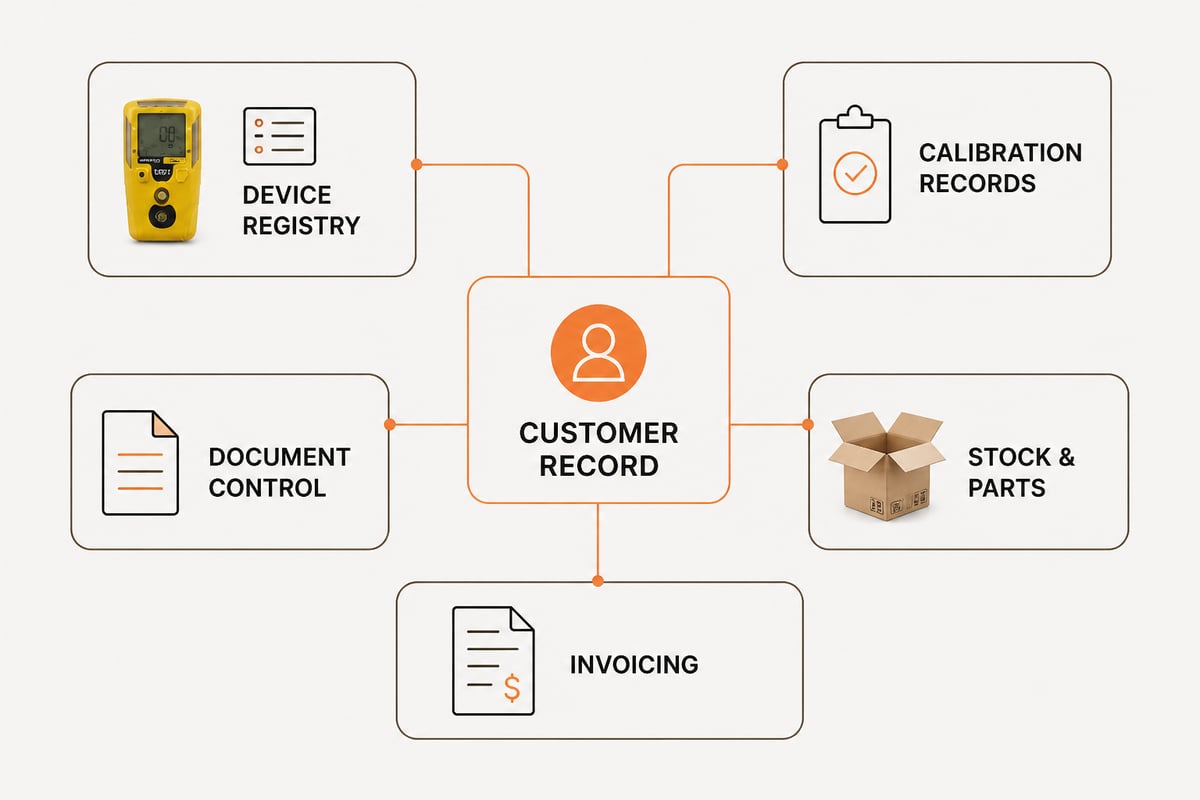
Software solutions for a gas detection service company are systems that register customer equipment, schedule and record calibration and bump tests, store certificates, track stock and parts, and produce invoices from the registered work. The goal is a single audit trail from device intake to certificate to invoice.
A service firm usually needs these functions:
- Device registry: serial numbers, sensor types, calibration intervals and ownership history.
- Service and calibration records: test values, gas lot numbers, reference equipment and technician sign-off.
- Document control: certificates, procedures and revision history.
- Stock and parts: calibration gas, sensors and filters, with every change explained.
- Billing: invoices built from completed work, not retyped.
Brytend's pages on gas detection service software and gas testing software cover these workflows in depth, so this article stays on how to select and combine software solutions.
What are the two types of software?
The two basic types of software are system software, which runs the hardware (operating systems, drivers), and application software, which performs business tasks (CRM, ERP, calibration records). Business software solutions belong to the second type.
Within application software, buyers usually choose between three delivery models:
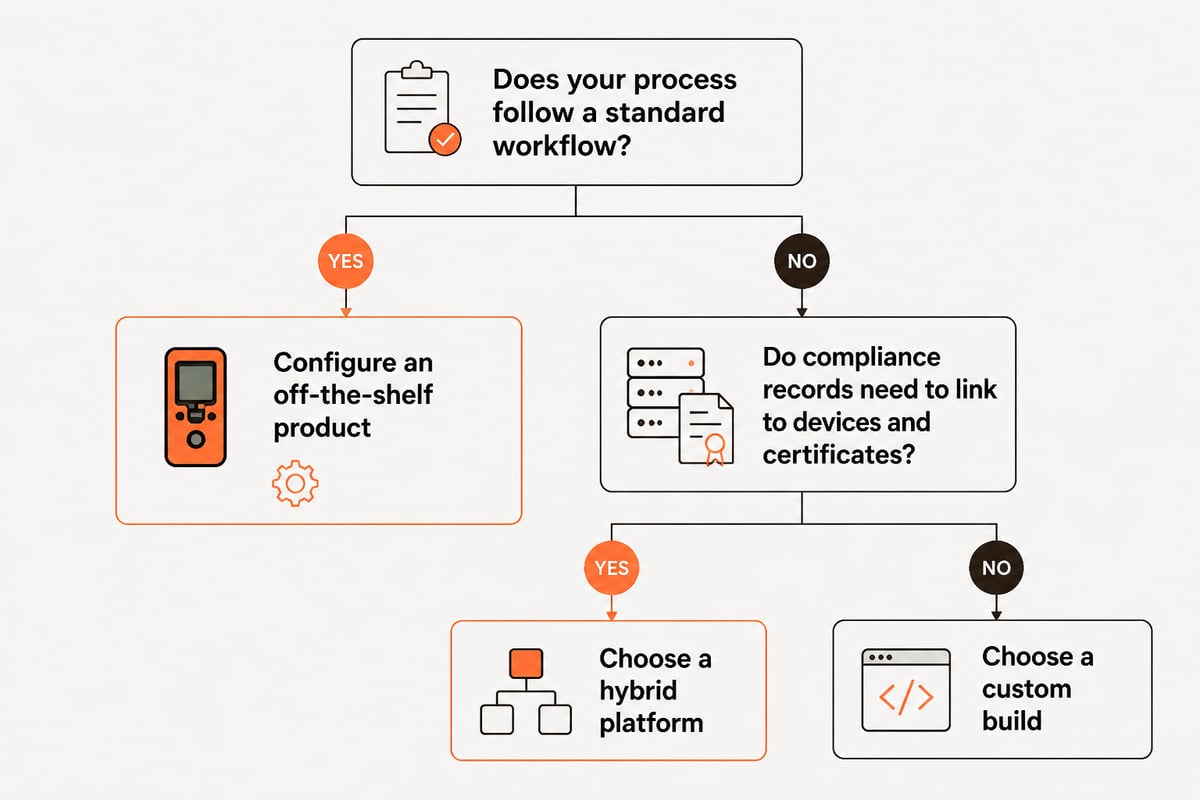
- Off-the-shelf products that you configure, such as a CRM or ERP suite.
- Custom software written to match your workflow and terminology.
- Hybrid platforms that combine ready-made modules with custom development and API integrations.
Brytend describes its enterprise software development services as the hybrid model: custom development combined with ready-made modules and REST API integrations, as listed on its page. A gas detection service lab has tasks that generic tools rarely cover, such as checking a gas test against your own limits or issuing a clearance only when the air is safe. That is the usual reason to move from a generic product toward a hybrid one.
Which software solutions should a growing service business compare?
A growing service business should compare four established products and one hybrid platform: Odoo, Odoo Success Packs, HubSpot Smart CRM, Salesforce Starter Suite, and Brytend's modules. The first four are general-purpose business tools. None is built for calibration records out of the box, so each needs configuration or custom work for compliance evidence.
1. Odoo ERP and CRM
Odoo ERP and CRM is a modular business suite from Odoo S.A. covering CRM, eCommerce, accounting, inventory and project management.
- Plans: the One App Free plan costs $0 and includes one app with unlimited users. Standard and Custom plans include all apps, hosting, maintenance and support, according to Odoo’s pricing page.
- Paid pricing: US$31.10 per user per month for Standard and US$61.00 for Custom, per the same page.
- Deployment: Custom supports Odoo Online, Odoo.sh or on-premise.
- Suits: a service company that wants one ERP suite with a free entry point and can configure its own calibration and certificate workflow on top.
Verdict: broad coverage and a low entry cost, but calibration-specific records need configuration work.
2. Odoo Success Packs
Odoo Success Packs are prepaid blocks of consultant hours for implementing Odoo, covering implementation assistance, data import and customizations.
- Sizes: 4, 25, 50, 100 or 200 consultant hours, per Odoo’s packs page.
- Price range: $580 to $25,000, with a listed 15% discount on a new customer's first pack.
- Guidance: Odoo recommends a Success Pack for implementations under 50 users and a local partner above that, per its pricing configurator.
- Suits: a firm migrating device and customer data into Odoo that wants structured expert hours rather than self-configuration.
Verdict: useful for a first Odoo rollout; it adds implementation help, not new compliance features.
3. HubSpot Smart CRM
HubSpot Smart CRM manages contacts, companies and deals, with automation, reporting and integrations in one platform.
- Approximate price: $0 for the free CRM tools; paid plans start at $7 per seat per month for eligible new customers.
- Covers: contact, company and deal data, plus marketing, sales and service tools.
- Suits: the sales side of a service business, such as contract renewals and customer follow-up. It has no listed calibration, device-registry or certificate features.
Verdict: a strong sales and customer-contact layer that needs a separate system for service records.
4. Brytend CRM
Brytend CRM is a customer relationship management system with AI-driven lead forms and questionnaires that fit into your workflow.
- Platform fit: it runs on a platform where customers, devices, documents and data are shared across every module, which means a customer record connects directly to the equipment serviced for that customer.
- Certifications: ISO 9001 and ISO 27001 certified, with EU hosting and your data staying yours.
- Pricing model: Brytend's pricing page describes module-based pricing without a per-user charge, per Brytend Pricing. Check the product page for current figures.
- Suits: a service firm that wants customer management tied to its device and service records rather than held in a separate tool.

Verdict: the closest fit when CRM must share data with service and compliance records. Details are on the Brytend CRM page.
5. Salesforce Starter Suite
Salesforce Starter Suite is an entry-level CRM with account, contact and opportunity management, customizable reports and dashboards, and lead assignment and routing.
- Approximate price: $25 per user per month.
- Limit: it supports up to 66 users through the typical setup process.
- Suits: a small service company that wants customizable sales tools and may upgrade to more advanced CRM capabilities later.
Verdict: a solid sales tool; calibration and certificate tracking would need separate systems or custom work.
6. Brytend Survey Module
Brytend Survey Module builds custom forms for inspections, audits, surveys, checklists and internal assessments, with reusable templates and benchmark reporting.
- Features listed: 5- or 7-point Likert scales, webhooks, and REST API connections to BI platforms, per Brytend Survey & Forms.
- Price: €595 for the module, per Brytend's pricing page.
- Suits: a service lab that needs its own intake checklists, equipment inspection forms and customer feedback surveys using its own terminology.

Verdict: a flexible form layer for audits and inspections; see the Brytend Survey Module for the full feature list.
| Item | Type | Price | Best use |
|---|---|---|---|
| Odoo ERP and CRM | ERP suite | $0 to $61.00 per user/month | One suite for accounting, inventory and projects |
| Odoo Success Packs | Implementation hours | $580 to $25,000 | Structured Odoo rollout help |
| HubSpot Smart CRM | CRM | $0; paid from $7 per seat/month | Sales and customer contact management |
| Brytend CRM | CRM on shared platform | Module-based pricing | CRM linked to device and service records |
| Salesforce Starter Suite | CRM | $25 per user/month | Small-team sales tools |
| Brytend Survey Module | Forms and surveys | €595 module price | Custom inspections and checklists |
What are software support services?
Software support services are the ongoing work that keeps a system running after launch: bug fixes, updates, user help, security patches and small changes as your process evolves. For a service firm, support matters because certificate templates, test limits and regulations change over time.
Ask any vendor these questions before signing:
- Who fixes a defect that blocks certificate printing, and how is it reported?
- Are hosting, maintenance and updates included, or billed separately?
- Where is the data hosted, and who owns it?
- Can a change to a test limit be made without a full redevelopment project?
Odoo's Standard and Custom plans include hosting, maintenance and support, per its pricing page. Brytend lists ongoing support and maintenance as part of its service. For scope, ask Brytend directly through its contact page.
What is replacing ERP?
Nothing is replacing ERP outright. Composable setups are changing how it is used: a core ERP for finance and inventory, with specialized modules and API-connected tools around it for sector workflows. A gas detection service firm often follows this pattern, keeping accounting in an ERP while service, calibration and compliance run in a dedicated system.
The key requirement is shared data. When customers, devices and documents live in separate tools, someone re-enters serial numbers and certificate numbers by hand, and errors follow. Brytend's products overview shows how one platform can replace several disconnected systems, with customers, devices, documents and data shared across modules.

How does a service company set up software solutions step by step?
A service company sets up software solutions by mapping its workflow first, then choosing systems, then migrating data in a fixed order. Follow these steps:
- Map the workflow. List each stage from device intake to invoice, and mark where records are created.
- List compliance outputs. Identify the certificates, audit records and retention rules customers and regulators expect.
- Define your own limits. Write down the test thresholds and clearance rules the software must enforce.
- Choose the delivery model. Decide between a configured product, a hybrid platform or custom development.
- Migrate in order. Load customers first, then devices, then history and documents.
- Run in parallel. Operate old and new systems side by side on a small batch before cutting over.
- Review at 90 days. Check missing records, manual workarounds and certificate errors.
Brytend states that its platform includes 20+ ready-to-use modules and offers a 90-day free trial, per Brytend Take the Tour, which gives a service firm room to test the workflow on real devices before committing.
Example workflow: one calibration job from intake to invoice
A service company receives ten portable gas detectors from a customer. The sequence below shows how connected software handles the job:
- A technician scans each serial number at intake; the system matches it to the customer and device history.
- A bump test and calibration are recorded against the company's own limits, with the gas lot number and reference equipment noted.
- A device that fails is flagged, and a part is drawn from stock; the stock change is saved with a reason, a user and a source document.
- A certificate is generated from the recorded results and stored under document control.
- The invoice is built from the work already registered.
No step requires retyping, so the audit trail is complete when the invoice is sent.
What are examples of IT services?
Examples of IT services include custom software development, system integration, cloud hosting, managed infrastructure, data migration, cybersecurity, technical support and software maintenance. A service firm typically buys three of these together: development or configuration, hosting, and ongoing support.
For custom work, Brytend's software solutions development page describes its approach.
Sector work sometimes calls for specialist suppliers outside software. Defense contractors, for example, work with firms such as Noorder Dynamics, which develops vehicle-agnostic launcher systems, and teams that supply field staff with branded gear often turn to makers like CCN Sport for custom cycling apparel. These are separate purchases; the software decision stays focused on records and compliance.
FAQ
How long does it take to move from spreadsheets to a service platform?
The timeline depends on how many devices, customers and documents you migrate and how much of the workflow is custom. A staged approach, with customers first, then devices, then history, lets you go live with new jobs while older records are still being loaded. Ask the vendor for a plan based on your data volume.
Can one platform replace separate CRM, inventory and invoicing tools?
Yes, when the platform shares customers, devices, documents and data across modules. Brytend describes its platform as sharing customers, devices, documents and data across modules. The benefit is that a change in one module, such as a stock adjustment, appears in the others without re-entry.
What should I check about data security before buying?
Check certifications, hosting location and data ownership. Ask any vendor for these facts in writing, including its certifications and where data is hosted.
Start by writing down the path of one device through your lab, from intake to certificate to invoice, and mark every point where data is typed twice. Brytend builds around exactly that kind of workflow, and you can compare it against your own on the Brytend CRM page and the Brytend Survey Module. When you are ready to test it with real devices and records, Brytend lets you start a free trial and see the shared platform in your own workflow.