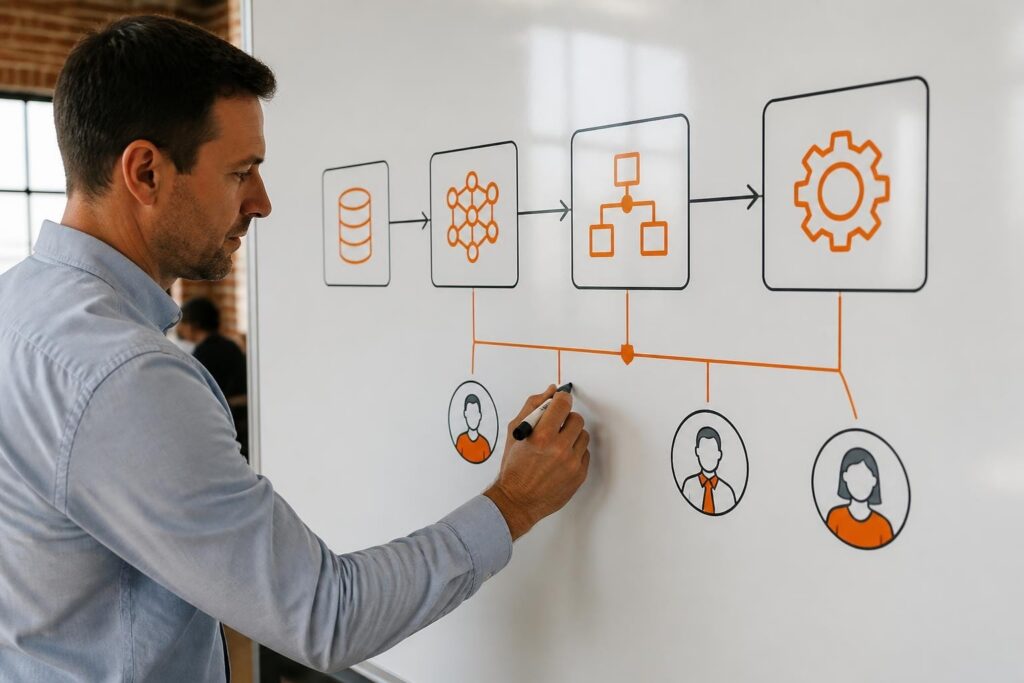
EHS software is a platform that centralizes and automates the management of environmental, health, and safety (EHS) programs across an organization. It enables teams to track incidents, manage compliance obligations, conduct audits and inspections, and report on performance metrics from a unified system. EHS software is a digital platform designed to manage regulatory compliance, risk assessment, and operational safety across industrial and commercial environments.
Organizations deploy ehs software to replace manual, spreadsheet-based processes with structured workflows that enforce consistency, maintain audit trails, and provide real-time visibility into safety performance. These platforms typically integrate with enterprise systems and field devices to capture data from multiple sources and support decision-making across EHS functions.
What Are the Core Functional Modules in EHS Software?
EHS software delivers functionality through discrete modules that address specific compliance and operational requirements. Each module supports a defined set of workflows and data structures.
Incident management captures details of workplace injuries, near misses, and environmental releases. Users log events through structured forms, assign investigations, track corrective actions, and generate incident reports. The module maintains a historical record searchable by location, severity, root cause, and other attributes.
Compliance management tracks regulatory obligations, permits, and reporting deadlines. The system maps regulations to responsible parties, monitors change logs, and generates submission-ready reports for agencies such as EPA and OSHA. Compliance calendars send automated reminders before deadlines.
Audit and inspection functionality supports scheduled and ad hoc assessments. Users build custom checklists, capture findings in the field via mobile apps, assign corrective actions, and track closure. Audit trails document all observations and follow-up activities. For service-oriented businesses, integrating with inspection management software provides additional workflow automation and scheduling capabilities.
Risk assessment modules enable qualitative and quantitative analysis of workplace hazards. Teams score risks using matrices, document mitigation measures, and prioritize control actions. The module links risk records to incidents and audit findings to support continuous improvement.
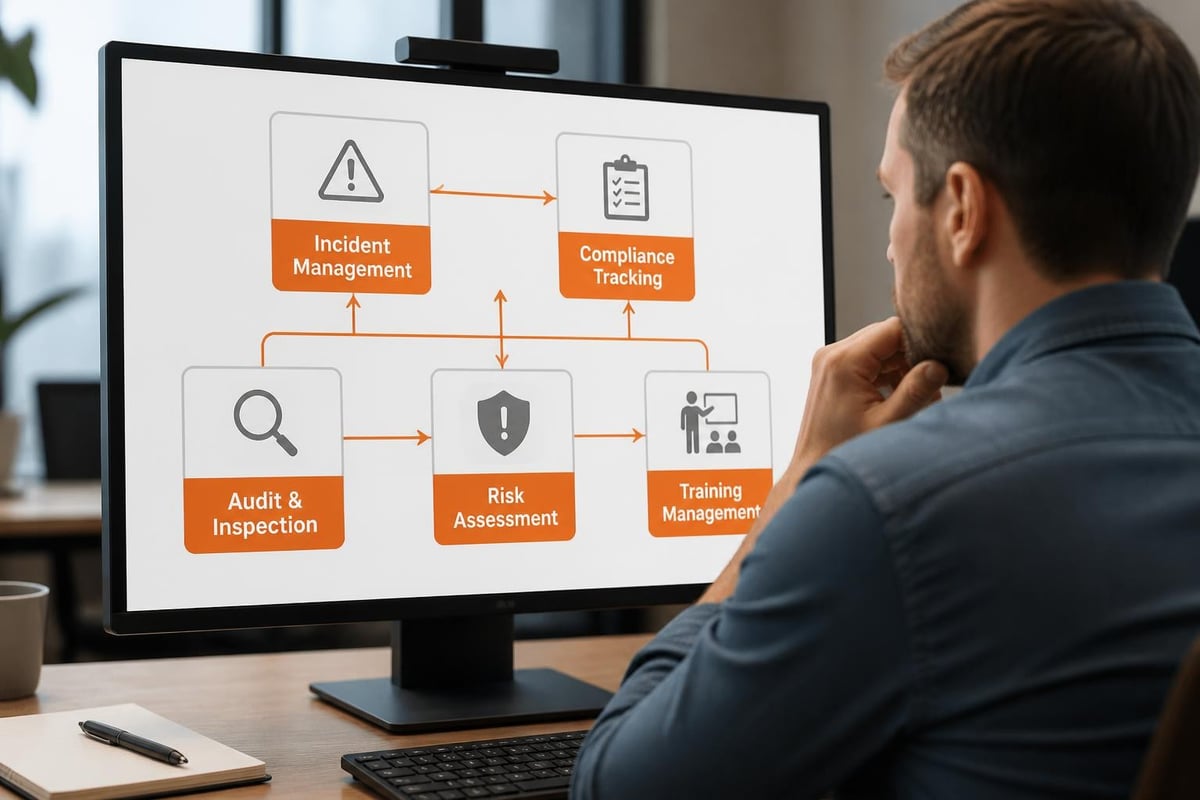
Training and competency management tracks certifications, refresher schedules, and course completions. The system assigns training based on job roles or risk exposures, sends notifications for upcoming exams, and maintains competency records for audits.
Document control centralizes policies, procedures, safety data sheets (SDS), and permits. Version control, approval routing, and access permissions ensure users reference current, authorized documents. The module supports retrieval during inspections and regulatory reviews.
| Module | Primary Function | Key Data Objects |
|---|---|---|
| Incident Management | Capture and investigate events | Incidents, injuries, near misses, root causes |
| Compliance Management | Track regulations and deadlines | Permits, obligations, agency reports |
| Audit & Inspection | Conduct assessments | Checklists, findings, corrective actions |
| Risk Assessment | Evaluate and mitigate hazards | Risk matrices, controls, action plans |
| Training Management | Manage certifications | Courses, competencies, expiration dates |
| Document Control | Maintain authoritative records | Policies, SDS, permits, procedures |
These modules share a common data model, enabling cross-functional analysis. For example, linking incident records to audit findings and training gaps supports root-cause analysis and targeted interventions.
How Do Deployment Models Affect Implementation and Cost?
EHS software is delivered through cloud-based (SaaS), on-premise, and hybrid deployment models. Each model presents distinct trade-offs in infrastructure, control, and total cost of ownership.
Cloud-based platforms host applications and data in vendor-managed data centers. Organizations access the system through web browsers and mobile apps. The vendor handles infrastructure provisioning, software updates, backups, and security patching. Cloud platforms scale elastically to accommodate user growth and peak loads.
Advantages include rapid deployment, predictable subscription pricing, and automatic feature updates. Cloud platforms eliminate on-site server maintenance and reduce IT overhead. Vendors distribute infrastructure costs across multiple tenants, lowering per-customer expenses. NIST guidance on cybersecurity provides frameworks for evaluating cloud service security controls and data protection measures.
On-premise deployments install software on organization-owned servers within corporate data centers or private cloud environments. IT teams manage hardware, operating systems, databases, and application servers. This model offers maximum control over data residency, network topology, and integration architecture.
On-premise systems suit organizations with strict data sovereignty requirements, legacy infrastructure constraints, or regulatory mandates that restrict cloud storage. However, organizations bear the full cost of hardware, software licensing, upgrades, and dedicated IT staff. Deployment timelines extend to accommodate infrastructure provisioning and configuration.
Hybrid models combine cloud and on-premise components. Sensitive data resides on-premise while analytics, reporting, and collaboration features run in the cloud. Alternatively, organizations may deploy core modules on-premise and use cloud services for mobile access or external stakeholder portals.
| Deployment Model | Hosting | Infrastructure Responsibility | Cost Structure | Update Cadence |
|---|---|---|---|---|
| Cloud (SaaS) | Vendor data center | Vendor | Subscription per user/module | Automatic, frequent |
| On-Premise | Customer data center | Customer IT team | License + hardware + maintenance | Manual, scheduled |
| Hybrid | Mixed | Shared | Mixed | Variable by component |
Deployment decisions also impact integration complexity. Cloud platforms typically offer pre-built connectors to common enterprise systems, while on-premise deployments may require custom middleware and API development. Organizations evaluating deployment models should assess existing infrastructure, IT capabilities, compliance constraints, and long-term scalability requirements.
What Criteria Should Guide EHS Software Vendor Evaluation?
Selecting ehs software requires structured evaluation of vendor capabilities, product fit, and long-term partnership viability. Organizations should assess vendors across functional, technical, and business dimensions.
Functional coverage measures how well the platform supports required EHS processes. Evaluators should map current and planned workflows to vendor modules, identify gaps, and determine whether gaps can be closed through configuration, custom development, or third-party integrations. Verdantix Green Quadrant: EHS Software 2025 provides research-driven comparisons of platform capabilities and market positioning.
Usability and adoption directly impact ROI. Platforms with intuitive interfaces, mobile-first design, and minimal training requirements accelerate user adoption. Request live demonstrations with realistic scenarios and involve end users (safety managers, frontline workers, auditors) in evaluations. Assess offline mobile capabilities for locations with limited connectivity.
Integration and interoperability determine how well the platform fits into existing technology ecosystems. Evaluate API quality, pre-built connectors to ERP and HR systems, support for industry data standards (e.g., OSHA 300 logs, EPA reporting formats), and data import/export tools. Organizations with custom software needs may benefit from workflow automation software that connects EHS data to broader operational processes.
Compliance and regulatory support ensures the platform keeps pace with changing regulations. Vendors should demonstrate how they monitor regulatory updates, deliver compliance content, and adapt workflows to new requirements. Confirm coverage for jurisdictions where the organization operates.

Configurability and extensibility enable the platform to adapt to unique organizational requirements. Evaluate form builders, workflow engines, custom field support, and reporting tools. Platforms that support low-code customization reduce reliance on vendor professional services and internal development resources. For businesses managing service-based workflows, reviewing capabilities similar to calibration management software highlights how EHS platforms handle serialized asset tracking and scheduled maintenance.
Vendor stability and support affect long-term viability. Investigate vendor financial health, customer retention, product roadmap transparency, and support service levels. Request customer references in similar industries and company sizes. Assess the vendor's commitment to security through certifications (ISO 27001, SOC 2) and vulnerability management programs.
Pricing transparency enables accurate budgeting. Understand all cost components: subscription fees, implementation services, user training, data migration, ongoing support, and fees for additional modules or user seats. Clarify contract terms including minimum commitments, auto-renewal clauses, and exit provisions.
Organizations benefit from scoring vendors using weighted criteria aligned to business priorities. Formal evaluation matrices document trade-offs and support defensible procurement decisions.
How Does EHS Software Support Multi-Site and Multi-Jurisdictional Operations?
Organizations operating across multiple facilities and regulatory jurisdictions require ehs software that accommodates organizational complexity while maintaining data consistency and governance.
Hierarchical data structures represent corporate, regional, site, and department levels. Platforms assign users, assets, and compliance obligations to specific nodes in the hierarchy. This structure supports global roll-ups for executive dashboards and localized views for site-level managers.
Role-based access control restricts data visibility and edit permissions based on user roles and organizational assignments. For example, site safety coordinators access only their location's records, while regional managers view aggregated data across multiple sites. Administrative roles configure workflows, manage users, and define system settings.
Multi-language and localization capabilities enable consistent user experiences across global workforces. Platforms should support interface translation, locale-specific date and number formats, and region-appropriate terminology. Some vendors provide pre-configured compliance content for specific countries or industries.
Compliance content libraries map regulatory requirements to organizational obligations. Advanced platforms update libraries when regulations change and notify affected users. Multi-jurisdictional organizations subscribe to libraries covering all operating regions.
Workflow Example: Incident Reporting Across Global Operations
A manufacturing company operates facilities in the United States, Germany, and Singapore. An employee at the Singapore site sustains a minor injury requiring first aid.
-
Field report: The employee's supervisor logs the incident through the mobile app, selecting the Singapore facility and the affected body part from a dropdown menu. The system auto-populates local time, location, and reporting manager based on the user's profile.
-
Local investigation: The Singapore safety coordinator receives an automated notification, assigns an investigator, and sets a due date for the investigation report. The investigator documents witness statements, captures photos of the work area, and identifies a slippery floor surface as the root cause.
-
Corrective action: The system creates a corrective action requiring installation of anti-slip flooring. The maintenance team receives a work order through integration with the facility management system. The action is tracked to completion with photographic evidence of the completed work.
-
Regulatory reporting: The platform determines the incident is recordable under Singapore's Workplace Safety and Health Act. It generates a pre-filled submission form that the safety coordinator reviews and submits to the Ministry of Manpower electronically.
-
Global aggregation: Corporate EHS leadership in the United States views the incident in a global dashboard. They compare Singapore's incident rate to other regions, identify flooring hazards as a recurring issue across facilities, and initiate a company-wide flooring audit program.
This workflow demonstrates how ehs software unifies local execution with global oversight, automates compliance obligations, and enables data-driven decision-making across organizational boundaries.
What Integrations Enhance EHS Software Value?
EHS software delivers maximum value when integrated with complementary enterprise systems and operational technology. Strategic integrations eliminate data silos, reduce manual entry, and enable cross-functional analytics.
ERP and financial systems provide master data for locations, cost centers, and organizational hierarchies. Integration ensures EHS records reference authoritative data sources and enables financial analysis of safety-related costs (incident expenses, fines, remediation). Data flows support budgeting for safety programs and tracking ROI on risk mitigation investments.
HR and talent management systems supply employee records, job roles, and competency data. Integration automates training assignments based on role changes, tracks certification expiration dates, and correlates incident rates with workforce demographics or experience levels. Organizations leveraging compliance monitoring software can extend this to contractor and vendor workforce compliance.
Asset management and CMMS platforms link equipment identifiers to maintenance records, inspection schedules, and failure modes. EHS systems correlate equipment failures with incidents and environmental releases. Predictive maintenance insights help prevent safety events. For specialized applications, contractor compliance software ensures third-party service providers meet safety standards when working on organizational assets.
IoT sensors and monitoring equipment provide real-time data on environmental conditions, equipment performance, and worker location. Air quality monitors detect hazardous gas concentrations and trigger automated alerts. Wearable devices measure physiological signals (heart rate, heat stress) and notify supervisors when thresholds are exceeded. Integration transforms ehs software from a reactive recordkeeping system to a proactive risk management platform.
Business intelligence and analytics tools aggregate EHS data with operational and financial metrics. Dashboards visualize leading and lagging indicators, benchmark performance against industry standards, and identify trends requiring intervention. Advanced platforms leverage machine learning to predict incident likelihood and recommend preventive actions. Research on digital technology in occupational health explores enablers, barriers, and outcomes of digital tools in workplace safety contexts.
Communication and collaboration platforms (email, messaging, portals) streamline notifications, approvals, and stakeholder engagement. Integration ensures timely alerts for overdue actions, compliance deadlines, and critical incidents. External portals enable contractors and suppliers to submit safety documentation and training records directly into the ehs software.
- Data quality and governance: Integrations introduce dependencies on source system data accuracy. Establish data stewardship responsibilities, validation rules, and exception handling procedures.
- Security and access control: Integrated systems share sensitive data. Implement encryption in transit and at rest, authenticate API calls, and log all data exchanges for audit purposes.
- Integration architecture: Choose between point-to-point, middleware-based, or API gateway patterns based on the number of systems, transaction volumes, and complexity. Document data mappings, transformation logic, and error handling.
- Testing and monitoring: Validate integrated workflows end-to-end before production deployment. Implement monitoring to detect failed data transfers, latency issues, or data inconsistencies.
Organizations should prioritize integrations based on business value, data availability, and technical feasibility. Phased approaches that start with high-impact, low-complexity integrations build momentum and demonstrate ROI.
How Do Organizations Measure EHS Software ROI and Performance?
Quantifying return on investment for ehs software requires defining baseline metrics, identifying benefit categories, and tracking performance over time. Organizations should establish measurement frameworks before deployment to capture pre-implementation data.
Cost avoidance and reduction represent direct financial benefits. EHS software reduces incident-related costs (medical expenses, workers' compensation premiums, regulatory fines) by improving hazard identification and control effectiveness. It eliminates costs associated with manual processes (data entry labor, paper forms, physical document storage). Organizations should track these costs pre- and post-implementation to quantify savings.
Productivity gains result from streamlined workflows and reduced administrative burden. Safety managers spend less time compiling reports, tracking action items, and searching for documentation. Automated compliance calendars prevent missed deadlines and associated penalties. Quantify productivity by measuring time spent on specific tasks before and after implementation.
Risk mitigation benefits include reduced incident frequency and severity. Leading indicators (audits completed, hazards identified, training compliance) predict lagging indicators (recordable injury rate, lost-time incidents, environmental releases). Tracking both indicator sets demonstrates how the platform drives improved safety outcomes. Organizations should benchmark performance against industry averages and internal historical trends.
Compliance and audit performance improves as documentation becomes centralized, complete, and audit-ready. Organizations pass regulatory inspections with fewer findings and spend less time responding to information requests. Track audit findings, response times, and regulator feedback as qualitative measures of platform effectiveness.
Data quality and decision-making benefits emerge as structured data replaces inconsistent spreadsheets. Executives gain real-time visibility into safety performance across locations. Root-cause analysis identifies systemic issues rather than treating symptoms. While difficult to quantify directly, improved decision-making drives long-term competitive advantage.
| Benefit Category | Measurement Approach | Data Sources |
|---|---|---|
| Cost Avoidance | Track incident costs, fines, workers' comp premiums | Financial records, insurance claims, incident logs |
| Productivity | Time studies for key tasks, workflow completion rates | User surveys, system usage logs, task timestamps |
| Risk Mitigation | Leading/lagging safety indicators, incident trends | Incident records, audit findings, training completion |
| Compliance | Audit findings, deadline compliance, penalty avoidance | Audit reports, compliance calendars, agency correspondence |
| Data Quality | Completeness, accuracy, timeliness of safety data | Data validation reports, audit trails, stakeholder feedback |
Organizations should report ROI using both financial metrics (payback period, net present value) and non-financial outcomes (injury rate reduction, compliance improvement). Executive dashboards that combine financial and safety performance build support for ongoing platform investment and expansion.
For service-oriented operations managing safety-critical equipment, the platform's ability to track maintenance schedules and service history contributes to both safety and revenue protection. Brytend offers service and compliance software designed to connect asset lifecycle management with regulatory obligations, enabling unified oversight of equipment condition, service intervals, and safety certifications.
What Emerging Capabilities Are Shaping EHS Software Evolution?
EHS software platforms continue to evolve as new technologies, regulatory expectations, and market forces drive innovation. Organizations evaluating vendors should assess roadmaps and emerging capabilities that will define next-generation platforms.
Artificial intelligence and machine learning enhance prediction, automation, and insights. Natural language processing analyzes incident narratives to identify common themes and emerging risks. Predictive models forecast incident likelihood based on historical patterns, environmental conditions, and workforce factors. AI-powered chatbots guide users through reporting workflows and answer common compliance questions. SafetyTech Review provides vendor-neutral analysis of AI features and practical evaluation criteria for EHS technology adoption.
Sustainability and ESG integration reflects growing expectations for environmental transparency. Modern ehs software expands beyond compliance to support carbon accounting, supply chain emissions tracking, and sustainability reporting. Platforms align with frameworks such as GRI, SASB, and TCFD. Forrester’s sustainability management software landscape analyzes how EHS platforms are evolving to address broader ESG requirements.
Mobile-first design accommodates field-based workforces and remote operations. Modern platforms prioritize native mobile apps with offline capabilities, voice-to-text input, and barcode/QR code scanning. Wearables integration provides hands-free data capture and real-time alerts in hazardous environments.
Advanced analytics and visualization democratize data exploration. Self-service dashboards enable safety managers to create custom reports without IT support. Geospatial visualization maps incident clusters and identifies location-specific risks. Time-series analysis reveals seasonality and trend patterns.
Regulatory intelligence automates change monitoring. Platforms track regulatory updates across jurisdictions, map changes to affected obligations, and notify responsible parties. Some vendors employ legal experts to interpret requirements and update pre-configured compliance content.
Industry-specific solutions address vertical market requirements. Platforms offer preconfigured workflows, compliance libraries, and data models tailored to manufacturing, construction, oil and gas, healthcare, and other industries. Specialization accelerates deployment and improves functional fit.

Organizations should balance investment in mature, proven capabilities with selective adoption of emerging technologies that address specific pain points. Pilot programs and phased rollouts reduce risk when implementing cutting-edge features.
How Do Organizations Ensure Successful EHS Software Implementation?
Successful ehs software deployments require structured project management, stakeholder engagement, and change management discipline. Organizations should treat implementation as a business transformation initiative rather than a technology installation.
Executive sponsorship secures funding, prioritizes the project, and drives adoption. Sponsors articulate the business case, communicate expectations, and remove organizational barriers. They participate in steering committees that resolve escalated issues and approve scope changes.
Cross-functional implementation teams represent all stakeholder groups: EHS leadership, site safety coordinators, IT, HR, operations, and frontline workers. Teams define requirements, validate designs, conduct testing, and support user training. Broad representation builds buy-in and ensures the platform serves diverse user needs.
Requirements definition and process mapping document current-state workflows, identify inefficiencies, and design future-state processes. Teams prioritize must-have requirements versus nice-to-have features. Requirements traceability links design decisions to business needs and supports scope management.
Data migration and cleansing transfer historical records from legacy systems to the new platform. Organizations should assess data quality, standardize formats, and archive obsolete records. Cleansing improves data reliability and prevents technical debt in the new system.
Configuration and customization adapt the platform to organizational needs. Teams build custom forms, configure workflows, define user roles, and set up integrations. Platforms with low-code tools empower business users to make changes without development resources.
Testing and validation ensure the platform meets requirements and performs reliably. Unit testing verifies individual components, integration testing validates data flows, and user acceptance testing confirms end-to-end workflows. Testing should include realistic scenarios, edge cases, and failover procedures.
Training and communication prepare users for the transition. Role-based training delivers relevant content to each user group. Job aids, video tutorials, and quick-reference guides support ongoing learning. Communication campaigns explain why the change is happening, what benefits users will experience, and how to get help.
Phased rollout reduces risk by deploying to a subset of locations or user groups first. Pilots validate configuration, identify issues, and build confidence before enterprise-wide launch. Organizations should plan for adequate support resources during stabilization periods.
Continuous improvement treats go-live as the beginning, not the end. Organizations should monitor usage, collect feedback, track KPIs, and release enhancements iteratively. Regular user forums and governance committees ensure the platform evolves with changing needs.
EHS software centralizes environmental, health, and safety management through modules for incident tracking, compliance monitoring, audits, risk assessment, and training. Organizations evaluating platforms should assess functional coverage, deployment models, integration capabilities, and vendor stability to ensure long-term fit. If your organization requires custom EHS functionality, specialized asset tracking, or integration with existing safety systems, Brytend delivers tailored software solutions designed to meet specific operational and compliance requirements.