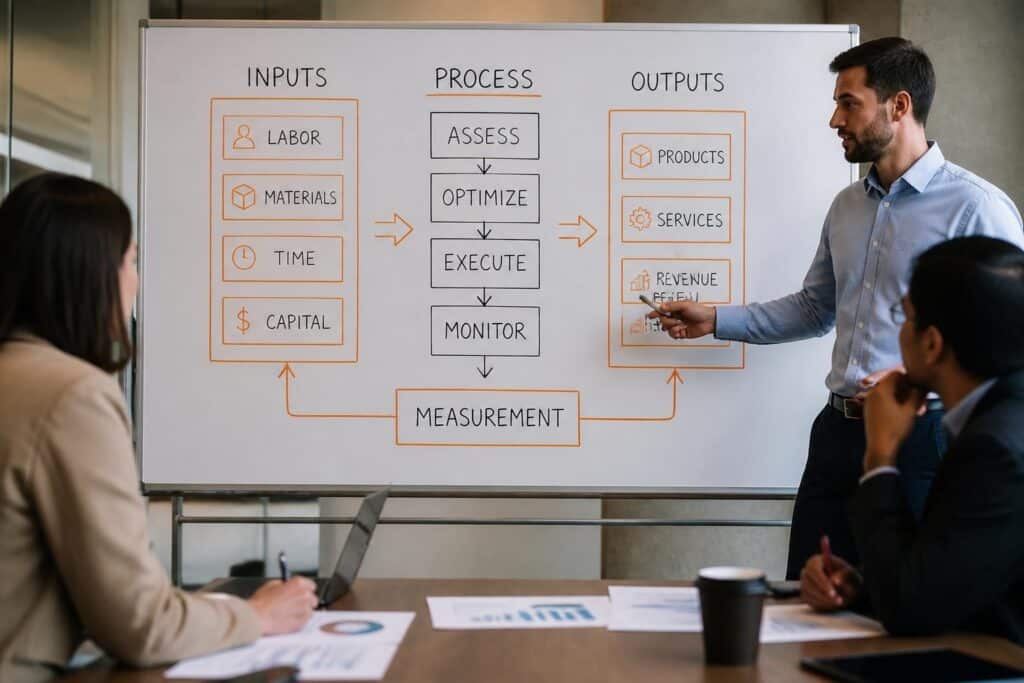
Compliance monitoring software is a platform that continuously tracks, measures, and documents an organization's adherence to regulatory requirements, industry standards, and internal policies through automated data collection, control testing, and audit trail management.
Note: compliance monitoring software focuses on continuously watching your systems and processes for policy or regulatory violations as they happen. For the broader discipline of identifying, scoring, and mitigating compliance risk across an organization, see our guide to compliance risk software.
TL;DR:
- Compliance monitoring software automates evidence collection, control testing, and regulatory tracking across multiple frameworks (ISO, FDA, OSHA, SOX)
- Continuous monitoring replaces periodic manual audits with real-time alerts, automated controls assessment, and persistent audit trails
- Integration with ERP, CMMS, and QMS systems creates unified compliance data repositories and eliminates duplicate data entry
- ROI stems from reduced audit preparation time (60-80%), lower non-compliance penalties, and improved certification maintenance
- Selection criteria include multi-framework support, workflow automation, serialized asset tracking, and customizable reporting dashboards
What Is Compliance Monitoring Software and Why Do Organizations Need It?
Compliance monitoring software provides continuous, automated oversight of an organization's adherence to regulatory obligations, industry certifications, and internal governance policies. Unlike periodic manual audits, these platforms operate continuously, collecting evidence, testing controls, and flagging deviations in real time.
Organizations implement compliance monitoring software to address three critical challenges. First, the volume and complexity of regulatory requirements have grown exponentially. A manufacturing facility might simultaneously maintain ISO 9001, ISO 14001, ISO 45001, FDA 21 CFR Part 11, OSHA recordkeeping, and EPA reporting obligations. Manual tracking across disparate spreadsheets creates gaps, duplicates effort, and increases audit risk.
Second, stakeholders demand continuous assurance, not point-in-time certification. NIST Special Publication 800-137 defines Information Security Continuous Monitoring (ISCM) as maintaining ongoing awareness of information security, vulnerabilities, and threats to support organizational risk management. This principle extends across all compliance domains. Regulators, customers, and insurance carriers increasingly require evidence of persistent control effectiveness between formal audits.
Third, serialized inventory and asset-intensive operations require granular traceability. Equipment calibration, preventive maintenance, service history, and chain-of-custody documentation must link to specific serialized items. Manual systems cannot maintain these relationships at scale. Compliance monitoring software built for industrial operations connects asset registries, service records, and compliance obligations through unique identifiers.
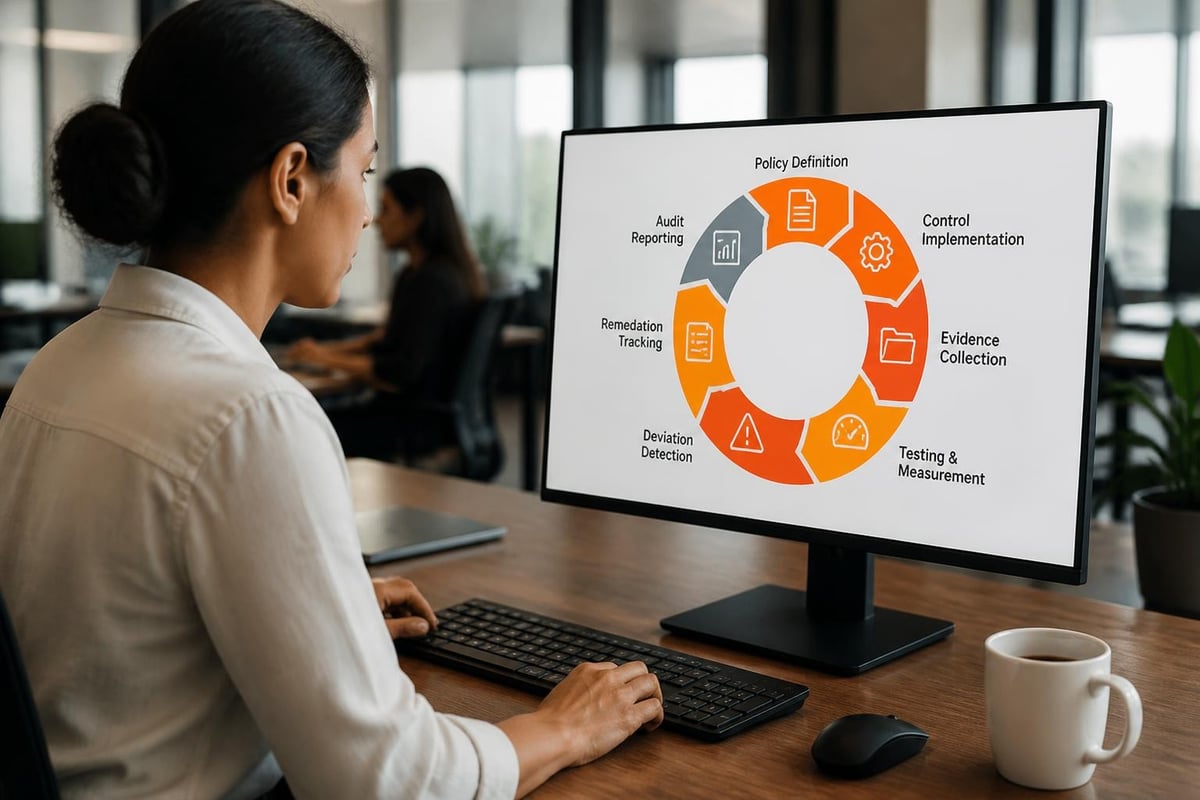
The ISO 37301:2021 standard for compliance management systems outlines the governance framework compliance monitoring software must support, including leadership commitment, policy documentation, competence requirements, operational planning, performance evaluation, and continual improvement.
How Does Compliance Monitoring Software Work Technically?
Compliance monitoring software operates through five integrated technical components that transform regulatory requirements into automated monitoring workflows.
1. Requirements Repository and Framework Mapping
The platform maintains a structured database of regulatory requirements, control objectives, and compliance obligations. Each requirement maps to specific control activities, responsible parties, evidence types, testing frequency, and acceptance criteria. Organizations import requirements from regulatory texts, standards bodies, or industry templates, then customize based on their operations.
Advanced systems support multi-framework mapping where a single control satisfies multiple requirements. For example, an equipment calibration procedure might simultaneously address ISO 9001 clause 7.1.5 (monitoring and measuring resources), FDA 21 CFR Part 820.72 (inspection, measuring, and test equipment), and internal quality policy QP-310.
2. Data Collection and Integration Layer
The software integrates with operational systems to collect compliance evidence automatically. Common integration points include:
- ERP systems: Financial controls, procurement approvals, supplier qualifications
- CMMS platforms: Preventive maintenance completion, calibration records, work order histories
- QMS applications: Nonconformance reports, corrective actions, document revisions
- Environmental monitoring: Emissions data, waste disposal records, permit compliance
- Laboratory systems: Test results, chain-of-custody, instrument logs
- Access control: User permissions, segregation of duties, privileged access reviews
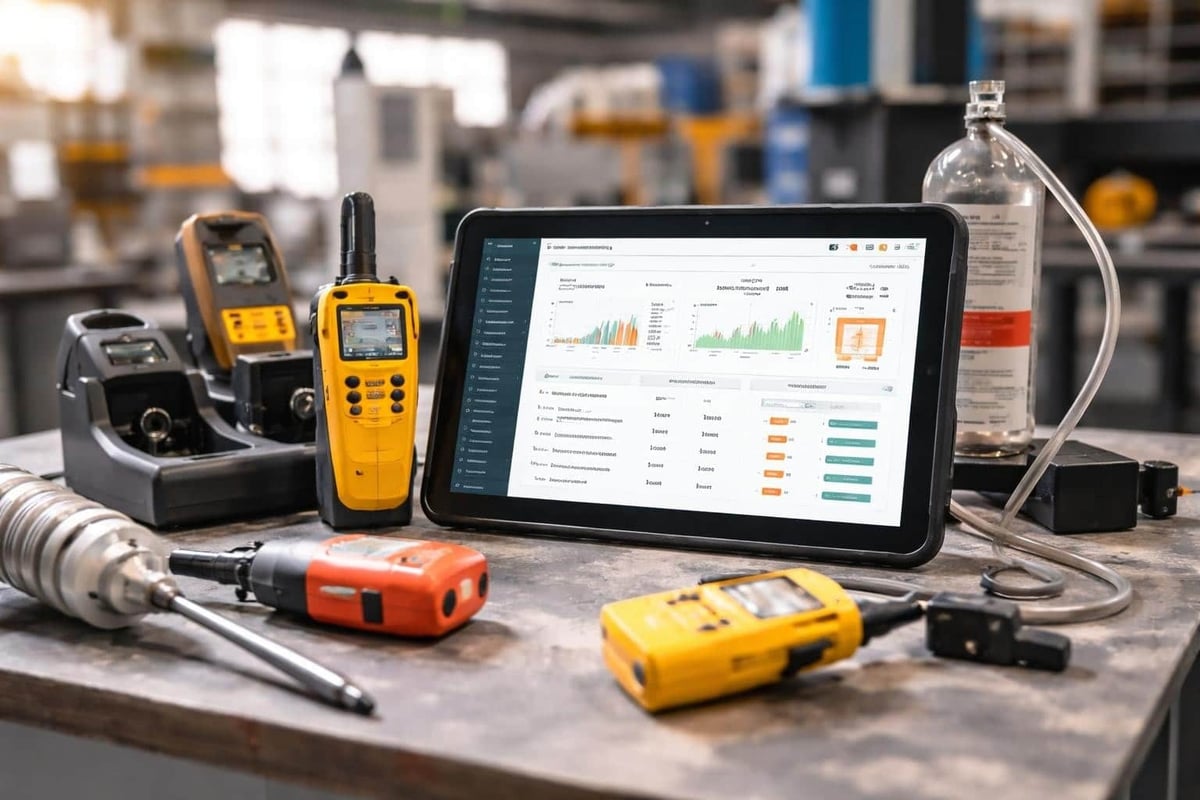
API connections, file imports, and database synchronization eliminate manual data entry. The Brytend Service Module demonstrates how serialized inventory tracking, automated service reminders, and certificate generation create persistent compliance evidence for asset-intensive operations without duplicate data management.
3. Automated Control Testing and Monitoring Rules
The platform executes predefined tests against collected data to verify control effectiveness. Testing approaches include:
| Test Type | Description | Example |
|---|---|---|
| Exception monitoring | Flags transactions or events that violate defined thresholds | Equipment operated beyond calibration due date; procurement above approval authority |
| Attribute sampling | Randomly selects records and evaluates against criteria | 25 random customer complaints reviewed for timely closure within SLA |
| Continuous analytics | Statistical analysis of populations to detect anomalies | Control chart monitoring of environmental parameters; duplicate vendor payments |
| Configuration validation | Compares current system settings against approved baseline | User permissions reconciliation; segregation of duties matrix verification |
| Completeness checks | Verifies required documentation exists for applicable events | Training records for all quality personnel; safety data sheets for hazardous materials |
ISACA’s guidance on continuous controls monitoring emphasizes the importance of linking control objectives to measurable KPIs and automating as much testing as technically and economically feasible.
4. Deviation Management and Workflow Automation
When monitoring detects a control failure or compliance gap, the platform initiates remediation workflows. Configurable routing assigns issues to responsible personnel based on type, severity, location, or other attributes. Each deviation requires root cause analysis, corrective action planning, and evidence of resolution before closure.
Workflow automation tracks elapsed time against response SLAs, escalates overdue items, and maintains complete audit trails of all activities and approvals. This structured approach satisfies the corrective action requirements common across ISO management system standards.
5. Reporting, Dashboards, and Audit Trail
Compliance monitoring software generates role-based dashboards showing current status across all monitored frameworks, controls, and business units. Visualizations highlight:
- Control effectiveness ratings and trending
- Open findings by age, priority, and owner
- Upcoming deadlines for testing, renewals, or submissions
- Key risk indicators and threshold breaches
- Certification readiness scores
All data changes, test executions, workflow actions, and configuration modifications create immutable audit logs with timestamps, user identities, and before/after values. This persistent audit trail supports both internal reviews and external examinations without additional preparation effort.
What Are the Key Features and Capabilities to Evaluate?
Organizations selecting compliance monitoring software should evaluate capabilities across eight functional dimensions.
Multi-Framework and Regulation Support
The platform must accommodate all applicable regulatory requirements and industry standards without forcing organizations into a single framework. Look for:
- Pre-built content libraries for common regulations (ISO 9001/14001/45001, FDA, OSHA, SOX, GDPR, HIPAA)
- Custom framework creation tools for internal policies and emerging requirements
- Cross-mapping capabilities to link related requirements across frameworks
- Version control for regulatory updates and standard revisions
Serialized Asset and Inventory Tracking
For equipment-intensive operations, compliance monitoring must extend to individual serialized items. Essential capabilities include:
- Unique identifiers for each asset, instrument, tool, or container
- Lifecycle tracking from acquisition through disposal
- Service history and maintenance scheduling tied to specific units
- Calibration management with automatic alerts before due dates
- Chain-of-custody documentation for controlled items
- Integration with barcode/RFID systems for physical verification
Organizations managing inventory management systems should verify that compliance monitoring platforms can consume asset data from existing repositories rather than requiring duplicate registries.
Workflow Automation and Role-Based Access
Compliance processes involve multiple roles (quality, operations, management, technical specialists). The software must support:
- Configurable approval chains based on deviation type, cost, or risk level
- Automatic assignment and escalation rules
- Email and mobile notifications for pending tasks
- Role-based permissions controlling data visibility and action authority
- Delegation capabilities for absences and organizational changes
Evidence Collection and Document Management
Audit readiness depends on organized, retrievable evidence. Required features include:
- Automatic association of evidence with specific requirements and test instances
- Version-controlled document repository with check-in/check-out
- Electronic signatures meeting 21 CFR Part 11 when applicable
- Photo and file attachments linked to assets, locations, or findings
- Retention policy enforcement and automated disposal
- Search and filter tools for rapid evidence retrieval during audits
Analytics, Reporting, and Trend Analysis
Beyond pass/fail monitoring, the platform should provide insights into compliance program health:
- Configurable KPI dashboards by framework, process, site, or time period
- Trend charts showing control effectiveness over time
- Comparative benchmarking across business units or facilities
- Risk heatmaps highlighting concentrated vulnerabilities
- Export capabilities for regulatory submissions and board reporting
KPMG’s research on compliance analytics demonstrates how data-driven monitoring programs identify systemic issues earlier and allocate resources more effectively than checklist-based approaches.
System Integration and API Capabilities
Standalone compliance tools create data silos and manual reconciliation burden. Evaluate:
- REST APIs for bidirectional data exchange
- Pre-built connectors for common enterprise platforms (SAP, Oracle, Microsoft Dynamics)
- ODBC/database access for custom queries and data warehouses
- Webhook support for event-driven automation
- Single sign-on (SSO) and directory integration
Customization and Configuration Flexibility
Every organization's compliance profile differs. The software should allow:
- Custom fields and data models without vendor professional services
- User-definable testing rules and monitoring logic
- Configurable forms and checklists
- Tailored workflows reflecting actual approval processes
- Localization for multinational operations (language, time zones, units)
Mobile Access and Offline Capability
Shop floor, field, and laboratory personnel require mobile access for inspections, audits, and data collection. Essential mobile features:
- Native iOS and Android applications, not just responsive web
- Offline data entry with automatic synchronization when connected
- Barcode and QR code scanning
- Photo capture with geolocation tagging
- Digital signature collection
What Is the ROI and Business Impact of Compliance Monitoring Software?
Organizations implementing compliance monitoring software realize financial returns and operational improvements across multiple dimensions.
Reduced Audit Preparation Time
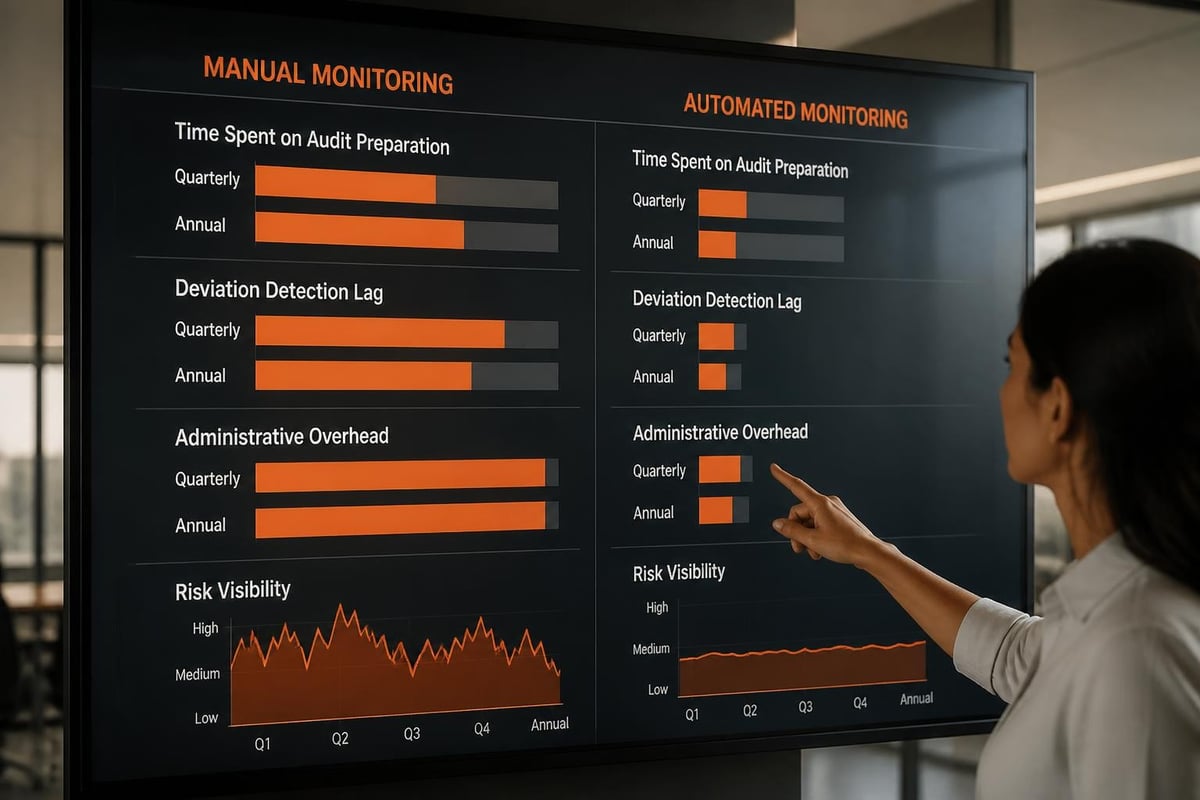
Manual audit preparation consumes weeks of staff time gathering evidence, reconciling inconsistencies, and creating documentation packages. Automated compliance monitoring maintains continuous audit readiness with:
- Persistent audit trails requiring no retrospective construction
- Pre-mapped evidence to specific requirements
- Automated report generation for common audit requests
- Real-time visibility into control gaps before auditors arrive
Typical time reduction: 60-80% of pre-audit preparation effort. For organizations with annual ISO surveillance audits, triennial renewals, and periodic customer audits, this translates to hundreds of reclaimed staff hours annually.
Lower Non-Compliance Costs
Compliance failures carry direct costs: regulatory fines, lost certifications, customer chargebacks, insurance premium increases, and legal expenses. Indirect costs include diverted management attention, remediation project expenses, and reputational damage.
Compliance monitoring software reduces these risks by:
- Detecting control failures immediately rather than months later during audits
- Preventing minor deviations from accumulating into systemic issues
- Documenting good-faith compliance efforts that mitigate penalties
- Maintaining certification continuity that protects market access
A single avoided FDA warning letter (average remediation cost: $500K-$2M) or ISO certification suspension (lost revenue during decertification: varies by industry) justifies multi-year platform investments.
Increased Operational Efficiency
Compliance activities consume operational resources. Software automation reduces burden through:
- Elimination of duplicate data entry across compliance, quality, and maintenance systems
- Automated reminder and escalation replacing manual tracking spreadsheets
- Self-service reporting reducing requests to compliance staff
- Faster deviation closure through structured workflows
Organizations report 20-40% reduction in compliance program administrative overhead post-implementation.
Better Risk Visibility and Decision-Making
Manual compliance tracking provides rearview visibility-organizations learn about problems after they occur. Continuous monitoring enables forward-looking risk management:
- Leading indicators predicting future compliance failures
- Resource allocation based on control effectiveness trends
- Data-driven prioritization of remediation investments
- Executive dashboards supporting informed risk acceptance decisions
PwC’s Global Compliance Study found that organizations with mature compliance analytics and automation capabilities demonstrate 30% better risk identification and 25% faster issue resolution than those using manual processes.
Competitive Differentiation
In regulated B2B markets, compliance capabilities influence customer selection. Demonstrated compliance excellence through:
- Customer portal access to relevant compliance data
- Automated compliance certificate provisioning
- Transparent supply chain traceability for serialized products
- Third-party audit performance
Organizations using compliance monitoring software win contracts requiring demonstrated control maturity and respond faster to customer due diligence requests.
What Are Common Implementation Mistakes and How to Avoid Them?
Organizations implementing compliance monitoring software frequently encounter preventable failures that delay ROI and reduce adoption.
Mistake 1: Attempting to Automate Before Standardizing Processes
Software cannot fix poorly designed compliance processes. Organizations that automate inconsistent procedures across sites or departments create rigid dysfunction. Before implementation:
- Document current-state compliance workflows for each framework
- Identify unnecessary variations across business units
- Design target-state standardized processes with stakeholder input
- Validate that standardized approach meets all regulatory requirements
- Configure software to match standardized design
Mistake 2: Insufficient Attention to Integration Architecture
Compliance monitoring software that operates as an island requires extensive manual data entry and creates duplicate records. Organizations underestimate integration complexity and costs. Avoid this by:
- Cataloging all source systems providing compliance-relevant data during requirements phase
- Evaluating integration capabilities and costs before vendor selection
- Designing data governance policies for master data management (Which system owns equipment records? How do asset numbers synchronize?)
- Building integration incrementally rather than attempting "big bang" connections
- Planning for ongoing integration maintenance as source systems upgrade
Deloitte’s guidance on cloud-based compliance monitoring emphasizes the importance of API-first architectures that treat integration as a first-class design requirement, not an afterthought.
Mistake 3: Over-Customization and Feature Bloat
The flexibility of modern platforms tempts organizations to customize extensively, creating complex configurations that become difficult to maintain and upgrade. Apply these guardrails:
- Use platform standard functionality unless customization addresses a documented regulatory requirement
- Limit custom fields to those with clear reporting or analytical purpose
- Resist recreating existing system functionality (document management, training tracking) inside compliance platform
- Maintain configuration documentation explaining the business purpose of each customization
- Review customizations annually and retire unused features
Mistake 4: Inadequate Change Management and Training
Technical implementation succeeds, but users continue manual workarounds because they don't understand the platform or trust automated monitoring. Effective change management includes:
- Executive sponsorship communicating why compliance monitoring improvement matters
- Role-based training focusing on specific tasks users will perform
- Pilot deployment in one business unit before enterprise rollout
- Designated power users providing peer support during transition
- Feedback loops capturing user suggestions for workflow refinement
Organizations should budget 15-25% of implementation project cost for change management activities.
Mistake 5: Neglecting Mobile and Field Worker Requirements
Compliance monitoring designed for office-based quality staff fails when frontline personnel cannot easily record observations, complete checklists, or document corrective actions from shop floor or field locations. Successful implementations:
- Involve operations supervisors and technicians in requirements gathering
- Test mobile applications under actual working conditions (connectivity, lighting, glove use)
- Design mobile workflows for single-handed operation during inspections
- Provide offline capability for areas with unreliable wireless coverage
- Optimize form design for tablet and smartphone screen sizes
How Does Compliance Monitoring Software Fit Within Broader GRC Platforms?
Compliance monitoring capabilities exist on a spectrum from standalone specialized applications to modules within comprehensive Governance, Risk, and Compliance (GRC) platforms. Understanding this landscape guides appropriate selection.
Standalone Compliance Monitoring Software
Specialized compliance monitoring applications provide deep functionality for specific regulatory domains or operational contexts:
- Industry-specific solutions (pharmaceutical quality, medical device, food safety, environmental management)
- Function-specific tools (equipment calibration, laboratory compliance, workplace safety)
- Framework-focused platforms (ISO management systems, SOX internal controls)
Advantages of standalone tools:
- Deeper domain expertise and regulatory content
- Specialized workflow optimized for specific compliance activities
- Lower cost for organizations with narrow compliance scope
- Faster implementation due to focused feature set
Limitations:
- Integration burden to connect with other risk and compliance systems
- Fragmented view across compliance domains
- Duplicate infrastructure and administration
- Limited scalability as compliance requirements expand
Integrated GRC Platform Modules
Enterprise GRC platforms incorporate compliance monitoring as one module alongside risk management, policy management, internal audit, third-party risk, and business continuity. Organizations implement the modules addressing their priority needs.
Advantages of integrated platforms:
- Unified data model linking risks, controls, policies, and audit findings
- Consolidated reporting across governance domains
- Single vendor relationship and support contract
- Shared workflow engine and user interface
- Centralized administration and security
Limitations:
- Higher total cost for organizations needing only compliance monitoring
- Less depth in specialized compliance scenarios
- Longer implementation timelines for enterprise platforms
- Potential feature overlap with existing systems
Forrester’s buyer’s guide on GRC platforms recommends that organizations map current and three-year-forward governance requirements before deciding between specialized or integrated approaches.
Hybrid Architectures
Many organizations deploy hybrid models: integrated GRC platform for enterprise-wide risk and policy management, connected to specialized compliance monitoring applications for deep operational compliance. This approach balances breadth and depth while maintaining data connectivity through APIs and integration platforms.
For example, an organization might use an enterprise GRC platform for enterprise risk management, board reporting, and compliance program oversight, while connecting specialized quality management and environmental monitoring systems that capture detailed operational compliance data from manufacturing facilities.
What Compliance Monitoring Trends Are Shaping 2026 and Beyond?
The compliance monitoring software landscape continues evolving rapidly as regulatory expectations, technology capabilities, and organizational practices advance.
Continuous Compliance Replacing Periodic Audits
The traditional model of annual audits and three-year recertifications is giving way to continuous monitoring and dynamic certification. The Cloud Security Alliance describes continuous compliance monitoring as an operational requirement, not a competitive advantage, particularly for cloud-based and distributed operations.
Regulators increasingly expect organizations to demonstrate real-time control effectiveness, not point-in-time compliance snapshots. Compliance monitoring software provides the technical infrastructure for this shift through:
- Always-on monitoring producing fresh evidence daily
- Automated control testing replacing sampling-based audits
- Real-time dashboards showing current compliance posture
- Exception-based rather than population-based examination
AI and Machine Learning Integration
Compliance monitoring platforms are incorporating AI capabilities across multiple use cases:
- Anomaly detection: Machine learning identifies unusual patterns in compliance data that might indicate control failures (unexpected vendor relationships, atypical transaction volumes, irregular timing patterns)
- Predictive analytics: Statistical models forecast compliance risks based on historical patterns (which equipment types fail calibration most frequently, which processes generate the most deviations)
- Natural language processing: AI extracts requirements from regulatory text and maps them to existing controls automatically
- Intelligent automation: Platforms learn from user corrections and suggest improved monitoring rules over time
These capabilities enhance detection accuracy and reduce false positives that burden compliance teams.
Cloud-Native and API-First Architectures
Modern compliance monitoring platforms are built cloud-native from inception rather than on-premise applications retrofitted for cloud deployment. This architecture provides:
- Automatic updates delivering new regulatory content and features without upgrade projects
- Elastic scalability supporting global enterprises and small organizations with identical platforms
- Mobile-first design treating smartphones and tablets as primary devices
- API-first development where every function is accessible programmatically for integration and automation
The SANS Institute’s guidance on security monitoring emphasizes that cloud-based monitoring architectures dramatically reduce infrastructure management burden while improving data collection frequency and breadth.
Serialized Traceability as Standard Requirement
Regulatory agencies and industry standards increasingly mandate unit-level traceability for equipment, products, and materials. Compliance monitoring software must track obligations and evidence at the serialized item level, not just category or location:
- Equipment calibration and service history linked to specific asset serial numbers
- Product genealogy connecting finished goods to source material lot numbers
- Tool usage tracking for controlled or certified implements
- Container and vessel cleaning validation by unique identifier
Organizations that select compliance monitoring platforms without robust serialized inventory capabilities face costly replacements as traceability requirements expand across industries. Solutions built for equipment lending and tracking demonstrate how serialized item management integrates with compliance workflows without duplicate data structures.
Expanded Third-Party and Supply Chain Compliance Monitoring
Organizations bear compliance responsibility for their extended supply chains and third-party service providers. Compliance monitoring software is extending beyond internal controls to include:
- Supplier compliance certification management and expiration tracking
- Automated collection of vendor compliance evidence (insurance, licenses, audit reports)
- Third-party risk scoring based on compliance performance
- Supply chain traceability linking materials to source compliance data
This expansion requires platforms that support external portal access, automated document collection workflows, and risk-based monitoring intensity calibration.
Integration with Operational Technology and IoT
Compliance monitoring is converging with operational technology (OT) and Internet of Things (IoT) sensors to enable real-time measurement of compliance-relevant parameters:
- Environmental monitoring (temperature, humidity, air quality) automatically logged to compliance records
- Equipment performance data (run hours, cycle counts, error rates) feeding predictive maintenance and compliance scheduling
- Process parameters captured continuously rather than through manual rounds
- Geolocation and movement tracking for controlled items
This operational data integration creates objective, high-frequency compliance evidence superior to manual inspection records.

Organizations building compliance capabilities in 2026 should select platforms architected for these emerging requirements rather than tools designed for yesterday's compliance approaches. Custom development allows organizations to build exactly what they need today while maintaining flexibility to incorporate advancing capabilities as regulatory and operational requirements evolve.
For businesses managing complex compliance obligations across multiple frameworks and serialized assets, Brytend provides tailored software solutions that integrate compliance monitoring with operational systems. Their team specializes in creating custom platforms that match your specific regulatory requirements, asset tracking needs, and workflow processes.
Compliance monitoring software transforms regulatory adherence from periodic manual verification to continuous automated assurance, reducing audit preparation time while improving control effectiveness and risk visibility. Organizations implementing these platforms should prioritize integration architecture, serialized traceability capabilities, and workflow automation aligned with standardized processes. Brytend builds custom compliance monitoring solutions tailored to your regulatory frameworks, operational environment, and integration requirements, ensuring your platform grows with your compliance maturity.
Frequently Asked Questions About Compliance Monitoring Software
What is compliance monitoring software?
Compliance monitoring software continuously checks an organization’s systems, transactions, and processes against regulatory and internal policy requirements, flagging violations in real time instead of relying on periodic manual audits.
What are compliance monitoring tools used for?
They are used to catch policy or regulatory violations as they occur, maintain an audit trail for regulators, and reduce the manual effort of continuous compliance checks across finance, data privacy, healthcare, and other regulated functions.
How is compliance monitoring different from compliance risk software?
Compliance monitoring is the continuous, real-time watching function. Compliance risk software is the broader discipline of identifying, assessing, and mitigating risk — monitoring is typically one component within a full risk program.
Do small and mid-sized businesses need compliance monitoring software?
Any organization subject to regulatory requirements or internal policy standards benefits from automated monitoring, since manual spot-checks scale poorly and increase the chance that a violation goes unnoticed until an audit or incident.