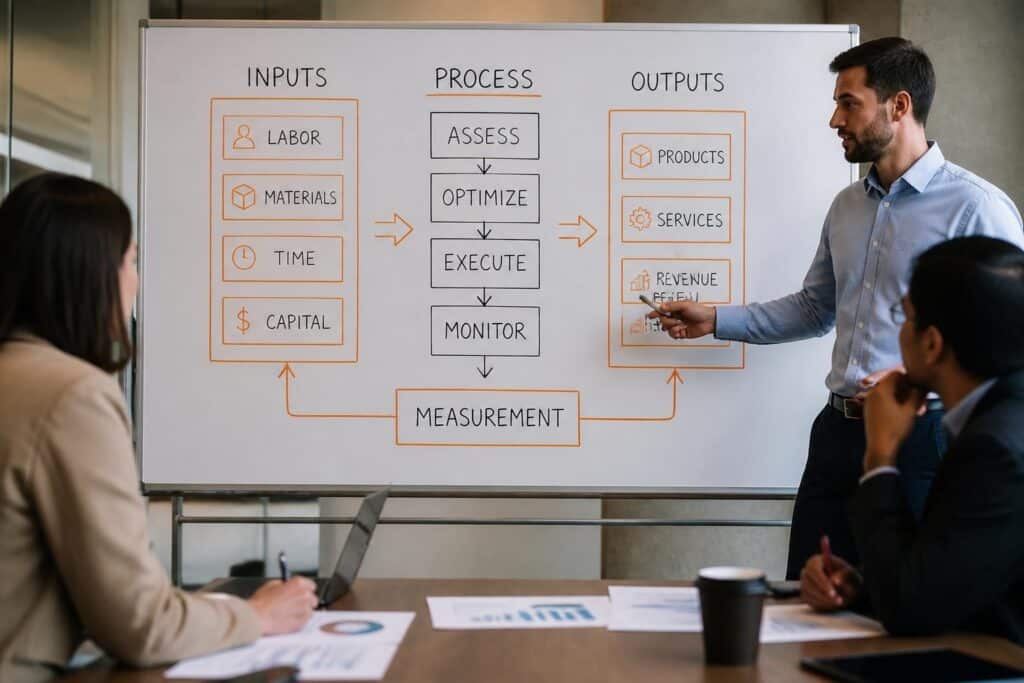
Organizations waste an estimated 20-30% of their revenue on inefficient processes, duplicated effort, and manual workarounds. As companies scale, these inefficiencies compound exponentially, creating bottlenecks that slow decision-making and erode competitive advantage. The ability to systematically streamline processes has become a critical competency for operations leaders navigating the complexity of modern business operations in 2026.
TL;DR:
- Streamlining processes means systematically removing waste, redundancy, and unnecessary steps from workflows to improve speed, accuracy, and resource utilization.
- Effective process streamlining requires mapping current workflows, identifying bottlenecks, prioritizing improvements based on ROI, and implementing automation where appropriate.
- Custom software solutions deliver higher ROI than off-the-shelf tools for complex or industry-specific workflows by eliminating workarounds and fitting exact operational requirements.
- Change management is essential-60-70% of process improvement initiatives fail due to poor adoption, not technical issues.
- Organizations should start with high-volume, high-error processes before tackling specialized or low-frequency workflows.
What Does It Mean to Streamline Processes?
To streamline processes is to systematically analyze, redesign, and optimize workflows by removing unnecessary steps, reducing handoffs, eliminating redundancies, and automating repetitive tasks to achieve specific outcomes faster with fewer resources.
Process streamlining differs from simple automation. Automation applies technology to existing workflows, which can inadvertently speed up inefficient processes. Streamlining first examines whether each step adds value, eliminates waste, then applies appropriate technology. This approach prevents organizations from automating broken workflows-a common mistake that locks in inefficiency.
Organizations typically streamline processes to achieve one or more of these objectives:
- Reduce cycle time: Decrease the duration from process initiation to completion
- Lower operating costs: Minimize labor hours, materials, or overhead required
- Improve accuracy: Reduce error rates and rework cycles
- Enhance visibility: Create real-time insight into process status and bottlenecks
- Enable scaling: Allow processes to handle increased volume without proportional resource growth
Understanding what to streamline requires distinguishing value-adding activities from waste. Value-adding steps transform inputs in ways customers will pay for. Waste includes waiting, excess motion, overprocessing, defects, and unnecessary inventory or information transfer.

How Do You Identify Which Processes to Streamline First?
Start by mapping all processes in a department or function, then score each on three dimensions: frequency, error rate, and strategic impact. Processes that score high on all three dimensions deliver the fastest ROI when streamlined.
Process Prioritization Framework:
| Criterion | Weight | Scoring Method |
|---|---|---|
| Frequency | 30% | Executions per month × hours per execution |
| Error Rate | 25% | % of executions requiring rework or correction |
| Strategic Impact | 25% | Revenue or customer satisfaction dependency (1-5 scale) |
| Improvement Potential | 20% | Estimated time/cost reduction possible (%) |
High-frequency processes with modest inefficiency often yield better returns than complex, low-frequency processes, even if the latter have severe problems. A process executed 500 times monthly with 10% waste reduction saves more total hours than a quarterly process with 50% waste reduction.
After scoring, conduct value stream mapping for your top five candidates. Document every step, decision point, handoff, and wait time. Measure actual cycle time versus touch time (active work). The gap reveals hidden waste.
Red flags indicating streamlining priority:
- Multiple systems for the same data: Sales reps entering customer information in CRM, spreadsheets, and email
- Serial approvals with no parallel paths: Six signatures required in sequence when four could happen simultaneously
- Manual data transfer between systems: Copying information from one application to another
- Verbal or email-based handoffs: "Let me know when you're done" instead of automated notifications
- Inconsistent execution: Different team members following different versions of the same process
Focus first on processes that cross departmental boundaries. These typically contain the most waste because each department optimizes for local efficiency rather than end-to-end flow. Understanding how CRM systems connect customer interactions across sales, service, and support illustrates this cross-functional integration.
What Are the Steps to Streamline Processes Effectively?
Effective process streamlining follows a structured six-phase methodology adapted from Lean and Six Sigma disciplines, tailored for 2026's digital-first environment.
Phase 1: Document Current State
Map the process exactly as executed today, not as documented in procedure manuals. Shadow employees, capture screenshots, record decision rules, and measure actual timeframes. Identify all inputs, outputs, systems, and stakeholders.
Use SIPOC (Supplier, Input, Process, Output, Customer) diagrams to establish boundaries. For each step, document who performs it, what information they need, what systems they access, and how long it takes.
Phase 2: Analyze and Measure Baseline
Quantify current performance across key metrics: cycle time, error rate, cost per execution, customer satisfaction impact, and resource utilization. Establish statistical baselines to measure improvement against.
Common measurement mistakes:
- Measuring only successful completions, ignoring failed attempts or abandoned workflows
- Averaging times without understanding variation (a process averaging 2 hours might range from 30 minutes to 8 hours)
- Focusing solely on labor cost while ignoring opportunity cost or customer impact
- Failing to capture exception handling and workaround effort
Phase 3: Identify Root Causes of Inefficiency
Apply the Five Whys technique to each identified bottleneck or waste source. Most process inefficiency stems from system limitations, unclear decision criteria, missing information at the point of work, or misaligned incentives.
Distinguish symptoms from causes. "This step takes too long" is a symptom. The cause might be waiting for information stored in another system, unclear authority to proceed, or lack of standardized inputs from the previous step.
Phase 4: Design Future State
Redesign the workflow by applying these principles in order:
- Eliminate: Remove steps that don't add value or exist only because of previous system limitations
- Combine: Merge sequential steps that could be done simultaneously or by the same person
- Resequence: Move steps to reduce wait time or enable parallel processing
- Simplify: Reduce complexity in decision rules, approvals, or data requirements
- Automate: Apply technology to remaining manual, repetitive steps
MIT research on workflow redesign demonstrates that organizations achieving the greatest efficiency gains redesign workflows before applying automation, rather than automating existing processes.
Phase 5: Implement Technology and Change Management
Technology enablement and people adoption must proceed in parallel. The most sophisticated automation delivers zero value if employees revert to old methods.
Implementation sequence:
- Pilot with a small team to validate the redesigned process and surface hidden issues
- Document new standard operating procedures with clear decision criteria
- Train all affected employees on both the new process and supporting tools
- Establish clear success metrics and feedback loops
- Monitor adoption and address resistance through coaching, not mandates
Prosci’s ADKAR methodology provides structured frameworks for building awareness, desire, knowledge, ability, and reinforcement necessary for sustained adoption.
Phase 6: Monitor and Continuously Improve
Establish control charts and dashboards that track the metrics baselined in Phase 2. Set thresholds that trigger investigation when performance degrades. Schedule quarterly reviews to identify new optimization opportunities as business conditions change.
Process streamlining is not a one-time project. Effective organizations build continuous improvement into operating rhythms through kaizen events, retrospectives, and regular process audits.

What Role Does Custom Software Play in Streamlining Processes?
Custom software eliminates the compromises, workarounds, and manual bridges required when adapting off-the-shelf solutions to unique workflows. For processes central to competitive advantage or those with industry-specific requirements, custom development typically delivers 3-5× higher ROI than configuring packaged software.
When Custom Software Delivers Superior Streamlining:
Organizations benefit most from custom software when:
- Workflows involve proprietary methods or intellectual property that differentiate the business
- Industry regulations require specific traceability, audit trails, or reporting that generic tools don't support
- Integration requirements span multiple legacy systems with unique data models
- User roles and permissions follow non-standard patterns
- Process volume justifies development investment (typically 50+ executions weekly)
Generic CRM or ERP systems force users to adapt their work to the software's assumptions about how business operates. Custom solutions adapt to actual workflows, eliminating the translation layer where errors and inefficiency accumulate.
For example, field service management software designed for industrial equipment servicing includes serialized asset tracking, service history linking, and automated compliance documentation that generic task management tools cannot replicate without extensive customization.
Custom vs. Off-the-Shelf: ROI Comparison
| Factor | Off-the-Shelf | Custom Software |
|---|---|---|
| Initial Cost | Lower ($5K-50K) | Higher ($50K-500K) |
| Implementation Time | 1-3 months | 3-12 months |
| Workflow Fit | 60-80% match | 95-100% match |
| Workaround Requirement | High | Minimal |
| Maintenance Cost | 15-20% annual | 10-15% annual |
| Competitive Differentiation | None | High |
| Long-term TCO (5 years) | Higher for complex workflows | Lower for complex workflows |
Custom software becomes cost-effective when the annual value of eliminated workarounds exceeds 15-20% of development cost. Calculate workaround cost by measuring time spent manipulating data between systems, manual data entry duplicating information, and errors introduced through translation steps.
Organizations successfully streamline processes through custom development by starting with detailed process documentation before writing code. Working with experienced development teams ensures software design reflects actual operational needs rather than developers' assumptions about how work should flow.
Brytend CRM exemplifies this approach by incorporating AI-driven lead capture and customizable workflows that match each client's specific sales process, eliminating the data re-entry and process adaptation required with standardized CRM platforms. Organizations streamline customer relationship processes by implementing CRM systems designed around their unique workflows rather than forcing teams to adapt to rigid, pre-built systems.

How Do You Measure ROI From Process Streamlining Initiatives?
ROI measurement for process streamlining requires capturing both hard cost reductions and soft value creation across multiple dimensions. Most organizations underestimate returns by measuring only direct labor savings while ignoring quality improvements, faster time-to-market, and enhanced customer experience.
Comprehensive ROI Framework:
Calculate total return across six categories:
- Direct labor savings: (Hours eliminated per execution) × (Executions per year) × (Fully loaded hourly rate)
- Error reduction value: (Error rate decrease %) × (Annual executions) × (Average cost per error)
- Opportunity cost recovery: (Cycle time reduction days) × (Revenue per day for time-sensitive workflows)
- Customer satisfaction impact: (NPS or CSAT increase points) × (Customer lifetime value correlation)
- Compliance risk reduction: (Audit findings decrease) × (Average cost per finding)
- Scaling capacity: (Additional volume handled) × (Cost to handle via previous method)
Example Calculation:
A B2B service company streamlines its customer onboarding process:
- Labor savings: 8 hours eliminated per onboarding × 150 customers/year × $65/hour = $78,000
- Error reduction: 25% fewer setup errors × 150 customers × $500 average correction cost = $18,750
- Faster revenue recognition: 5 days faster to first invoice × 150 customers × $300 daily opportunity cost = $225,000
- Total annual return: $321,750
- Implementation cost: $85,000 (software + process redesign)
- ROI: 278% first year, ongoing $320K+ annual benefit
Measure ROI at 30, 90, and 180 days post-implementation to track adoption curves and identify unexpected benefits or challenges. Early wins build momentum for broader process improvement initiatives.
Common ROI Measurement Mistakes:
- Counting time saved without verifying employees actually stopped doing eliminated tasks
- Measuring best-case performance instead of average performance across all users
- Ignoring implementation and change management costs in total investment
- Failing to establish valid baselines before process changes
- Attributing improvements to streamlining that resulted from other concurrent initiatives
NIST guidance on automation and assessment emphasizes measuring both efficiency gains and maintained compliance when streamlining regulated processes.
What Are the Biggest Mistakes When Trying to Streamline Processes?
Organizations attempting to streamline processes commonly fail by automating without redesigning, changing too much simultaneously, ignoring the people side of change, or optimizing individual steps rather than end-to-end flow.
Automating Broken Processes
The most expensive mistake is applying technology to existing workflows without first eliminating waste. Automated inefficiency runs faster but remains inefficient. Always redesign before automating.
Example: A manufacturer automated purchase order approvals, reducing approval time from 2 days to 2 hours. However, the approval process itself was unnecessary for 80% of orders under $5,000 from established vendors. Proper streamlining would have eliminated approval entirely for routine purchases, not just accelerated it.
Changing Too Much at Once
Attempting to streamline all processes simultaneously overwhelms organizations and prevents learning from early implementations. Pilot approaches, gather lessons, then scale.
Start with 1-2 high-value processes, achieve measurable success, document lessons learned, then expand. Rapid sequential improvement beats simultaneous chaos.
Ignoring Change Management
Technical process redesign accounts for only 30-40% of streamlining success. The remaining 60-70% depends on people adopting new methods. The World Economic Forum’s analysis of organizational adaptation shows successful companies invest equally in technology and in helping employees transition to new workflows.
Change Management Essentials:
- Involve process users in redesign, not just management
- Communicate why changes matter, not just what changes
- Provide hands-on training, not just documentation
- Expect initial productivity dips during transition periods
- Celebrate early wins and address resistance with coaching
Optimizing Silos Instead of End-to-End Flow
Improving individual departmental efficiency often worsens overall organizational performance when it creates bottlenecks elsewhere. Streamlining must consider complete value streams from customer request to delivery.
A sales team implementing faster quote generation is counterproductive if operations cannot fulfill at the promised timelines. System-level thinking prevents local optimization that damages global performance.
Failing to Standardize Before Automating
Automating inconsistent processes locks in variation and creates multiple automated paths requiring maintenance. Establish standard methods first, then apply technology.
Pre-automation checklist:
- Process executed the same way by all users
- Decision criteria clearly documented and agreed upon
- Inputs standardized with defined formats and sources
- Exception handling rules established
- Performance metrics and targets defined
Organizations that standardize before streamlining achieve 40-60% better adoption rates and sustain improvements longer than those rushing to technology solutions.

How Does Process Streamlining Apply to Specific Industries?
While core streamlining principles remain consistent, implementation varies significantly across industries based on regulatory requirements, asset intensity, customer interaction patterns, and operational complexity.
Manufacturing and Industrial Operations
Manufacturing organizations streamline processes to reduce setup times, minimize work-in-progress inventory, improve equipment utilization, and accelerate quality inspections. Serialized inventory tracking and traceability requirements create unique needs that generic software often handles poorly.
Digital service forms replace paper-based inspections, maintenance logs, and quality checklists, eliminating transcription errors and enabling real-time visibility into equipment status across facilities.
Key streamlining opportunities:
- Predictive maintenance scheduling based on actual equipment usage versus calendar intervals
- Automated quality data capture at production points instead of end-of-line batch inspection
- Integrated planning connecting demand forecasts directly to production scheduling
- Real-time inventory visibility eliminating physical counts and reconciliation cycles
Professional Services and Consulting
Service organizations streamline client onboarding, project delivery, time tracking, and billing processes. High-touch client relationships require flexibility that rigid standardization can damage.
Custom software enables standardized data capture with flexible workflows, maintaining process consistency while allowing professional judgment. Project templates with built-in best practices streamline delivery while preserving customization.
Field Service and Equipment Distribution
Field service companies manage technician scheduling, parts inventory, service documentation, compliance reporting, and customer communication across distributed locations. Process efficiency directly impacts customer satisfaction and operational cost.
Streamlining reduces dispatch time, improves first-time fix rates, automates compliance documentation, and eliminates duplicate data entry between field and office systems. Mobile-enabled workflows allow technicians to complete documentation on-site rather than recreating information later.
B2B Sales and Distribution
Complex B2B sales cycles involve multiple stakeholders, custom pricing, technical specifications, and long approval chains. Streamlining reduces quote generation time, improves forecast accuracy, and accelerates contract negotiation.
Integrated systems connecting CRM, quoting, inventory, and fulfillment eliminate handoffs where opportunities stall. Automated proposal generation from standardized templates maintains brand consistency while reducing preparation time from days to hours.
What Emerging Technologies Enable Better Process Streamlining in 2026?
Modern streamlining leverages AI-powered decision support, no-code automation platforms, API-first architectures, and real-time analytics that were impractical or unavailable in previous years.
AI and Machine Learning
AI enables smarter automation by handling exceptions and variations that rule-based systems cannot process. Natural language processing extracts structured data from unstructured sources like emails and documents. Predictive models identify potential bottlenecks before they occur.
Practical AI applications for streamlining:
- Intelligent document routing based on content analysis
- Predictive resource allocation optimizing capacity utilization
- Anomaly detection flagging process deviations for investigation
- Natural language interfaces reducing training requirements for complex systems
AI works best when combined with clean, structured processes. Applying AI to chaotic workflows produces inconsistent results. Streamline first, then augment with intelligence.
API-First Integration
Modern systems expose functionality through APIs, enabling lightweight integration without complex middleware or custom coding. Organizations streamline processes by connecting best-of-breed systems rather than forcing all functionality into single platforms.
API-based architectures support gradual modernization. Replace one component while maintaining connections to existing systems, reducing risk and enabling phased investment.
Low-Code and No-Code Platforms
These platforms enable business users to modify workflows without developer involvement, accelerating iteration and reducing backlogs. However, governance is critical to prevent proliferation of ungoverned solutions.
Establish clear guidelines for when citizen development is appropriate versus when professional development is required. Simple forms and linear workflows suit no-code tools. Complex logic, security requirements, or integration needs warrant custom development.
Real-Time Analytics and Monitoring
Modern dashboards provide live visibility into process performance, enabling rapid response to developing issues. Track cycle time, queue depth, error rates, and resource utilization continuously rather than through periodic reports.
Real-time monitoring transforms reactive operations into proactive management. Identify patterns indicating future problems and adjust before impact occurs.
Technology Selection Framework:
| Requirement | Best Approach |
|---|---|
| Simple data collection | No-code forms (survey tools, digital checklists) |
| Connecting 2-3 standard systems | API integration via platforms like Zapier |
| Complex business logic or calculations | Custom software development |
| High-volume transaction processing | Custom or enterprise platforms |
| Unique competitive differentiators | Custom software development |
| Rapid prototyping and iteration | Low-code platforms for non-critical processes |
Technology should serve streamlined processes, not dictate them. Select tools after redesigning workflows, not before.
Effective process streamlining requires systematic methodology, organizational commitment to change, and technology aligned with actual operational needs. Organizations that invest in thorough analysis before automation, prioritize end-to-end flow over departmental optimization, and balance technology investment with change management consistently achieve sustainable efficiency gains.
Whether you need to streamline customer interactions, service delivery, or internal operations, Brytend develops custom software solutions designed around your specific workflows and business requirements. Our experienced team helps organizations identify streamlining opportunities, redesign processes for maximum efficiency, and implement technology that eliminates workarounds while supporting your teams' success.