
Software sales represents the systematic process of identifying prospects, demonstrating value, negotiating terms, and closing contracts for software products or services. This revenue-generating function combines relationship building, technical expertise, pricing strategy, and structured methodologies to convert prospects into paying customers across SaaS, enterprise software, and custom development markets.
TL;DR:
- Software sales follows a multi-stage process from lead generation through contract closure and renewal
- Key metrics include customer acquisition cost (CAC), annual recurring revenue (ARR), and net revenue retention (NRR)
- Successful approaches use consultative methodologies like Challenger Sales and MEDDIC qualification
- Pricing models range from per-user subscriptions to usage-based and value-based structures
- Post-sale success drives expansion revenue and reduces churn in subscription models
What Is the Software Sales Process
The software sales process is a defined sequence of stages that moves a prospect from initial awareness to signed contract and ongoing customer relationship. This process varies by product complexity, deal size, and sales cycle length, but follows core stages that establish qualification criteria, value alignment, and mutual commitments.
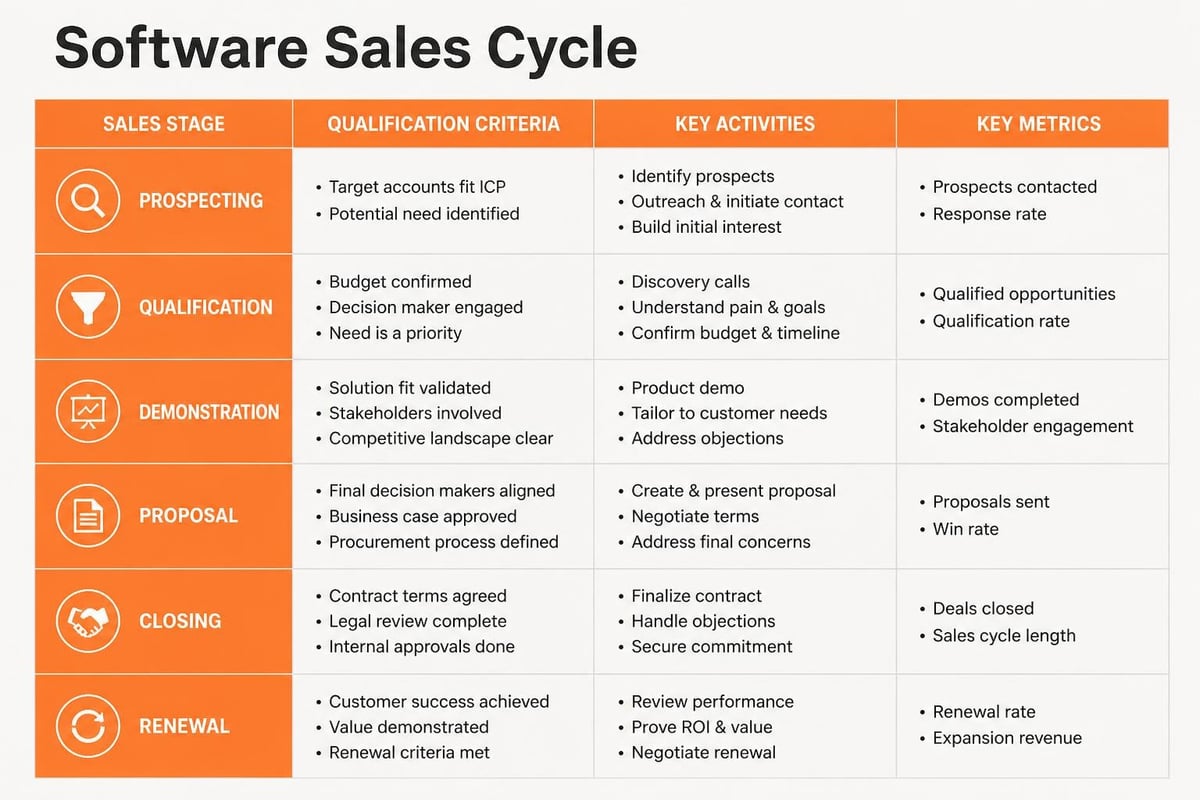
A typical B2B software sales process includes six primary stages:
- Prospecting and lead generation – Identifying potential customers through outbound research, inbound marketing, referrals, and partnerships
- Discovery and qualification – Understanding prospect needs, budget, authority, timeline, and fit using frameworks like BANT or MEDDIC
- Demonstration and value mapping – Presenting solutions, conducting product demos, and connecting features to specific business outcomes
- Proposal and negotiation – Submitting formal pricing, terms, and scope while addressing objections and commercial concerns
- Contract closure – Finalizing legal agreements, security reviews, and procurement requirements
- Onboarding and expansion – Implementing solutions, training users, and identifying upsell opportunities
According to the 2024 SaaS Benchmarks report, average sales cycles range from 34 days for small deals under $5,000 to 170+ days for enterprise contracts exceeding $100,000 in annual contract value.
Discovery Stage Requirements
Discovery determines whether a prospect has genuine need, budget, and organizational support for your solution. Effective discovery goes beyond surface-level pain points to uncover business impact, technical requirements, decision-making processes, and success criteria.
Critical discovery questions address:
- Current workflows and systems used for the problem your software solves
- Quantified impact of the problem (time wasted, revenue lost, errors made)
- Previous attempts to solve the issue and why they failed
- Decision-making process, stakeholders involved, and approval requirements
- Budget allocated and procurement timeline
- Technical environment, integration needs, and security/compliance requirements
Sales teams that conduct thorough discovery close deals 47% faster than those using generic presentations, because they can tailor demonstrations and proposals to verified needs rather than assumed requirements.
How Do Software Sales Methodologies Work
Software sales methodologies provide structured frameworks for managing complex B2B sales cycles with multiple stakeholders, long evaluation periods, and significant investment decisions. These methodologies standardize rep behavior, qualification criteria, and advancement triggers to improve forecast accuracy and win rates.
The Challenger Sales methodology has become dominant in software sales due to its focus on teaching prospects new perspectives rather than simply responding to stated requirements. Challenger reps lead with insights about industry trends, competitive threats, or unrealized opportunities that reframe how buyers think about their problems.
| Methodology | Best For | Core Principle | Key Stages |
|---|---|---|---|
| Challenger | Complex B2B software | Teach, tailor, take control | Warmer, reframe, rational drowning, emotional impact |
| MEDDIC | Enterprise deals >$50K | Rigorous qualification | Metrics, economic buyer, decision criteria, decision process, identify pain, champion |
| Solution Selling | Custom development | Diagnose before prescribing | Pain discovery, vision creation, value quantification |
| SPIN Selling | Consultative sales | Question-led discovery | Situation, problem, implication, need-payoff questions |
MEDDIC Qualification Framework
MEDDIC (Metrics, Economic Buyer, Decision Criteria, Decision Process, Identify Pain, Champion) requires sales reps to verify specific information before advancing deals through pipeline stages. This qualification rigor prevents wasted time on unwinnable opportunities.
A qualified MEDDIC opportunity must have:
- Metrics – Quantified business impact the prospect expects from your solution (e.g., "reduce processing time by 40 hours per month")
- Economic Buyer – Identified executive with budget authority who has agreed to the business case
- Decision Criteria – Written requirements your solution must meet, with relative weighting of must-haves versus nice-to-haves
- Decision Process – Documented steps, stakeholders, and timeline from proposal to contract signature
- Identify Pain – Verified business problem with cost of inaction that exceeds cost of your solution
- Champion – Internal advocate with power and credibility who actively sells on your behalf
Organizations using MEDDIC report 25-30% higher win rates on qualified opportunities compared to generic qualification approaches, because they eliminate deals lacking essential success criteria before investing significant sales resources.
What Metrics Define Software Sales Performance
Software sales performance measurement combines activity metrics, conversion metrics, and economic metrics to evaluate individual rep productivity, team effectiveness, and business unit health. These metrics differ significantly between transactional SaaS sales and complex enterprise software sales.
Essential software sales metrics include:
Activity Metrics:
- Outbound contacts per day (calls, emails, social touches)
- Meetings scheduled and completed
- Demonstrations delivered
- Proposals submitted
Conversion Metrics:
- Lead-to-opportunity conversion rate
- Opportunity-to-win conversion rate
- Average sales cycle length by deal size
- Win rate versus primary competitors
Economic Metrics:
- Customer Acquisition Cost (CAC) – Total sales and marketing expense divided by new customers acquired
- Annual Recurring Revenue (ARR) or Annual Contract Value (ACV)
- Average Contract Value (ACV) or Average Selling Price (ASP)
- Customer Lifetime Value (LTV)
- CAC Payback Period – Months required to recover acquisition costs through gross margin
The 2024 SaaS Benchmarks report shows median CAC payback periods of 18 months for B2B SaaS companies, with top quartile performers achieving 12-month payback. Net Revenue Retention (NRR) averages 105% for best-in-class software companies, indicating expansion revenue exceeds churn.

Revenue Metrics for Custom Software Development
Custom software development sales requires modified metrics because deals are typically project-based rather than subscription-based, and revenue recognition follows milestone completion rather than monthly recurring charges.
Critical metrics for custom development sales include:
- Pipeline Coverage Ratio – Total pipeline value divided by quarterly quota (should be 3-4x for enterprise deals with 25% win rates)
- Project Margin – Revenue minus direct costs (development hours, third-party services, infrastructure)
- Repeat Customer Rate – Percentage of clients returning for additional projects within 18 months
- Scope Expansion Rate – Percentage of projects that expand beyond initial statement of work
- Average Project Value – Mean contract value across all closed deals
For firms like Brytend, which specializes in custom software solutions, tracking these metrics helps identify which industries, project types, or engagement models deliver the highest lifetime value and inform strategic positioning decisions.
How Does Software Pricing Impact Sales Results
Software pricing strategy directly influences sales cycle length, win rates, competitive positioning, and customer lifetime value. Pricing models in 2026 have evolved beyond simple per-user subscriptions to include usage-based, outcome-based, and hybrid structures that align cost with realized value.
According to the SBI State of B2B SaaS Pricing report, 38% of B2B software companies now use usage-based or hybrid pricing models, up from 23% in 2023, because these models reduce buyer risk and capture more value from power users.
Common software pricing models include:
| Pricing Model | Structure | Best For | Sales Considerations |
|---|---|---|---|
| Per-user/seat | Fixed price per user per month | Collaboration tools, CRM systems | Easy to understand but penalizes team growth |
| Tiered/feature-based | Packages with increasing capabilities | SMB to enterprise sales | Clear upgrade path but potential for feature confusion |
| Usage-based | Price scales with consumption metrics | Infrastructure, APIs, data processing | Aligns with value but creates revenue unpredictability |
| Value-based | Price tied to business outcomes | Enterprise software, custom development | Maximizes willingness to pay but requires outcome tracking |
| Flat-rate unlimited | Single price regardless of usage | Simple tools, niche applications | Predictable but leaves money on table with heavy users |
Value-Based Pricing for Custom Development
Value-based pricing sets prices according to quantified business value delivered rather than cost-plus margins or competitive benchmarks. This approach is particularly effective for custom software development where solutions create measurable efficiency gains, revenue increases, or risk reductions.
A custom customer relationship management system that automates sales workflows and eliminates 60 hours of manual data entry monthly creates approximately $7,200 in annual labor savings (60 hours × 12 months × $10/hour fully loaded cost). Value-based pricing would charge 20-40% of annual savings ($1,440-$2,880 annually), capturing significant value while delivering ROI above 200%.
Brytend CRM offers comprehensive customer relationship management capabilities that automate lead tracking, streamline workflows, and provide AI-driven insights. Organizations implementing structured CRM systems report 29% higher win rates and 27% shorter sales cycles compared to teams using spreadsheets or disconnected tools.

Implementing value-based pricing requires:
- Discovery of business metrics – Identify current state performance (time spent, error rates, revenue per customer)
- Quantification of improvement – Project future state based on similar implementations or pilot results
- Financial modeling – Convert improvements into dollar value using client's labor rates, margin assumptions, or opportunity costs
- Risk-adjusted pricing – Set price at percentage of projected value that compensates for implementation uncertainty
Value-based approaches increase average deal sizes 30-50% compared to cost-plus pricing for custom development projects, because they shift conversations from hours and resources to business outcomes and return on investment.
What Does the Modern Software Buyer Journey Look Like
The modern software buying journey in 2026 is largely self-directed, with buyers completing 60-70% of their evaluation process before engaging sales representatives. This shift requires software sales teams to focus on digital enablement, thought leadership, and rapid response to inbound signals rather than traditional cold prospecting.
Research from Forrester on the State of Business Buying shows that B2B buyers now interact with an average of 11.4 pieces of content before requesting a demonstration, and 83% prefer to research independently through vendor websites, peer reviews, and industry publications.
Buyer Journey Stages and Sales Alignment
Modern software buyers move through distinct stages that require different sales responses and content types:
Awareness Stage (Problem Recognition):
- Buyer realizes current approach is insufficient
- Researches problem symptoms and potential solutions
- Sales response: Educational content, industry benchmarking, problem frameworks
- Content types: Blog posts, research reports, industry guides
Consideration Stage (Solution Exploration):
- Buyer evaluates solution categories and approaches
- Compares vendors, reads reviews, requests demonstrations
- Sales response: Product education, differentiation, proof points
- Content types: Product comparisons, case studies, ROI calculators
Decision Stage (Vendor Selection):
- Buyer narrows to 2-3 finalists and conducts detailed evaluation
- Requires internal approval, legal review, security assessment
- Sales response: Custom proposals, reference calls, executive alignment
- Content types: Security documentation, implementation plans, contract templates
Implementation Stage (Onboarding):
- Buyer deploys solution and trains users
- Validates expected outcomes and identifies expansion opportunities
- Sales response: Success planning, quarterly business reviews, upsell discussions
- Content types: Training materials, best practice guides, feature updates
Aligning sales activities with actual buyer behavior reduces friction, improves win rates, and shortens sales cycles by delivering relevant information when buyers are ready to consume it rather than forcing premature sales conversations.
How Do Software Sales Teams Handle Technical Complexity
Technical complexity in software sales creates both challenges and differentiation opportunities. Solutions involving custom development, system integration, or enterprise architecture require sales professionals who can navigate technical discussions while maintaining focus on business outcomes.
Effective technical sales approaches include:
Sales Engineer Partnership:
Pairing account executives with solutions engineers who handle deep technical discussions, architecture reviews, and proof-of-concept implementations. This division allows AEs to focus on business alignment while SEs address technical feasibility, integration requirements, and implementation planning.
Technical Qualification Frameworks:
Structured discovery of technology stack, existing systems, integration points, data volumes, security requirements, and compliance obligations. This information determines solution feasibility, implementation complexity, and potential technical objections before advancing deals.
Proof of Concept (POC) Governance:
Defining specific success criteria, timeline, and resource commitments before beginning technical evaluations. Effective POCs include written objectives, acceptance criteria, and next-step commitments to prevent endless evaluation cycles.
Managing Custom Development Sales Cycles
Custom software development sales cycles average 60-120 days for mid-market deals and 180+ days for enterprise engagements, because buyers must define requirements, evaluate technical capabilities, and secure budget approval for multi-year relationships.
Critical activities in custom development sales include:
- Requirements discovery workshops – Facilitated sessions that document current workflows, pain points, and desired outcomes
- Technical architecture review – Assessment of existing systems, integration needs, and technology constraints
- Phased implementation proposal – Breaking large projects into milestone-based phases that demonstrate value and reduce risk
- Reference architecture presentation – Showing similar implementations with comparable technical complexity
- Development team introduction – Connecting prospects with actual developers who will build their solution
Organizations like Brytend succeed in custom development sales by combining business consultancy with technical expertise, allowing sales teams to credibly discuss both strategic objectives and implementation details. This dual capability reduces buyer uncertainty and accelerates decision-making.
What Role Does Customer Success Play in Software Sales
Customer success has evolved from post-sale support to a revenue-generating function that drives expansion, prevents churn, and influences new customer acquisition through references and case studies. In subscription software models, retention economics often matter more than new customer acquisition for long-term profitability.
The Bain Technology Report 2024 documents that customer success organizations are failing at many software companies, with average Net Revenue Retention declining from 120% in 2021 to 105% in 2024. This degradation stems from reactive support models rather than proactive value realization frameworks.
High-performing customer success operations include:
Onboarding Excellence:
- Structured 30-60-90 day implementation plans with specific milestones
- User training and certification programs
- Success criteria validation within first quarter
Health Score Monitoring:
- Product usage analytics tracking feature adoption and engagement depth
- Support ticket volume and sentiment analysis
- Relationship health through executive sponsor engagement
Expansion Planning:
- Quarterly business reviews that document ROI and identify new use cases
- Feature adoption roadmaps that introduce advanced capabilities
- Upsell triggers based on usage thresholds or organizational changes
Renewal Management:
- 120-day renewal preparation with outcome documentation
- Multi-year incentives and commitment-based discounting
- Executive alignment on strategic value beyond tactical features
Software Sales and Long-Term Revenue Models
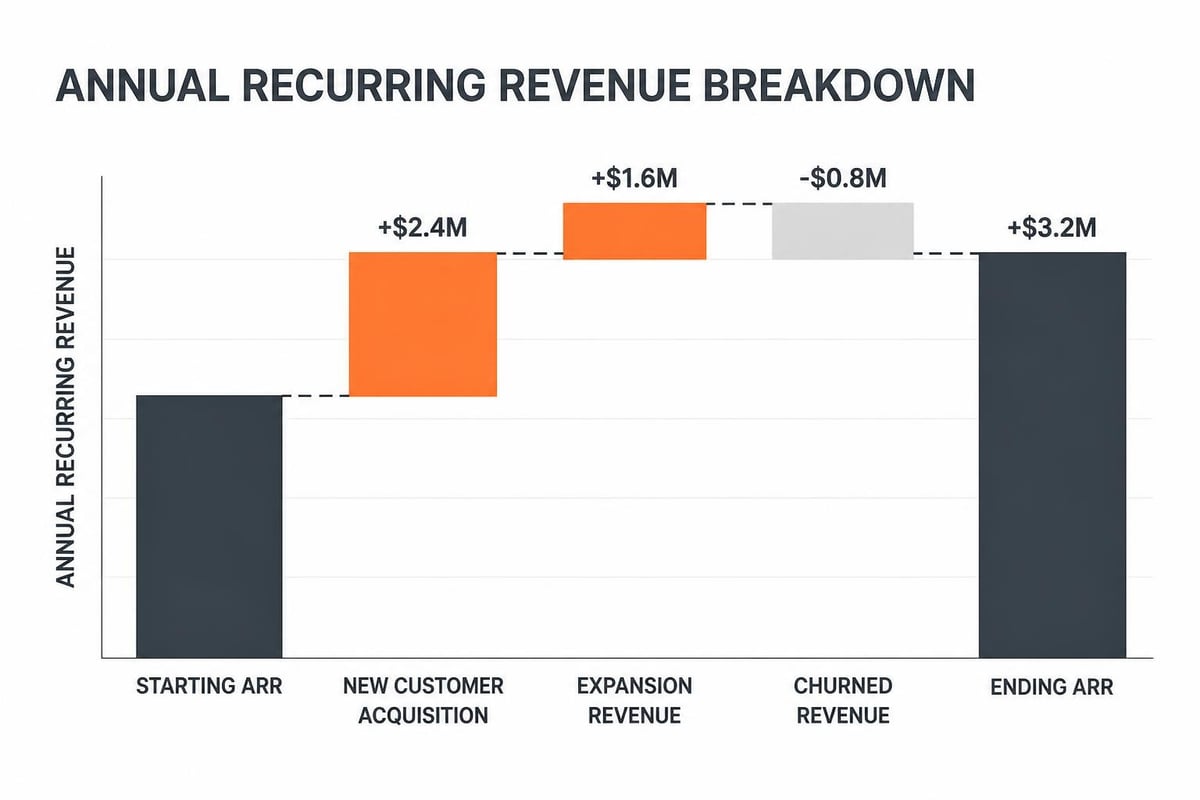
Software sales performance increasingly depends on post-sale revenue through expansion and renewals rather than solely on new customer acquisition. This economic shift requires sales teams to maintain customer relationships beyond contract signature and participate in expansion opportunities.
Organizations with Net Revenue Retention above 110% achieve this through:
- Land-and-expand strategies – Starting with departmental implementations and expanding enterprise-wide
- Usage-based upsells – Automatic revenue growth as customer consumption increases
- Feature-based upgrades – Tiered pricing that encourages upgrading as needs grow
- Multi-product cross-sells – Selling complementary solutions to existing customers
For custom development firms, long-term revenue comes from ongoing maintenance, feature enhancements, and new project work from satisfied clients. Tracking repeat customer rates and expansion project values provides insight into solution quality and relationship strength.
How Do Software Sales Teams Use Technology and Tools
Software sales organizations use technology stacks that include CRM systems, sales engagement platforms, proposal software, and analytics tools to manage pipelines, automate repetitive tasks, and provide visibility into sales performance.
Essential technology categories include:
Customer Relationship Management:
Centralized databases that track all prospect and customer interactions, including emails, calls, meetings, and notes. Modern CRM systems integrate with email, calendar, and communication tools to automatically log activities and update records.
Sales Engagement Platforms:
Tools that automate outbound sequences, track email opens and link clicks, and provide templates for common scenarios. These platforms increase rep productivity by standardizing proven messaging and automating follow-up cadences.
Proposal and CPQ (Configure-Price-Quote):
Systems that generate accurate proposals, configure complex products, apply pricing rules, and produce professional documents. CPQ tools reduce quoting errors and accelerate proposal delivery from days to hours.
Revenue Intelligence:
Analytics platforms that analyze call recordings, email content, and meeting transcripts to identify winning behaviors, coach reps, and forecast deal outcomes. These tools use AI to surface patterns in successful deals.
Contract and Document Management:
Digital signature, version control, and approval workflow systems that accelerate legal review and contract execution from weeks to days.
Mature software sales organizations integrate these systems to create unified workflows where data flows automatically between tools, eliminating manual data entry and providing real-time pipeline visibility. This integration is particularly important for custom software development firms managing complex, multi-phase engagements with evolving requirements.
Software sales in 2026 combines structured methodologies, data-driven metrics, buyer-centric processes, and technical expertise to convert prospects into long-term customers. Success requires understanding modern buying behavior, implementing rigorous qualification, delivering measurable value, and building relationships that extend beyond initial contract signature. Whether you need a robust customer relationship management system to track complex sales cycles or custom development expertise to build solutions that drive your revenue operations, Brytend delivers tailored software that aligns with your specific sales processes and business objectives.