
Compliance risk software is a category of enterprise applications that automates the identification, assessment, monitoring, and mitigation of regulatory and policy compliance risks across an organization. Organizations face mounting pressure from regulators, auditors, and stakeholders to demonstrate consistent adherence to frameworks such as SOX, GDPR, HIPAA, ISO standards, and internal governance policies. Manual compliance processes-spreadsheets, email chains, periodic audits-introduce human error, visibility gaps, and delayed remediation. Compliance risk software centralizes control libraries, automates evidence collection, tracks policy exceptions, and generates audit-ready documentation, reducing both risk exposure and administrative burden.
Note: compliance risk software covers the full cycle of identifying, assessing, and mitigating regulatory and policy risk. If you specifically need continuous, real-time monitoring of systems and transactions for violations, see our guide to compliance monitoring software.
What Is Compliance Risk Software and Why Do Organizations Use It?
Compliance risk software is a platform that consolidates regulatory requirements, maps them to internal controls, monitors control effectiveness, and provides real-time visibility into compliance posture. It translates complex regulatory obligations into actionable tasks, assigns ownership, tracks completion, and maintains a timestamped audit trail.
Organizations deploy compliance risk software for five primary reasons:
- Regulatory complexity: Companies operating in multiple jurisdictions or industries must comply with dozens of overlapping frameworks. Software maps requirements to controls once and applies them across business units.
- Audit efficiency: Automated evidence collection, control testing workflows, and centralized documentation reduce audit preparation time by 50-70% and lower external audit fees.
- Real-time risk visibility: Dashboards surface control failures, overdue remediation tasks, and emerging risks immediately, enabling proactive management rather than reactive firefighting.
- Consistency and accountability: Workflow engines enforce standardized processes, assign clear ownership, and prevent tasks from falling through cracks during personnel changes or organizational restructuring.
- Scalability: As organizations grow, acquire new entities, or enter new markets, compliance risk software scales policy distribution, control testing, and reporting without proportional headcount increases.
According to COSO’s guidance on integrating compliance risk into enterprise risk management, compliance should not operate in isolation but connect to strategic, operational, and financial risk management. Compliance risk software enables this integration by linking control performance to broader risk registers and executive dashboards.
Key Functional Capabilities
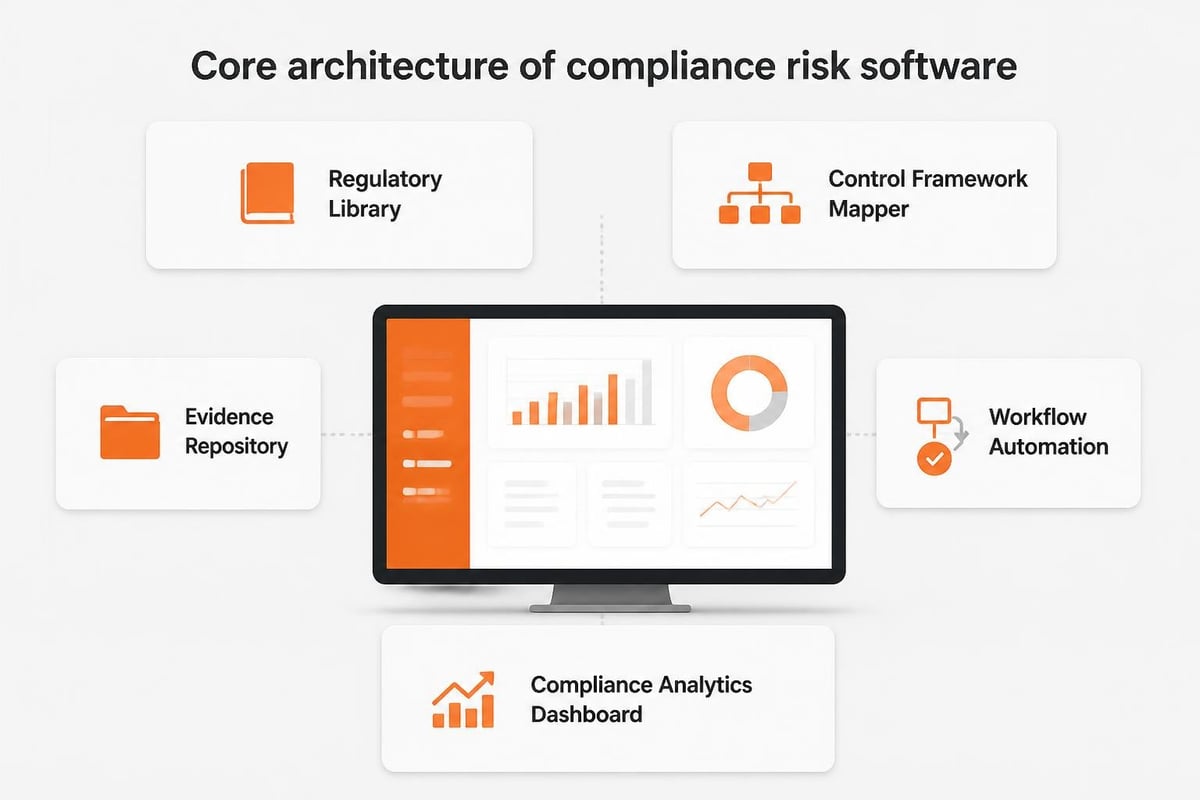
Effective compliance risk software delivers six core capabilities:
- Regulatory intelligence library: Pre-built, continuously updated regulatory content for major frameworks (SOX 404, GDPR Articles, FDA 21 CFR Part 11, PCI DSS) with change alerts when regulations are amended.
- Control framework management: Centralized repository of internal controls, mapped to regulatory requirements, business processes, and risk categories. Supports control hierarchies, versioning, and approval workflows.
- Risk and control assessment: Risk scoring matrices, control effectiveness ratings, and automated testing schedules. Supports control self-assessments (CSAs), manager certifications, and independent testing.
- Evidence and documentation: Centralized vault for policies, procedures, sign-offs, screenshots, test results, and third-party certifications. Automated linking of evidence to specific controls and requirements.
- Issue and remediation tracking: Deficiency identification, root-cause analysis, remediation action plans, escalation workflows, and closure verification. Integration with project management and ticketing systems.
- Reporting and analytics: Role-based dashboards, compliance scorecards, trend analysis, and audit-ready reports. Pre-built templates for board presentations, regulatory filings, and audit committees.
How Does Compliance Risk Software Differ from Manual Processes?
Manual compliance management relies on static documents, periodic reviews, and fragmented data stores. Compliance risk software transforms these into dynamic, connected, and continuously monitored systems.
| Aspect | Manual Process | Compliance Risk Software |
|---|---|---|
| Control library | Word documents, shared drives, version conflicts | Centralized database, version control, approval audit trail |
| Risk assessment | Annual spreadsheet exercises, inconsistent scoring | Continuous monitoring, standardized criteria, automated alerts |
| Evidence collection | Email requests, manual aggregation, lost attachments | Automated collectors, timestamped uploads, metadata tagging |
| Control testing | Ad-hoc sampling, manual documentation, delayed findings | Scheduled testing, workflow routing, real-time dashboards |
| Audit prep | Weeks of manual aggregation, last-minute scrambles | On-demand report generation, pre-linked evidence packages |
| Policy distribution | Email blasts, no confirmation, no version tracking | Targeted distribution, read receipts, attestation workflows |
The Deloitte report on technology use in compliance found that organizations using automated compliance platforms reduced compliance program costs by 25-40% while improving control testing coverage and audit quality.
Manual processes create latency between a control failure and remediation, often measured in weeks or months. Compliance risk software compresses this cycle to hours or days through automated monitoring and instant routing to responsible parties.
Common Manual Compliance Mistakes Software Prevents
- Orphaned controls: Controls remain in policy manuals long after processes change or owners leave the organization.
- Evidence gaps: Auditors request evidence for a control test, and the team discovers documentation was never collected or has been lost.
- Inconsistent risk ratings: Different departments apply different risk criteria, making aggregated risk reports meaningless.
- Policy version confusion: Employees reference outdated policies, creating compliance gaps and audit findings.
- Reactive issue tracking: Deficiencies are identified but not logged, assigned, or tracked to closure, resulting in repeat findings.
What Are the Core Features of Compliance Risk Software?
Compliance risk software varies by vendor and use case, but enterprise-grade platforms share a common feature set organized around the compliance lifecycle: identify, assess, control, monitor, report.
Regulatory Content and Mapping
Pre-built regulatory libraries translate legal language into operational requirements. For example, GDPR Article 30 (records of processing activities) is mapped to specific documentation controls, data inventory requirements, and update frequencies. When a regulation is amended, the software flags affected controls and triggers review workflows.
Change management features track which controls are impacted by new regulations or internal policy changes, automatically re-assign ownership, and schedule updated testing.
Policy and Procedure Management
Centralized policy authoring, review, approval, and distribution. Version control ensures only current policies are accessible. Policy attestation workflows require employees to acknowledge receipt and understanding, with non-compliance escalations and tracking.
Policy effectiveness monitoring links policy distribution to related incidents, control failures, and audit findings to identify gaps between policy intent and operational reality.
Control Assessment and Testing
Compliance risk software automates control testing schedules based on risk ratings (e.g., high-risk controls tested quarterly, low-risk annually). Testing workflows guide testers through sampling criteria, testing steps, evidence requirements, and pass/fail documentation.
Control self-assessment (CSA) campaigns distribute questionnaires to control owners, aggregate responses, and flag inconsistencies or missing data. Manager certifications collect sign-offs on control effectiveness for SOX or similar frameworks.
Continuous control monitoring integrates with operational systems to validate control execution in real time. For example, segregation of duties (SoD) monitoring queries ERP access logs to detect conflicts immediately rather than waiting for quarterly user access reviews.
The NIST guidance on continuous monitoring emphasizes automating control assessment to maintain ongoing awareness of security and compliance posture, a principle directly applicable to compliance risk software design.

Issue and Remediation Management
Deficiency logging captures control failures, policy violations, and audit findings in a centralized tracker. Root-cause analysis templates guide investigation and corrective action planning. Remediation workflows assign tasks, set deadlines, and escalate overdue items to management.
Trend analysis identifies recurring issues (e.g., the same control fails in multiple business units), prompting process redesign rather than repeated point fixes.
Audit and Reporting
Compliance risk software generates audit-ready documentation packages: control descriptions, risk assessments, test results, evidence files, and issue logs, all cross-referenced and timestamped. Role-based dashboards provide executives, compliance teams, and auditors with tailored views of compliance posture.
Pre-built report templates support board presentations (high-level risk summaries), regulatory filings (detailed control attestations), and audit committee briefings (trends, emerging risks, remediation status).
How Do You Implement Compliance Risk Software?
Successful implementation requires careful planning, stakeholder alignment, and phased rollout. Organizations that treat compliance risk software as a technology purchase rather than a business transformation frequently encounter adoption resistance and incomplete deployments.
Implementation Steps
-
Define scope and objectives: Identify which regulations, business units, and processes are in scope for the initial deployment. Set measurable objectives (e.g., reduce audit prep time by 50%, achieve 95% on-time control testing).
-
Assess current state: Document existing compliance processes, control libraries, risk assessments, and pain points. Identify data sources, system integrations, and stakeholder roles.
-
Select software and configure: Evaluate vendors based on regulatory content coverage, integration capabilities, workflow flexibility, and reporting features. Configure control frameworks, risk matrices, workflow rules, and user roles.
-
Migrate data and integrate systems: Import existing control libraries, policies, and historical assessment data. Integrate with ERP, HR, IT service management, and document management systems to automate evidence collection.
-
Train users and launch pilots: Train control owners, compliance teams, and auditors on workflows, evidence submission, and reporting. Launch pilots in one business unit or regulatory domain, refine processes, and document lessons learned.
-
Roll out enterprise-wide: Expand deployment to remaining business units and regulatory frameworks. Establish ongoing governance: regular control library reviews, workflow optimization, and continuous improvement.
-
Monitor adoption and optimize: Track usage metrics (control test completion rates, evidence submission timeliness, user login frequency). Collect feedback, refine workflows, and expand automation.
Best Practices for Deployment
- Start with high-impact, high-visibility frameworks: SOX or GDPR deployments demonstrate immediate value and build executive support for broader rollout.
- Integrate with existing workflows: Embed compliance tasks into tools employees already use (e.g., task management, email, ERP) rather than forcing them into a separate system.
- Assign dedicated change management resources: Compliance risk software changes roles, responsibilities, and daily routines. Change management ensures adoption and minimizes resistance.
- Automate evidence collection where possible: Integrate with log aggregators, access control systems, and databases to pull evidence automatically rather than relying on manual uploads.
- Maintain clean data: Regularly review and retire obsolete controls, update risk ratings, and validate evidence links to prevent the system from becoming a digital junk drawer.
Organizations that integrate compliance risk software into service delivery workflows often benefit from complementary capabilities in digital service forms and service documentation systems, ensuring compliance data is captured at the point of work rather than reconstructed afterward.
What ROI and Business Value Does Compliance Risk Software Deliver?
Compliance risk software generates measurable financial returns through cost reduction, risk mitigation, and operational efficiency. ROI calculations should account for both hard savings (reduced audit fees, avoided penalties) and soft benefits (faster decision-making, improved risk culture).
Quantifiable ROI Metrics
| Metric | Manual Baseline | With Compliance Risk Software | Improvement |
|---|---|---|---|
| Audit preparation time | 8-12 weeks | 2-4 weeks | 60-75% reduction |
| External audit fees | Baseline | 15-30% lower | Cost savings from efficient evidence provision |
| Control testing coverage | 60-80% of planned tests | 95-100% completion | Improved risk coverage |
| Time to identify control failure | 30-90 days (quarterly review) | Real-time to 1 day | 97-99% faster detection |
| Remediation cycle time | 60-120 days | 20-45 days | 50-70% faster issue closure |
| Policy attestation completion | 70-85% | 95-100% | Improved compliance culture |
Strategic Business Value
Beyond cost savings, compliance risk software delivers strategic benefits:
- Enterprise risk integration: Compliance risks are linked to operational, financial, and strategic risk registers, enabling holistic risk-based decision-making.
- M&A integration: Acquired entities are rapidly assessed for compliance gaps, controls are harmonized, and integrated into corporate governance frameworks.
- Regulatory agility: New regulatory requirements are mapped to controls and deployed across the organization in weeks rather than quarters.
- Audit confidence: Consistent, documented, and tested controls reduce audit findings and support clean audit opinions.
- Executive visibility: Real-time compliance dashboards inform board discussions, investor relations, and strategic planning.
The PwC analysis of digital compliance transformation highlights how organizations using compliance automation achieve faster regulatory response times and shift compliance from a cost center to a strategic enabler.
How Do You Select Compliance Risk Software for Your Organization?
Selecting compliance risk software requires evaluating functional fit, technical architecture, vendor viability, and total cost of ownership. Organizations should define selection criteria before vendor outreach to avoid feature distraction and ensure alignment with strategic compliance objectives.
Selection Criteria Checklist
Regulatory coverage:
- Does the platform include pre-built content for your primary regulatory frameworks?
- How frequently is regulatory content updated, and what is the change notification process?
- Can you configure custom controls and requirements for internal policies or niche regulations?
Integration and data flow:
- Which systems (ERP, HR, IT service management, document repositories) must the software integrate with?
- Does the platform support API-based integrations, file imports, or real-time data connectors?
- Can evidence be collected automatically from operational systems?
Workflow and usability:
- Are workflow rules configurable without custom development?
- Does the interface support role-based views (executive dashboards, control owner task lists, auditor evidence requests)?
- Is the platform accessible via mobile devices for field or remote compliance activities?
Scalability and performance:
- Can the platform handle your transaction volumes (number of controls, users, business units, regulations)?
- What is the data retention and archival approach for multi-year audit trails?
- Does the vendor support multi-tenant, regional, or entity-specific deployments?
Reporting and analytics:
- Are pre-built reports available for your regulatory filings and board presentations?
- Can you build custom reports and dashboards without vendor services?
- Does the platform support data export for external analysis or visualization tools?
Vendor considerations:
- What is the vendor's financial stability, client base, and regulatory expertise?
- What implementation, training, and ongoing support services are included?
- How does pricing scale with users, business units, or modules?
Organizations developing custom software solutions for compliance risk management should prioritize flexibility, integration capabilities, and long-term maintainability, ensuring the platform can evolve with regulatory changes and organizational growth.

Build vs. Buy Decision
Some organizations consider building compliance risk software in-house, particularly if they have unique regulatory requirements or extensive existing systems. Build decisions make sense when:
- Off-the-shelf platforms cannot support highly specialized regulatory frameworks or industry-specific compliance processes.
- The organization has significant custom integration requirements and dedicated development resources.
- Regulatory content updates are infrequent, and the organization can maintain its own compliance library.
However, most organizations benefit from commercial platforms due to:
- Regulatory content maintenance: Vendors employ regulatory specialists to track changes across dozens of frameworks, a resource-intensive task difficult to replicate in-house.
- Faster time to value: Commercial platforms deploy in months rather than the 12-24 months typical for custom development.
- Lower total cost of ownership: Licensing fees are often lower than the ongoing development, maintenance, and upgrade costs of custom systems.
- Proven workflows: Platforms incorporate best practices from hundreds of implementations, reducing process design risk.
Organizations pursuing custom development should engage experienced teams capable of delivering enterprise software with the scalability, security, and maintainability required for compliance-critical applications.
What Are Common Challenges When Deploying Compliance Risk Software?
Compliance risk software implementations encounter predictable challenges. Anticipating and addressing these obstacles improves adoption, shortens deployment timelines, and maximizes ROI.
Data Migration and Quality
Legacy compliance data often resides in inconsistent formats: spreadsheets with different schemas, Word documents with outdated control descriptions, email threads with approval evidence. Migrating this data requires cleansing, standardization, and validation.
Mitigation strategies:
- Conduct a data quality assessment before migration, identifying duplicates, obsolete controls, and missing information.
- Use migration as an opportunity to rationalize the control library, retiring outdated controls and consolidating redundant ones.
- Prioritize migration of active, high-risk controls and historical audit findings; defer or discard low-value legacy data.
Resistance to Process Change
Control owners accustomed to informal, email-based compliance processes may resist structured workflows, standardized testing protocols, and mandatory evidence submission. Compliance teams may view the software as added bureaucracy rather than efficiency.
Mitigation strategies:
- Involve control owners in workflow design to ensure processes reflect operational reality and do not introduce unnecessary steps.
- Demonstrate time savings by automating evidence collection, pre-populating testing templates, and streamlining reporting.
- Tie compliance performance to performance reviews or management dashboards to reinforce accountability.
Integration Complexity
Compliance risk software relies on data from operational systems (user access logs, transaction records, training completion data) to automate evidence collection and continuous monitoring. Integration failures result in manual workarounds, undermining automation benefits.
Mitigation strategies:
- Prioritize integrations with high-value, stable systems (e.g., ERP, Active Directory) where data is reliable and APIs are well-documented.
- Implement staged integration rollout, starting with read-only data pulls before attempting bi-directional workflows.
- Allocate dedicated IT resources for integration development and maintenance rather than treating it as a side project.
Scope Creep and Customization
Organizations frequently request extensive customization to match existing processes, terminology, and reporting formats. Excessive customization delays deployment, complicates upgrades, and increases total cost of ownership.
Mitigation strategies:
- Differentiate between required customizations (regulatory or legal mandates) and preferences (nice-to-have features or terminology).
- Adopt vendor best practices and standard workflows wherever possible, reserving customization for true differentiators.
- Evaluate the upgrade impact of each customization; avoid changes that prevent future version updates.
User Adoption and Training
Compliance risk software is only effective if users consistently submit evidence, complete testing, and close issues on schedule. Incomplete adoption results in partial visibility, manual workarounds, and compliance gaps.
Mitigation strategies:
- Provide role-based training tailored to each user group (executives, control owners, compliance teams, auditors).
- Embed compliance tasks into existing workflows (e.g., integrate control testing reminders into project management tools).
- Publish quick-reference guides, video tutorials, and FAQs accessible within the platform.
- Monitor usage metrics and proactively reach out to low-engagement users with targeted support.
Brytend's expertise in custom software development and agile development methodologies enables rapid iteration, user feedback incorporation, and deployment of compliance software tailored to organizational workflows and culture.

How Does Compliance Risk Software Support Specific Regulatory Frameworks?
Compliance risk software platforms typically include pre-built control libraries and workflow templates for major regulatory frameworks. Understanding how the software maps to your specific regulations ensures efficient deployment and complete coverage.
SOX (Sarbanes-Oxley Act)
SOX compliance requires documenting and testing internal controls over financial reporting (ICFR). Compliance risk software supports SOX by maintaining control matrices mapped to financial statement assertions, automating quarterly control testing, collecting evidence of control execution, and generating management certifications.
Key features for SOX:
- Pre-built COSO framework control library
- Segregation of duties (SoD) monitoring integrated with ERP user access
- Automated evidence collection from financial systems
- Control deficiency tracking with severity classification (control deficiency, significant deficiency, material weakness)
- Management representation letters and CEO/CFO certifications
GDPR (General Data Protection Regulation)
GDPR requires organizations to document processing activities, conduct data protection impact assessments (DPIAs), and demonstrate accountability. Compliance risk software supports GDPR by maintaining records of processing activities (Article 30), automating DPIA workflows, tracking consent management, and generating breach notification documentation.
Key features for GDPR:
- Data inventory and classification linked to processing purposes
- DPIA templates and risk assessment workflows
- Consent tracking with timestamped opt-ins and opt-outs
- Data subject access request (DSAR) response workflows
- Vendor risk assessments for data processors
HIPAA (Health Insurance Portability and Accountability Act)
HIPAA requires safeguards for protected health information (PHI) and regular risk assessments. Compliance risk software supports HIPAA by documenting technical, administrative, and physical safeguards, automating risk assessments, tracking business associate agreements (BAAs), and maintaining audit logs.
Key features for HIPAA:
- Pre-built HIPAA Security Rule control library
- Risk assessment workflows for PHI systems
- Business associate agreement (BAA) tracking and renewal alerts
- Breach risk assessment and notification workflows
- Employee training and acknowledgment tracking
Industry-Specific Regulations
Compliance risk software vendors often provide industry-specific modules:
- PCI DSS (Payment Card Industry Data Security Standard): Cardholder data environment (CDE) scoping, quarterly vulnerability scanning integration, penetration testing tracking, and compensating control documentation.
- ISO 27001: Information security management system (ISMS) controls, Statement of Applicability (SoA) management, and audit workflows.
- FDA 21 CFR Part 11: Electronic records and signatures validation, audit trail requirements, and system access controls for life sciences.
What Emerging Trends Are Shaping Compliance Risk Software in 2026?
Compliance risk software continues to evolve, incorporating advanced technologies and responding to regulatory complexity. Organizations evaluating platforms should understand emerging capabilities that will define next-generation compliance management.
Artificial Intelligence and Machine Learning
AI and machine learning enhance compliance risk software in four areas:
- Regulatory change detection: Natural language processing (NLP) monitors regulatory publications, identifies relevant changes, and maps them to affected controls automatically.
- Risk prediction: Machine learning models analyze historical control failures, testing results, and operational data to predict high-risk controls and prioritize testing resources.
- Evidence validation: AI reviews submitted evidence (e.g., screenshots, policy documents, access logs) for completeness, relevance, and consistency, flagging anomalies for human review.
- Natural language querying: Users ask compliance questions in plain language (e.g., "Which controls address data encryption requirements?"), and the system returns relevant controls, policies, and evidence.
Rules-as-Code and Machine-Readable Regulations
Regulatory technology (RegTech) vendors are developing machine-readable versions of regulations, enabling direct ingestion into compliance risk software. Rules-as-code translates regulatory text into executable logic, automating compliance checks and reducing interpretation ambiguity.
For example, GDPR data retention rules can be encoded as logic that automatically flags non-compliant data storage periods, triggers remediation workflows, and logs compliance evidence.
Integrated GRC Platforms
Compliance risk software is increasingly integrated with broader governance, risk, and compliance (GRC) platforms, connecting compliance controls to:
- Enterprise risk management (ERM): Compliance risks are scored, aggregated, and managed alongside operational, strategic, and financial risks.
- Internal audit: Audit plans are risk-based, drawing on compliance control performance and risk assessments to prioritize audit coverage.
- Third-party risk management: Vendor risk assessments include compliance controls, with ongoing monitoring of vendor compliance posture and certifications.
This integration eliminates data silos, reduces redundant assessments, and provides unified risk visibility.
Continuous Controls Monitoring
Continuous controls monitoring (CCM) shifts from periodic testing to real-time validation. Compliance risk software integrates with operational systems to evaluate control execution continuously rather than quarterly or annually.
Examples include:
- Access control monitoring: Real-time validation that user access rights match approved roles, with immediate alerts for SoD violations.
- Transaction monitoring: Automated review of financial transactions against policy thresholds, flagging exceptions for review.
- Policy compliance: Continuous scanning of IT configurations, database permissions, and network settings against security policies.
CCM reduces control failure detection time from weeks to minutes, enabling faster remediation and lower risk exposure.
Compliance risk software transforms manual, reactive compliance processes into automated, proactive risk management systems, delivering measurable ROI through reduced audit costs, faster issue resolution, and improved regulatory confidence. Selecting and implementing the right platform requires clear objectives, stakeholder alignment, and disciplined change management to ensure adoption and sustained value. Brytend specializes in building custom software solutions tailored to unique compliance workflows, regulatory requirements, and enterprise integration needs, helping organizations achieve compliance efficiency and risk visibility at scale.