Cost efficiency determines whether an organization extracts maximum value from every dollar spent. In 2026, businesses face mounting pressure to demonstrate return on investment across all operational expenses, from cloud infrastructure to personnel allocation. Understanding how to measure and improve cost efficiency separates high-performing organizations from those struggling with resource waste.
TL;DR:
- Cost efficiency is the ratio of output value to input cost, measuring how effectively resources convert into results
- Measure it through unit economics, process waste analysis, and resource utilization rates
- Software development delivers 20-35% efficiency improvements through automation and workflow optimization
- Track both direct costs (materials, labor) and indirect costs (delays, errors, rework)
- Implement continuous monitoring systems to identify cost leaks before they compound
What Is Cost Efficiency?
Cost efficiency is the relationship between the resources consumed and the value produced, expressed as the ability to achieve desired outcomes while minimizing expenditure. An organization operates cost-efficiently when it delivers the same or better results using fewer resources, or produces significantly more value with the same resource allocation.
The concept differs from simple cost reduction. Cutting expenses without regard for output quality or quantity damages long-term value creation. True cost efficiency maintains or improves output quality while optimizing resource consumption.
Cost Efficiency vs. Cost Effectiveness
| Dimension | Cost Efficiency | Cost Effectiveness |
|---|---|---|
| Focus | Input-output ratio | Goal achievement relative to cost |
| Measurement | Units produced per dollar | Outcomes achieved per dollar |
| Time horizon | Short to medium term | Medium to long term |
| Application | Operational processes | Strategic initiatives |
Organizations need both metrics. Cost effectiveness evaluates whether you chose the right objectives. Cost efficiency measures whether you executed those objectives optimally.
How Do You Measure Cost Efficiency?
Measuring cost efficiency requires establishing clear input costs and quantifiable outputs. Start by identifying all resources consumed in a process: direct labor hours, materials, equipment time, software licenses, and overhead allocation. Then define output units that reflect actual value delivered.
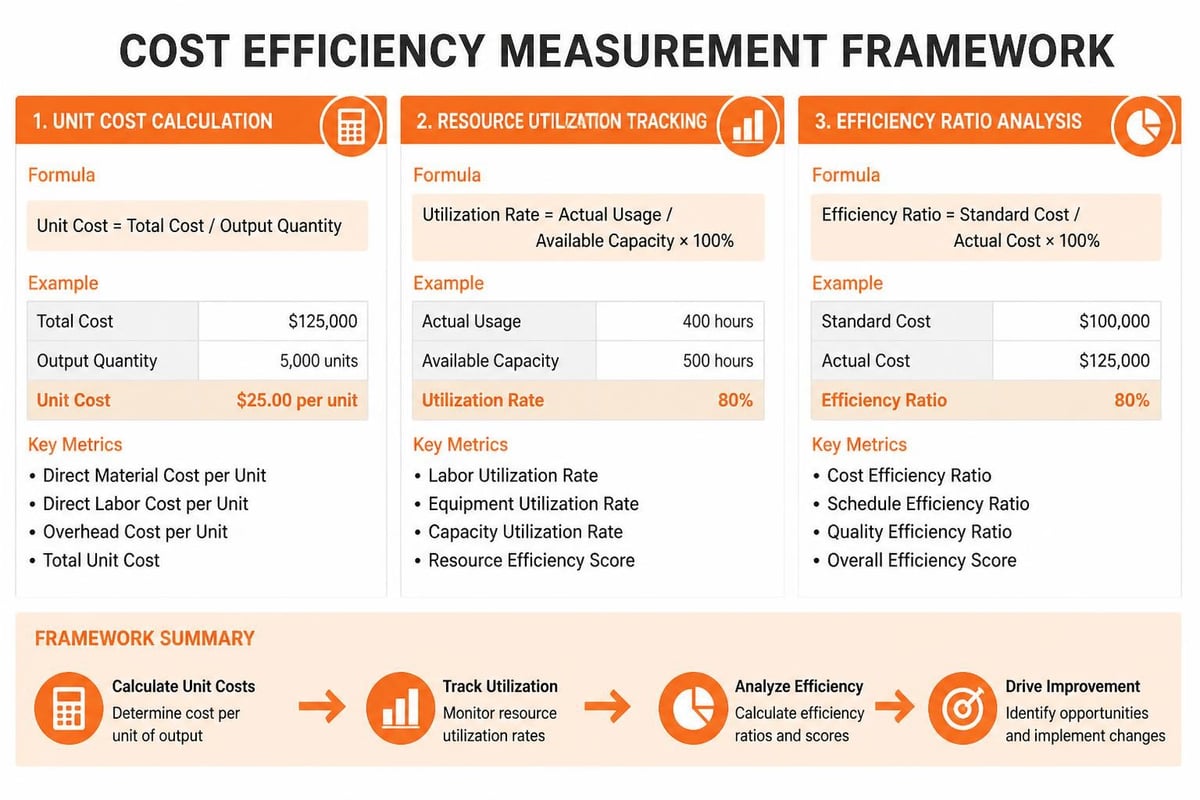
Core Measurement Formulas
Unit cost calculation: Total Cost / Number of Units Produced = Cost per Unit
Resource utilization rate: (Actual Resource Usage / Available Resource Capacity) × 100 = Utilization %
Efficiency ratio: Standard Cost for Actual Output / Actual Cost = Efficiency Index
A manufacturing operation spending $50,000 to produce 10,000 units achieves a unit cost of $5.00. If process improvements reduce total cost to $42,000 for the same output, unit cost drops to $4.20, representing a 16% efficiency gain.
According to research on digital business-process integration, organizations that implement systematic efficiency measurement improve both economic and environmental performance through operational optimization.
Track these metrics consistently:
- Labor productivity: Output per employee hour
- Material yield: Usable output from raw materials
- Cycle time: Duration from start to completion
- Error rate: Defects or rework per unit
- Equipment effectiveness: Productive time vs. total available time
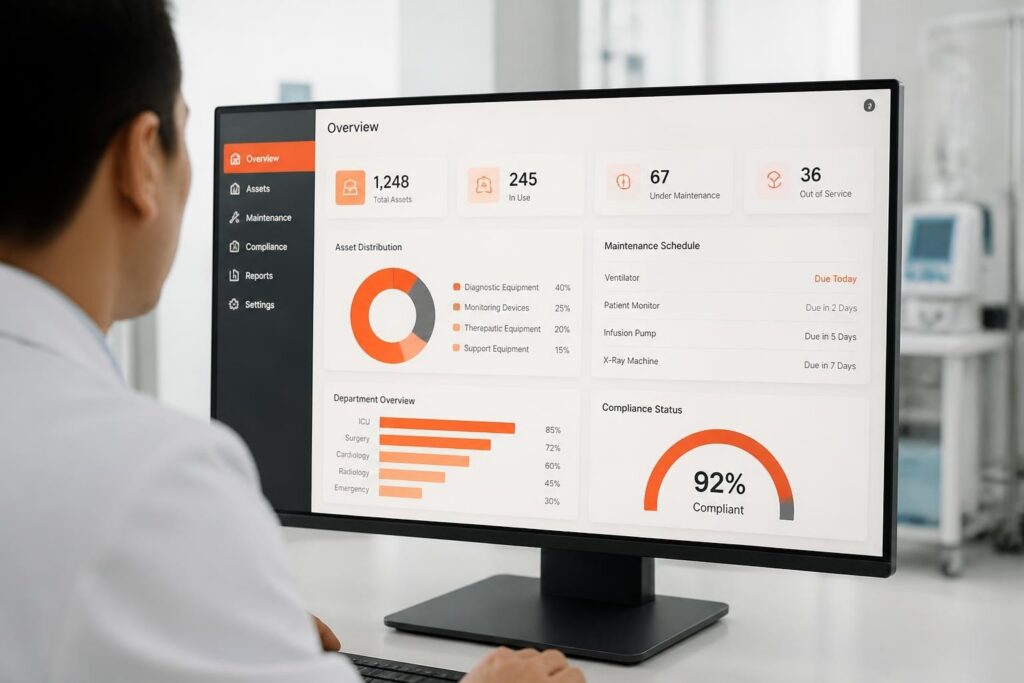
Modern software-based asset management systems enable real-time efficiency monitoring, with documented improvements of 20-35% in operational efficiency through better financial traceability and waste reduction.
What Drives Cost Inefficiency in Business Operations?
Cost inefficiency stems from six primary sources: redundant processes, poor resource allocation, information gaps, quality failures, underutilized capacity, and manual workflows. Each category creates waste that compounds over time.
Redundant processes occur when multiple departments duplicate effort without coordination. Three teams manually entering the same customer data into separate systems wastes labor and introduces errors requiring correction cycles.
Poor resource allocation means assigning expensive resources to low-value tasks. Senior engineers spending 15 hours weekly on data entry represents opportunity cost measured in hundreds of dollars per hour.
Common Efficiency Killers
- Manual data entry and transfer between disconnected systems
- Delayed decision-making due to incomplete or inaccessible information
- Inventory carrying costs from inaccurate demand forecasting
- Rework cycles caused by unclear specifications or communication failures
- Underutilized subscriptions for software licenses no one uses
- Emergency maintenance resulting from deferred preventive service
Information gaps force reactive decision-making. Without visibility into service history, maintenance teams perform unnecessary inspections or miss critical service intervals. Organizations implementing field service management software eliminate these gaps through centralized documentation and automated scheduling.
Quality failures generate the highest hidden costs. A NIST manufacturing case study documented how lean training reduced scrap rates and transportation costs, yielding measurable annual savings through improved first-pass quality.
Manual workflows scale poorly. The cost per transaction remains constant or increases with volume, while automated processes exhibit declining marginal costs as volume grows.
How Does Custom Software Improve Cost Efficiency?
Custom software development addresses cost inefficiency by automating repetitive tasks, eliminating data silos, and providing real-time visibility into operations. Organizations replace manual processes consuming hours of labor with automated workflows executing the same tasks in seconds.
Automation ROI Calculation
Annual labor cost saved: (Hours per Week × Hourly Rate × 52 Weeks) − Implementation Cost = First Year Savings
A customer service team spending 20 hours weekly on manual data compilation at $35/hour incurs $36,400 in annual labor cost. Implementing automated reporting systems through custom CRM development eliminates 90% of this work, saving $32,760 annually after accounting for implementation costs.
| Efficiency Driver | Mechanism | Typical Impact |
|---|---|---|
| Process automation | Eliminates manual task execution | 60-80% time reduction |
| Data centralization | Single source of truth | 40-60% fewer errors |
| Real-time monitoring | Immediate issue detection | 30-50% faster response |
| Workflow standardization | Consistent execution | 25-40% quality improvement |
| Predictive analytics | Proactive resource allocation | 15-30% capacity optimization |
Custom development delivers advantages over off-the-shelf software. Pre-built solutions require workflow adaptation to software constraints, forcing organizations to maintain inefficient processes. Custom applications conform to optimal workflows, eliminating unnecessary steps rather than digitizing waste.
The AWS State of Cost Efficiency report identifies rightsizing, idle resource cleanup, and strategic capacity planning as distinguishing practices among cost-efficient cloud customers. Custom software enables these practices through tailored monitoring and automated resource management.
Organizations using Brytend CRM configure lead processing, questionnaire workflows, and customer interaction tracking to match their specific sales processes, eliminating unnecessary steps and reducing lead response time from hours to minutes.

Integration capabilities multiply efficiency gains. Custom software connects previously isolated systems, allowing data to flow automatically between operations, finance, and customer management platforms. This eliminates redundant entry and ensures consistency across all business functions.

What Mistakes Do Organizations Make With Cost Efficiency Initiatives?
The most damaging mistake is optimizing individual functions without considering system-wide impact. Reducing procurement costs by 15% through cheaper suppliers seems efficient until inferior materials increase defect rates by 25%, creating downstream rework costs that exceed procurement savings.
Critical Implementation Errors
Focusing solely on direct costs while ignoring indirect expenses produces incomplete optimization. Cutting training budgets reduces immediate expenditure but increases error rates, customer complaints, and employee turnover, which carry higher total costs.
Implementing generic solutions without customization forces organizations to adapt efficient processes to software limitations. A manufacturing company adopted standard inventory software that required manual workarounds for serialized equipment tracking, negating efficiency gains through added complexity.
Neglecting change management during efficiency initiatives creates resistance and workarounds. Employees bypassing new systems to maintain familiar workflows eliminate intended benefits while adding system maintenance costs.
- Measuring cost reduction instead of efficiency ratios incentivizes cutting resources regardless of output impact
- Ignoring quality metrics during cost optimization drives race-to-bottom decisions
- Failing to establish baselines before changes prevents measuring actual improvement
- Optimizing for local rather than global efficiency creates bottlenecks elsewhere
- Underestimating implementation time and disruption leads to abandoned initiatives
A steel processing plant case study demonstrated how systematic layout planning with lean techniques reduced material flow length by 34% and improved space utilization by 26%. Success required comprehensive workflow analysis before physical changes, not reactive adjustments to individual workstations.
Organizations implementing service management systems without first documenting current service workflows often discover the software highlights process gaps they should have addressed before automation. The sequence matters: optimize processes first, then automate optimized workflows.
Short-term thinking undermines efficiency initiatives. Delaying preventive maintenance saves immediate costs but increases failure rates and emergency repair expenses. Enbridge’s 2025 sustainability report emphasizes asset modernization and operational excellence as cost competitiveness drivers, recognizing that strategic investments in efficiency compound over years.
How Do You Build a Cost Efficiency Improvement Program?
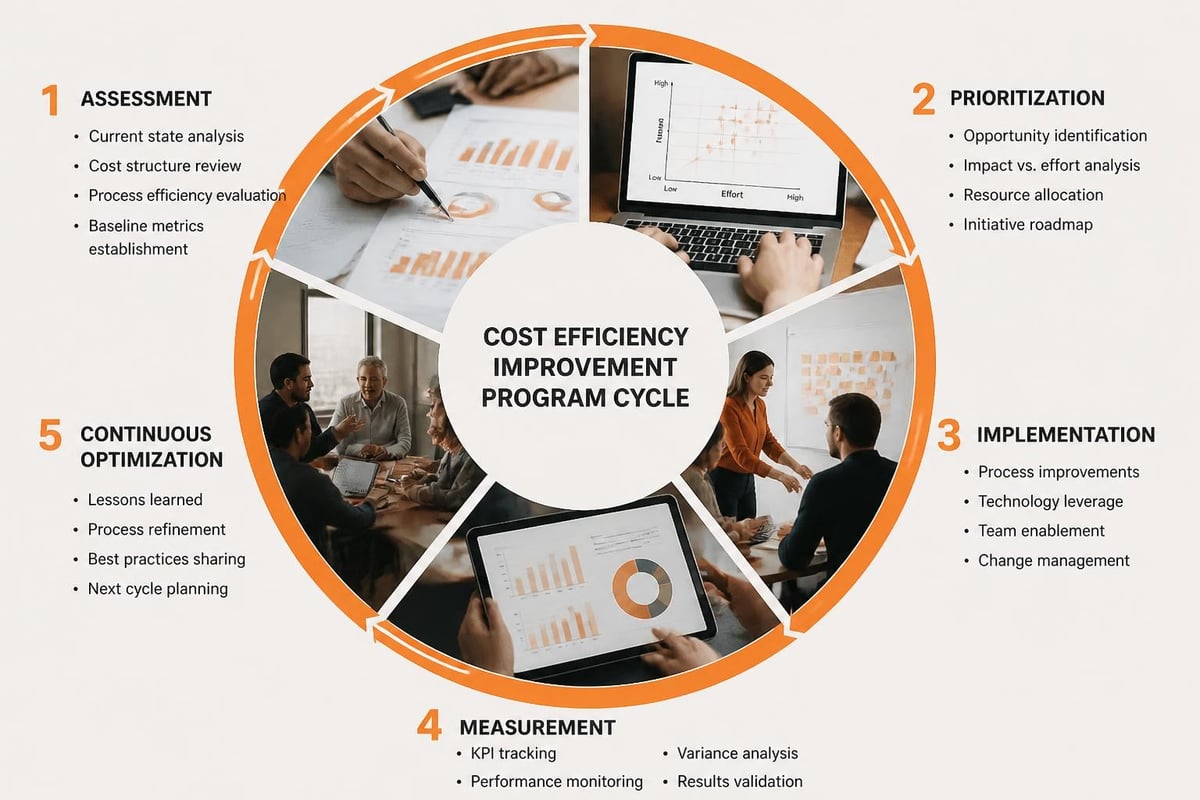
Building an effective cost efficiency program requires systematic assessment, prioritized implementation, and continuous measurement. Start by mapping current processes to identify waste, redundancy, and bottlenecks consuming resources without adding value.
Step-by-Step Implementation Process
Phase 1: Assessment and baseline establishment
- Document all major business processes from end to end
- Calculate current cost per transaction or unit for each process
- Identify manual steps, data transfers, and decision delays
- Measure error rates, cycle times, and resource utilization
- Establish baseline metrics for comparison
Phase 2: Opportunity identification and prioritization
- Categorize inefficiencies by type (manual, redundant, quality, capacity)
- Estimate potential savings for each improvement opportunity
- Assess implementation difficulty and resource requirements
- Prioritize based on ROI: (Annual Savings / Implementation Cost)
- Select 3-5 high-impact initiatives for initial focus
Phase 3: Solution design and development
Organizations building custom software solutions for efficiency gains follow iterative development cycles:
- Requirements definition: Specify desired outcomes and constraints
- Workflow optimization: Eliminate unnecessary steps before automation
- System design: Map data flows and integration points
- Prototype development: Build minimum viable solution
- User testing: Validate efficiency gains with actual users
- Refinement: Adjust based on real-world usage patterns
Phase 4: Implementation and change management
- Train users on new systems and processes before go-live
- Implement in phases to manage risk and learning
- Monitor adoption rates and identify workarounds
- Collect user feedback for rapid iteration
- Document new standard operating procedures
Phase 5: Measurement and optimization
Track progress against baseline metrics weekly:
| Metric | Baseline | Target | Current | Variance |
|---|---|---|---|---|
| Unit cost | $5.23 | $4.18 | $4.45 | -6.4% from target |
| Cycle time | 4.2 days | 2.5 days | 3.1 days | -26% improvement |
| Error rate | 8.3% | 3.0% | 4.7% | -43% improvement |
| Staff hours | 156/week | 95/week | 118/week | -24% reduction |
Continuous improvement requires treating efficiency as an ongoing discipline rather than a one-time project. Schedule quarterly process reviews to identify new optimization opportunities as operations evolve.
What Role Does Technology Play in Sustainable Cost Efficiency?
Technology enables sustainable cost efficiency through three mechanisms: automation that reduces marginal costs, visibility that prevents waste, and scalability that accommodates growth without proportional resource increases.
Automation reduces marginal costs by replacing variable labor expenses with fixed technology investments. Processing one customer order manually costs the same as processing the hundredth order. Automated order processing incurs upfront development costs but near-zero marginal cost for additional transactions.
Real-time visibility prevents waste before it compounds. Traditional monthly financial reviews identify cost overruns weeks after they occur. Modern digital service forms and tracking systems capture cost data as transactions happen, enabling immediate correction.
Technology Investment Priorities
Organizations achieving highest efficiency gains prioritize:
- Process automation for repetitive, high-volume tasks with clear rules and defined outcomes
- Data integration eliminating manual transfers between systems and departments
- Analytics platforms identifying patterns invisible in manual reviews
- Mobile access enabling field work without returning to office for data entry
- Predictive maintenance preventing failures rather than reacting to breakdowns
Cloud computing shifts capital expenses to operational expenses while improving resource utilization. Instead of purchasing server capacity for peak demand that sits idle during normal operations, cloud infrastructure scales dynamically, charging only for actual consumption.
Custom software development creates competitive advantages through process optimization. While competitors use generic tools requiring workflow compromises, organizations with tailored solutions eliminate unnecessary steps entirely. This efficiency gap compounds over time as custom systems evolve with business needs.
Contract management systems demonstrate technology's role in preventing cost leakage. Automated renewal tracking ensures timely renegotiation rather than automatic renewals at unfavorable terms. Centralized vendor data enables spend analysis revealing volume discount opportunities.
Technology investments deliver returns through compounding efficiency gains. Initial implementation saves 100 hours monthly. Process improvements enabled by better data save another 50 hours. Integration with other systems eliminates 75 more hours. The cumulative effect exceeds simple automation ROI calculations.
Sustainable efficiency requires maintenance and evolution. Technology systems degrade without updates, optimization, and adaptation to changing requirements. Organizations partnering with experienced development teams ensure their efficiency tools evolve rather than becoming legacy constraints.
Achieving cost efficiency demands systematic measurement, targeted optimization, and technology enablement rather than across-the-board cost cutting. Organizations that measure efficiency ratios, eliminate process waste, and implement custom automation create sustainable competitive advantages through superior resource utilization. Brytend specializes in developing custom software solutions that address specific efficiency challenges, from automated service tracking to integrated CRM systems, helping organizations transform cost structures through tailored technology.
Frequently Asked Questions About Cost Efficiency
What does cost efficiency mean?
Cost efficiency measures how much value or output an organization gets for every unit of money it spends. A cost-efficient process delivers the same result (or better) using less spend, time, or resources than the alternative — it is a ratio of output to input, not simply “spending less.”
What is a good cost efficiency ratio?
There is no universal benchmark. A “good” ratio depends on industry, business model, and which metric is being tracked, such as cost-to-income ratio or cost per unit produced. The most useful approach is tracking your own ratio over time and against direct competitors, since a healthy ratio in retail looks very different from one in software or healthcare.
Is cost efficiency the same as cost effectiveness?
No. Cost efficiency asks whether you are spending as little as possible to produce a given output. Cost effectiveness asks whether you are spending on the right things to reach a goal at all. A process can be cost-efficient (cheap to run) without being cost-effective (achieving the intended outcome), which is why both metrics matter together.
How can software improve cost efficiency?
Custom software improves cost efficiency by automating manual tasks, removing duplicate data entry, and giving teams real-time visibility into where resources are wasted — turning guesswork about spending into measurable, repeatable savings.