

RFID asset tracking uses radio-frequency identification technology to automatically identify and locate physical assets in real time without line-of-sight scanning. Organizations across manufacturing, healthcare, logistics, and field service operations implement these systems to eliminate manual tracking errors, reduce search time, and maintain accurate asset inventories throughout complex workflows.
TL;DR:
- RFID asset tracking combines tags, readers, antennas, and middleware to automate asset identification and location updates
- Organizations achieve 95-99% inventory accuracy compared to 65-75% with manual or barcode systems
- Passive UHF tags cost $0.10-$0.50 per unit and last 10+ years without batteries
- Implementation requires tag selection, reader placement, software integration, and workflow redesign
- ROI typically occurs within 12-18 months through labor savings and asset utilization improvements
How Does RFID Asset Tracking Work in Enterprise Environments
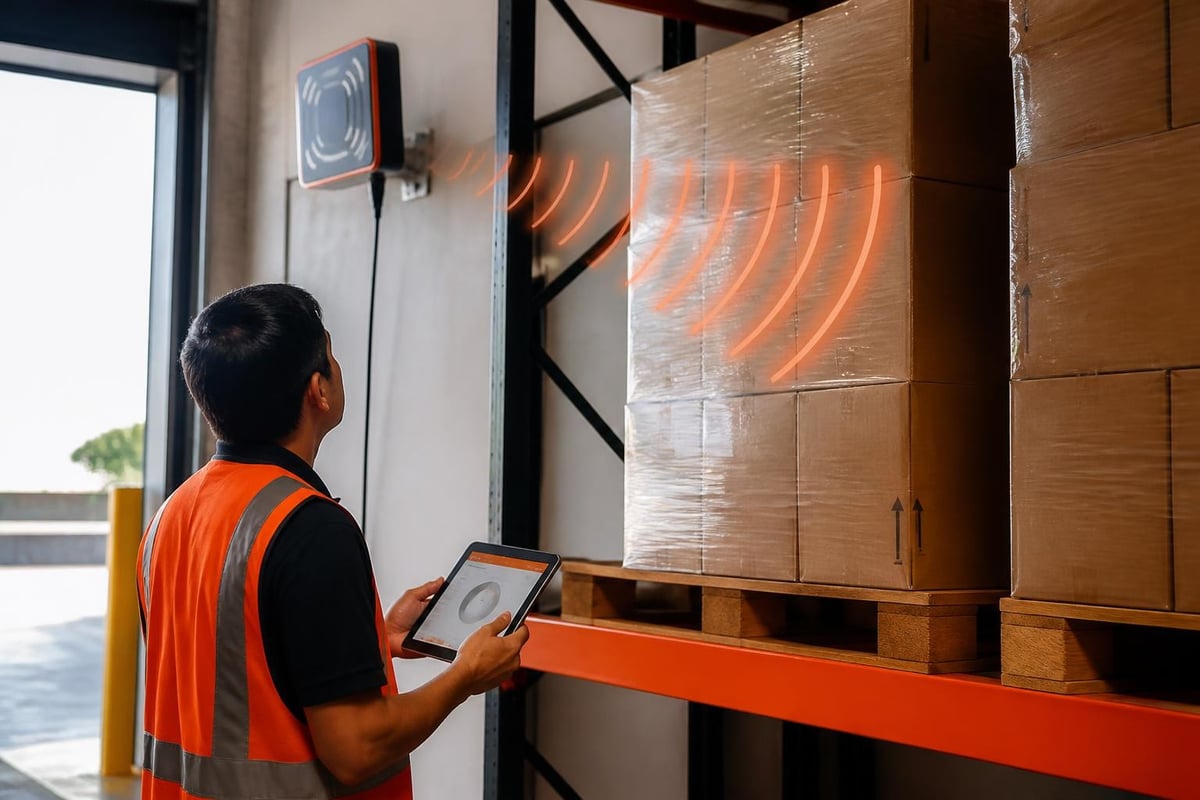
RFID asset tracking operates through electromagnetic fields that transmit data between tags attached to assets and readers positioned at strategic locations. When an RFID tag enters a reader's electromagnetic field, the tag receives power (passive tags) or activates its battery (active tags) to transmit its unique identifier and any stored data back to the reader.
The reader captures this information and forwards it through middleware software that filters, processes, and routes the data to enterprise systems. This architecture enables automatic updates whenever tagged assets move through designated zones, eliminating manual scanning and providing continuous visibility.
Core System Components
Tag hardware contains an integrated circuit and antenna sealed in various form factors (labels, hard tags, metal-mount tags). Passive tags draw power from reader signals and operate at distances from inches to 40+ feet depending on frequency band. Active tags include batteries for extended range (300+ feet) and sensor capabilities.
Reader infrastructure includes fixed portal readers, handheld devices, and overhead antennas strategically positioned at doorways, storage areas, loading docks, and workstations. Multi-antenna readers can cover wide areas and provide directional information about asset movement.
Middleware platforms manage reader networks, filter duplicate reads, apply business rules, and transform raw tag data into meaningful location events. This layer prevents database flooding and ensures only actionable information reaches enterprise systems.
Integration endpoints connect RFID data streams to asset management, ERP, maintenance, and analytics platforms through APIs, database synchronization, or file transfers. Understanding how RFID systems integrate with enterprise software platforms ensures accurate data flow across business operations.
What Are the Different Types of RFID Tags for Asset Tracking
Selecting appropriate tag types directly impacts system performance, cost, and longevity. Organizations must match tag specifications to asset materials, environmental conditions, read range requirements, and budget constraints.
| Tag Type | Read Range | Power Source | Lifespan | Unit Cost | Best For |
|---|---|---|---|---|---|
| Passive UHF | 1-40 feet | Reader field | 10+ years | $0.10-$0.50 | General assets, pallets, tools |
| Passive HF | 1-12 inches | Reader field | 10+ years | $0.20-$1.00 | Item-level tracking, access control |
| Active UHF | 300+ feet | Battery | 3-7 years | $15-$50 | Vehicles, containers, outdoor assets |
| Semi-passive | 100+ feet | Battery + field | 5-10 years | $5-$20 | Temperature monitoring, high-value items |
Passive UHF tags dominate enterprise rfid asset tracking deployments because they offer the optimal balance of read range, cost, and durability. These tags operate in the 860-960 MHz frequency band and work effectively on non-metallic surfaces like plastic equipment cases, wooden pallets, and cardboard containers.
Metal-mount tags feature specialized designs that compensate for the electromagnetic interference metals create. Standard tags fail when attached directly to metal surfaces because the metal reflects radio waves and detunes the antenna. Metal-mount tags incorporate spacer materials and tuned antennas that maintain performance on steel tools, aluminum cases, and metal shelving.
Ruggedized enclosures protect tags in harsh industrial environments with extreme temperatures, chemical exposure, vibration, and impact. IP67-rated tags withstand water immersion and dust intrusion, while industrial-grade housings survive drops from 10+ feet and temperature ranges from -40°F to 185°F.
Tag Selection Criteria
Organizations should evaluate these technical factors before purchasing tags:
- Asset material composition (plastic, metal, liquid, composite)
- Required read distance (inches for item-level, feet for zone tracking, hundreds of feet for outdoor monitoring)
- Environmental conditions (temperature extremes, moisture, chemicals, physical stress)
- Attachment method (adhesive, bolt-mount, cable tie, embedded)
- Data storage needs (unique ID only or additional sensor/configuration data)
- Expected lifespan (disposable for single-use or permanent for capital equipment)
How Do You Implement RFID Asset Tracking Systems Step by Step
Successful implementation requires systematic planning, infrastructure design, integration development, and change management. Organizations that skip proper planning encounter read accuracy problems, workflow disruptions, and failed ROI expectations.
Phase 1: Assessment and Planning (Weeks 1-4)
Document current workflows by mapping how assets move through facilities, who handles them, where they're stored, and what information systems currently track. Identify pain points where manual processes create errors, delays, or visibility gaps.
Define technical requirements including read range specifications, accuracy targets, system capacity, integration endpoints, and performance metrics. Establish whether the system needs real-time updates or periodic batch synchronization based on operational requirements.
Select pilot scope by choosing a contained area or asset category with clear success criteria. Pilot deployments validate technical assumptions before full-scale rollout and provide user feedback for workflow refinement. Healthcare organizations implementing RFID for medical equipment tracking typically start with high-value mobile assets in controlled departments before expanding hospital-wide.
Phase 2: Infrastructure Design (Weeks 5-8)
Position readers strategically at locations where automatic identification provides maximum value. Common placements include entry/exit portals, storage room doorways, workstation zones, and loading dock gates. Reader density depends on required location granularity versus infrastructure cost.
Design read zones by testing tag orientation, reader power settings, and antenna placement to achieve consistent read rates without capturing tags from adjacent zones. Proper read zone definition prevents false location updates when tags are read by unintended readers.
Plan power and network connectivity for each reader location. Fixed readers require PoE (Power over Ethernet) or electrical outlets plus wired or wireless network access. High-density installations may need network switches and additional access points to support reader quantities.
Phase 3: Software Integration (Weeks 9-16)
Deploy middleware configuration to manage reader networks, filter duplicate reads, and transform raw RFID events into business transactions. Middleware applies rules like "only record location change if asset remains in zone for 5+ seconds" to prevent false updates from tags passing near doorways.
Develop integration connectors between RFID middleware and enterprise systems. Custom API development allows real-time data exchange, while batch file transfers support systems without API access. Organizations with existing field service management software need connectors that automatically update asset locations, service histories, and availability status based on RFID events.
Build user interfaces that display real-time asset locations, search capabilities, movement histories, and exception alerts. Dashboards should surface actionable information like "overdue equipment returns" or "unexpected asset locations" rather than raw tag reads.
Phase 4: Pilot Testing (Weeks 17-20)
Execute controlled tests with tagged assets moving through read zones while monitoring system performance. Measure read accuracy, false positive rates, location update latency, and system stability under expected traffic volumes.
Train pilot users on new workflows, handheld reader operation, exception handling, and system reporting. Collect user feedback on workflow friction points and system usability issues requiring adjustment.
Validate integration accuracy by comparing RFID location data against physical asset locations and manual records. Investigate any discrepancies to identify tag placement problems, read zone configuration errors, or integration logic failures.
Phase 5: Full Deployment (Weeks 21-32)
Tag remaining assets using consistent placement locations and orientations validated during pilot testing. Establish quality control processes to verify tag attachment quality and initial system registration before releasing assets to operations.
Expand infrastructure to additional facilities or departments following the validated design patterns. Maintain configuration documentation and standard operating procedures to ensure consistent deployment quality.
Monitor performance metrics including read accuracy, location update frequency, exception rates, and system uptime. Continuous monitoring identifies degrading tag performance, reader failures, or integration problems requiring maintenance.

What ROI Can Organizations Expect from RFID Asset Tracking
Financial justification requires quantifying both direct cost savings and operational improvements. Organizations typically analyze labor reduction, asset utilization, inventory accuracy, and compliance benefits to calculate payback periods.
Direct Cost Savings
Labor reduction represents the largest savings category for most deployments. Manual asset counting, searching, and reconciliation consume significant staff time. RFID automation eliminates routine counting cycles and reduces search time from hours to minutes.
A manufacturing facility with 5,000 tools spending 20 staff hours per week searching for missing equipment saves approximately $52,000 annually (20 hours × 52 weeks × $50/hour burden rate) by implementing rfid asset tracking that provides instant location lookup.
Lost asset recovery prevents replacement purchases through improved visibility. Organizations with 10% annual asset loss rates on $2 million in movable equipment waste $200,000 yearly on unnecessary replacements. RFID systems reducing loss to 2% save $160,000 annually in avoided purchases.
Inventory carrying cost reduction occurs when accurate asset counts reveal excess inventory. Organizations maintaining 20% safety stock buffers due to uncertainty can reduce buffers to 5% with real-time visibility, freeing capital and reducing storage costs.
Operational Improvements
Asset utilization increases happen when real-time availability information reduces hoarding and enables sharing across departments. Healthcare facilities tracking mobile equipment report 15-25% utilization improvements, effectively expanding capacity without capital investment.
Compliance cost avoidance protects organizations from fines, audit failures, and certification losses. Industries with mandatory asset tracking requirements (medical device tracking, controlled substance monitoring, hazardous material handling) avoid penalties through automated documentation.
Process cycle time reduction accelerates workflows dependent on asset availability. Construction sites locating tools in minutes instead of hours complete more jobs per day. Service organizations finding equipment quickly maintain tighter appointment schedules.
ROI Calculation Framework
| Cost Category | One-Time | Annual |
|---|---|---|
| RFID tags (5,000 @ $0.30) | $1,500 | $150 (10% replacement) |
| Readers (20 fixed @ $1,500) | $30,000 | $3,000 (maintenance) |
| Antennas (40 @ $200) | $8,000 | – |
| Middleware/software | $25,000 | $5,000 (licensing) |
| Integration development | $40,000 | – |
| Installation labor | $15,000 | – |
| Total Investment | $119,500 | $8,150 |
| Annual Savings | $212,000 | |
| Payback Period | 7.0 months |
Organizations should model their specific costs and benefits using actual labor rates, asset values, and operational metrics to determine project viability.
What Common Mistakes Should You Avoid in RFID Implementation
Implementation failures typically stem from predictable technical and organizational errors. Recent analysis of RFID implementation challenges identifies recurring problems that derail projects and reduce system effectiveness.
Technical Configuration Errors
Inadequate tag testing on actual asset materials causes read failures after deployment. Tags that perform perfectly in free air fail when attached to metal equipment, liquid containers, or carbon fiber composites. Organizations must test tags on representative samples in operational environments before purchasing thousands of units.
Poor read zone design creates either coverage gaps or excessive overlap. Insufficient reader power misses tags, while excessive power reads tags from adjacent rooms, generating false location data. Proper site surveys using spectrum analyzers and temporary reader setups validate coverage before permanent installation.
Insufficient middleware filtering floods databases with duplicate reads and drains system resources. A tag passing through a reader field generates dozens of reads per second. Without proper filtering rules, systems process millions of redundant transactions daily, degrading performance and obscuring meaningful events.
Integration timing failures occur when RFID systems update locations before dependent business processes complete. An asset scanned leaving a service area before technicians complete service documentation creates data inconsistencies. Proper integration design coordinates RFID events with business transaction completion.
Organizational and Process Issues
Inadequate change management leaves users confused about new workflows and resistant to system adoption. Organizations must communicate why changes occur, how new processes work, and what benefits users receive. Lack of training on handheld readers and exception handling prevents users from leveraging system capabilities.
Unrealistic accuracy expectations lead to disappointment when systems achieve 98% read rates instead of 100%. No automatic identification technology achieves perfect accuracy under all conditions. Organizations should design processes assuming occasional tag failures and establish exception handling workflows.
Scope creep during implementation delays deployment and inflates costs. Projects expanding beyond initial pilot scope before validating basic functionality encounter compounding technical problems and budget overruns. Successful deployments validate narrow use cases before expanding.
Ignoring data quality fundamentals undermines system value. RFID provides accurate identification of tagged items but cannot correct underlying master data problems. Organizations with duplicate asset records, missing serial numbers, or incorrect categorizations must clean data before expecting meaningful reports from RFID systems.
Best Practices for Risk Mitigation
Follow these guidelines to avoid common pitfalls:
- Conduct material testing for every asset type before tag purchase
- Design pilot scope to validate technical assumptions before scaling
- Establish performance baselines using current manual processes for comparison
- Document workflows clearly before and after RFID implementation
- Budget 20% contingency for unexpected site conditions or technical challenges
- Plan integration testing with adequate time for troubleshooting and refinement
- Develop exception procedures for handling tag failures and system downtime
How Does RFID Compare to Barcode and Manual Asset Tracking
Organizations evaluating automatic identification technologies must understand functional and economic trade-offs between RFID, barcodes, and manual systems. No single technology fits all use cases optimally.
Technology Comparison Matrix
| Capability | Manual Logs | Barcode | Passive RFID | Active RFID |
|---|---|---|---|---|
| Read speed | 30+ sec/item | 1-2 sec/item | 100+ items/sec | 100+ items/sec |
| Line of sight required | Yes | Yes | No | No |
| Range | Touch | 6-18 inches | 1-40 feet | 300+ feet |
| Simultaneous reads | One | One | 500+ tags | 1,000+ tags |
| Tag cost | $0 | $0.01-$0.05 | $0.10-$0.50 | $15-$50 |
| Infrastructure cost | None | Low | Medium | High |
| Environmental durability | Low | Low | High | High |
| Data modification | Easy | Difficult | Easy | Easy |
Manual tracking systems offer zero technology costs but scale poorly as asset counts grow. Organizations tracking hundreds of items manage effectively with spreadsheets and periodic physical counts. Beyond 1,000 assets, manual processes become unreliable and consume excessive labor.
Barcode systems provide cost-effective automatic identification for workflows supporting line-of-sight scanning. Retail, warehouse picking, and receiving operations work well with barcodes because staff handle items individually and can orient labels toward scanners. Supply chain use cases for RFID demonstrate scenarios where line-of-sight limitations prevent barcode effectiveness.
Passive rfid asset tracking eliminates line-of-sight and manual scanning requirements, enabling automatic updates as assets move through read zones. This capability fits workflows where staff don't handle items individually or where real-time location visibility provides operational value. The 10-50× higher tag cost versus barcodes requires operational savings to justify investment.
Active RFID systems support long-range tracking for outdoor assets, vehicles, and wide-area location requirements. Battery-powered tags enable sensor integration for temperature, shock, and environmental monitoring. Higher tag costs ($15-$50) and battery replacement requirements limit deployments to high-value assets requiring advanced capabilities.
Selection Decision Framework
Choose RFID over barcodes when operations require:
- Hands-free automation during asset movement (portals, conveyors, bulk reading)
- Hidden tag placement where labels face inaccessible directions or suffer damage
- Simultaneous identification of dozens to hundreds of items in seconds
- Real-time location tracking as assets move between zones automatically
- Harsh environments where barcode labels deteriorate from moisture, abrasion, chemicals, or temperature extremes
- Write capabilities to update tag data in field conditions
Choose barcodes over RFID when:
- Budget constraints limit infrastructure investment
- Line-of-sight workflows support easy scanning during item handling
- Simple identification without location tracking or automated reads suffices
- Item-level granularity requires extremely low per-unit tag costs
- Existing processes already incorporate manual scanning steps
How Do You Select RFID Asset Tracking Software and Hardware Partners
Technology selection directly impacts implementation success, system longevity, and total cost of ownership. Organizations should evaluate vendors across technical capabilities, integration flexibility, industry experience, and long-term support commitment.
Software Platform Requirements
Integration architecture determines how easily RFID data flows into existing enterprise systems. Platforms offering REST APIs, webhook notifications, database synchronization, and pre-built connectors for major ERP/asset management systems reduce custom development costs and accelerate deployment.
Scalability characteristics support system growth as organizations expand RFID coverage. Cloud-based platforms automatically scale computing resources, while on-premises installations require capacity planning and hardware provisioning. Systems should handle 10× current tag volumes without architectural changes.
Data model flexibility accommodates diverse asset types, custom attributes, location hierarchies, and organizational structures. Rigid systems designed for specific industries force workarounds when business requirements don't match vendor assumptions. Organizations with complex workflows benefit from platforms supporting customizable service and maintenance tracking that adapts to unique operational needs.
Reporting and analytics capabilities transform raw location data into actionable business intelligence. Standard reports should cover asset utilization, movement patterns, dwell times, exception conditions, and compliance metrics. API access enables custom analytics development for organization-specific requirements.

Hardware Vendor Evaluation
Reader compatibility with existing network infrastructure reduces installation costs. Readers supporting Power over Ethernet (PoE) eliminate electrical work at each location. Wi-Fi connected readers simplify network cabling but may face bandwidth constraints in high-density deployments.
Tag variety and customization options ensure appropriate solutions exist for all asset types. Vendors offering metal-mount tags, high-temperature tags, flexible labels, and ruggedized enclosures provide more deployment flexibility than limited-catalog suppliers.
Technical support quality impacts troubleshooting speed and system uptime. Vendors providing phone support, remote diagnostics, configuration assistance, and advance replacement programs minimize downtime when equipment fails. Organizations should verify support response times and escalation procedures before purchasing.
Certification and standards compliance ensures interoperability and regulatory adherence. Look for readers certified by regulatory bodies (FCC, CE, IC), tags compliant with ISO 18000-63 (UHF RFID standard), and vendors participating in industry organizations like RAIN RFID Alliance or GS1.
Vendor Relationship Considerations
Successful long-term partnerships require alignment beyond initial purchase:
- Industry experience with similar use cases reduces implementation risk
- Reference customers provide independent validation of vendor claims
- Product roadmap alignment with emerging standards and technologies
- Financial stability indicates vendor longevity and ongoing support capability
- Training programs for internal staff reduce dependence on vendor services
- Upgrade policies define costs and procedures for system expansion
Organizations should request proof-of-concept demonstrations using actual asset samples in representative environments before committing to large-scale purchases. Controlled testing validates vendor claims and reveals potential technical limitations before financial commitment.
What Industries Benefit Most from RFID Asset Tracking
While rfid asset tracking applies across virtually all industries managing physical assets, certain sectors achieve particularly compelling returns due to regulatory requirements, asset characteristics, or operational workflows.
Healthcare and Medical Equipment
Healthcare facilities track thousands of mobile assets including infusion pumps, wheelchairs, ventilators, and diagnostic equipment across multiple buildings. Recent healthcare RFID implementations demonstrate full lifecycle traceability from acquisition through cleaning, maintenance, and disposal.
RFID enables real-time equipment location, automated utilization reporting, maintenance schedule enforcement, and recall management. Hospitals reduce rental equipment costs by 30-50% through improved internal equipment availability and eliminate manual room-by-room searches that consume nursing time.
Manufacturing and Industrial Operations
Manufacturing facilities track tools, fixtures, dies, containers, and work-in-process inventory throughout production processes. Automated tool crib check-out, production line material verification, and finished goods tracking improve efficiency and quality control.
Organizations achieve accountability for high-value tooling (precision gauges, custom fixtures, calibrated instruments), reduce production delays from missing components, and maintain accurate work-in-process inventory for financial reporting. Practical RFID inventory tracking guidance covers implementation approaches across diverse manufacturing environments.
Field Service and Equipment Rental
Service organizations managing tool fleets, test equipment, and rental inventory across multiple technicians and job sites benefit from automated check-in/check-out, vehicle loading verification, and customer site inventory management.
RFID reduces tool loss, improves asset utilization, prevents job site theft, and documents equipment delivery/return for billing accuracy. Service providers achieve faster job completion through rapid equipment location and reduce capital expenditure by identifying underutilized assets.
Logistics and Distribution
Warehouses, distribution centers, and freight terminals use RFID for pallet tracking, returnable container management, and high-value shipment monitoring. Automated receiving, cycle counting, and shipping verification improve inventory accuracy while reducing manual scanning labor.
Organizations achieve real-time inventory visibility, faster order fulfillment, and improved shipment accuracy. Returnable asset programs (pallets, totes, racks) benefit particularly from automated tracking that maintains accountability across supply chain partners.
Government and Defense
Military installations, government facilities, and law enforcement agencies track weapons, sensitive equipment, controlled substances, and evidence through chain-of-custody requirements. RFID provides automated audit trails, access control integration, and tamper detection for compliance and security.
Deployments support arms room management, equipment issue/return automation, and sensitive item accountability that meets regulatory standards while reducing administrative burden.
Organizations considering RFID asset tracking should evaluate their specific pain points against these industry use cases to determine alignment. Workflows requiring real-time location visibility, automated identification during movement, or tracking of assets across distributed locations typically justify RFID investment.
RFID asset tracking delivers measurable operational improvements and cost savings when organizations properly match technology capabilities to workflow requirements, execute systematic implementations, and integrate tracking data into enterprise systems. The combination of automatic identification, hands-free operation, and bulk reading capabilities addresses limitations inherent in manual and barcode-based approaches.
Organizations implementing rfid asset tracking systems need robust software platforms that transform raw tag data into actionable business intelligence while integrating seamlessly with existing enterprise systems. Brytend develops custom software solutions that connect RFID infrastructure to asset management, maintenance scheduling, and operational workflows, ensuring technology investments deliver maximum value. Contact Brytend to discuss how tailored RFID integration can optimize your asset tracking operations.