

Healthcare asset management software is a digital platform that tracks, monitors, and manages the full lifecycle of medical equipment and devices across healthcare facilities. It automates inventory control, maintenance scheduling, compliance documentation, and utilization reporting to reduce costs and improve patient safety. Organizations implement these systems to maintain regulatory compliance, extend equipment lifespan, and ensure critical devices are available when needed.
What is healthcare asset management software?
Healthcare asset management software is a specialized system designed to track, maintain, and optimize medical equipment throughout its operational lifecycle. The software centralizes asset data, automates preventive maintenance schedules, tracks device locations, manages warranty information, and generates compliance reports required by regulatory bodies.
These platforms address unique healthcare challenges that general asset-tracking tools cannot handle. Medical devices require calibration records, biomedical certification documentation, and tracking aligned with device-tracking requirements under federal regulations. Healthcare asset management software integrates these functions into workflows that support clinical engineering teams, biomedical technicians, and facility managers.
The software typically connects serialized inventory with service histories, recall notices, and utilization patterns. By maintaining a single source of truth for every device, organizations reduce equipment downtime, prevent compliance violations, and make data-driven capital purchasing decisions.
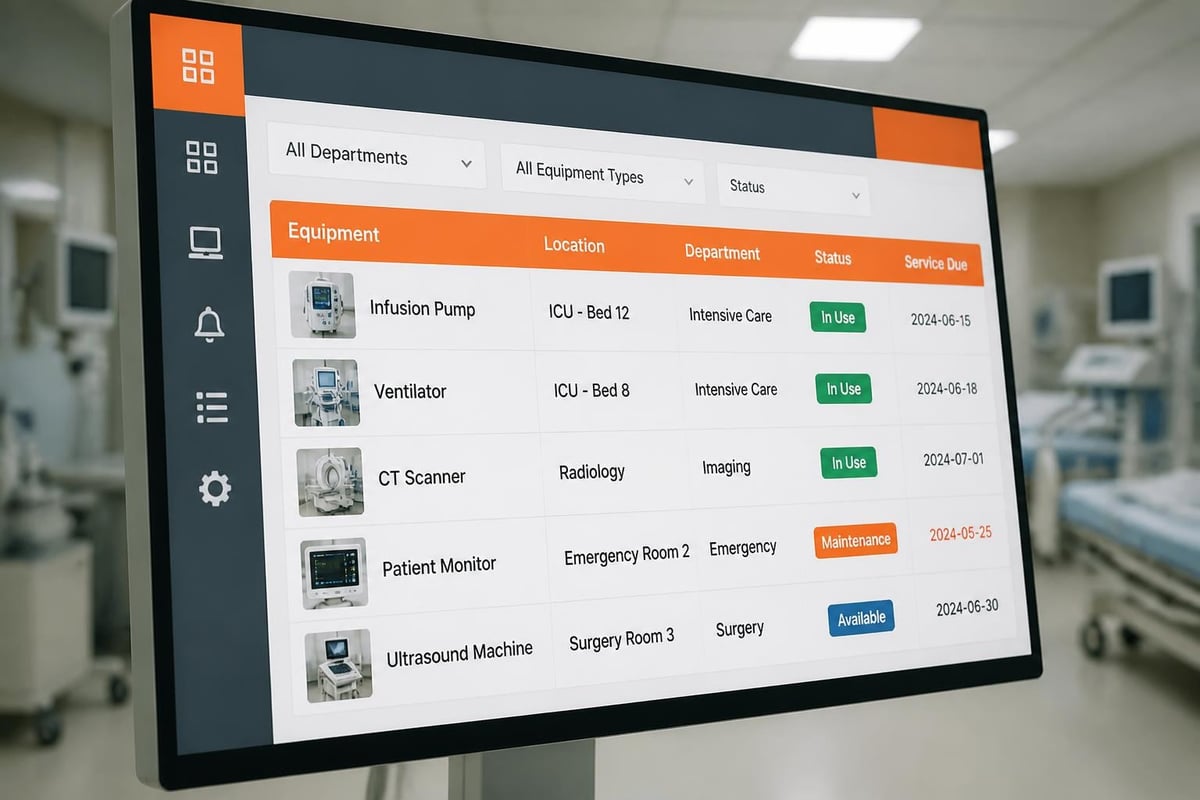
Key capabilities distinguish healthcare-specific platforms from generic asset-management tools:
- Automated compliance tracking for regulatory standards and accreditation requirements
- Biomedical work-order management linking assets to service tickets and technician certifications
- Integration with clinical systems to monitor device utilization and patient safety data
- Recall and hazard alerts based on manufacturer updates and safety bulletins
- Mobile barcode scanning for real-time location updates and service documentation
Why do healthcare organizations need specialized asset management software?
Healthcare facilities face distinct operational and regulatory pressures that make specialized software essential. Medical equipment represents capital investments totaling millions of dollars, yet many hospitals lack accurate inventories or maintenance records. The American Hospital Association reports rising capital costs and financial pressures that demand better utilization and lifecycle management of existing equipment.
Patient safety depends on reliable, properly maintained devices. The ECRI Institute’s annual health technology hazards analysis identifies equipment failures and maintenance gaps as recurring sources of preventable harm. Healthcare asset management software mitigates these risks by ensuring devices receive timely inspections, calibration, and preventive maintenance before failures occur.
Regulatory compliance adds another layer of complexity. Accreditation bodies require documented proof of equipment maintenance, staff competency, and quality control testing. Standards organizations such as AAMI publish detailed guidance on medical equipment management that healthcare technology management (HTM) departments must implement and demonstrate. Manual spreadsheets cannot scale to meet these documentation requirements across thousands of devices.
The World Health Organization emphasizes that effective medical equipment management improves healthcare delivery in resource-constrained environments. Software automates inventory control, procurement planning, and maintenance scheduling, freeing clinical engineering staff to focus on critical repairs and strategic initiatives.
Workflow automation and service efficiency
Healthcare asset management software transforms how biomedical teams operate. Instead of paper-based logs and reactive repair calls, technicians work from automated schedules generated by the system. Service reminders trigger work orders based on manufacturer intervals, usage hours, or regulatory timeframes.
Consider a typical biomedical service workflow:
- The system generates a preventive maintenance work order for an infusion pump based on the manufacturer's six-month interval
- A biomedical technician receives the mobile notification and scans the device barcode to retrieve service history and procedures
- The technician completes calibration testing, documents results in the mobile app, and attaches test equipment certificates
- The system updates the asset record, schedules the next service date, and closes the work order automatically
- Compliance reports pull completed service records for upcoming accreditation surveys
This automation reduces administrative overhead and ensures no device exceeds its service interval. Organizations using asset service management platforms report significant reductions in missed inspections and documentation errors.
What features should healthcare asset management software include?
Effective healthcare asset management software combines inventory control, maintenance management, and compliance reporting in an integrated platform. Organizations should evaluate systems against specific functional requirements that align with HTM department workflows and institutional policies.
| Feature category | Core capabilities | Business impact |
|---|---|---|
| Asset tracking | Barcode/RFID scanning, location history, custody chain | Real-time visibility, reduced lost equipment |
| Maintenance management | PM scheduling, work orders, technician assignment, parts inventory | Reduced downtime, extended asset life |
| Compliance documentation | Service certificates, calibration records, audit trails | Accreditation readiness, regulatory compliance |
| Integration | CMMS, EHR, purchasing, biomedical databases | Eliminated duplicate entry, unified data |
| Mobile access | Native apps, offline mode, photo capture | Field efficiency, real-time updates |
| Reporting | Utilization analysis, cost tracking, compliance dashboards | Data-driven decisions, budget justification |
Serialized inventory and asset hierarchies
Healthcare asset management software must uniquely identify every device with serialized records. Each asset entry includes manufacturer details, model number, serial number, purchase date, warranty expiration, and assigned location. The system supports asset hierarchies that group related items-for example, linking accessory components to parent devices or organizing equipment by department, building, or care area.
Advanced platforms track ownership models including hospital-owned equipment, leased devices, vendor-managed inventory, and loaner items from manufacturers. This distinction matters for maintenance responsibility, insurance coverage, and capital accounting.

Service and calibration management
The service module forms the operational core of healthcare asset management software. It automates preventive maintenance schedules based on configurable rules: calendar intervals, usage meters, or triggering events. When a service comes due, the system generates a work order, assigns it to qualified technicians, and provides mobile access to procedures and forms.
Calibration tracking is critical for devices used in diagnosis or treatment. The software maintains calibration certificates, links to test equipment used, and enforces tolerances defined by manufacturers or regulatory standards. Calibration management software capabilities ensure devices meet accuracy requirements and provide audit-ready documentation.
Organizations implementing structured service modules gain complete lifecycle visibility. The Brytend Service Module offers exactly this capability-registering serialized inventory, automating service reminders, and generating certificates that document maintenance activities with accuracy and ease.

Compliance and regulatory reporting
Healthcare asset management software must generate reports that satisfy accreditation surveyors and regulatory inspectors. Standard reports include:
- Equipment maintenance completion rates by department or device category
- Overdue preventive maintenance listings with risk prioritization
- Service history summaries for specific assets or device types
- Technician productivity and workload distribution
- Adverse event investigations linking device failures to maintenance records
The system maintains complete audit trails showing who performed services, what tests were completed, and when records were modified. This documentation proves compliance with Joint Commission standards, FDA quality system regulations, and manufacturer instructions for use. Organizations with robust compliance monitoring software reduce survey preparation time and demonstrate continuous quality improvement.
Integration with hospital systems
Standalone asset-management systems create data silos that duplicate work and introduce errors. Healthcare asset management software should integrate with:
- Computerized maintenance management systems (CMMS) to coordinate facilities and biomedical work
- Electronic health records (EHR) to correlate device use with patient outcomes
- Enterprise resource planning (ERP) platforms for purchasing, accounting, and inventory
- Biomedical device databases that provide manufacturer bulletins, recalls, and service procedures
These integrations eliminate manual data entry and ensure information flows bidirectionally. When purchasing completes a device acquisition, the record automatically populates the asset-management system with warranty details and suggested maintenance intervals.
How should organizations evaluate and select healthcare asset management software?
Selecting healthcare asset management software requires structured assessment of institutional needs, vendor capabilities, and implementation resources. Organizations should form evaluation teams that include biomedical engineering leadership, IT staff, clinical department representatives, and compliance officers.
Requirements definition and use cases
Begin by documenting current asset-management processes and identifying pain points. Map workflows for asset acquisition, service scheduling, technician dispatch, documentation, and reporting. Quantify existing challenges: equipment downtime hours, compliance documentation time, inventory accuracy rates, and technician productivity metrics.
Define specific use cases the software must support:
- A biomedical technician receives an urgent repair call, locates the nearest replacement device, and creates a work order from a mobile device
- The compliance manager generates an accreditation report showing all imaging equipment received required inspections within the past year
- Clinical engineering reviews utilization data to identify underused equipment that can be redeployed instead of purchasing additional units
- The finance department tracks total cost of ownership for device categories to inform capital budget planning
These scenarios clarify functional requirements and provide test cases during vendor demonstrations.
Vendor evaluation criteria
Assess healthcare asset management software vendors against technical, operational, and strategic criteria. Request demonstrations using your actual device inventory and service procedures rather than generic examples.
Technical evaluation factors:
- Cloud-hosted versus on-premises deployment options aligned with IT policies
- Mobile platform support (iOS, Android) with offline capabilities
- API availability for integrations with existing hospital systems
- Security architecture including encryption, access controls, and audit logging consistent with cybersecurity practices for healthcare organizations
- Scalability to support growing device inventories and additional facilities
Operational considerations:
- Configuration flexibility to match institutional policies and workflows without custom code
- User interface design that minimizes training time for biomedical staff
- Reporting tools that non-technical users can operate independently
- Vendor support model including response times, training resources, and upgrade schedules
Strategic alignment:
- Vendor experience with similar healthcare organizations in size and complexity
- Product roadmap alignment with emerging standards such as the ISO 55000 asset management framework
- Total cost of ownership including licensing, implementation, training, and ongoing support
- Vendor financial stability and long-term viability
Organizations seeking custom software solutions should evaluate whether vendors can adapt platforms to unique institutional requirements or integrate with specialized clinical systems.
What implementation approach ensures successful deployment?
Healthcare asset management software projects fail when organizations underestimate data migration complexity, user training requirements, and change management needs. Successful implementations follow phased approaches that build competency and demonstrate value before expanding scope.
Data preparation and migration
Asset data quality determines system effectiveness. Before migration, conduct a physical inventory to verify device counts, locations, and serial numbers. Cleanse manufacturer and model data to ensure consistency. Identify authoritative data sources for purchase dates, warranty information, and service histories.
Plan data migration in stages:
- Pilot device category: Select a manageable equipment type (e.g., infusion pumps) with well-documented service requirements
- Core asset attributes: Migrate manufacturer, model, serial number, location, and purchase data
- Service history: Import historical maintenance records to establish baseline intervals and next service dates
- Extended attributes: Add warranty details, lease terms, accessory relationships, and customized fields
- Validation and cleanup: Run data quality reports, correct errors, and establish data governance policies
Organizations often discover that historical service records are incomplete or inaccurate. Accept that initial data will require ongoing refinement as teams use the system and identify gaps.
Phased rollout and training
Launch healthcare asset management software with limited scope to validate workflows and build user confidence. A recommended phasing approach:
Phase 1 (Months 1-2): Implement asset tracking and location management for a single department or device category. Train biomedical technicians on mobile scanning and basic asset lookups. Measure inventory accuracy improvements.
Phase 2 (Months 3-4): Activate preventive maintenance scheduling and work-order management. Technicians begin receiving automated service assignments and documenting work in the system. Track completion rates and documentation quality.
Phase 3 (Months 5-6): Enable advanced features including calibration tracking, parts inventory, compliance reporting, and integrations with hospital systems. Expand to additional departments and device categories.
Phase 4 (Months 7+): Achieve full operational deployment across all facilities and equipment types. Focus on process optimization, advanced analytics, and strategic utilization management.
Training must be role-specific and scenario-based. Biomedical technicians need mobile app proficiency and field documentation skills. Managers require reporting and analytics training. Compliance officers need audit preparation and regulatory reporting capabilities.
Measuring success and continuous improvement
Define key performance indicators (KPIs) before implementation to measure impact objectively. Relevant metrics include:
- Inventory accuracy: Percentage of devices located where the system indicates
- PM compliance rate: Percentage of scheduled preventive maintenance completed on time
- Mean time to repair (MTTR): Average duration from fault report to device return to service
- Equipment availability: Percentage of time critical devices are operational and available
- Cost per device: Total maintenance and lifecycle costs divided by asset count
- Compliance documentation time: Hours required to prepare accreditation reports
Review these metrics monthly during implementation and quarterly once operational. Use data to identify process improvements, training needs, and system configuration adjustments. Organizations that treat healthcare asset management software as a continuous improvement platform rather than a one-time project achieve sustained operational benefits.
How does healthcare asset management software support strategic decision-making?
Beyond operational efficiency, healthcare asset management software provides data that informs capital planning, utilization optimization, and financial stewardship. Executives and clinical engineering leaders use analytical capabilities to justify investments and demonstrate value.
Utilization analysis and rightsizing
The software tracks equipment usage patterns across departments and care areas. Low-utilization devices represent capital tied up in unnecessary inventory. High-demand equipment may require additional units or alternative deployment strategies.
Utilization reports reveal:
- Devices sitting idle for extended periods that can be redeployed or sold
- Equipment frequently transferred between departments indicating need for centralized pool management
- Seasonal or cyclical demand patterns that inform purchasing timing
- Specialty devices used infrequently that might be better managed as rental or shared resources
Healthcare asset management software enables evidence-based decisions about fleet size, replacement timing, and allocation strategies that maximize return on capital investment.
Total cost of ownership and lifecycle planning
Tracking maintenance costs, parts consumption, and service hours by device model reveals total cost of ownership beyond initial purchase price. Some equipment requires frequent repairs or expensive consumables that make ownership less economical than expected.
The software aggregates lifecycle costs including:
- Purchase or lease payments
- Preventive maintenance labor and materials
- Corrective maintenance and unplanned repairs
- Calibration and testing services
- Accessories, consumables, and replacement parts
- Training and competency maintenance
These data inform replacement decisions. Equipment approaching end-of-life with rising maintenance costs may justify early replacement even with remaining useful life. Conversely, reliable devices with low service costs can extend beyond typical replacement cycles.
Vendor and contract performance
Healthcare asset management software documents service provider performance when organizations rely on third-party maintenance contracts. Tracking response times, first-time fix rates, and recurring issues by vendor supports contract negotiations and vendor selection decisions.
Organizations can compare in-house biomedical services against outsourced alternatives using actual cost and performance data. This transparency supports strategic sourcing decisions and ensures vendors deliver contracted service levels.
Healthcare asset management software transforms medical equipment from passive inventory into strategically managed resources that support quality care and operational efficiency. Organizations that implement these platforms gain real-time visibility, automate compliance documentation, and make data-driven capital decisions. Whether you need to track specialized safety equipment, manage complex service workflows, or ensure regulatory compliance, Brytend develops custom software solutions tailored to your specific operational requirements and institutional goals.