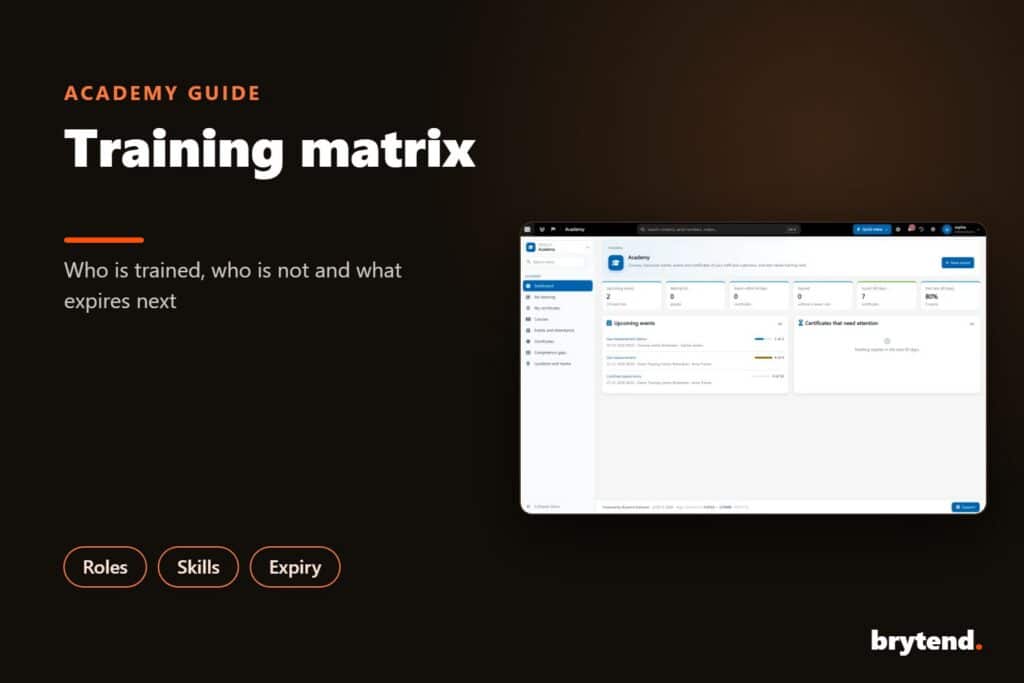
Training records are the documents that prove an employee received a specific training: who attended, which course, when, who gave it, what the result was and until when the qualification is valid. They usually consist of a signed attendance list, an exam or assessment result and a certificate. Employers keep training records to show auditors, customers and inspectors that people are competent for their work, and to know when refresher training is due. The safest approach is to keep them per employee, digitally, with the evidence attached and the expiry date visible.
TL;DR:
- A complete training record has the employee, course, date, trainer, duration, result, certificate and expiry date
- Signed attendance and an assessment result are the evidence; a line in a spreadsheet alone is not
- Keep records at least as long as the employee works for you and as long as the qualification matters, and longer where law or contracts require it
- Paper attendance lists get lost, are hard to read and cannot warn you before something expires
- Digital training records with QR check-in, e-signatures and certificates in one place make audits short
Employee training records are the documented evidence of each person’s completed trainings, assessments and certificates.
What Are Training Records?
A training record is the written proof that a training happened and that a specific person completed it. One training session usually creates several records: an attendance list for the whole group, an individual result per participant and, if they passed, a certificate. Together they form the employee’s training history.
Training records are different from a training plan (what people still need to do) and from a training matrix (the overview of who is qualified for what). The matrix is built on the records. If the records are incomplete, the matrix shows the wrong picture.
What Should an Employee Training Record Contain?
Whatever system you use, every record should answer the same questions. An auditor will check them one by one.
| Field | Why it matters |
|---|---|
| Employee name and number | Links the record to one person without doubt |
| Training title and version | Shows which content was taught; a course updated after a law change is a different version |
| Date, duration and location | Proves when and how long the training took place |
| Trainer or provider | Shows the training was given by a qualified person or accredited body |
| Attendance proof | Signature, check-in time or online completion log |
| Assessment and result | Exam score, practical check or trainer sign-off |
| Certificate and number | The document the employee shows to customers and inspectors |
| Expiry date | Tells you when a refresher is due |
For safety and technical trainings, it also helps to record the equipment or procedure the training covered. “Gas detector service course, model X, firmware 3” is much more useful during an incident investigation than “technical training”.
Why Are Training Records Important?
Proof of competence for audits
ISO 9001 clause 7.2 and ISO 45001 both ask organisations to keep documented evidence of competence. Contractor safety schemes such as VCA ask for valid certificates per employee. In practice auditors pick a few employees and ask for their records. If one is missing, it becomes a finding.
Legal duties
Many safety rules require employers to train workers before they start certain tasks and to repeat that training. In the United States, OSHA lists dozens of standards with training requirements in its publication Training Requirements in OSHA Standards. European countries have similar rules under their own occupational health and safety laws. Without records you cannot show you met them.
Customer requirements
Industrial customers, hospitals and utilities increasingly ask contractors to send training records before the work starts, or check them at the gate. Being able to send a valid certificate in minutes wins work.
Incident investigations
After an accident, one of the first questions is whether the people involved were trained. Complete records protect both the employee and the company.
How Long Should You Keep Training Records?
There is no single retention period that applies everywhere. It depends on the country, the type of training and your contracts. A practical rule many companies use:
- At least as long as the qualification is valid, so you can always prove a current certificate
- At least as long as the employee works for you, plus a period after they leave, because claims can come later
- Longer for training linked to health risks, such as hazardous substances or noise, where some laws require decades
- As long as customer contracts or your quality system say, which may be longer than the law
Write the retention period per record type in your quality system and apply it consistently. Under the GDPR you should also not keep personal data longer than needed, so a clear retention rule protects you in both directions. Software with retention settings can do this for you: records stay as long as needed and are flagged for deletion after that, unless a legal hold applies.
Paper or Digital Training Records?
Many companies still run trainings with a printed attendance list that goes around the room. It works until someone needs to find it.
| Paper records | Digital records | |
|---|---|---|
| Attendance | Signature on a list, sometimes unreadable | QR check-in with time stamp and e-signature |
| Finding a record | Search through binders per year | Search by name, course or certificate number |
| Expiry | Nobody is warned | Reminders before a certificate expires |
| Sharing with customers | Scan and e-mail | Certificate with a check QR code or portal access |
| Risk of loss | Fire, water, moves, lost folders | Backed up, access controlled, audit trail |
Digital does not mean a folder of scanned PDFs. A scan is still a paper record, only harder to find. The value comes from structured data: the system knows the person, the course, the date and the expiry, so it can sort, warn and report.
How Do You Set Up Digital Training Records?
1. Standardise your courses
Make one list of trainings with a fixed name, version, validity period and required evidence. “First aid”, “First Aid refresher” and “EHBO 2025” should be one course with versions, not three.
2. Collect existing evidence
Scan or import existing certificates and attendance lists and link them to the right employee and course. Enter the completion and expiry dates. What you cannot prove, mark as missing.
3. Capture attendance at the source
Let participants check in with a QR code or sign on a tablet during the training. The record is then created on the spot instead of being typed in later from a list.
4. Issue certificates from the system
Generate the certificate when the trainer confirms the result. The certificate number, date and expiry then match the record by definition.
5. Turn on reminders
Set a warning period per course so employees and managers know in time when a refresher is due.
How Does Brytend Academy Handle Training Records?
Brytend Academy creates the training record while the training happens. Participants register for a classroom training or online course, check in with a QR code, and sign on their phone. The trainer records the exam or practical check, a second person can confirm it under the four-eye rule, and the certificate is issued with its own check QR code and expiry date.
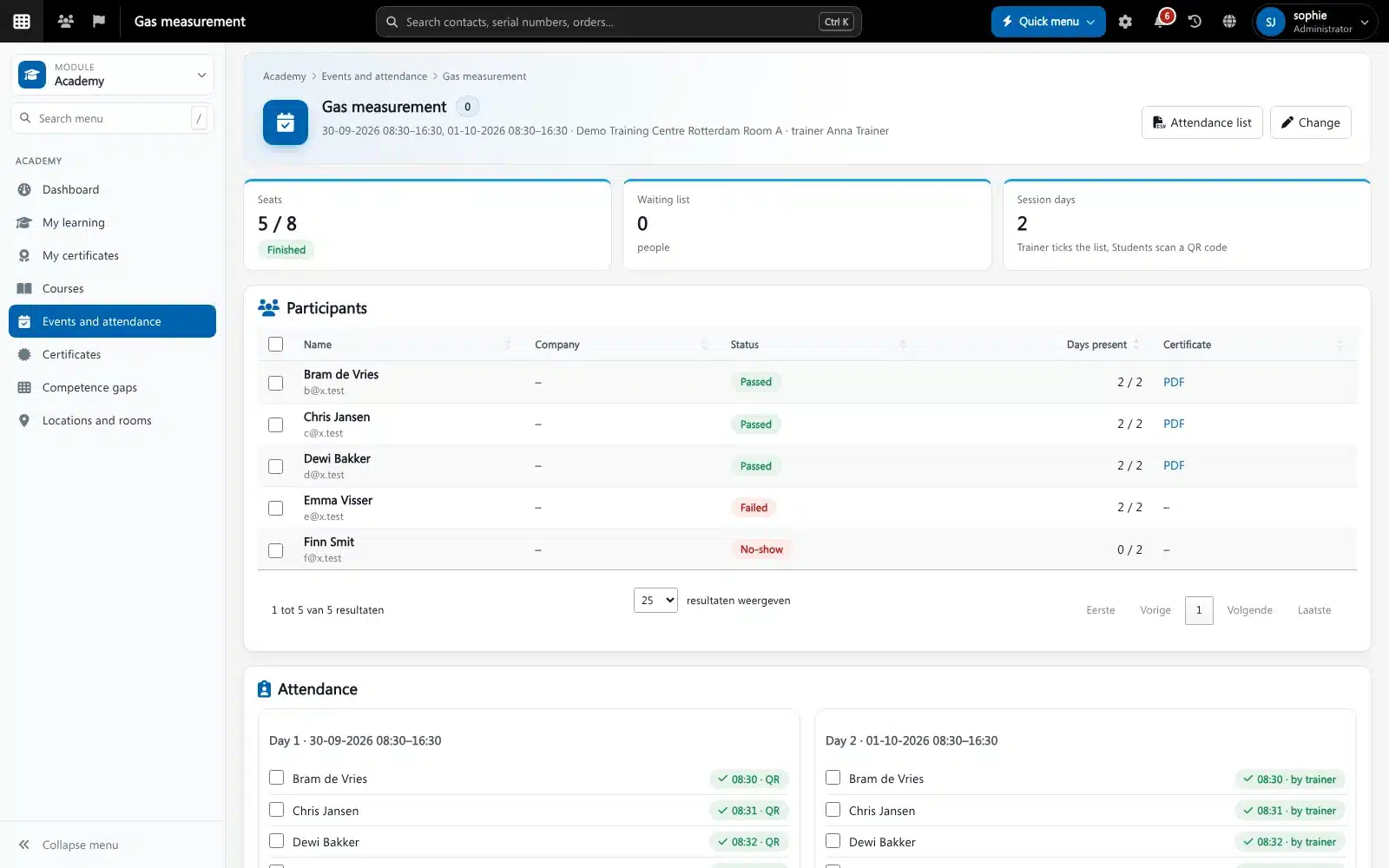
- One record per employee: every course, result and certificate, with the evidence attached
- Expiry reminders: notices to the employee and manager before a certificate runs out
- Check QR on certificates: customers and auditors scan it to see if a certificate is genuine and valid
- Linked to HR and document control: employee data comes from Brytend HR, and course material and procedures can be controlled documents in document control
- Mobile app: employees show their own certificates on their phone at the customer’s gate
For HSE teams the same records feed the safety side of the business. The EHS software guide explains how training, incidents and inspections connect.
What Are Common Training Record Mistakes?
- No expiry date: the record shows a course was done in 2019 but not whether it is still valid
- Group records only: an attendance list without individual results does not prove each person passed
- Records stored per trainer: each trainer keeps their own files, so nobody has the full picture
- Retyping from paper: errors in names and dates creep in, and the record is days or weeks behind
- Old course versions: no link to which version of the course material was used
Frequently Asked Questions About Training Records
What are training records?
Training records are documents that prove an employee completed a training. They include who attended, the course, date, trainer, result, certificate and expiry date. Employers use them as evidence of competence for audits, customers and inspectors.
What should be included in an employee training record?
An employee training record should include the employee name and number, training title and version, date and duration, trainer or provider, proof of attendance, assessment result, certificate number and expiry date.
How long should training records be kept?
Keep training records at least as long as the qualification is valid and the employee works for you, plus a period after they leave. Some health and safety rules and customer contracts require longer periods, so write the retention period per record type in your quality system.
Are digital training records accepted in audits?
Yes. Auditors accept digital training records when they are complete, protected against unauthorised changes and traceable. Time-stamped check-ins, electronic signatures and an audit trail often make digital records stronger evidence than paper lists.
Who is responsible for keeping training records?
The employer is responsible for keeping training records. In practice HR, the HSE manager or the training coordinator maintains them, but the company as a whole must be able to show them on request.
What is the difference between training records and a training matrix?
Training records are the individual proofs of completed trainings. A training matrix is the overview built on those records that shows who is qualified for what and where the gaps are.
How can I check if a training certificate is valid?
Check the certificate number and expiry date against the issuer’s records. Certificates issued by Brytend Academy have a check QR code that shows straight away whether the certificate is genuine and still valid.
Training records are the evidence behind every claim that your people are qualified. Keep them per employee, with attendance, result, certificate and expiry date, and capture them during the training rather than typing them in later. Then audits, customer requests and refresher planning take minutes instead of days. Brytend Academy builds those records automatically from QR check-in, signatures and certificates. Start a free 90-day trial and run your next training with it.