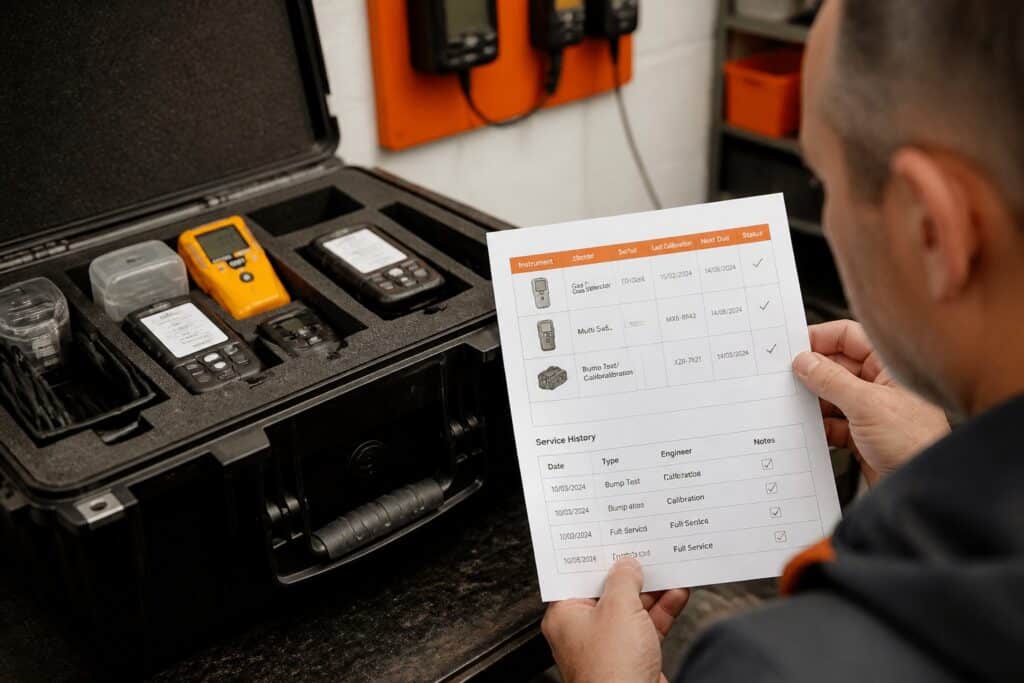
An SCBA inspection is a structured check of a self-contained breathing apparatus to confirm it will deliver clean air when someone’s life depends on it. It covers the facepiece, harness, regulator, cylinder, gauges and alarms, and it happens at several levels: a quick check before every use, a more thorough periodic check, and an annual service on a test bench by a trained technician. Each level must be recorded against the serial number of the set and its cylinder, because an inspection that is not written down did not happen as far as an auditor is concerned.
TL;DR:
- Check every SCBA before use and after cleaning; check sets kept for emergencies at least monthly
- Have a trained technician run a full functional test on a test bench at least once a year, or as the manufacturer prescribes
- Track cylinders separately: pressure, hydrostatic test date and end of service life
- Record date, inspector, findings, repairs and serial numbers for every check
- Take a set out of service the moment it fails a check, and link the repair to the record
Breathing apparatus is used by fire services, industrial rescue teams, offshore crews, chemical plants and anyone who enters spaces where the air is toxic or short of oxygen. The equipment differs by brand, but the logic of inspection is the same everywhere. This guide walks through that logic, gives a practical checklist, and shows how service companies keep the records under control when they look after hundreds of sets for different customers.
What Is an SCBA Inspection?
An SCBA inspection is a documented check that a breathing apparatus is complete, undamaged and working within the limits set by its manufacturer. It is different from cleaning and different from repair, although an inspection often leads to both.
Three kinds of inspection are common:
- Pre-use check: done by the wearer or crew before the set is used or put back on the truck. It takes a few minutes and focuses on pressure, leaks and alarms.
- Periodic inspection: a weekly or monthly check of sets that are stored ready for use, often combined with cleaning and disinfection after use.
- Annual service and functional test: done by a technician trained by the manufacturer, using a test bench to measure flow, pressure, alarm activation and leak tightness. Parts such as O-rings are replaced according to the service schedule.
On top of that, the air cylinder has its own life cycle with hydrostatic tests and a maximum service life. That is why good records keep the backpack, the facepiece and the cylinder as separate items that are linked, rather than as one “SCBA” line in a spreadsheet.
What Rules and Standards Apply to SCBA Inspection?
Which rules apply depends on country and sector, but they share the same core: inspect before use, inspect stored equipment at fixed intervals, follow the manufacturer’s instructions and keep records.
| Region or sector | Main reference | What it asks for |
|---|---|---|
| United States, general industry | OSHA 29 CFR 1910.134 (respiratory protection) | Inspect respirators before each use and during cleaning; inspect emergency-use respirators at least monthly; keep SCBA cylinders charged; record date, inspector, findings, remedial action and serial number for emergency equipment |
| United States, fire service | NFPA standards on SCBA care and maintenance (NFPA 1852, now consolidated into NFPA 1850) | Inspection after each use, regular periodic checks, annual flow testing by trained technicians |
| Europe, product standard | EN 137 | Requirements for open-circuit compressed air breathing apparatus with full face mask |
| Europe, use and care | EN 529 (guidance on respiratory protective devices) | Selection, use, care and maintenance, including inspection and record keeping |
| Breathing air quality | EN 12021 / compressed breathing air standards | Quality of the air filled into cylinders |
The OSHA text is public; see the respiratory protection standard 1910.134 for the exact wording. Always treat the manufacturer’s maintenance manual as the minimum, because intervals and torque values differ between models.
What Should a Pre-Use SCBA Inspection Checklist Include?
A pre-use check should be short enough that people actually do it, and complete enough to catch the faults that matter. A typical checklist:
Cylinder and valve
- Pressure: the gauge shows a full cylinder. OSHA asks that cylinders are recharged when pressure falls to 90% of the manufacturer’s recommended level.
- Test date: the hydrostatic test date is valid and the cylinder is within its service life.
- Condition: no dents, cuts, heat damage or damaged composite wrap; valve and hand wheel turn smoothly.
Harness and backplate
- Straps and buckles: no cuts, fraying, burns or broken buckles.
- Cylinder retention: the cylinder strap or clamp locks properly.
High-pressure system and alarms
- Leak test: open the cylinder valve, close it, and watch the gauge for a pressure drop over the time the manufacturer specifies.
- Gauge match: the cylinder gauge and the pressure gauge on the shoulder strap read within the allowed difference.
- Low-pressure warning: bleed the system slowly and confirm the whistle or electronic alarm activates at the right pressure.
- Electronics: PASS device or telemetry unit switches on, battery is fine.
Facepiece and demand valve
- Visor and seals: no scratches that block vision, no cracks, exhalation valve clean and working.
- Fit and seal: negative pressure test on the face; positive pressure holds.
- Demand valve: delivers air on first breath, bypass works, no free flow.
Anything that fails goes out of service at once with a tag, and the reason is written down. A set that is tagged on paper but still listed as “available” in the planning system is a common and dangerous gap.
How Often Should SCBA Be Inspected?
The short answer: before every use, after every use, monthly for sets in storage, and once a year on a test bench. In more detail:
| Check | Typical interval | Who does it |
|---|---|---|
| Pre-use check | Before each use, at shift start on fire trucks | Wearer or crew |
| Post-use inspection and cleaning | After each use | Trained user or workshop |
| Periodic inspection of stored sets | At least monthly for emergency-use sets | Trained person |
| Functional test on test bench | At least annually, or per manufacturer | Manufacturer-trained technician |
| Overhaul of regulator and demand valve | Per manufacturer schedule, often every few years | Authorised service centre |
| Cylinder hydrostatic test | Commonly every 5 years for composite cylinders, depending on approval | Approved test station |
| Cylinder end of life | Often 15 years for composite cylinders, unless approved for longer | Owner or service company |
Because each component runs on its own clock, the hard part is not knowing the intervals. It is keeping track of which of hundreds of components is due, where it is, and whether the customer has been told.
What Happens During the Annual SCBA Service?
The annual service is where most problems are found. A technician with the right training for the brand connects the set to a test bench and runs a sequence of measurements, usually including:
- High-pressure and medium-pressure leak tightness
- Pressure reducer output and stability
- Low-pressure warning activation point and volume
- Demand valve opening pressure and positive pressure in the facepiece
- Exhalation valve opening pressure
- Facepiece leak test
Measured values, pass or fail per step, replaced parts, the bench used and its own calibration date all belong in the service record. Customers increasingly expect a certificate the same day, with the serial numbers and the next due date on it.
How Do You Keep SCBA Maintenance Records That Pass an Audit?
An auditor or insurer will usually ask four things: show me the list of sets, show me when each one was last inspected, show me what was found, and show me that failures were fixed before the set was used again. Records that answer those questions have a few things in common:
- One record per serial number. Backpack, facepiece, demand valve and cylinder each have their own record, linked to the set they are currently part of. When a cylinder moves to another set, the history moves with it. A clean product registration per unit is the starting point.
- Checklists, not free text. Each step is a field with pass or fail and, where relevant, a measured value. That makes it possible to report on failures by model or by component.
- Who and when, automatically. The inspector’s name and the date are captured by the system, not typed afterwards.
- Status that blocks use. A failed check sets the item to “out of service” until a repair is recorded.
- Due dates that trigger work. The next monthly check, annual service and hydrostatic test are calculated, not remembered.
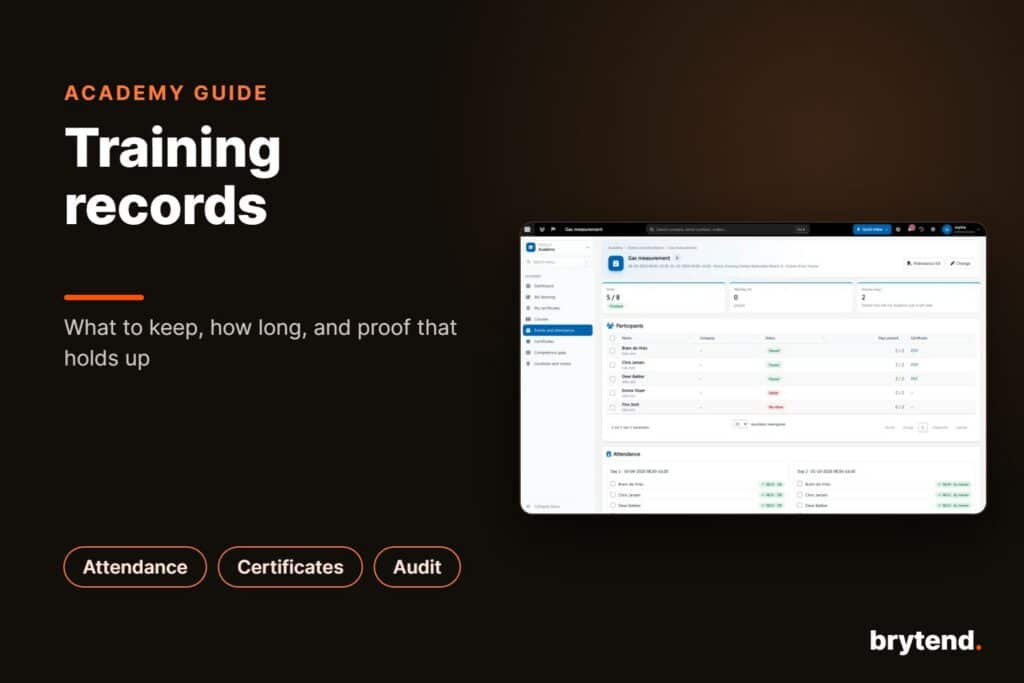
- Proof of competence. Records of who is trained to service which brand; see our guide to training records.
Scanning a QR code or barcode on the set to open its record removes most typing errors. Read more in our guide to QR code asset tracking.
What Should SCBA Maintenance Software Do?
Paper cards and spreadsheets work for a handful of sets. For a fire service with a few hundred sets, or a service company that maintains breathing apparatus for dozens of customers, they break down: due dates are missed, cylinder histories get lost and certificates take days. SCBA inspection and maintenance software should at least:
- Register every set, facepiece and cylinder by serial number, linked to customer, site and location.
- Hold a checklist per product group and brand, including measured values from the test bench.
- Plan pre-use, monthly, annual and hydrostatic test dates automatically per component.
- Produce a certificate per set, with serial numbers, results and next due date, and send it to the customer.
- Block equipment that failed, and create a repair job at once.
- Show the full history per serial number in one screen, for audits and warranty claims.
- Work on a phone or tablet in the workshop and on site.
The same structure works for other respiratory protection: escape sets, airline equipment, filter masks and powered air respirators. It also fits naturally next to gas detection, because many service companies maintain both; our gas detection service software guide covers that side.
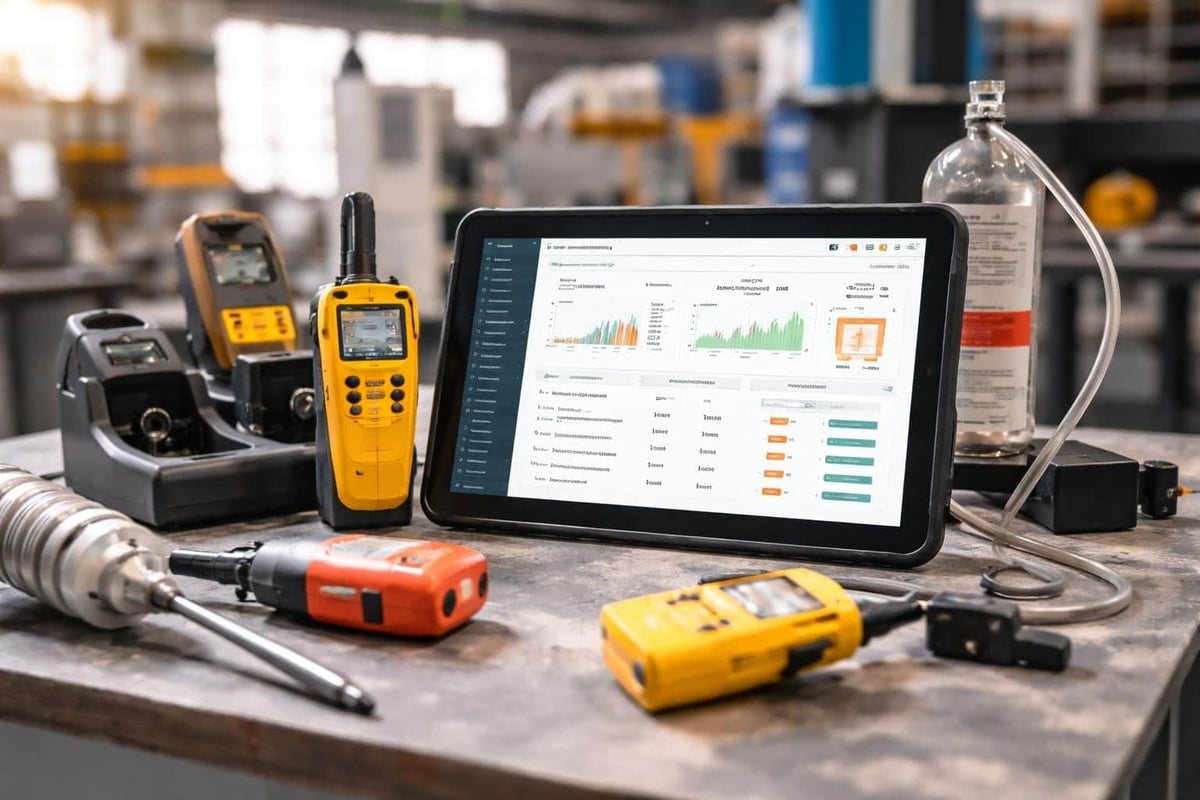
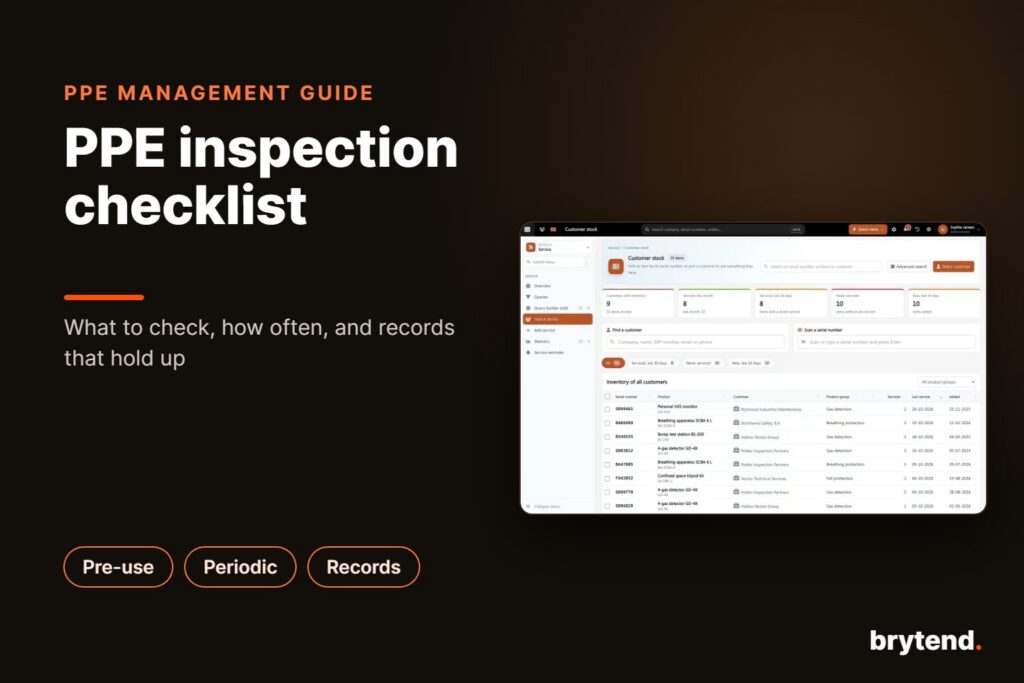
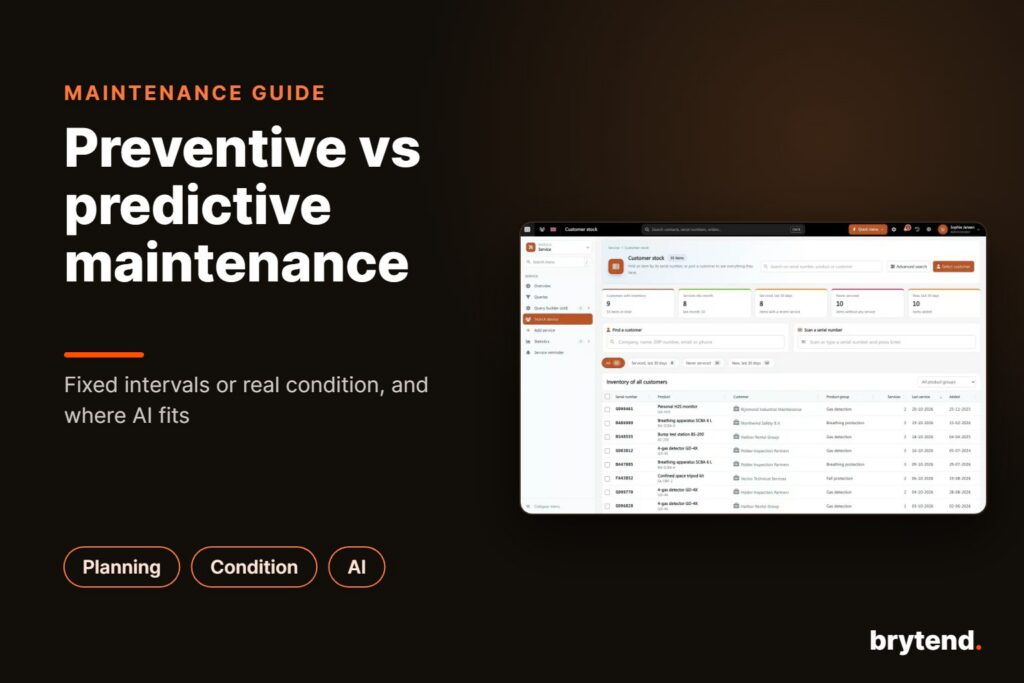
In Brytend, breathing apparatus is registered in the Service and Inspections module: each product group gets its own service protocol and certificate layout, the next inspection follows from the last one, and the customer receives the certificate by email. For a wider view of inspection tools, see our guide to inspection management software, and for the rest of the PPE in your care, our PPE inspection checklist.
What Are the Most Common SCBA Inspection Mistakes?
- Treating the set as one item. Cylinders and facepieces move between sets. If the history is stored per set, it is lost the first time parts are swapped.
- Skipping the monthly check on spare sets. Sets that are rarely used are the ones most likely to be found empty or leaking in an emergency.
- Recording “OK” without values. A pass without the measured value cannot show a slow drift towards failure.
- Losing the hydrostatic test date. A cylinder past its test date may not be filled, and a filling station that checks finds out before you do.
- No link between failure and repair. A failed check without a recorded fix leaves an open question in every audit.
- Technicians without current training. Annual service by someone whose brand training has lapsed can invalidate the result.
Frequently Asked Questions About SCBA Inspection
How often should an SCBA be inspected?
An SCBA should be checked before every use and after every use, and sets stored for emergencies should be inspected at least monthly. On top of that, a trained technician should run a full functional test on a test bench at least once a year, or as often as the manufacturer prescribes.
What is checked in an SCBA pre-use inspection?
A pre-use inspection checks cylinder pressure and test date, the harness and straps, a high-pressure leak test, the low-pressure warning alarm, the facepiece seal and the demand valve. It takes a few minutes and any failure takes the set out of service until it is repaired.
How often do SCBA cylinders need a hydrostatic test?
Composite SCBA cylinders commonly need a hydrostatic test every 5 years, but the exact interval depends on the cylinder’s approval and local rules. Many composite cylinders also have a maximum service life, often 15 years, after which they must be taken out of use.
Who is allowed to service breathing apparatus?
Routine pre-use and monthly checks can be done by trained users. The annual functional test and repairs to regulators and demand valves should be done by a technician trained and authorised by the manufacturer of that brand.
What records should be kept for SCBA inspections?
Keep the date, the inspector, the serial numbers of the set, facepiece and cylinder, the checklist results with measured values, any defects found and the repair carried out. For emergency-use respirators OSHA 1910.134 explicitly asks for date, inspector, findings, remedial action and serial number.
What is the difference between SCBA inspection and SCBA maintenance?
Inspection checks whether the apparatus is complete and working. Maintenance is the work that keeps it that way: cleaning, disinfection, replacing parts, overhauls and cylinder testing. Both should be recorded in the same history per serial number.
Can software replace paper SCBA inspection records?
Yes, as long as it records the same details and keeps them tamper-proof: who did the check, when, on which serial number and with what result. Software adds automatic due dates, out-of-service blocking and certificates, which paper cannot do.
SCBA inspection is simple in principle and hard in practice, because every set, facepiece and cylinder runs on its own clock. Get the records right per serial number, let the system calculate what is due, and certificates and audits stop being a scramble. Want to see how this works for your own equipment? Visit Brytend and start a free 90-day trial.