
TL;DR
- Leads are potential customers who have expressed interest in your products or services through specific actions or engagement
- Lead generation combines inbound strategies (content, SEO, forms) and outbound tactics (email, networking, targeted outreach) to attract qualified prospects
- Lead qualification frameworks like BANT and MEDDIC help prioritize prospects based on budget, authority, need, and timeline
- Effective lead scoring systems assign points based on demographic fit and behavioral engagement to identify sales-ready opportunities
- CRM systems automate lead tracking, nurturing, and conversion by centralizing data and triggering workflow actions
- A lead is a person or organization that has demonstrated interest in a company’s products or services by taking a measurable action such as filling out a form, requesting information, or engaging with content.
In custom software development, leads represent potential clients who need tailored solutions but require education, qualification, and nurturing before becoming active projects. Unlike consumer purchases, software development leads typically involve multiple decision-makers, longer sales cycles, and complex technical requirements. Understanding how to identify, generate, qualify, and convert these leads directly impacts revenue growth and project pipeline health.
What Are the Different Types of Leads in B2B Software Development
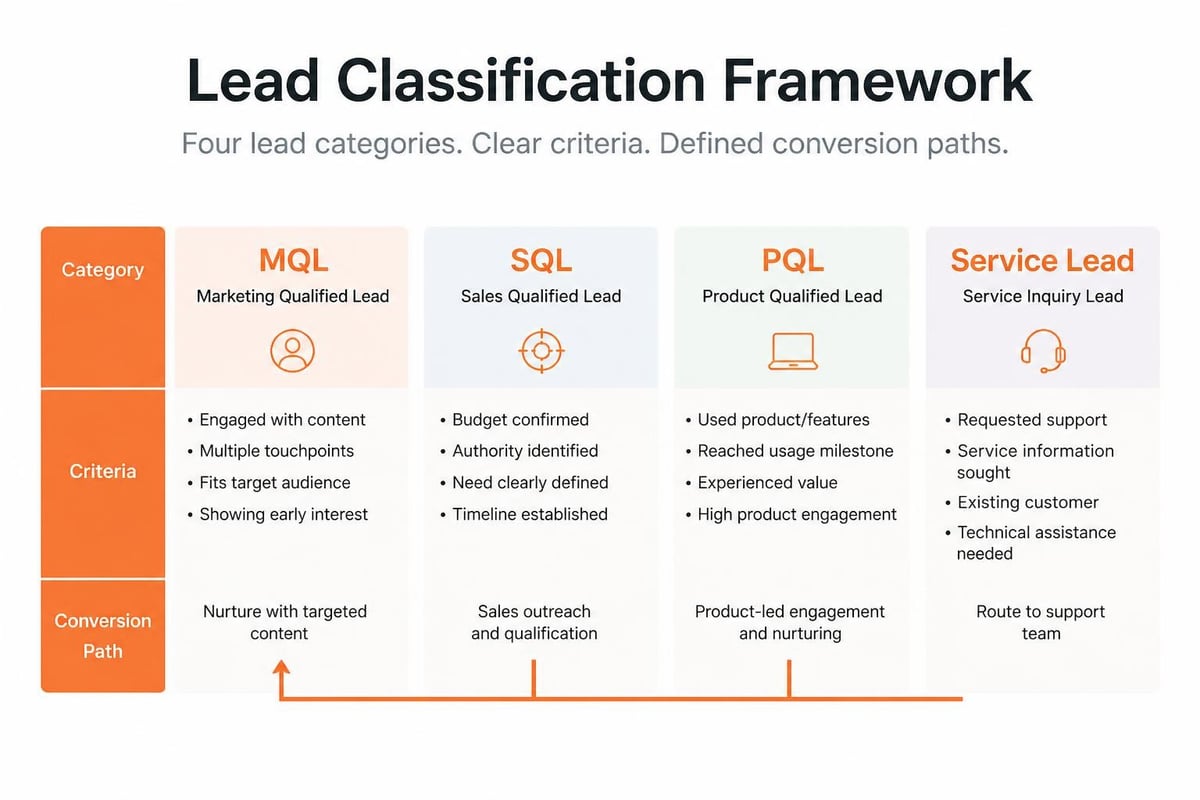
Leads fall into distinct categories based on their awareness level and readiness to purchase. Marketing Qualified Leads (MQLs) have engaged with educational content but haven’t signaled immediate buying intent. They might download whitepapers about cloud migration or attend webinars on mobile app development frameworks.
Sales Qualified Leads (SQLs) have been vetted by sales teams and meet specific criteria indicating purchase readiness. These prospects have defined project requirements, identified budgets, and established timelines. In software development, an SQL might be a manufacturing company that has requested a proposal for a custom ERP system with specific integration requirements.
Product Qualified Leads (PQLs) emerge from hands-on product experience, such as free trials or proof-of-concept projects. A prospect who tests a service module prototype and requests advanced features becomes a PQL.
Service Qualified Leads indicate interest in upgrades, add-ons, or additional services. An existing client using basic web development services who inquires about mobile app extensions represents this category.
| Lead Type | Definition | Example Action | Typical Timeline |
|---|---|---|---|
| MQL | Early-stage educational interest | Downloads technical guide | 3-6 months |
| SQL | Sales-verified buying readiness | Requests detailed proposal | 1-3 months |
| PQL | Product trial engagement | Tests demo environment | 2-8 weeks |
| Service Lead | Existing client expansion | Asks about new features | 1-4 weeks |
Cold leads have no prior relationship with your company. Warm leads have some familiarity through referrals, previous interactions, or shared connections. Hot leads demonstrate urgent need and immediate buying intent, often requesting same-week consultations.
How Do You Generate High-Quality Leads for Custom Software Development
Lead generation combines strategic content creation with targeted outreach to attract prospects who match your ideal client profile. Start by building dedicated landing pages for specific services like web development, mobile app creation, or cloud infrastructure, each optimized for relevant search terms and conversion.
Content marketing establishes expertise through technical articles, case studies, and implementation guides. Publishing detailed analyses of common software challenges-like legacy system modernization or API integration complexity-attracts decision-makers researching solutions. Search engine optimization strategies ensure this content ranks for queries your prospects use.
Inbound lead generation tactics:
- Technical blog posts addressing specific pain points (system integration failures, scalability bottlenecks)
- Gated resources like architecture templates or technology stack comparison guides
- Webinars demonstrating complex implementations with real code examples
- Interactive tools such as project cost calculators or technology assessment quizzes
Outbound lead generation methods:
- Targeted LinkedIn outreach to IT directors and CTOs in specific industries
- Email sequences to companies using outdated technology stacks
- Industry conference participation and speaking engagements
- Strategic partnerships with complementary service providers
Sales intelligence tools identify companies showing buying signals, such as job postings for digital transformation roles or recent funding announcements. Modern B2B lead generation strategies increasingly leverage AI to predict which accounts are most likely to need custom software solutions.
Referral programs incentivize existing clients to introduce your services to peers facing similar challenges. A satisfied client who implemented your inventory management system might refer another manufacturer in their network.
Account-based marketing (ABM) focuses resources on high-value target accounts through personalized campaigns. Instead of broad outreach, ABM creates custom content addressing specific challenges faced by individual prospects-like developing a tailored CRM solution for their unique workflow.
Lead Capture and Form Optimization
Effective lead capture balances information gathering with user experience. Request only essential details initially-name, company, email, and primary challenge-then collect additional qualification data through progressive profiling during follow-up interactions.
Multi-step forms increase completion rates by breaking requests into digestible segments. First screen captures contact information, second screen identifies project type, third screen gathers timeline and budget ranges.
Form placement matters significantly. Embedding requests after valuable content (below detailed technical articles or at webinar conclusion) converts better than immediate popups. Exit-intent triggers can capture abandoning visitors without disrupting initial engagement.
What Is Lead Qualification and Why Does It Matter
Lead qualification is the systematic process of evaluating prospects against predefined criteria to determine their likelihood of becoming customers and prioritizing sales efforts accordingly. Without qualification, sales teams waste time on unfit prospects while qualified opportunities stagnish.
Effective lead qualification frameworks separate high-potential leads from casual researchers. The BANT framework evaluates Budget (financial resources available), Authority (decision-making power), Need (specific problem requiring solution), and Timeline (urgency for implementation).
BANT qualification questions:
- Budget: “What budget range have you allocated for this software project?”
- Authority: “Who else will be involved in the final decision?”
- Need: “What specific operational challenges are you trying to solve?”
- Timeline: “When do you need the solution operational?”
MEDDIC provides deeper qualification for complex B2B sales: Metrics (quantifiable impact), Economic Buyer (budget holder), Decision Criteria (evaluation factors), Decision Process (approval workflow), Identify Pain (critical problems), Champion (internal advocate).
CHAMP prioritizes Challenges first, recognizing that understanding pain points before budget discussions builds stronger relationships. This framework asks: What challenges keep you from achieving goals? How are you addressing these currently? What authority do you have to implement solutions? What financial resources exist? When must this be resolved?
| Framework | Primary Focus | Best For | Key Advantage |
|---|---|---|---|
| BANT | Budget qualification | Transactional sales | Quick disqualification |
| MEDDIC | Process mapping | Enterprise deals | Thorough validation |
| CHAMP | Challenge identification | Consultative sales | Relationship building |
| GPCTBA/C&I | Problem-solution fit | Complex solutions | Comprehensive insight |
Qualification occurs at multiple stages. Initial qualification filters obvious non-fits-companies too small for enterprise solutions or those seeking capabilities outside your expertise. Deep qualification examines technical requirements, integration complexity, and organizational readiness for change.

How Do You Score and Prioritize Leads Effectively
Lead scoring assigns numerical values to prospects based on demographic fit and behavioral engagement, creating objective prioritization for sales follow-up. A manufacturing company with 500+ employees (demographic fit) who attended two webinars and downloaded three technical guides (behavioral engagement) scores higher than a small startup that only viewed your homepage.
Demographic scoring evaluates firmographic data against your ideal customer profile. Company size, industry, technology stack, and revenue range each receive points when they match target criteria. A prospect in manufacturing using legacy .NET systems scores highly for a development firm specializing in modernization.
Demographic scoring criteria:
- Company size: 200-500 employees (+15 points), 500-1000 (+25 points), 1000+ (+30 points)
- Industry match: Target sectors (+20 points), adjacent sectors (+10 points)
- Technology stack: Outdated systems needing replacement (+25 points)
- Geographic location: Primary service regions (+10 points)
Behavioral scoring tracks engagement intensity and purchase intent signals. Downloading a general whitepaper indicates lower intent than requesting a custom proposal. Visiting pricing pages repeatedly or exploring detailed technical documentation suggests active evaluation.
Behavioral scoring actions:
- Email opens: +2 points per open
- Content downloads: +10 points (general) to +25 points (technical specifications)
- Webinar attendance: +20 points (live), +10 points (recording)
- Pricing page visits: +30 points
- Demo requests: +50 points
- Multiple team member engagements: +40 points
Negative scoring prevents wasting resources on poor-fit prospects. Frequent unsubscribes (-20 points), bounced emails (-15 points), or job titles outside decision-making roles (-10 points) reduce priority.
Threshold scores trigger specific actions. Leads reaching 75+ points automatically route to sales for outreach within 24 hours. Scores between 50-74 enter nurture sequences with targeted content. Below 50 remains in general marketing automation.
Time decay prevents stale leads from appearing active. Engagement older than 30 days loses 50% of its point value. After 90 days, subtract points entirely to reflect diminished interest.
Lead Scoring Implementation in CRM Systems
Modern CRM platforms automate scoring calculations and trigger workflows based on score changes. When a prospect crosses the SQL threshold, the system assigns them to the appropriate sales representative, sends internal notifications, and initiates personalized outreach sequences.
Integration between marketing automation and CRM ensures consistent scoring across all touchpoints. A lead who attends a webinar through marketing automation and later visits the pricing page tracked in CRM receives cumulative points from both activities.
Regular score calibration maintains accuracy. Monthly analysis of conversion rates by score range identifies whether thresholds need adjustment. If leads scoring 60-70 convert at similar rates to 70-80, your threshold may be too conservative.

What Are the Critical Steps in the Lead Generation Process
The lead generation process follows eight systematic stages from initial analysis through conversion tracking. Analysis defines your ideal customer profile by examining existing successful clients-industry, company size, technical challenges, budget ranges, and decision-making structures.
Stage 1: Market and Audience Analysis
Identify industries with highest custom software needs. Manufacturing companies modernizing operations, healthcare organizations requiring HIPAA-compliant systems, and logistics firms building route optimization tools represent distinct segments requiring different approaches.
Stage 2: Multi-Channel Research
Compile prospect lists using LinkedIn Sales Navigator, industry directories, technology stack databases, and event attendee lists. Research reveals which companies use outdated systems, recent funding rounds indicating investment capacity, and digital transformation initiatives.
Stage 3: Messaging Development
Create value propositions addressing specific pain points. A message to manufacturers emphasizes production efficiency gains and system integration. Healthcare messaging focuses on compliance, data security, and patient experience improvements.
Stage 4: Outreach Execution
Deploy coordinated campaigns across email, LinkedIn, content marketing, and targeted advertising. Initial contact establishes expertise without immediate sales pressure-sharing relevant case studies or offering free assessments.
Stage 5: Engagement and Qualification
Respond to inquiries within one hour to maximize conversion rates. Initial conversations gather BANT or MEDDIC information while providing genuine value through preliminary recommendations.
Stage 6: Lead Nurturing
Not all qualified leads buy immediately. Nurture sequences deliver staged content matching their position in the buying journey-awareness content for early-stage leads, comparison guides for active evaluators, implementation timelines for near-decision prospects.
Stage 7: Sales Handoff
Transfer qualified leads to sales with complete context: engagement history, pain points discussed, technical requirements mentioned, budget indicators, timeline expectations, and competitor mentions.
Stage 8: Performance Analysis
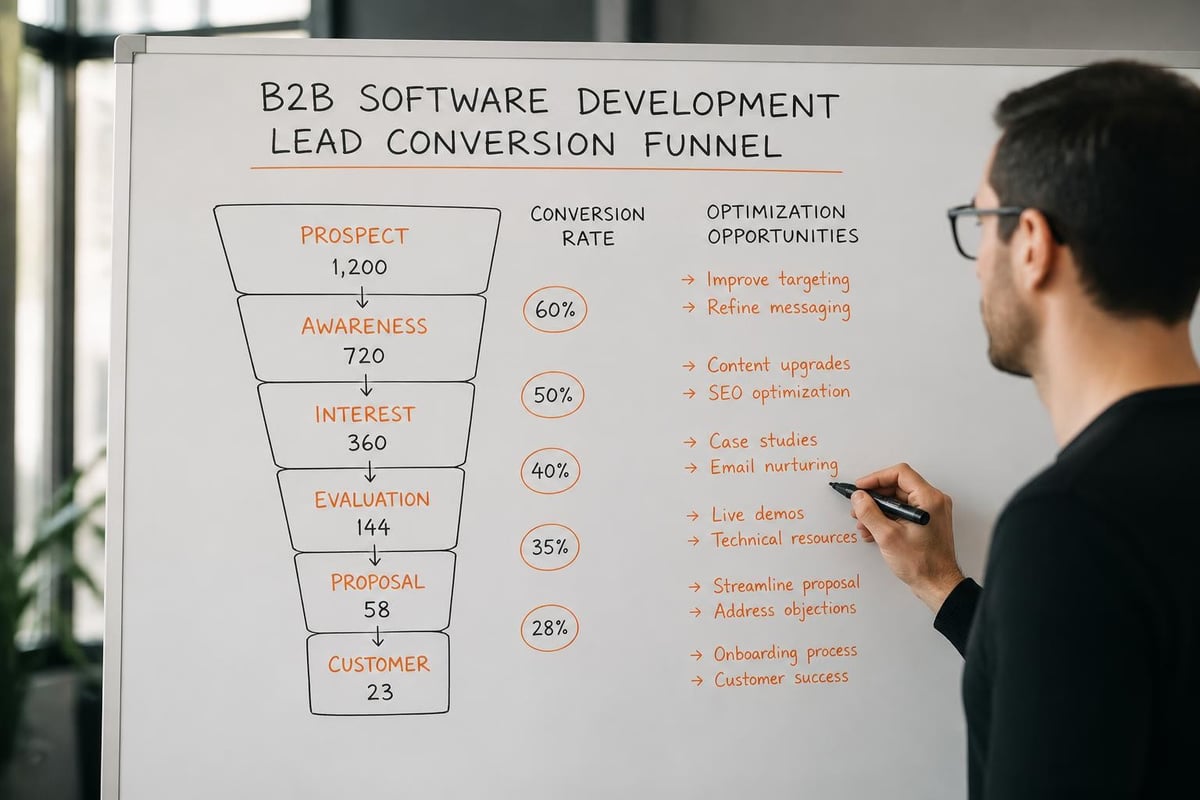
Track conversion rates at each stage to identify bottlenecks. Low MQL-to-SQL conversion suggests qualification criteria need refinement. High SQL-to-opportunity conversion but low close rates indicates proposal or pricing issues.
How Do You Nurture Leads Through the Sales Funnel
Lead nurturing maintains engagement with prospects not ready for immediate purchase through systematic, value-focused communication. Most custom software projects involve 3-12 month evaluation periods before contract signing-nurturing prevents leads from going cold during extended decision cycles.
Email sequences deliver progressively detailed content matching prospect maturity. Early-stage sequences share educational content about common challenges and solution approaches. Mid-stage content compares implementation methodologies and technology options. Late-stage sequences provide detailed case studies, ROI calculators, and implementation timelines.
Nurture sequence example for manufacturing software:
- Week 1: Article on common ERP integration challenges
- Week 3: Case study showing 40% efficiency improvement
- Week 5: Webinar on modern manufacturing technology stacks
- Week 7: Interactive ROI calculator for automation projects
- Week 9: Client testimonial video from similar company
- Week 11: Consultation offer with technical architect
Content personalization increases engagement significantly. Segmenting by industry, company size, and identified challenges enables relevant messaging. A prospect interested in mobile development receives mobile-specific case studies, not generic software content.
Multi-channel nurturing combines email with LinkedIn engagement, retargeting ads, and direct mail for high-value accounts. A prospect who opened three emails but hasn’t responded might engage with a LinkedIn message from a senior developer or personalized video.
Marketing Automation and Behavioral Triggers
Automation platforms trigger responses based on specific actions. When a lead downloads a technical specification document, the system automatically sends related implementation guides and schedules a follow-up task for sales outreach in three days.
Lead behavior reveals buying stage shifts. A prospect who suddenly visits multiple team-member pages, pricing information, and case studies within 48 hours shows accelerated interest requiring immediate sales engagement-not another automated email.
Re-engagement campaigns target leads gone dormant. After 60 days of inactivity, send a value-driven message: “Three New Case Studies in [Their Industry]” or “Updated Technology Comparison Guide.” Offer easy re-entry points like one-click content access rather than form-gated downloads.
What Challenges Affect Lead Quality and Conversion Rates
Poor lead quality wastes sales resources and inflates customer acquisition costs. Common quality issues include incomplete contact information, prospects outside target markets, decision-makers with no authority, and leads seeking information with no genuine buying intent.
Form spam and bot submissions contaminate databases with invalid data. Implement CAPTCHA verification, email confirmation steps, and real-time validation checks. Monitor submission patterns-dozens of leads from the same IP address or identical job titles suggest fraudulent activity.
Data quality deterioration factors:
- Contact information decay: 30% of B2B database contacts change annually
- Company changes: Mergers, acquisitions, and reorganizations invalidate firmographic data
- Technology shifts: Prospects adopt new systems, changing their fit for your solutions
- Role changes: Decision-makers switch positions or companies
Lead response time critically impacts conversion. Leads contacted within five minutes convert 21 times higher than those contacted after 30 minutes. Implement instant notification systems ensuring immediate sales follow-up for high-scoring leads.
Misalignment between marketing and sales creates conversion barriers. Marketing generates leads meeting their criteria, but sales considers them unqualified. Regular alignment meetings establish shared definitions of qualified leads and feedback loops for continuous improvement.
Long sales cycles cause lead stagnation. Custom software projects involve multiple stakeholders, competing priorities, and budget approval processes. Leads lose momentum without consistent engagement, requiring robust nurturing systems maintaining relationships during extended evaluation periods.
Attribution complexity obscures which channels generate quality leads. A prospect might discover your company through organic search, attend a webinar, download resources, engage with LinkedIn ads, and ultimately convert via email-making single-touch attribution meaningless. Multi-touch attribution models credit all influences appropriately.
Technical Integration and System Challenges
CRM systems failing to integrate with marketing automation, website analytics, and communication platforms create data silos. A lead fills out a website form, but the information doesn’t sync to the CRM for six hours-by which time they’ve engaged with competitors offering faster response.
Manual data entry introduces errors and delays. Sales representatives copying information from emails or notes into CRM fields make typos, forget details, or deprioritize administrative tasks during busy periods. API-based integrations automate data flow between systems.
Inadequate lead tracking loses attribution and context. When sales contacts a lead weeks after initial inquiry without access to their content downloads, email opens, or website visits, conversations lack personalization and relevance.
How Do You Optimize Lead Conversion and Close Rates
Conversion optimization begins with analyzing your current funnel metrics. Calculate conversion rates at each stage: website visitor to lead, lead to MQL, MQL to SQL, SQL to opportunity, opportunity to customer. Identify the weakest transition points requiring attention.
Funnel optimization priorities:
- Below 2% visitor-to-lead conversion: Improve value propositions and reduce form friction
- Below 40% MQL-to-SQL conversion: Tighten lead qualification criteria or enhance nurturing
- Below 30% SQL-to-opportunity conversion: Refine discovery processes and proposal quality
- Below 25% opportunity-to-customer close rate: Address pricing, differentiation, or sales methodology
A/B testing identifies high-performing variations. Test different value propositions, form lengths, content offers, email subject lines, and call-to-action copy. A software development firm testing “Get Custom Solution Roadmap” versus “Request Free Technical Consultation” might discover 40% higher conversion with the second option.
Personalization at scale uses dynamic content and segmentation. Landing pages displaying industry-specific examples, testimonials from similar companies, and relevant case studies convert better than generic messaging. Email subject lines including company names or industry terms achieve higher open rates.
Sales enablement content supports prospect conversations. Provide sales teams with ROI calculators, technical comparison sheets, implementation timelines, and reference architectures. When a prospect asks about cloud migration timelines, sales can share a detailed process document immediately rather than promising follow-up.
Qualification Improvements and Sales Process Refinement
Continuous qualification improvement requires feedback loops between sales and marketing. Sales teams report which lead sources and characteristics correlate with successful closes versus time-wasting interactions. Marketing adjusts targeting, messaging, and qualification criteria accordingly.
Discovery call frameworks ensure consistent information gathering. Standardized questions about current systems, pain points, budget parameters, decision processes, and success metrics provide complete context for accurate proposals and prevent late-stage surprises.
Proposal quality directly impacts close rates. Generic proposals listing services and prices underperform compared to customized documents addressing specific challenges, proposed solutions with technical architecture diagrams, phased implementation plans, and clear success metrics tied to prospect’s stated goals.
Social proof through case studies, testimonials, and references reduces perceived risk. Prospects evaluating enterprise software implementations want evidence of successful similar projects. “We helped three manufacturing companies integrate legacy ERP systems with modern cloud platforms” provides specific, relevant credibility.
Follow-up persistence matters for complex B2B sales. Research shows 80% of sales require five or more follow-ups, yet most salespeople give up after two attempts. Systematic follow-up sequences combining value-added content with direct outreach maintain momentum.
Case Example: Manufacturing Company Lead Conversion
A mid-sized manufacturer downloaded a whitepaper about production tracking systems, entering the database as an MQL with 25 points. Over four weeks, they attended a webinar (+20 points), visited the pricing page twice (+60 points), and had three employees view case studies (+45 points), totaling 150 points.
The lead automatically routed to sales, who discovered during qualification that the company had allocated $200,000 for a custom production management system, needed implementation within six months, and had executive buy-in. This qualified SQL entered a customized nurture sequence including manufacturing-specific content and weekly sales check-ins.
After reviewing detailed proposals from three vendors, the prospect selected the development firm that demonstrated understanding of their specific powder coating process challenges and proposed a phased implementation minimizing production disruption-converting from initial lead to signed contract in 12 weeks.
What Role Does Technology Play in Lead Management
Customer Relationship Management (CRM) systems centralize all lead data, interactions, and activities in a single platform accessible to marketing, sales, and service teams. CRM platforms like Brytend CRM track every touchpoint from initial website visit through project completion and ongoing support.
Marketing automation platforms execute complex nurture campaigns, score leads based on behavior, segment audiences dynamically, and trigger personalized communications. Integration with CRM ensures seamless handoff when leads reach sales-ready status.
Essential technology stack components:
- CRM system for centralized lead and customer data
- Marketing automation for email campaigns and nurturing
- Website analytics for behavior tracking and attribution
- Form builders with progressive profiling capabilities
- Sales intelligence tools for account research and enrichment
- Communication platforms for email tracking and calling
- Proposal automation for customized document generation
AI-powered tools predict lead quality by analyzing historical conversion patterns. Machine learning models identify which combinations of firmographic and behavioral attributes correlate with successful closes, automatically scoring new leads more accurately than manual rules.
Chatbots qualify and route leads 24/7, capturing interest outside business hours. A prospect visiting your website at midnight can interact with a chatbot that asks qualifying questions, schedules consultations, and routes high-priority inquiries for morning follow-up.
Data enrichment services append missing information to lead records automatically. When someone submits only name and email, enrichment tools add company details, job title, social profiles, and technology stack information-providing sales with complete context.
Conversation intelligence platforms analyze sales calls for qualification effectiveness, competitor mentions, objections patterns, and successful closing techniques. Recording and transcribing discovery calls reveals which questions uncover the most valuable insights and which approaches generate strongest engagement.
Integration and Automation Benefits
API integrations eliminate manual data transfer between systems. When a lead downloads content from your website, marketing automation captures the action, updates the lead score in CRM, triggers a follow-up email sequence, notifies the assigned sales representative, and logs the activity-all automatically within seconds.
Workflow automation handles routine tasks that would otherwise consume hours. New leads automatically receive welcome emails, get assigned to appropriate sales representatives based on territory or specialization, trigger internal notifications, and enter nurture sequences matching their profile.
Real-time dashboards provide visibility into pipeline health, conversion metrics, lead source performance, and team activities. Sales managers identify bottlenecks, forecast accurately, and allocate resources based on current data rather than weekly reports.
Successful lead management combines strategic generation tactics with rigorous qualification processes, systematic nurturing, and technology-enabled optimization. By implementing structured frameworks for identifying, scoring, and converting prospects, custom software development firms build predictable revenue pipelines and improve sales efficiency. Brytend develops custom CRM solutions that streamline your entire lead management process, integrating qualification frameworks, automated scoring, and nurture workflows tailored to your specific sales methodology and customer journey.
FAQs
What is a lead in custom software development?
A lead is a potential client who shows interest in custom software solutions by taking measurable actions, like filling out a form.
How do you generate high-quality leads for custom software development?
High-quality leads are generated through targeted content creation, strategic outreach, and optimized landing pages, ensuring alignment with ideal client profiles.
What are the different types of leads in B2B software development?
Leads are categorized as MQLs, SQLs, PQLs, and Service Qualified Leads, each indicating varying levels of interest and readiness to purchase.
Can CRM systems help in lead management and conversion?
Yes, CRM systems automate lead tracking, nurturing, and conversion by centralizing data and triggering specific workflow actions.
How long does the lead qualification process typically take?
The lead qualification process can vary, but initial qualification can happen within hours, while deep qualification may take days to weeks.
How do you score and prioritize leads effectively?
Leads are scored based on demographic fit and behavioral engagement, creating an objective prioritization for sales follow-up.
What challenges affect lead quality and conversion rates?
Challenges include poor lead quality, misalignment between marketing and sales, long sales cycles, and data quality deterioration.
Why Prospects Hesitate: Trust and Friction in the Capture Process
Even a well-targeted lead capture form loses prospects when it fails to earn their trust or asks for more effort than the offer justifies. Visitors weigh an implicit exchange every time they see a form: what they must give up in personal information against what they expect to receive in return. When that exchange feels unclear, unequal, or risky, they abandon rather than commit. Common trust gaps include forms with no visible privacy assurance, no indication of what happens after submission, and no social proof that the company has delivered value to others in a similar position.
Friction compounds the trust problem. Every additional field, every ambiguous call-to-action, and every multi-step form without a visible progress indicator gives a hesitant prospect one more reason to leave. The forms that convert best ask only for what is immediately necessary, defer secondary qualification questions to a later stage of the relationship, and make the next step unmistakably clear. Reviewing field-by-field necessity and streamlining the visual path to submission typically recovers a meaningful share of the abandonment described above.
Data privacy expectations add a further layer that cannot be an afterthought. Prospects, particularly in B2B software buying, increasingly expect a visible link to how their information will be used and stored, and forms that operate in regions covered by GDPR or similar regulations need explicit consent language built into the capture flow itself rather than buried in a separate policy page. Treating compliance as a trust signal, not just a legal requirement, tends to improve completion rates rather than hurt them.
What Slow or Manual Lead Handling Actually Costs
Even a form that converts well can leak value after submission if the leads it produces are not handled quickly. Teams that route new leads through spreadsheets, shared inboxes, or manual hand-offs between marketing and sales introduce delay at exactly the point where speed matters most: response time is one of the strongest predictors of whether a lead ultimately converts, and leads contacted within the first hour convert at dramatically higher rates than leads contacted after a delay of even a few hours. Manual processes also degrade data quality over time, since inconsistent entry and duplicate records accumulate without a system enforcing structure.
Automating the hand-off from capture to first contact, and connecting form submissions directly into the CRM and lead-scoring workflow described above, closes this gap without requiring a larger sales team. The combination of a low-friction, trustworthy capture form and a fast, automated follow-up process is what actually determines whether lead generation effort turns into revenue.