
Managing IT services requires structured processes, clear governance, and appropriate technology platforms to ensure consistent service delivery. Organizations face increasing complexity as technology infrastructure expands, user expectations rise, and business operations become more dependent on digital systems. Effective IT service management aligns technology capabilities with business objectives while maintaining operational efficiency and user satisfaction.
TL;DR:
- Managing IT services involves structured frameworks like ITIL to standardize service delivery processes
- Service desk operations, incident management, and change control form the foundation of ITSM
- Automation reduces manual workload and improves response times for common service requests
- Custom software solutions can integrate disparate systems and create unified service management platforms
- Continuous improvement through metrics and feedback loops enhances service quality over time
Managing IT services is a systematic approach to designing, delivering, supporting, and improving technology services that meet business requirements and user needs through standardized processes and governance structures.
What Does Managing IT Services Involve?
Managing IT services encompasses the complete lifecycle of technology services from strategy and design through transition, operation, and continual improvement. This discipline requires coordination across multiple domains including infrastructure management, application support, security operations, and user service delivery.
IT Service Management (ITSM) provides the foundational framework for structuring these activities. The core components include:
- Service strategy – Defining services that align with business objectives
- Service design – Creating service architectures and support processes
- Service transition – Managing changes and deployments without disrupting operations
- Service operation – Day-to-day delivery including incident and problem management
- Continual service improvement – Analyzing performance and implementing enhancements
Organizations implement these components through established frameworks, with ITIL (Information Technology Infrastructure Library) being the most widely adopted standard. ITIL provides detailed process descriptions, role definitions, and key performance indicators for each service management activity.
The service catalog serves as the central reference point for all available IT services. This catalog documents service descriptions, service levels, support hours, request procedures, and dependencies. Users reference the catalog to understand available services and how to request support or access.

Service Desk Functions
The service desk acts as the single point of contact between IT services and users. This function handles all service requests, incidents, and initial problem diagnosis. Effective service desks categorize and prioritize incoming requests based on business impact and urgency.
Core service desk responsibilities:
- Log all incidents and service requests with complete information
- Provide first-level diagnosis and resolution for common issues
- Escalate complex problems to specialized support teams
- Track request status and communicate progress to users
- Close resolved requests after confirming user satisfaction
Modern service desks leverage self-service portals where users can submit requests, search knowledge bases, and track resolution progress. This approach reduces call volume while giving users more control over their support experience.
How Do You Implement Effective Incident Management?
Incident management focuses on restoring normal service operation as quickly as possible after disruptions. An incident is any unplanned interruption or reduction in service quality. The goal is minimizing business impact rather than identifying root causes, which falls under problem management.
The incident management process follows a structured workflow:
| Stage | Activities | Typical Duration |
|---|---|---|
| Detection | User report or monitoring alert identifies issue | Minutes |
| Logging | Service desk records all incident details | 2-5 minutes |
| Categorization | Assign category and priority based on impact | 1-2 minutes |
| Diagnosis | Identify cause and potential resolution | 15 minutes – 4 hours |
| Resolution | Implement fix and verify service restoration | Varies by complexity |
| Closure | Confirm with user and document resolution | 5-10 minutes |
Priority assignment combines impact (number of users affected) and urgency (time sensitivity) to determine response requirements. Critical incidents affecting multiple users or business-critical systems receive immediate attention, while low-priority issues may queue for scheduled resolution.
Effective incident management requires comprehensive documentation. Each incident record should capture symptoms, diagnostic steps attempted, resolution actions, and root cause if identified. This documentation becomes valuable reference material for future similar incidents.
Escalation Procedures
Not all incidents resolve at the first support level. Escalation procedures define when and how to transfer incidents to specialized teams. Functional escalation moves incidents to teams with specific technical expertise. Hierarchical escalation involves management when incidents exceed resolution time targets or require additional resources.
Clear escalation criteria prevent delays. For example, database performance issues escalate to the database administration team after 30 minutes of unsuccessful first-level troubleshooting. Network connectivity problems escalate immediately to network operations.
What Are the Key Components of Change Management?
Change management ensures modifications to IT infrastructure, applications, or services occur in controlled ways that minimize risk and disruption. All changes follow documented processes regardless of size or complexity. This governance prevents unauthorized modifications that could cause outages or security vulnerabilities.
Standard change categories:
- Standard changes – Pre-approved, low-risk modifications following established procedures
- Normal changes – Require evaluation and approval from change advisory board
- Emergency changes – Urgent modifications to resolve critical incidents or security issues
The change advisory board (CAB) reviews proposed changes for technical feasibility, business impact, resource requirements, and rollback procedures. CAB membership typically includes representatives from infrastructure teams, application development, security, and business units.
Every change request documents the modification scope, implementation plan, testing procedures, rollback approach, and expected business impact. This information allows informed approval decisions and ensures implementation teams have clear direction.
Testing and Validation
Changes move through testing environments before production deployment. Development environments allow initial coding and unit testing. Integration environments verify that changes work correctly with dependent systems. User acceptance testing in staging environments confirms business requirements are met.
Rollback plans define procedures for reversing changes if problems occur during implementation. These plans identify specific steps, required time, data preservation approaches, and success criteria for determining when rollback is necessary.
How Does Problem Management Reduce Recurring Incidents?
Problem management identifies and addresses the underlying causes of incidents to prevent recurrence. While incident management focuses on quick restoration, problem management investigates why incidents occur and implements permanent solutions.
The problem management process involves:
- Problem detection – Identifying patterns in incident data or proactive analysis
- Problem logging – Creating problem records linked to related incidents
- Investigation and diagnosis – Root cause analysis using systematic techniques
- Workaround identification – Temporary solutions while permanent fixes develop
- Known error documentation – Recording problems and workarounds for reference
- Resolution implementation – Deploying permanent fixes through change management
Organizations typically discover problems through two approaches. Reactive problem management analyzes incident trends to identify recurring issues. Proactive problem management examines system performance data, capacity metrics, and technology assessments to prevent potential problems.
Root cause analysis techniques include the "five whys" method, fishbone diagrams, and fault tree analysis. These approaches systematically trace symptoms back to underlying causes rather than addressing surface-level issues.

What Role Does Automation Play in Managing IT Services?
Automation transforms managing IT services by handling repetitive tasks, enforcing consistent processes, and accelerating response times. Artificial intelligence and machine learning now enhance traditional automation with intelligent decision-making capabilities.
High-impact automation opportunities:
- Automated ticket classification and routing based on content analysis
- Self-healing infrastructure that detects and corrects common configuration issues
- Chatbots handling routine service requests and password resets
- Automated software deployment and patching processes
- Predictive analytics identifying potential incidents before they occur
Service request automation particularly benefits from workflow technology. Common requests like software access provisioning, hardware ordering, or account creation follow predictable approval and fulfillment steps. Automated workflows route requests through appropriate approval chains, trigger fulfillment actions, and notify users of completion.
Brytend's custom software development expertise enables organizations to build automation solutions tailored to specific service management requirements. Rather than forcing business processes into generic platforms, custom applications integrate with existing systems while supporting unique workflows and governance requirements.
Automation Implementation Best Practices
Start automation initiatives with high-volume, low-complexity processes. Password resets, software license requests, and access provisioning typically offer quick wins with clear ROI. These successes build organizational confidence in automation capabilities.
Document manual processes thoroughly before automating them. Automation codifies existing workflows, so inefficient manual processes become inefficient automated processes. Process optimization should precede automation implementation.
Monitor automation outcomes to verify they meet service level expectations. Automated processes sometimes handle edge cases incorrectly or create new problems while solving others. Continuous monitoring with human oversight ensures automation improves rather than degrades service quality.
How Do You Measure IT Service Management Performance?
Measurement drives improvement in managing IT services. Organizations track key performance indicators (KPIs) that reflect service quality, operational efficiency, and business value delivery. These metrics inform decision-making and identify improvement opportunities.
Critical ITSM metrics:
| Metric Category | Example Metrics | Target Ranges |
|---|---|---|
| Service Desk | First-call resolution rate, average handle time | 70-80%, 8-12 minutes |
| Incident Management | Mean time to resolve (MTTR), incident volume | <4 hours, trending down |
| Change Management | Change success rate, emergency change percentage | >95%, <5% |
| Service Availability | Uptime percentage, mean time between failures | 99.5-99.9%, increasing |
| User Satisfaction | Customer satisfaction score (CSAT) | >85% |
Service level agreements (SLAs) define specific commitments for service availability, response times, and resolution timeframes. SLAs create accountability and set user expectations. Organizations track SLA compliance rates and analyze breaches to identify systemic issues.
Leading indicators predict future performance problems before they impact users. Growing incident backlog, increasing change failure rates, or declining first-call resolution percentages signal developing issues requiring intervention.
Dashboard and Reporting Requirements
Effective reporting presents metrics at appropriate levels for different audiences. Executive dashboards show high-level trends in service availability, major incident impacts, and cost efficiency. Operational dashboards provide real-time incident queue status, change schedules, and resource utilization for service delivery teams.
Regular service reviews bring together IT leadership and business stakeholders to examine performance trends, discuss service improvements, and align on priorities. These reviews typically occur monthly or quarterly depending on organizational needs.
What Are Common Mistakes in Managing IT Services?
Organizations frequently encounter predictable challenges when implementing or improving IT service management practices. Recognizing these patterns helps avoid costly missteps.
Frequent ITSM implementation errors:
- Treating ITSM as purely a technology implementation rather than a process and culture change
- Implementing all ITIL processes simultaneously instead of phased adoption
- Creating overly complex processes that slow service delivery and frustrate users
- Failing to customize frameworks to organizational context and requirements
- Neglecting ongoing training as staff changes and processes evolve
Process documentation that nobody follows provides no value. Documentation should be concise, accessible, and regularly updated to reflect current practices. If documented processes diverge from actual workflows, either update the documentation or correct the practices.
Tool selection often emphasizes features over usability and fit. Managed IT service providers recommend selecting platforms that support required workflows without unnecessary complexity. Custom software development allows organizations to build exactly what they need rather than adapting to generic tool constraints.
Cultural Resistance Factors
Service management maturity requires cultural acceptance beyond process definition. Teams accustomed to informal, ad-hoc approaches may resist structured processes they perceive as bureaucratic. Change management (organizational, not technical) addresses this resistance through stakeholder engagement, training, and demonstrating clear benefits.
Users sometimes bypass official channels when they perceive service desk processes as slow or unhelpful. This shadow IT creates security risks, prevents accurate workload tracking, and reduces service management effectiveness. Improving service desk responsiveness and user experience reduces bypass behavior.
How Does Managing IT Services Support Business Objectives?
Effective IT service management directly enables business capabilities and competitive advantages. Organizations that excel at managing IT services respond faster to market opportunities, maintain higher operational reliability, and allocate resources more efficiently.
Business value from mature ITSM practices includes:
- Reduced downtime – Systematic incident and problem management minimizes service disruptions
- Faster deployment – Controlled change processes enable rapid, low-risk releases
- Lower support costs – Automation and knowledge management reduce manual effort requirements
- Improved compliance – Documented processes and audit trails support regulatory requirements
- Better resource allocation – Capacity planning prevents over-provisioning and under-utilization
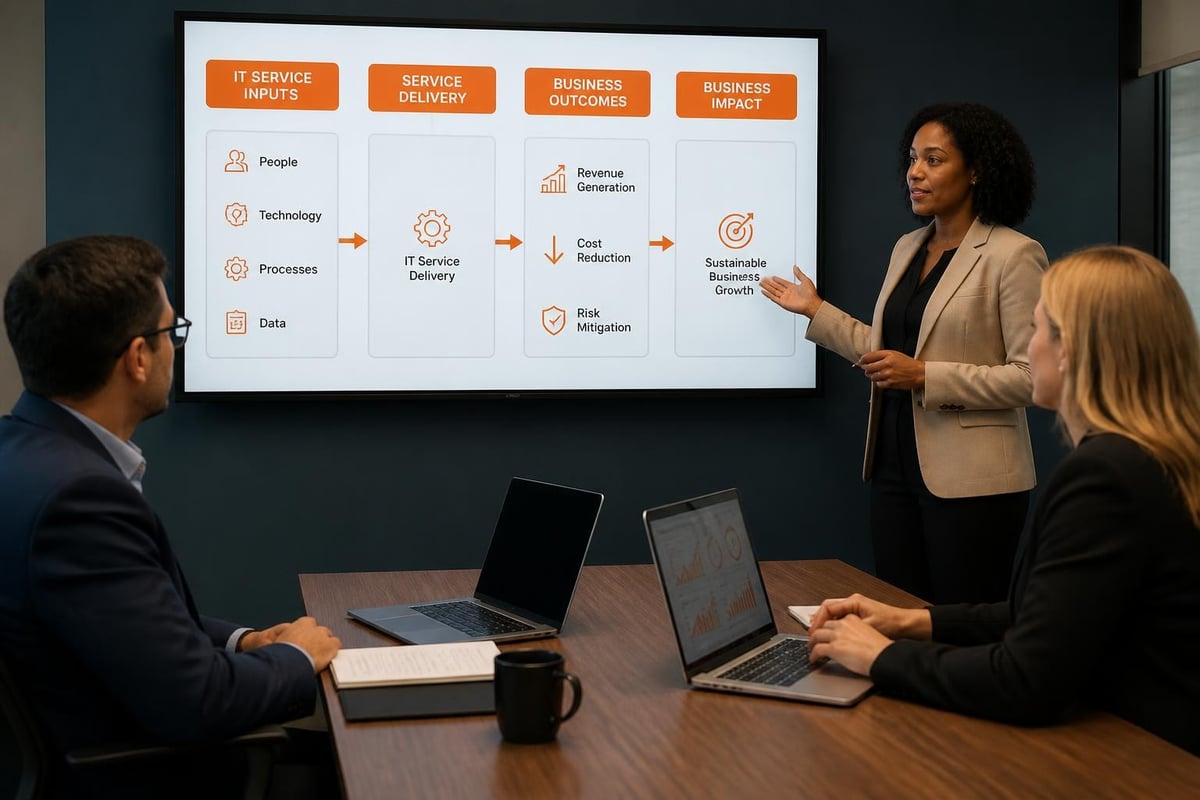
Service portfolio management connects IT services to business outcomes. Each service maps to specific business capabilities it enables. This alignment helps prioritize investments, retire obsolete services, and justify service costs through business value delivered.
Technology service providers increasingly leverage custom software to differentiate their service offerings. Standard commercial platforms provide baseline capabilities, but field service management software and custom integrations enable unique service delivery models that competitors cannot easily replicate.
Service Catalog Design
The service catalog translates technical capabilities into business terms. Instead of listing "email server hosting," the catalog describes "business communication services" with specific features, availability commitments, and support options. This business-focused presentation helps users understand available services and select appropriate options.
Catalog services should include clear cost information when using chargeback or showback models. Transparent pricing enables informed decision-making and encourages efficient resource consumption. Users who see costs are more likely to decommission unused services and select appropriately-sized options.
What Technology Platforms Support Managing IT Services?
Organizations implement IT service management through specialized software platforms that provide ticketing, workflow automation, asset tracking, and reporting capabilities. Platform selection depends on organizational size, complexity, integration requirements, and customization needs.
Commercial ITSM platforms offer comprehensive feature sets including incident management, problem management, change control, service catalog, knowledge base, and reporting dashboard capabilities. Leading platforms include ServiceNow, BMC Remedy, and Atlassian’s Jira Service Management.
Platform evaluation criteria:
- Support for required ITSM processes without excessive customization
- Integration capabilities with existing infrastructure and business systems
- User interface design and self-service portal usability
- Reporting and analytics depth for performance monitoring
- Automation and workflow capabilities for request fulfillment
- Mobile access for technicians and end users
- Total cost of ownership including licensing, implementation, and maintenance
Open-source alternatives like OTRS and Request Tracker provide core ITSM functionality at lower licensing costs but require more internal expertise for implementation and support.
Custom software development enables organizations to build service management capabilities precisely matched to their requirements. This approach particularly benefits organizations with unique workflows, complex system integrations, or specialized compliance requirements that commercial platforms cannot adequately address. Custom solutions integrate data from multiple sources, enforce specific business rules, and support proprietary service delivery processes.
The Brytend Service Module demonstrates how purpose-built applications can address specific service management requirements. By tracking serialized assets, automating service schedules, and generating service certificates, custom modules support workflows that generic ITSM platforms handle awkwardly or require extensive configuration to accommodate.

Integration Architecture
No ITSM platform operates in isolation. Service management systems integrate with monitoring tools that detect incidents, configuration management databases that track infrastructure details, asset management systems, and business applications. API-based integration architectures enable data exchange between these systems.
Modern integration approaches use event-driven architectures where monitoring systems automatically create incident tickets when thresholds breach. Configuration management database (CMDB) integration provides technicians with complete infrastructure context when diagnosing incidents. These integrations reduce manual data entry while improving information accuracy.
How Do You Build ITSM Maturity Over Time?
Service management maturity develops progressively through defined stages. Organizations typically start with reactive incident response and gradually adopt more sophisticated practices including proactive problem management, formal change control, and continuous improvement processes.
ITSM maturity progression:
| Maturity Level | Characteristics | Typical Timeline |
|---|---|---|
| Initial | Ad-hoc processes, no formal service desk | Starting point |
| Repeatable | Basic incident tracking, informal procedures | 6-12 months |
| Defined | Documented processes, service catalog, SLAs | 12-24 months |
| Managed | Metrics-driven improvement, integrated tools | 24-36 months |
| Optimizing | Automation, predictive analytics, continuous improvement | 36+ months |
Organizations should focus on foundational capabilities before adding advanced features. Establishing reliable incident management and basic change control provides more value than prematurely implementing comprehensive service portfolio management.
Quick wins maintain momentum during ITSM implementations. Launching a self-service password reset capability or implementing automated software deployment for common applications demonstrates tangible benefits while building toward comprehensive service management maturity.
Regular maturity assessments identify current capability levels and prioritize improvement initiatives. These assessments compare current practices against framework standards like ITIL and identify specific gaps requiring attention.
Training and Knowledge Development
Staff competency directly impacts service management effectiveness. Technical teams require training in ITSM concepts, organizational processes, and platform tools. ITIL Foundation certification provides baseline knowledge, while specialized training addresses specific tools and technologies.
Knowledge management captures organizational learning and makes it accessible for future use. When technicians resolve complex incidents, their diagnostic steps and solutions should enter knowledge bases. Over time, these knowledge bases reduce resolution times and improve consistency.
What Emerging Trends Are Shaping IT Service Management?
Managing IT services continues evolving as new technologies, methodologies, and user expectations emerge. Organizations must adapt their service management approaches to remain effective in changing environments.
Current ITSM trends:
- AI-powered automation – Machine learning classifies tickets, suggests solutions, and predicts incidents
- DevOps integration – Combining development and operations reduces deployment friction
- Cloud service management – Managing services across multiple cloud providers and hybrid environments
- Experience-focused design – Emphasizing user experience over purely technical metrics
- Value stream management – Optimizing end-to-end workflows that deliver business value
Artificial intelligence transforms incident management through automated categorization, intelligent routing, and solution recommendations based on historical patterns. AI chatbots handle routine requests, freeing human analysts for complex problems requiring judgment and creativity.
Integration between ITSM and DevOps practices enables faster, more reliable service delivery. Automated testing, continuous integration/continuous deployment (CI/CD) pipelines, and infrastructure-as-code approaches reduce change failure rates while accelerating release frequency.
Multi-cloud and hybrid environments create new service management challenges. Organizations must track services, manage incidents, and control changes across on-premises infrastructure, multiple cloud providers, and SaaS applications. Unified service management platforms that span these environments become essential.
User Experience Evolution
Traditional IT service management emphasized technical metrics like system uptime and ticket resolution times. Modern approaches recognize that user experience determines service success regardless of technical performance. A system with 99.9% uptime that delivers poor usability creates more user dissatisfaction than a system with 99% uptime but excellent user experience.
Experience-level agreements (XLAs) complement traditional SLAs by measuring user satisfaction, task completion rates, and overall service value perception. These metrics provide insight into whether services actually enable productive work or create frustration despite meeting technical targets.
Managing IT services effectively requires structured processes, appropriate technology platforms, continuous measurement, and ongoing improvement. Organizations that implement proven frameworks while adapting to their specific context achieve higher service quality, better resource efficiency, and stronger alignment between technology capabilities and business objectives. Brytend develops custom software solutions that address unique service management requirements, integrating disparate systems and supporting specialized workflows that commercial platforms cannot easily accommodate. Contact our team to discuss how tailored applications can enhance your IT service delivery capabilities.