
Enterprise software is a category of applications designed to meet the operational needs of large organizations rather than individual users. These systems handle complex workflows, manage substantial data volumes, support multiple concurrent users, and integrate across departments to deliver organization-wide capabilities. Unlike consumer software, enterprise solutions prioritize scalability, security, compliance, and cross-functional integration.
TL;DR:
- Enterprise software operates at organizational scale with multi-user access, departmental integration, and high data volumes
- Core categories include ERP, CRM, HCM, SCM, and specialized business management systems
- Selection requires evaluating scalability, integration capabilities, security compliance, and total cost of ownership
- Implementation follows structured phases: requirements gathering, vendor selection, deployment, training, and optimization
- ROI measurement tracks efficiency gains, cost reduction, data accuracy improvements, and process standardization
What Is Enterprise Software and How Does It Differ From Standard Applications?
Enterprise software is a system designed to serve the complex, integrated needs of organizations with multiple departments, substantial user counts, and high-volume data processing requirements. The defining characteristics separate these platforms from departmental or individual productivity tools.
Key differentiators include:
- Scale and concurrency: Supports hundreds to thousands of simultaneous users across locations
- Integration architecture: Connects disparate systems through APIs, middleware, and data synchronization
- Security and compliance: Implements role-based access control, audit trails, and regulatory compliance frameworks
- Customization depth: Allows workflow modification, field configuration, and business logic adaptation
- Data management: Handles complex relational databases with transaction integrity and backup protocols
Standard applications serve individual users or small teams with limited integration needs. Enterprise systems function as organizational infrastructure, embedding business rules and connecting processes across the value chain.

The distinction becomes critical when vertical AI integration enters the equation, as enterprise platforms must accommodate industry-specific AI workflows while maintaining data governance.
What Are the Main Categories of Enterprise Software?
Enterprise software divides into functional categories, each addressing specific organizational domains. Understanding these categories helps organizations identify capability gaps and integration requirements.
| Category | Primary Function | Typical Users | Core Modules |
|---|---|---|---|
| ERP | Financial and operational integration | Finance, operations, procurement | GL, AP/AR, inventory, manufacturing |
| CRM | Customer relationship management | Sales, marketing, service | Contact management, pipeline, campaigns |
| HCM | Human capital management | HR, payroll, talent acquisition | Recruiting, onboarding, benefits, performance |
| SCM | Supply chain operations | Procurement, logistics, warehousing | Demand planning, fulfillment, vendor management |
| Project Management | Task and resource coordination | Project teams, operations | Scheduling, resource allocation, time tracking |
Enterprise Resource Planning Systems
ERP platforms integrate financial management, supply chain operations, manufacturing, and reporting into unified databases. These systems became the foundation of enterprise software by consolidating departmental silos into standardized processes.
Modern ERP implementations extend beyond back-office functions to include customer-facing modules, quality management, and compliance tracking. Organizations leverage custom software development to adapt core ERP functionality to industry-specific workflows without compromising upgrade paths.
Customer Relationship Management Platforms
CRM systems centralize customer interactions, sales pipeline management, and marketing automation. Enterprise CRM distinguishes itself through territory management, partner portals, and service level agreement tracking.
The Brytend CRM demonstrates how enterprise requirements drive feature depth-from AI-driven lead forms to workflow-specific questionnaires that capture nuanced customer data across the engagement lifecycle.

Specialized Business Management Software
Beyond horizontal platforms, enterprise software includes vertical solutions addressing industry-specific requirements. Field service management software exemplifies this category, integrating dispatching, mobile workforce management, inventory control, and service history tracking for organizations with distributed operations.
How Do Organizations Select the Right Enterprise Software?
Selection methodology determines implementation success and long-term value realization. A structured evaluation process reduces risk and aligns technology investments with strategic objectives.
Requirements Documentation
Step 1: Document current state processes with quantified pain points, transaction volumes, and integration touchpoints.
Step 2: Define future state capabilities with measurable outcomes-process cycle time reduction, error rate improvement, or reporting automation percentages.
Step 3: Prioritize requirements using MoSCoW framework (Must have, Should have, Could have, Won't have) to focus vendor evaluation on critical capabilities.
Step 4: Identify integration requirements including existing systems, data migration scope, and API specifications.
Evaluation Criteria
Organizations must assess enterprise software across multiple dimensions beyond feature checklists:
- Scalability architecture: Can the system handle projected growth in users, transactions, and data volume without performance degradation?
- Integration flexibility: Does the platform support modern API standards (REST, GraphQL) and provide pre-built connectors for common systems?
- Customization approach: What percentage of requirements can be met through configuration versus custom development?
- Total cost of ownership: Include licensing, implementation, annual maintenance, infrastructure, and internal resource allocation
- Vendor viability: Assess financial stability, product roadmap, customer retention rates, and industry analyst positioning
The evolving role of AI in enterprise software adds new evaluation dimensions around model flexibility and data governance.
Common Selection Mistakes
Organizations frequently underestimate customization complexity, leading to scope creep and budget overruns. The assumption that commercial software will work "out of the box" ignores the reality that enterprise processes contain competitive differentiation requiring tailored functionality.
Another critical error involves inadequate stakeholder engagement. When IT departments select software without operational user input, adoption suffers and workarounds proliferate.
What Are the Implementation Phases for Enterprise Software?
Implementation follows a structured methodology regardless of deployment model (cloud, on-premise, or hybrid). Phase discipline directly correlates with project success rates.
Phase 1: Foundation and Planning
Requirements validation ensures documented needs match vendor capabilities demonstrated during selection. This phase includes infrastructure planning, resource allocation, and risk assessment.
Deliverables:
- Project charter with scope boundaries
- Detailed implementation timeline with dependencies
- Change management and communication plan
- Technical architecture document
Phase 2: Configuration and Development
System configuration translates business requirements into platform settings, user roles, and workflow rules. Custom development addresses gaps between standard functionality and organizational needs.
Data migration strategy determines approach (big bang versus phased), cleansing requirements, and validation protocols. Most organizations underestimate migration effort, allocating insufficient resources to data quality improvement.

Phase 3: Testing and Validation
Unit testing: Validates individual components function correctly
Integration testing: Confirms data flows properly between modules and external systems
User acceptance testing: Verifies business processes work as specified with realistic scenarios
Performance testing: Ensures system handles expected transaction volumes without degradation
Phase 4: Deployment and Stabilization
Production cutover requires detailed runbooks specifying exact sequence, rollback procedures, and success criteria. Post-deployment stabilization period (typically 30-90 days) addresses issues, optimizes performance, and refines configurations based on production usage patterns.
Organizations increasingly adopt task management software to coordinate implementation activities across distributed teams, ensuring accountability and visibility throughout deployment.
How Is Enterprise Software ROI Measured and Optimized?
Return on investment calculation extends beyond cost reduction to encompass efficiency gains, risk mitigation, and strategic capability enablement. Measurement frameworks must capture both quantitative and qualitative benefits.
Quantitative Metrics
| Metric Category | Measurement Approach | Typical Timeframe |
|---|---|---|
| Process efficiency | Cycle time reduction percentage | 6-12 months |
| Labor productivity | Hours saved per process instance | 3-6 months |
| Error reduction | Defect rate decrease, rework elimination | 6-12 months |
| Inventory optimization | Carrying cost reduction, stockout frequency | 12-18 months |
| Revenue impact | Deal velocity, customer retention improvement | 12-24 months |
Manual Process Comparison
Pre-implementation baseline establishes comparison benchmarks. For customer onboarding, manual processes might require:
- 45 minutes per customer for data entry across multiple systems
- 12% error rate requiring correction cycles
- 3-day processing time from initial contact to activation
- Limited visibility into bottlenecks and exceptions
Post-implementation with integrated enterprise software:
- 8 minutes per customer with automated data validation
- 2% error rate with built-in business rules
- 4-hour processing time with automated workflows
- Real-time dashboards showing pipeline status and delays
The efficiency delta translates directly to cost savings when multiplied by transaction volumes, while quality improvements reduce customer friction and support costs.
Optimization Strategies
Organizations maximize ROI through continuous improvement rather than treating implementation as a terminal state. Regular process reviews identify automation opportunities, eliminate redundant steps, and leverage underutilized platform capabilities.
User adoption metrics reveal training gaps and interface friction points. Low feature utilization often indicates inadequate change management rather than platform limitations.
As AI becomes embedded in daily operations, enterprise software ROI increasingly incorporates predictive capabilities and intelligent automation that reduce manual decision-making.
What Security and Compliance Requirements Apply to Enterprise Software?
Enterprise software security encompasses data protection, access control, audit capabilities, and regulatory compliance. Organizations face increasing scrutiny around data handling practices, making security architecture a primary selection criterion.
Access Control and Authentication
Role-based access control (RBAC) restricts system functions and data visibility based on job responsibilities. Granular permission structures allow organizations to enforce segregation of duties and implement least-privilege principles.
Multi-factor authentication (MFA) adds verification layers beyond passwords, reducing credential compromise risk. Modern enterprise platforms support single sign-on (SSO) integration, allowing centralized identity management through services like Active Directory or Okta.
Data Protection Mechanisms
Encryption standards: Data encryption both at rest and in transit using industry-standard protocols (AES-256, TLS 1.3)
Backup and recovery: Automated backup schedules with tested recovery procedures and defined recovery point objectives (RPO) and recovery time objectives (RTO)
Data residency: Compliance with geographic data storage requirements for GDPR, CCPA, and industry-specific regulations
Audit trails: Comprehensive logging of user actions, data modifications, and system access for forensic analysis and compliance verification
Regulatory Compliance
Industry-specific regulations impose documentation, process controls, and data handling requirements that enterprise software must support:
- Healthcare: HIPAA privacy and security rules for protected health information
- Finance: SOX controls for financial reporting accuracy and fraud prevention
- Manufacturing: FDA 21 CFR Part 11 for electronic records and signatures
- General: GDPR data subject rights including access, rectification, and erasure
Compliance capabilities extend beyond technical controls to include workflow enforcement, document management, and reporting tools that demonstrate adherence during audits.
The challenge of avoiding model lock-in while maintaining data sovereignty becomes particularly acute as AI capabilities become embedded in enterprise platforms.
How Does Cloud Deployment Impact Enterprise Software Strategy?
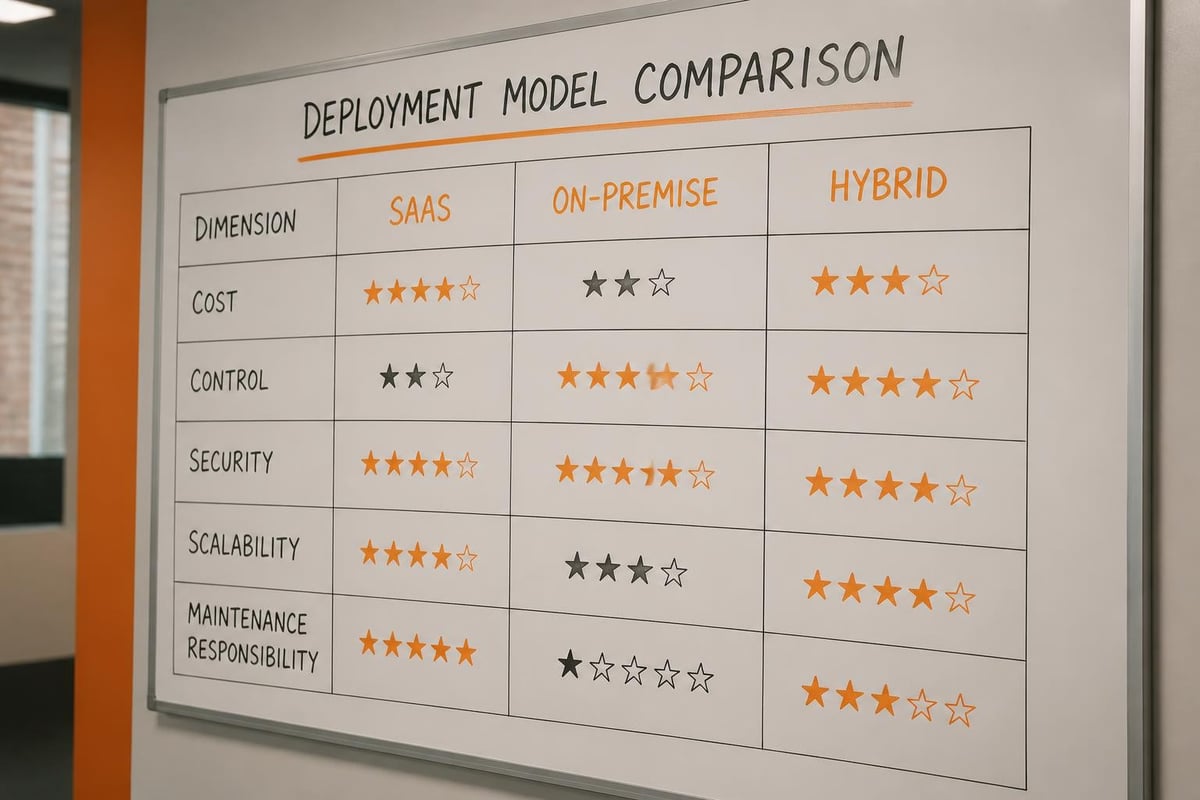
Cloud deployment models fundamentally changed enterprise software economics, implementation timelines, and operational responsibility distribution. Organizations now choose between software-as-a-service (SaaS), infrastructure-as-a-service (IaaS), and hybrid approaches based on control requirements and cost optimization.
SaaS Model Characteristics
Benefits:
- Reduced upfront capital expenditure with subscription pricing
- Vendor-managed infrastructure, security patches, and version upgrades
- Faster deployment timelines without hardware procurement
- Automatic scaling to accommodate growth
- Regular feature releases and platform improvements
Limitations:
- Reduced customization depth compared to on-premise installations
- Dependency on vendor roadmap for functionality additions
- Ongoing subscription costs that accumulate over system lifetime
- Data residency and sovereignty constraints in some jurisdictions
Hybrid Deployment Considerations
Many organizations adopt hybrid models, maintaining sensitive data on-premise while leveraging cloud services for analytics, collaboration, or customer-facing applications. This approach balances security requirements with cloud economics.
Integration complexity increases in hybrid environments, requiring robust middleware and API management to maintain data consistency across deployment boundaries.
What Future Trends Will Shape Enterprise Software Evolution?
Enterprise software evolution accelerates as emerging technologies mature and organizational expectations shift. Understanding trajectory helps organizations plan investments and avoid platform obsolescence.
Composable Architecture
Monolithic enterprise suites give way to composable architectures where organizations assemble best-of-breed components connected through standardized APIs. This approach increases flexibility but requires sophisticated integration management.
The shift toward software value questioning reflects growing enterprise sophistication in evaluating true business impact versus feature volume.
Embedded AI and Automation
AI capabilities transition from experimental features to core platform functionality. Predictive analytics, natural language interfaces, and intelligent automation become table stakes rather than differentiators.
However, concerns about AI-driven software sprawl highlight the importance of thoughtful integration rather than accumulating disconnected AI point solutions.
Industry-Specific Platforms
Generic horizontal platforms face pressure from vertical solutions designed for specific industries. Healthcare, manufacturing, construction, and other sectors demand deep process knowledge and regulatory compliance that general-purpose software struggles to deliver.
Organizations increasingly seek partners with domain expertise who can configure and extend platforms for industry-specific workflows. Brytend's specialization in custom software solutions reflects this trend toward tailored implementations that preserve platform upgrade paths while delivering industry-specific functionality.
Low-Code and Citizen Development
Low-code platforms democratize application development, allowing business users to build departmental solutions without traditional coding. This trend shifts IT from gatekeeper to governance provider, establishing guardrails while empowering business-led innovation.
The challenge lies in preventing shadow IT proliferation while capturing legitimate innovation. Successful organizations establish citizen development programs with architectural standards, security reviews, and integration requirements.
Data Management and Governance
As enterprise data management matures, organizations recognize data quality as foundational to AI effectiveness and analytical insight. Enterprise software must provide data governance tools, master data management, and data lineage tracking.
Poor data quality undermines even the most sophisticated platforms. Organizations that treat data as strategic assets-with ownership, quality metrics, and improvement programs-extract substantially higher value from enterprise software investments.
Enterprise software delivers organizational capability when properly selected, implemented, and optimized against measurable business outcomes. Success requires disciplined evaluation methodology, structured implementation, continuous measurement, and alignment between technology capabilities and strategic objectives. Brytend specializes in creating tailored enterprise software solutions that address your specific operational requirements while maintaining scalability, security, and integration standards. Contact Brytend to discuss how custom development can optimize your enterprise software environment for sustained competitive advantage.
Frequently Asked Questions About Enterprise Software
What is enterprise software?
Enterprise software is an application built to serve the needs of an entire organization rather than a single user or small team, typically handling core functions like resource planning, customer data, or operations at scale, with requirements around security, integration, and administration that consumer software does not need to meet.
What is an example of enterprise software?
Common examples include enterprise resource planning (ERP) systems, customer relationship management (CRM) platforms, and human resources information systems (HRIS) — software used across departments rather than by one team.
What makes software “enterprise-level”?
Enterprise-level software is distinguished less by price and more by its ability to support many concurrent users, integrate with other business systems, enforce role-based permissions, and meet compliance and security requirements at organizational scale.