TL;DR
- Registering the test gas cylinder on every calibration links each calibration certificate to one gas lot and one expiry date.
- A recall or a complaint about a gas lot can then be traced to every gas detector calibrated with it within minutes.
- Months of registered gas use give a reliable forecast of how many cylinders a service team needs per gas mixture.
- A forecast based on registered use prevents both expired stock on the shelf and calibrations cancelled because a van ran out of gas.
Test gas cylinder registration is the practice in which a service technician records the cylinder, its gas lot and its expiry date on every calibration, so a service company can trace calibrations and plan purchases from real use.
What is a test gas cylinder?
A test gas cylinder is a pressurised cylinder with a certified gas mixture that service technicians use to calibrate and bump test gas detectors. It is also called a calibration gas cylinder or calibration gas bottle.
Calibration gas is a gas mixture with a known concentration of each component, for example methane, oxygen, hydrogen sulphide and carbon monoxide. The supplier states these on a certificate of analysis.
Four properties of a test gas cylinder matter for calibration quality:
- Gas mixture: the components and concentrations, which must match the detector’s sensors.
- Gas lot: the production batch, which links the cylinder to the supplier’s certificate of analysis.
- Expiry date: after this date the supplier no longer guarantees the stated concentrations.
- Remaining content: the gas left in the cylinder, which decides how many calibrations it can still serve.
Why register the test gas cylinder at every calibration?
Registering the test gas cylinder at every calibration makes each calibration certificate traceable to a specific gas lot. Without that record, nobody can prove which gas was used on which detector.
A calibration adjusts a gas detector’s readings to the concentrations in the test gas cylinder. If the gas lot was out of specification, every detector calibrated with it may read wrong.
Registration answers three questions that come up after a calibration:
- Which gas lot was used on this detector? Asked when a reading is disputed.
- Which detectors were calibrated with this gas lot? Asked when a supplier recalls a lot.
- Was the gas within its expiry date? Asked by the QHSE manager or an auditor.
ISO/IEC 17025 sets requirements for the competence of calibration laboratories, including metrological traceability. Outside an accredited laboratory the principle is the same: a calibration is only as reliable as its gas.
How do you register a test gas cylinder during calibration?
You register a test gas cylinder by receiving it once into the asset register with its gas lot and expiry date, and by selecting that cylinder on every service where it is used. The steps below follow one cylinder from delivery to its last use.
- Receive the cylinder. Record the gas mixture, gas lot, expiry date and place (warehouse or van), with the certificate of analysis.
- Assign a unique identity. Give each cylinder its own record, so two cylinders from the same gas lot can still be told apart.
- Pick the right cylinder before the job. The service technician takes the cylinder with the right gas mixture that expires first.
- Select the cylinder on the service report. During the calibration or bump test, the service technician selects the cylinder used. The gas lot is copied onto the calibration certificate.
- Book the gas used. Each service lowers the remaining content of the cylinder by the gas used per calibration.
- Flag expiry and low content. The asset register warns before a cylinder expires or runs low.
- Close the cylinder record. Mark an empty or expired cylinder and return it to the supplier.
What does a registered calibration look like in practice?
A registered calibration links the gas detector, the service technician, the test gas cylinder and the gas lot in one service record. The workflow below shows one example.
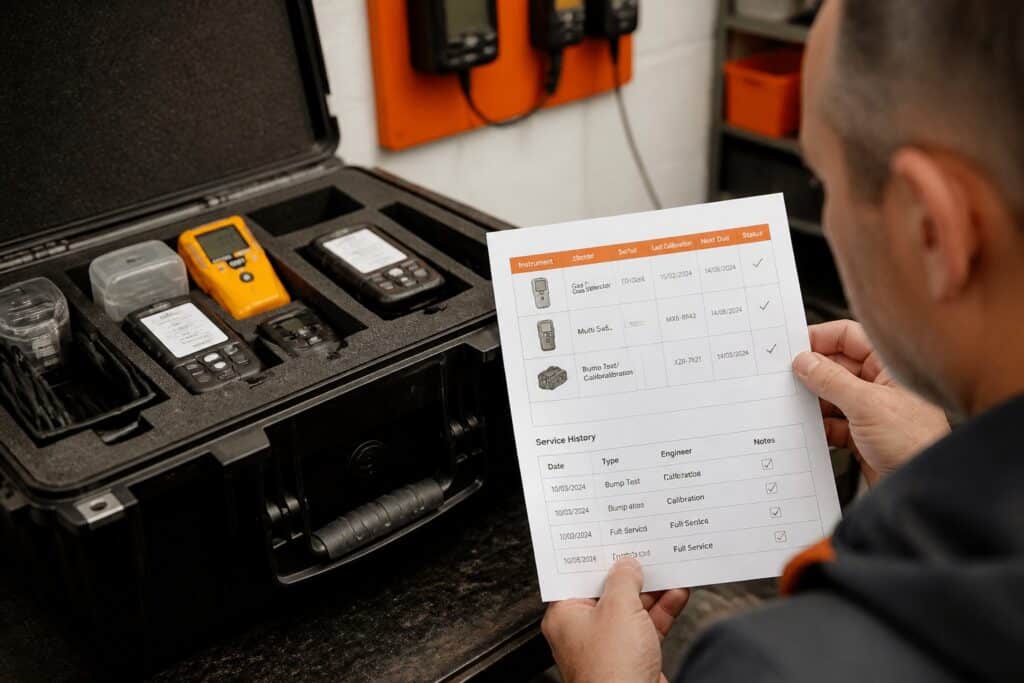
A serialized four-gas detector fails its bump test at a customer site and is booked in with a service order. At the workbench, the service technician selects the 58-litre four-gas test gas cylinder that expires first, connects the regulator and calibrates the detector. The service report stores the cylinder and its gas lot. The calibration certificate shows the gas lot and the next due date. The asset register lowers the cylinder’s remaining content and sets the detector’s next calibration date.
Three months later, the supplier reports a problem with that gas lot. The service manager searches the gas lot and recalls only the detectors calibrated with it.
How does registration help you forecast the coming months?
Registration produces a history of gas use per gas mixture, and that history drives a forecast of how many cylinders the coming months need.
A useful forecast of test gas cylinder demand combines four inputs:
- Past use per gas mixture: gas booked on services over the last twelve months, including seasonal peaks.
- Installed base: gas detectors at customer sites that are due for calibration or bump testing.
- Gas used per service: real consumption per calibration, learned from registered use.
- Current stock: cylinders in the warehouse and in each van, with remaining content and expiry dates.
The forecast compares expected demand with available gas, including expiry dates, and shows the expected shortage per gas mixture. The service manager orders the right cylinders in time, and none that will expire before use.
What are common mistakes with test gas cylinders?
The most common mistakes come from missing records rather than from bad gas.
- Recording only the gas mixture. Without the gas lot, a recall cannot be traced to individual detectors.
- Opening a new cylinder while an older one is still usable. The older cylinder then expires unused.
- Ordering on gut feeling. Purchases follow the last shortage instead of the planned workload.
- Letting cylinders pile up with one service technician. Other service technicians run short while gas expires in one van.
What are best practices for test gas cylinder registration?
The best practice is to treat every test gas cylinder as an asset with its own record, just like the gas detectors it calibrates.
- Receive every cylinder once, by gas lot and expiry date, before it goes into use.
- Use first expire, first out (FEFO): always pick the cylinder that expires first.
- Make cylinder selection part of the service report, so the record cannot be skipped.
- Allow only trained service technicians to handle hazardous gas mixtures, and record that training.
- Report damaged valves, leaks or suspect concentrations as incidents linked to the cylinder.
Manual vs automated test gas cylinder registration
Manual registration breaks down as soon as cylinders move between vans and sites. Automated registration in service management software keeps traceability and forecasting in one place.
| Aspect | Manual (paper or spreadsheet) | Automated (service management software) |
|---|---|---|
| Gas lot on the calibration certificate | Typed by hand, often missing | Copied from the selected cylinder |
| Tracing a recalled gas lot | Search through paper service reports | One search lists every detector |
| Remaining content | Estimated or unknown | Lowered with every service |
| Expiry warnings | Depends on someone checking the shelf | Flagged in lists and on the dashboard |
| Purchase planning | Based on the last shortage | Based on forecast demand per gas mixture |
| Cylinders in service vans | Unknown until the van returns | Visible per van and per service technician |
Illustrative case: a service company stops running out of gas
This case is illustrative; the company is fictional. Northfield Gas Services, with six service technicians, ordered cylinders when someone reported an empty one. An audit found expired cylinders in vans, and a shutdown job was delayed because no four-gas mixture was left.
The service manager started registering every test gas cylinder on receipt and on every service. After some months, the forecast showed which gas mixtures would run short before planned shutdowns, and the auditor could see the gas lot on every calibration certificate.
How Brytend supports test gas cylinder registration
Brytend’s gas cylinder tracking records each calibration gas bottle with its gas lot, expiry date, remaining content and place, next to your service and inspection work and calibration management. Service technicians pick the bottle that expires first, and the bottle and lot are stored on the service report.
The asset forecast uses the services of the last 12 months, the installed detectors and the gas used per service to show the predicted shortage and a suggested purchase per type. Bottle types are products in stock management, and dashboards and forecasts show what the coming months will probably bring.
Frequently asked questions
How long does a test gas cylinder last?
A test gas cylinder lasts until its expiry date or until it is empty, whichever comes first. The supplier sets the expiry date per gas mixture, because reactive gases are less stable than others. Remaining content depends on the gas used per calibration and the number of services.
Can an expired calibration gas cylinder still be used?
An expired calibration gas cylinder should not be used for calibration. After the expiry date, the supplier no longer guarantees the stated concentrations, so the calibration certificate cannot show traceable gas. Mark expired cylinders in the asset register and return or dispose of them according to the supplier’s instructions.
What should a calibration certificate say about the test gas?
A calibration certificate should name the gas mixture and concentrations, the gas lot and the cylinder’s expiry date, next to the detector serial number, the result and the next due date. These details let a service manager or auditor trace the calibration back to the supplier’s certificate of analysis.
What does FEFO mean for calibration gas?
FEFO means first expire, first out. Service technicians always use the calibration gas bottle that expires first, so fewer cylinders expire unused. FEFO only works when every cylinder’s expiry date is registered.
How many test gas cylinders should a service van carry?
The number depends on the planned services for that van, the gas mixtures its detectors need and the gas used per calibration. A forecast based on registered use per service technician shows what each van needs, and warnings show when cylinders pile up in one van.
Summary
Registering the test gas cylinder at every calibration makes each calibration certificate traceable to a gas lot and gives a reliable history of gas use. That history turns cylinder purchasing into a forecast, so service technicians always have valid gas and no cylinder expires on the shelf.
Take the tour to see how Brytend registers calibration gas bottles and forecasts what you need.