Hydrostatic testing is a pressure test in which a gas cylinder, fire extinguisher, pressure vessel or pipeline is filled with water and pressurised well above its normal working pressure to prove that it is strong enough and does not leak. For high-pressure gas cylinders, including SCBA and diving cylinders, the test also measures how much the cylinder expands under pressure and how much of that expansion remains afterwards. A cylinder that stretches too much or leaks is condemned. Hydrostatic tests are required at fixed intervals, usually every 3, 5, 10 or 12 years depending on the cylinder type and the rules that apply, and every result must be marked on the cylinder and recorded.
TL;DR:
- Water is used instead of air because it hardly compresses, so a failure releases very little stored energy
- Gas cylinders are usually tested with the water jacket method, which measures total and permanent expansion
- Typical intervals: 5 years for most DOT steel and aluminium cylinders and carbon fibre SCBA cylinders, 3 years for older fibreglass-wrapped cylinders, 5 or 12 years for fire extinguishers
- A passed test is stamped on the cylinder with the test date and the requalifier’s identification
- For service companies the hard part is not the test itself but knowing which cylinders are due, and keeping the proof
A hydrostatic test, often shortened to hydro test, is the periodic requalification test that decides whether a pressure container may stay in service.
What Is Hydrostatic Testing?
Hydrostatic testing checks the structural integrity of anything that holds gas or liquid under pressure. The item is filled with water (sometimes with a dye or corrosion inhibitor), all air is bled out, and the pressure is raised to a test pressure that is higher than the pressure the item sees in normal use. The pressure is held for a set time while the technician watches for leaks, pressure drop and deformation.
The test is used across many industries:
- Compressed gas cylinders: industrial gas, medical oxygen, calibration gas and specialty gas cylinders
- Breathing air cylinders: SCBA cylinders for fire brigades and industry, and scuba cylinders
- Fire extinguishers: the shells of water, foam, CO2 and dry chemical extinguishers
- Pressure vessels and piping: new or repaired vessels, process piping and pipelines before they go into service
- Hoses and fittings: fire hoses, high-pressure hoses and hydraulic components
This guide focuses on cylinders, because that is where hydrostatic testing becomes a recurring service task with due dates, markings and records, much like an SCBA inspection or a calibration.
Why Is Water Used Instead of Air?
Water is almost incompressible. When a vessel filled with water at high pressure ruptures, the pressure drops almost instantly and very little energy is released. The same vessel filled with compressed air or gas stores a large amount of energy, and a rupture can turn the vessel into fragments and throw them with great force. Using water makes it possible to push a cylinder well beyond its working pressure in a controlled way, which is exactly what a strength test needs.
Pneumatic testing with air or nitrogen does exist, but it is used only where water cannot be used, for example in systems that cannot tolerate moisture, and it requires much stricter safety measures.
How Does a Hydrostatic Test Work on a Gas Cylinder?
Most high-pressure cylinders are tested with the water jacket method, also called the volumetric expansion method. The cylinder is placed inside a sealed tank (the water jacket) that is also filled with water. When the cylinder is pressurised, it expands slightly and pushes water out of the jacket into a calibrated burette or onto a scale. That displaced water is the total expansion. When the pressure is released, the cylinder shrinks back, and any water that does not return shows the permanent expansion.
Step 1: Check the cylinder’s history and markings
The technician reads the serial number, specification, service pressure and last test date from the cylinder and checks that it is still within its service life. Composite cylinders past their service life are not tested; they are taken out of service.
Step 2: Visual inspection inside and out
The valve is removed and the cylinder is inspected externally and internally for dents, cuts, gouges, corrosion, pitting, fire damage and thread damage. In the US this follows CGA C-6 for steel, C-6.1 for aluminium and C-6.2 for composite cylinders. Many cylinders are condemned at this stage, before any pressure is applied.
Step 3: Fill, place in the jacket and pressurise
The cylinder is filled with water, connected to the test head and lowered into the water jacket. The pressure is raised to the test pressure, which for many DOT steel and aluminium cylinders is five thirds of the marked service pressure, and held for at least 30 seconds, or longer if the test equipment needs it to read a stable value.
Step 4: Measure total and permanent expansion
The technician records the total expansion at test pressure, releases the pressure and records the permanent expansion. For DOT 3A, 3AA and 3AL cylinders the cylinder fails when the permanent expansion is more than 10% of the total expansion. Composite and other cylinders have their own limits, often based on an elastic expansion value marked on the cylinder.
Step 5: Dry, mark and record
A passed cylinder is dried thoroughly inside, re-valved and stamped or labelled with the test date and the requalifier’s identification number. A failed cylinder is condemned. In both cases the result is written to the test record against the serial number.
How Often Is Hydrostatic Testing Required?
The interval comes from the cylinder specification and the transport or fire safety rules that apply where the cylinder is used. The table below shows common intervals. Always check the marking on the cylinder, its specification or special permit, and the current rules in your country.
| Equipment | Typical hydrostatic test interval | Main rule or standard |
|---|---|---|
| DOT 3AA steel and 3AL aluminium cylinders (US) | 5 years; 10 years for qualifying steel cylinders marked with a star | 49 CFR 180.209 |
| Carbon fibre composite SCBA cylinders | 5 years, with a service life often limited to 15 years | DOT specification or special permit; EN ISO 11623 in Europe |
| Fibreglass-wrapped aluminium SCBA cylinders | 3 years, with a 15-year service life | DOT special permit |
| Industrial gas cylinders (Europe) | Set per gas, commonly 10 years, shorter for some gases | ADR packing instruction P200, ISO 18119 |
| Water, foam, wet chemical and CO2 extinguishers | 5 years | NFPA 10 |
| Stored-pressure dry chemical extinguishers | 12 years | NFPA 10 |
| New or repaired pressure vessels and piping | Before first use and after repairs | ASME BPVC Section VIII, ASME B31.3 |
In the US, the requalification rules for DOT cylinders are in 49 CFR 180.205, and the extinguisher intervals are in NFPA 10. A cylinder that is past its test date may usually be used until it is empty but must not be refilled until it has been retested, so an overdue test quickly turns into a cylinder that cannot be used.
What Do Hydrostatic Test Markings Mean?
Every passed test leaves a mark on the cylinder, so the next person who handles it can see its status without opening a file.
- Test date: the month and year of the test, stamped into the shoulder of metal cylinders or printed on a label for composite cylinders
- Requalifier identification: in the US a requalifier identification number (RIN) issued by PHMSA; in Europe the mark of the inspection body
- Star (*): on some US steel cylinders, a star after the date means the cylinder qualifies for a 10-year interval
- Plus (+): on some steel cylinders, a plus sign means the cylinder may be filled up to 10% above its marked service pressure
- Visual inspection label or ring: many fill stations add a colour-coded label for the separate annual visual inspection
Markings are useful on the spot, but they are hard to read across a fleet. Finding every cylinder that is due next quarter means reading the stamps on every cylinder, unless the dates are also held in a system.
Who Is Allowed to Perform Hydrostatic Testing?
Hydrostatic testing of transport cylinders is a regulated activity. In the US only facilities approved by PHMSA, with a RIN, may requalify DOT cylinders, and they must keep detailed records of every test. In Europe periodic inspection and testing of transportable pressure equipment is done by notified or approved inspection bodies under the Transportable Pressure Equipment Directive. Fire extinguisher hydrostatic testing is carried out by certified service companies under local fire codes.
For most equipment owners this means the test itself is outsourced, while they remain responsible for knowing which cylinders are due, sending them on time, and keeping the certificates. Service companies that offer cylinder testing, SCBA maintenance or extinguisher service do it the other way around: they run the tests and must show their customers proof for every cylinder.
What Should a Hydrostatic Test Record Include?
A complete record makes the test traceable, which is what auditors, fire authorities and customers ask for.
- Cylinder identity: serial number, manufacturer, specification, service pressure, manufacturing date
- Test data: test date, test pressure, total expansion, permanent expansion and the calculated percentage or elastic expansion
- Visual inspection result: findings and the standard used
- Result: passed, failed or condemned, and the reason for a failure
- Who: the requalifier, technician and test equipment, including the calibration status of the test equipment
- Next due date: the next hydrostatic test and the end of the service life for composite cylinders
These are the same building blocks as the records for PPE inspections and certificates: an object with a serial number, a test with a result, and a due date.
How Do You Keep Track of Hydrostatic Test Due Dates?
Small fleets often manage with a spreadsheet. As the number of cylinders grows, and especially when you manage cylinders for several customers, spreadsheets start to fail: dates are typed wrong, cylinders change location, and nobody sees the cylinders that will be due in three months until they are already overdue.
Register every cylinder as a service object
Give every cylinder one record with its serial number, owner, location, specification, manufacturing date and test interval. A QR code or barcode label makes it easy to open the right record in the field, see QR code asset tracking.
Plan tests from due dates, not from memory
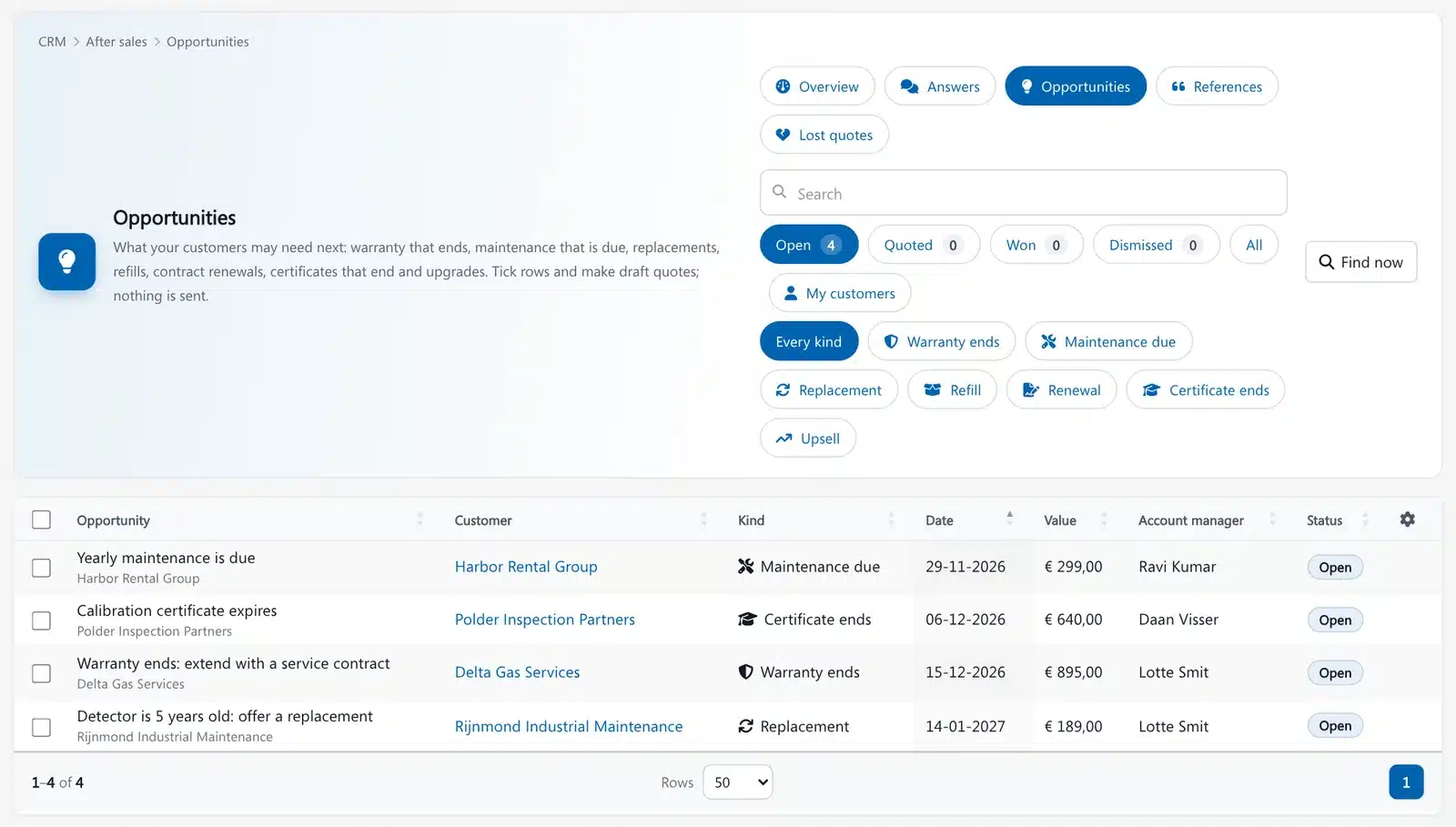
List the cylinders that are due in the coming months, group them per customer or site and plan them as work orders. Inspection management software turns due dates into planned jobs and reminders.
Attach the result and certificate to the cylinder
Store the test result, the certificate and the next due date on the cylinder record. When a customer or auditor asks for proof, it is one search away.
Block cylinders that are overdue or condemned
Make the status visible: in service, due soon, overdue, condemned. A condemned cylinder should never end up on a delivery note again.
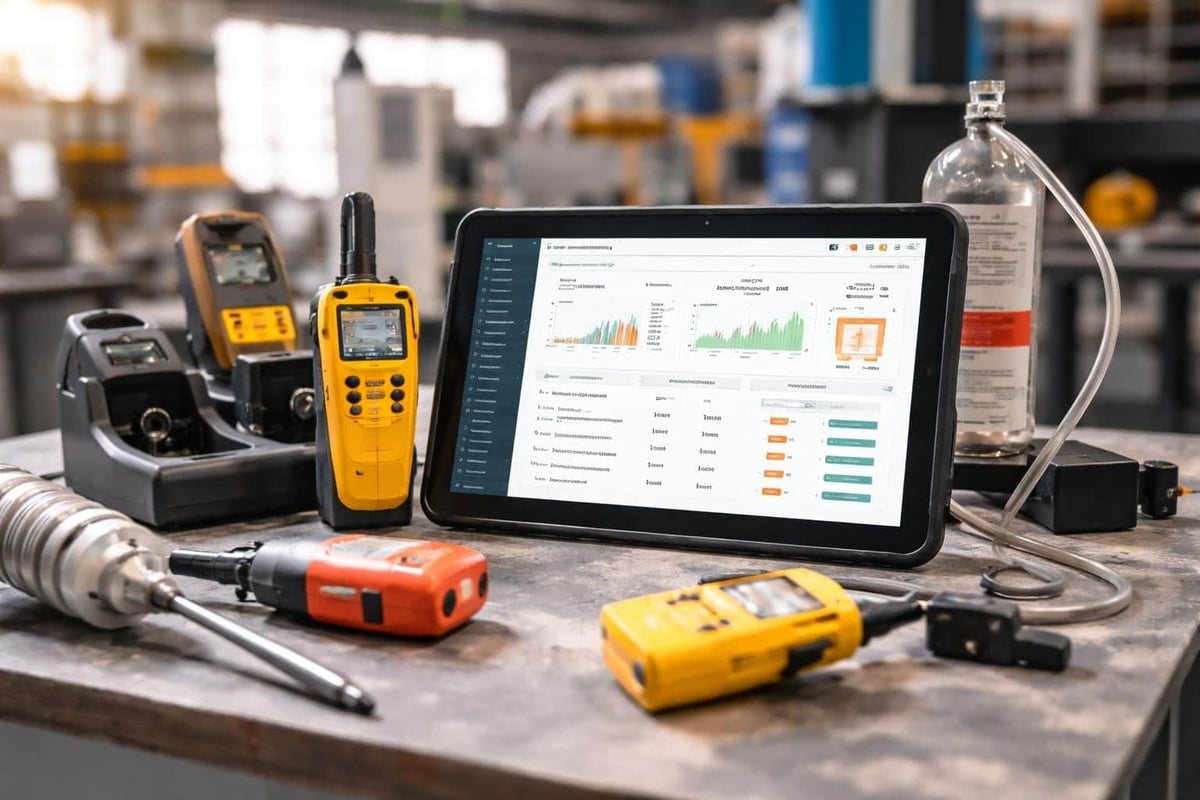
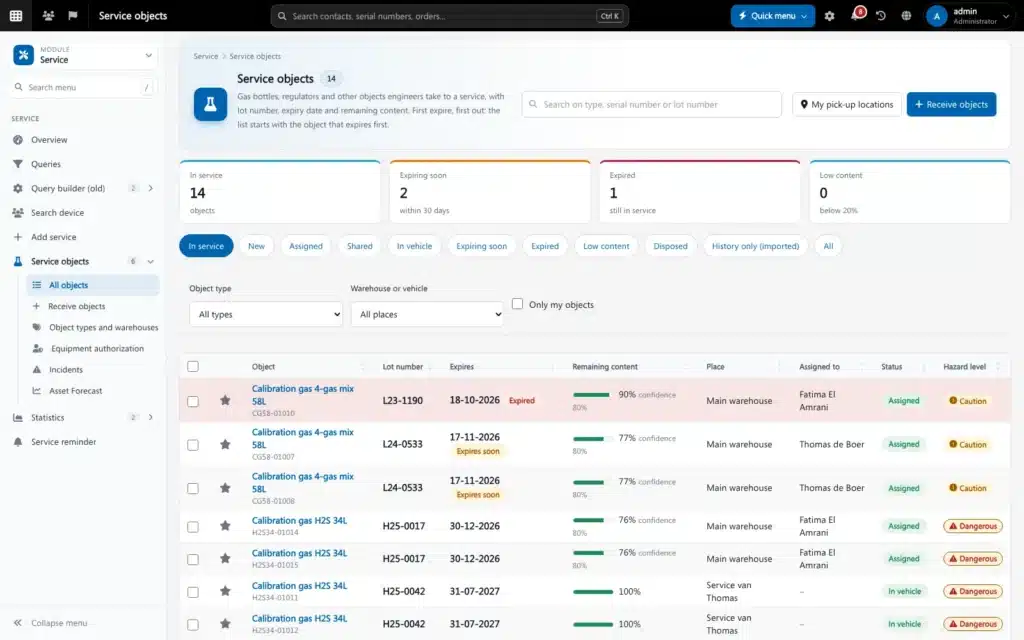
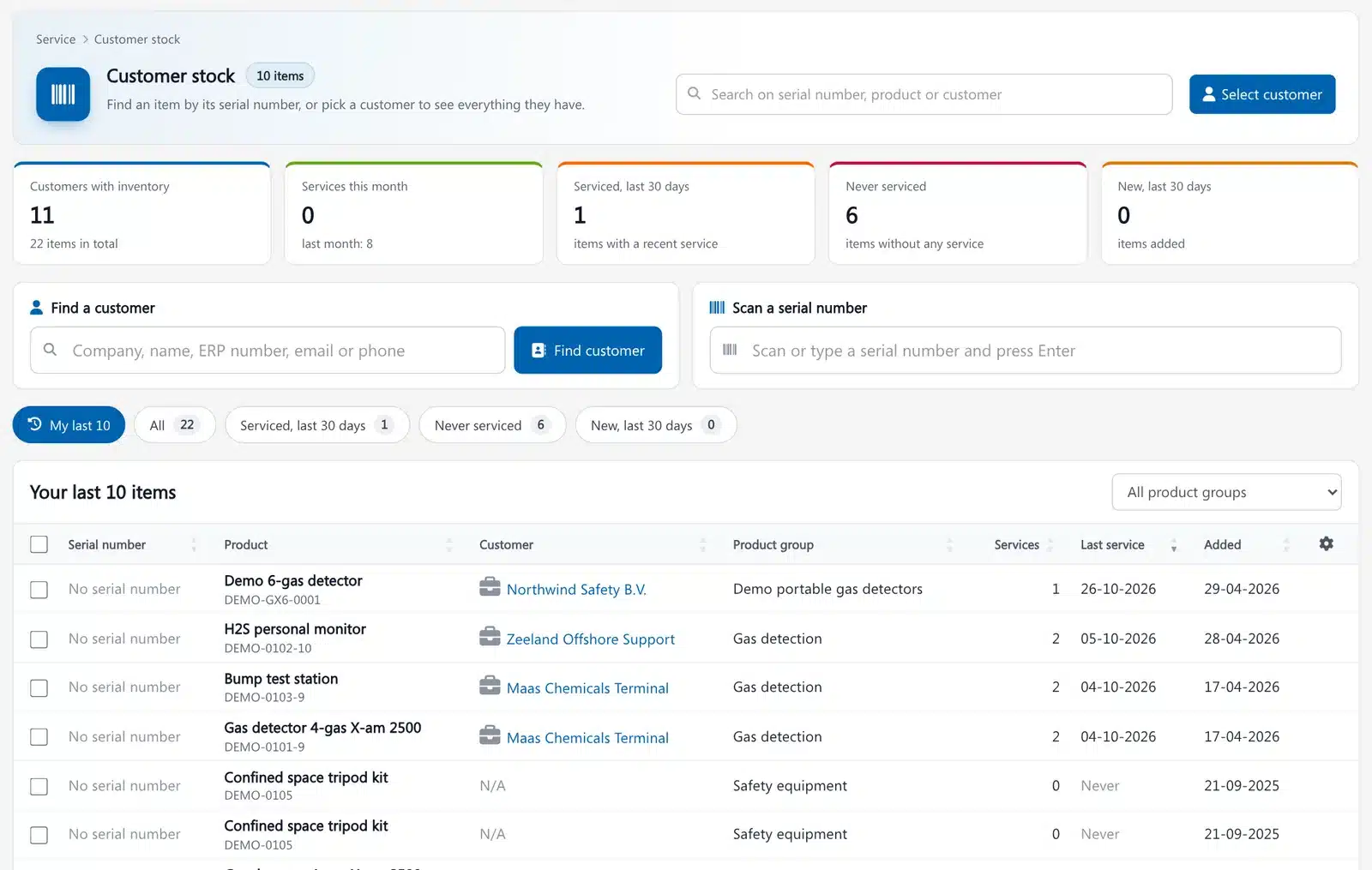
The Brytend Service and Inspections module keeps every device your customers own as customer stock with its serial number, service history and documents. Service reminders show which devices are due, every service is a numbered record with your own report template, and certificates stay with the device. The same module already handles gas detector calibrations and bump tests, so cylinders, breathing apparatus and detectors can be managed in one place.
What Are Common Hydrostatic Testing Mistakes?
- Confusing the visual inspection with the hydrostatic test: an annual visual inspection does not replace the periodic hydro test, and the other way round
- Ignoring service life: a composite cylinder that passes its hydro test still has to be retired at the end of its service life
- Poor drying: water left inside a steel cylinder causes internal corrosion and can contaminate breathing air
- Refilling overdue cylinders: a cylinder past its test date must not be refilled until it has been retested
- Records that cannot be found: paper certificates in a binder do not help when a customer asks about one serial number
- Uncalibrated test equipment: the expansion measurement is only as good as the calibration of the test system, so the equipment needs its own calibration management
Frequently Asked Questions About Hydrostatic Testing
What is hydrostatic testing?
Hydrostatic testing is a pressure test in which a cylinder, vessel or pipe is filled with water and pressurised above its normal working pressure to prove it is strong and leak free. For gas cylinders the test also measures how much the cylinder expands and whether it returns to its original size, which shows whether the metal or composite has weakened.
How often do gas cylinders need hydrostatic testing?
It depends on the cylinder type and the rules that apply. In the US most DOT steel and aluminium cylinders are retested every 5 years, some steel cylinders marked with a star qualify for 10 years, and composite cylinders follow the interval in their specification or special permit. In Europe the ADR packing instruction P200 sets intervals per gas, commonly 10 years for many industrial gases and shorter for some.
How often do SCBA cylinders need a hydrostatic test?
Most carbon fibre SCBA cylinders are hydrostatically tested every 5 years, and older fibreglass-wrapped cylinders every 3 years. Composite SCBA cylinders usually also have a fixed service life, often 15 years, after which they must be taken out of service even if they pass the test.
How often should fire extinguishers be hydrostatically tested?
Under NFPA 10, water, foam, wet chemical and carbon dioxide extinguishers are hydrostatically tested every 5 years, and most stored-pressure dry chemical extinguishers every 12 years. Local rules can be stricter, so always check the code your fire authority enforces.
What happens if a cylinder fails a hydrostatic test?
A cylinder that fails is condemned and must not be refilled. The test facility marks it as rejected or makes it unusable, the owner is informed, and the record of the failed test is kept with the cylinder’s serial number.
What do the markings after a hydrostatic test mean?
After a passed test the requalifier stamps or labels the cylinder with the test month and year and its own identification number, so anyone can see when the cylinder was last tested and by whom. On some US steel cylinders a star after the date means the cylinder qualifies for a 10-year retest interval.
How can software help with hydrostatic test due dates?
Service software stores every cylinder by serial number with its last test date and interval, so it can list which cylinders are due, send reminders and keep the test certificate with the cylinder record. Brytend does this as part of its Service and Inspections module, together with inspections, repairs and customer reports.
Hydrostatic testing proves that a cylinder can still safely hold its pressure, and the rules around it are strict for a good reason. The test itself is done by approved facilities, but the work around it is yours: knowing which cylinders are due, sending them on time, retiring condemned and expired cylinders, and keeping the proof for every serial number. If you service cylinders, breathing apparatus, extinguishers or gas detectors for your customers and want every due date, test and certificate in one place, Brytend builds service software that does exactly that.