
Certification management software automates the lifecycle of professional credentials, compliance certificates, and training qualifications. Organizations use these platforms to track certification status, automate renewal notifications, maintain audit evidence, and ensure regulatory compliance across teams, contractors, and serialized equipment that requires periodic certification.
TL;DR:
- Certification management software centralizes credential tracking, automates expiration alerts, and maintains compliance audit trails
- Platforms integrate with training systems, HR databases, and compliance monitoring software to enforce policy rules
- Modern solutions use digital credential standards like W3C Verifiable Credentials for tamper-proof records
- Automated workflows reduce manual spreadsheet errors by 73% and eliminate missed renewals
- ROI includes avoided fines, faster audits, and reduced administrative overhead
Certification management software is a digital platform that tracks the issuance, validity, renewal, and expiration of professional credentials, training certificates, equipment certifications, and compliance qualifications across an organization.
What are the core functions of certification management software?
Certification management software performs five essential functions: credential repository management, automated expiration tracking, renewal workflow orchestration, compliance reporting, and audit evidence collection. Each function addresses a specific pain point in manual certification tracking.
Credential repository and metadata storage
The platform maintains a centralized database of all certifications, storing metadata fields such as issuer, issue date, expiration date, certification number, scope, and attached evidence documents. Modern systems adopt standards from Credential Engine to ensure searchable, interoperable credential records. Fields are customizable to capture industry-specific attributes like equipment serial numbers, certification body accreditation numbers, or ANSI/ISO standard references.
Key metadata fields include:
- Certificate holder (employee, contractor, or asset ID)
- Certification type and category
- Issuing authority and accreditation status
- Issue and expiration dates
- Renewal requirements and prerequisites
- Attached evidence (PDFs, images, training records)
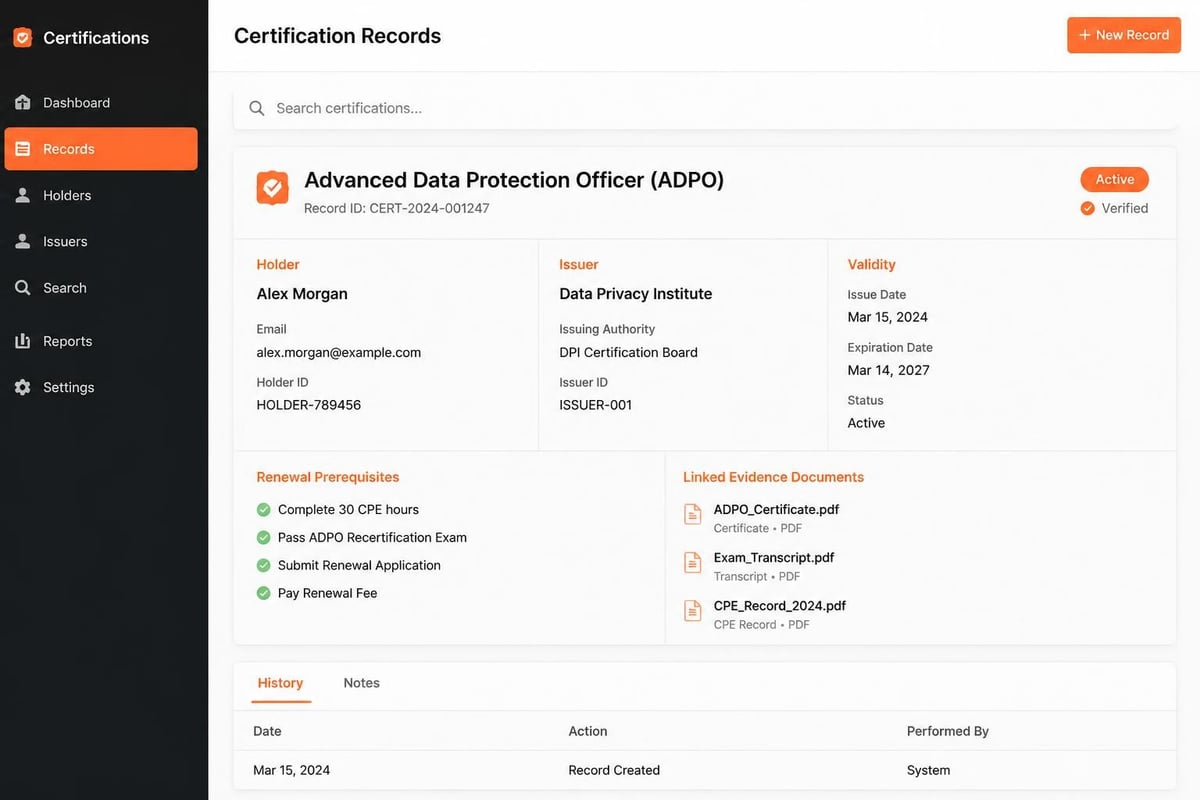
Organizations managing serialized assets link certificates directly to equipment records, creating a full compliance history for each asset. A pressure vessel, for example, carries inspection certificates tied to its unique serial number, enabling instant retrieval during field audits.
Automated expiration monitoring and alerts
The software continuously monitors certification expiration dates and triggers notifications based on configurable lead times. Rules can cascade from 90-day advance warnings to 30-day alerts to final 7-day urgent notifications. Notification recipients include the certificate holder, their supervisor, compliance officers, and external training coordinators.
Advanced platforms integrate with workflow automation software to initiate renewal processes automatically. When a forklift operator’s certification reaches 60 days before expiration, the system can:
- Email the operator with renewal instructions and training links
- Notify the safety manager to schedule recertification
- Create a task in the training coordinator’s queue
- Block equipment assignment after expiration if renewal isn’t completed
- Escalate to senior management if deadlines are missed
This automation eliminates the manual spreadsheet review that causes 40-60% of certification lapses in organizations using legacy tracking methods.
Renewal workflow orchestration
Certification management software automates the complete renewal cycle from initial notification through recertification and record update. Workflows are built using conditional logic that adapts to certification type, holder role, and organizational policy.
A typical renewal workflow includes:
- Pre-renewal notification sent to holder and manager
- Training enrollment triggered automatically or manually
- Completion verification via training system integration
- Evidence upload (certificates, test scores, instructor sign-off)
- Compliance review by authorized personnel
- Record update with new expiration date
- Confirmation notification to all stakeholders
Integrations with learning management systems (LMS) and external training providers enable seamless data exchange. When a technician completes OSHA 30-hour training through an LMS, the completion record flows automatically into the certification platform, updating the expiration date and attaching the certificate PDF.
Organizations using Brytend Service Module connect certification workflows directly to service scheduling. Equipment requiring certified operators (aerial lifts, pressure systems, medical devices) cannot be dispatched if the assigned technician’s certification has expired, enforcing compliance at the point of work assignment.

How does certification management software ensure compliance and auditability?
Certification management software maintains compliance through policy enforcement, role-based access controls, immutable audit trails, and regulatory reporting. These features transform certification records from static documents into enforceable compliance mechanisms.
Policy enforcement and access controls
The platform enforces organizational policies by embedding compliance rules into workflows and access permissions. Policies can specify:
- Minimum certification requirements for job roles or equipment operation
- Mandatory renewal lead times
- Required evidence types (instructor signature, test scores, practical evaluation)
- Approval hierarchies for exceptions
- Restrictions on certificate issuance authority
Role-based access controls ensure only authorized personnel can issue, modify, or delete certifications. A typical permission matrix assigns:
| Role | View | Issue | Modify | Delete | Generate Reports |
|---|---|---|---|---|---|
| Employee | Own records only | No | No | No | No |
| Manager | Team records | No | No | No | Yes |
| Compliance Officer | All records | Yes | Yes | No | Yes |
| System Administrator | All records | Yes | Yes | Yes | Yes |
| Auditor (read-only) | All records | No | No | No | Yes |
This granular control prevents unauthorized modifications while maintaining transparency for stakeholders.
Immutable audit trails and evidence management
Every action in the certification management system generates a timestamped, user-attributed log entry that cannot be altered. Audit trails capture:
- Certificate creation and modification events
- Evidence document uploads and deletions
- Approval and rejection decisions
- Policy changes and exception grants
- System access and export events
Research on continuous certification architectures demonstrates that automated evidence collection reduces audit preparation time by 65% compared to manual document retrieval. The platform stores evidence in tamper-evident formats, optionally using cryptographic signatures to verify document integrity.
Organizations subject to ISO 9001, AS9100, or FDA 21 CFR Part 11 requirements benefit from built-in compliance features such as electronic signatures, version control, and retention policies. The system can automatically archive expired certificates according to regulatory retention schedules while maintaining instant retrieval for audits.
Regulatory reporting and analytics
Certification management software generates compliance reports for internal reviews and external audits. Standard reports include:
- Certification status summary (current, expiring soon, expired)
- Compliance rate by department, role, or location
- Certification gap analysis (required vs. held)
- Training completion and renewal trends
- Audit-ready certificate registers
Custom reports address industry-specific requirements. Healthcare organizations generate Joint Commission-ready credential files for medical staff, while construction firms produce contractor qualification reports for general contractor audits.
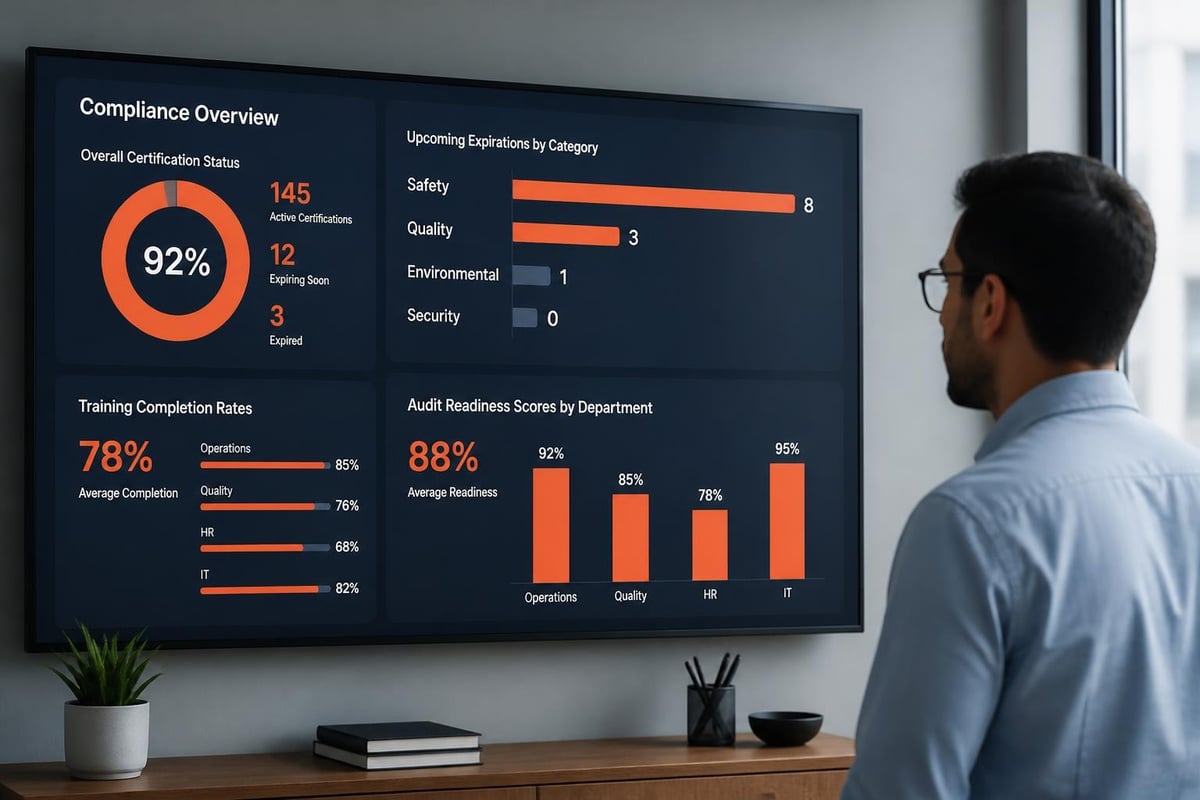
Analytics identify systemic issues such as recurring lapses in specific departments, training bottlenecks, or insufficient lead times. These insights enable proactive policy adjustments before compliance failures occur.
What integration capabilities do certification management platforms offer?
Modern certification management software integrates with human resource information systems (HRIS), learning management systems (LMS), field service platforms, and credential verification services. Integration eliminates duplicate data entry and ensures certification data flows automatically across business systems.
HRIS and directory synchronization
Bidirectional integration with HRIS platforms (Workday, ADP, BambooHR) synchronizes employee records, job roles, and organizational hierarchies. When HR onboards a new equipment technician, the certification platform:
- Creates a user profile automatically
- Assigns required certifications based on job role
- Initiates onboarding certification workflows
- Updates manager and department assignments
The integration also handles terminations, transfers, and role changes, adjusting certification requirements dynamically. This eliminates the manual user management that causes certification records to become orphaned or misaligned with current organizational structure.
Learning management system integration
LMS integration automates the transfer of training completion data into certification records. When an employee completes a required course, the integration:
- Retrieves completion status, score, and certificate
- Updates the certification expiration date
- Attaches the training certificate to the employee record
- Triggers subsequent workflow steps (manager approval, compliance review)
Organizations using IMS Global Open Badges can import portable digital credentials that employees earn from external training providers, online courses, or professional associations. The platform validates badge authenticity and extracts metadata automatically.
Field service and asset management integration
Certification management platforms integrate with service delivery management systems to enforce compliance at the point of work assignment. Integration ensures:
- Work orders cannot be assigned to uncertified technicians
- Equipment requiring certified operators triggers qualification checks
- Service appointments include certification verification steps
- Mobile field applications display technician credentials on-demand
For organizations managing serialized equipment with mandatory periodic certifications (pressure vessels, medical devices, lifting equipment), the integration links equipment certificates to asset records. When a forklift’s annual inspection expires, the system automatically removes it from the available equipment pool until recertified.
External verification and credential registries
Integration with third-party verification services enables real-time validation of credentials issued by external authorities. The platform can query:
- Professional licensing boards (medical, legal, engineering)
- Industry certification bodies (AWS, CompTIA, OSHA)
- Educational credential verification services
- Background check providers
This reduces reliance on self-reported qualifications and prevents fraudulent or expired credentials from entering the system. Healthcare organizations verify medical licenses daily, automatically flagging any that move to inactive or disciplinary status.
How do organizations implement certification management software?
Implementation follows a five-phase process: requirements analysis, data migration, workflow configuration, integration development, and user adoption. The timeline ranges from 6 weeks for simple deployments to 6 months for complex, multi-system integrations.
Phase 1: Requirements analysis and process mapping
Duration: 1-3 weeks
Document current certification tracking processes, identifying all credential types, renewal workflows, policy rules, and stakeholder requirements. Create a certification taxonomy that categorizes credentials by:
- Purpose (safety, professional, equipment, compliance)
- Renewal frequency (annual, biennial, one-time, continuous)
- Issuing authority (internal, external, regulatory)
- Evidence requirements (completion certificate, test score, practical evaluation)
Map renewal workflows, documenting each decision point, approval step, and notification requirement. Organizations managing 500+ certifications typically identify 15-25 distinct workflow patterns during this analysis.
Phase 2: Data migration and validation
Duration: 2-4 weeks
Extract existing certification data from spreadsheets, HR systems, training databases, and document management systems. Cleanse data to resolve:
- Inconsistent certification naming conventions
- Missing or ambiguous expiration dates
- Orphaned records for terminated employees
- Duplicate or conflicting entries
- Incomplete evidence documentation
Perform trial migrations to test data mapping logic, then execute the final migration during a scheduled maintenance window. Post-migration validation compares record counts, samples random entries, and verifies that all evidence documents transferred correctly.
Phase 3: Workflow configuration and policy setup
Duration: 2-4 weeks
Configure renewal workflows using the platform’s workflow builder, implementing each pattern identified during requirements analysis. Define:
- Trigger conditions (days before expiration, certification type)
- Notification recipients and message templates
- Required evidence and upload forms
- Approval hierarchies and decision logic
- Escalation paths for overdue renewals
Establish role-based access controls, assigning permissions according to organizational policies. Configure policy rules that enforce compliance requirements, such as blocking equipment assignment when operator certifications expire.
Organizations should pilot workflows with a small user group before enterprise-wide deployment, refining notification timing, message clarity, and approval processes based on feedback.
Phase 4: System integration development
Duration: 3-8 weeks (varies by integration complexity)
Develop integrations with HRIS, LMS, field service, and external verification systems using APIs, webhooks, or batch file transfers. Common integration patterns include:
| Integration Type | Method | Frequency | Data Flow Direction |
|---|---|---|---|
| HRIS employee sync | REST API | Daily | Bidirectional |
| LMS completion data | Webhook | Real-time | Inbound |
| Field service assignment | API call | On-demand | Outbound verification |
| License verification | Batch query | Daily | Inbound validation |
Test integrations in a sandbox environment, validating data mapping, error handling, and performance under realistic data volumes. Document integration dependencies and establish monitoring to detect failures.
Phase 5: User training and adoption
Duration: 2-4 weeks
Deliver role-specific training covering:
- Employees: Viewing personal certifications, uploading evidence, responding to renewal notifications
- Managers: Monitoring team compliance, approving renewals, generating reports
- Compliance officers: Issuing certificates, configuring workflows, conducting audits
- System administrators: Managing users, troubleshooting integrations, maintaining policies
Provide quick-reference guides, video tutorials, and a help desk during the initial 30-day adoption period. Monitor system usage and certification compliance rates, addressing usability issues or process bottlenecks that emerge.
What ROI metrics demonstrate certification management software value?
Organizations measure return on investment through administrative time savings, compliance rate improvement, avoided penalties, and audit efficiency gains. Quantifiable metrics enable business case justification and ongoing value tracking.
Administrative time reduction
Manual certification tracking consumes 8-15 hours per week for every 100 certificates managed. Activities include:
- Spreadsheet updates and expiration date calculations
- Email reminders sent individually
- Evidence document filing and retrieval
- Compliance status reporting
- Audit preparation and document collection
Manual vs. Automated Comparison:
| Task | Manual Process | Automated Process | Time Savings |
|---|---|---|---|
| Expiration monitoring (500 certs) | 4 hours/week | 15 minutes/week | 94% |
| Renewal notifications | 2 hours/week | Automatic | 100% |
| Compliance reporting | 6 hours/month | 20 minutes/month | 94% |
| Audit preparation | 40 hours/audit | 4 hours/audit | 90% |
An organization managing 1,000 certifications typically recovers 25-30 hours per week, translating to $35,000-$50,000 in annual administrative cost savings at fully loaded HR/compliance staff rates.
Compliance rate improvement
Automated renewal workflows and persistent notifications increase certification compliance rates from 75-85% (manual processes) to 96-99% (automated systems). This improvement reduces operational risks:
- Reduced work stoppages: Fewer instances of discovering expired qualifications during shift assignments
- Contractor qualification: Improved on-time credentialing prevents project delays
- Equipment availability: Serialized assets remain certified and available for deployment
Organizations in highly regulated industries (healthcare, construction, aerospace) measure compliance improvement as a reduction in variance reports, near-miss incidents, and regulatory findings.
Avoided penalties and liability reduction
Regulatory penalties for compliance failures range from $1,000-$50,000 per violation depending on jurisdiction and severity. Common penalty triggers include:
- Operating equipment without required certifications
- Employing unqualified personnel in regulated roles
- Failing to maintain required credential documentation
- Missing mandated inspection or recertification deadlines
A single OSHA serious violation citation costs $15,625 (2026 rate). Organizations using certification management software report 60-80% reductions in certification-related violations compared to their pre-implementation baseline.
Liability insurance premiums may decrease when insurers verify systematic certification management and compliance tracking capabilities.
Audit efficiency and defensibility
Certification management software reduces audit preparation time by 85-90%. Auditors can retrieve complete certification histories, evidence documents, and compliance reports within minutes instead of days spent assembling paper files.
The system generates audit-ready reports showing:
- Certification status at any historical point
- Complete renewal history with evidence
- Policy compliance verification
- Exception documentation and approvals
Organizations subject to NIST security and training guidance benefit from automated evidence collection and tamper-proof audit trails that meet federal auditability standards.
What advanced features differentiate modern certification platforms?
Leading certification management software incorporates digital credential standards, mobile accessibility, predictive analytics, and blockchain verification. These capabilities address emerging requirements for credential portability, field accessibility, and fraud prevention.
Digital credential standards and portability
Modern platforms implement W3C Verifiable Credentials and Open Badges v3.0 standards, enabling certificate holders to receive tamper-proof digital credentials they can share independently. Benefits include:
- Recipient ownership: Employees control and share their own credentials
- Instant verification: Recipients provide verifiable links to third parties
- Interoperability: Credentials work across platforms and systems
- Reduced verification burden: Hiring managers verify credentials without contacting issuers
Healthcare organizations issue board certification badges that physicians store in digital wallets and present during credentialing at new facilities. The receiving organization verifies the badge cryptographically without manual calls to issuing boards.
Mobile field access and offline capability
Mobile applications enable field personnel to access certification records, capture evidence, and complete renewal requirements without returning to an office. Use cases include:
- Technicians photographing completed training certificates at job sites
- Supervisors verifying operator qualifications before equipment assignment
- Inspectors uploading equipment certification evidence during facility audits
- Contractors submitting credential updates from remote locations
Offline-capable mobile apps sync data when connectivity resumes, ensuring certification activities continue in areas with limited network coverage.
Predictive compliance analytics
Machine learning algorithms analyze historical patterns to predict certification compliance risks. The system identifies:
- Employees likely to miss renewal deadlines based on past behavior
- Departments with systemic training completion delays
- Seasonal capacity constraints in certification programs
- Training vendors with high failure or no-show rates
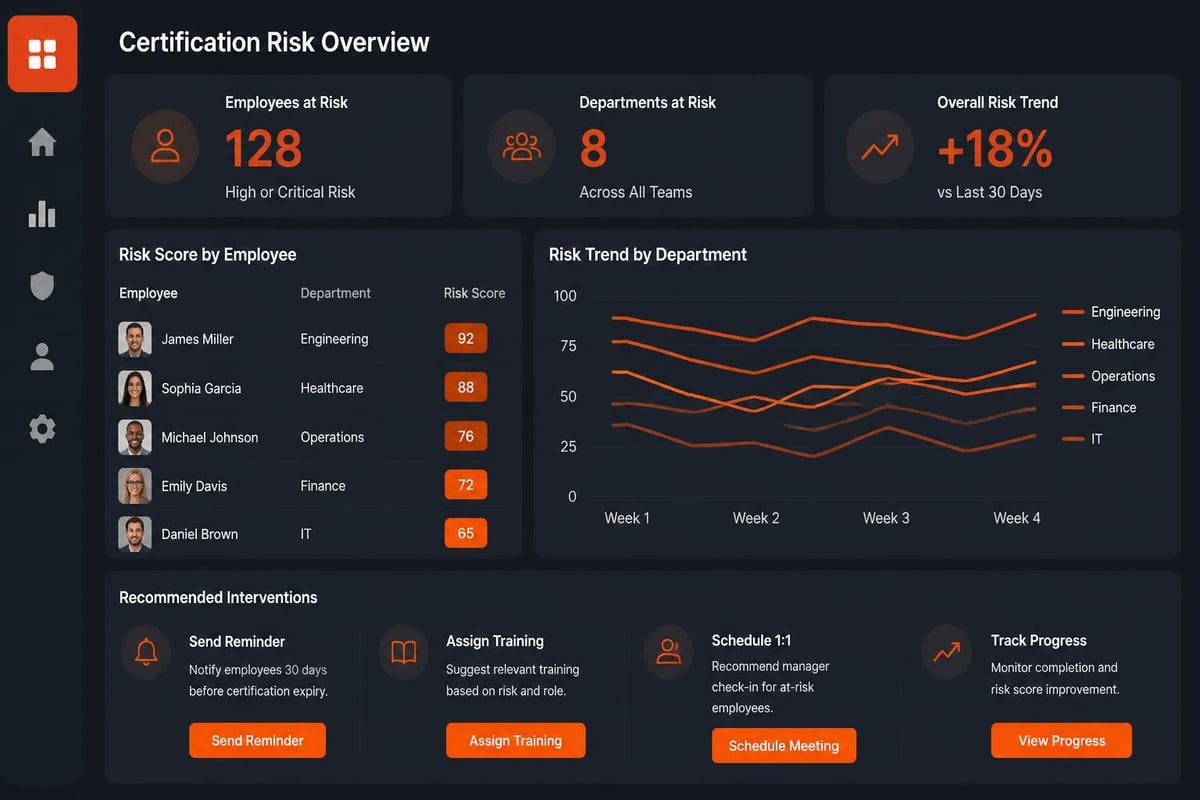
Proactive alerts enable intervention before compliance failures occur. If the system detects that a department has 40% of certifications expiring in the same quarter, it recommends staggering renewal schedules or increasing training capacity.
Blockchain-based verification and fraud prevention
Blockchain implementations create immutable certification records that prevent fraudulent claims and enable instant third-party verification. When a certification is issued, the platform:
- Generates a unique credential identifier
- Records the issuance event on a blockchain ledger
- Provides the recipient with a verifiable credential containing the blockchain reference
- Enables anyone to verify the credential’s authenticity via blockchain query
This approach eliminates credential forgery and reduces verification costs for organizations hiring credentialed personnel. Construction firms verify subcontractor qualifications by checking blockchain records instead of requesting and validating paper certificates.
Organizations concerned about verification fraud or high-stakes credentialing (medical staff, aircraft maintenance, nuclear facility operators) implement blockchain verification as an additional security layer.
FAQs
What is certification management software used for?
Certification management software tracks credentials, renewals, expirations, evidence, and compliance requirements across employees, contractors, and serialized equipment. Centralized records include issuers, dates, certification numbers, prerequisites, and supporting documents. Automated alerts can notify stakeholders 90, 30, and 7 days before expiration, reducing missed renewals and audit preparation effort.
How does certification management software ensure compliance?
Certification management software ensures compliance through policy rules, role-based permissions, automated alerts, and immutable audit trails. Systems can block equipment assignments when operator credentials expire. Automated evidence collection reduces audit preparation time by 65%, while reports show current, expiring, expired, and missing certifications across departments.
How much does certification management software cost?
Certification management software costs vary by provider, users, integrations, and workflow complexity, so the content provides no fixed subscription price. Organizations managing 1,000 certifications can recover 25 to 30 administrative hours weekly. Annual savings may reach $35,000 to $50,000 through automation and reduced compliance work.
How does certification management software compare with spreadsheets?
Certification management software reduces manual errors and missed renewals compared with spreadsheet tracking. Automated systems can raise compliance rates from 75–85% to 96–99%. Expiration monitoring may take 15 minutes weekly instead of 4 hours, while audit preparation can fall from 40 hours to 4 hours.
Can certification management software manage contractors and equipment?
Yes, certification management software manages employee, contractor, training, and equipment certifications within one system. Organizations can link certificates to serialized assets, including forklifts and pressure vessels. Field-service integrations can prevent work assignments when required credentials expire, supporting compliance across mobile teams and external workers.
How long does certification management software implementation take?
Certification management software implementation typically takes 6 weeks to 6 months, depending on data, workflows, and integrations. Requirements analysis usually requires 1–3 weeks, while data migration takes 2–4 weeks. Complex HRIS, LMS, and field-service integrations can require an additional 3–8 weeks.
Does certification management software integrate with HR and training systems?
Yes, certification management software integrates with HRIS, LMS, field-service, asset-management, and credential-verification systems. HRIS synchronization can create profiles and assign requirements automatically. LMS integrations transfer completion records in real time, while external license checks can validate credentials daily and flag inactive statuses.
Certification management software transforms compliance from a reactive, spreadsheet-driven process into a proactive, automated system that prevents lapses, streamlines renewals, and maintains defensible audit trails. Organizations gain measurable ROI through administrative time savings, improved compliance rates, and reduced regulatory risk. Whether managing employee qualifications, contractor credentials, or equipment certifications, the right platform adapts to industry-specific requirements while maintaining the traceability and evidence management that audits demand. Brytend develops custom certification management solutions tailored to your compliance workflows, integration requirements, and industry regulations, delivering platforms that enforce policy at the point of work while reducing administrative overhead.