Brytend ISO 27001 matters for a SaaS supplier because a SaaS supplier holds its customers’ data on its own systems. When you move your CRM, service records, contracts or HR files into a cloud platform, you hand over control of that information. ISO/IEC 27001 is the international standard that shows, through an independent audit, that the supplier manages information security in a structured way: it knows its risks, has controls in place to deal with them, and keeps checking and improving those controls. For the customer it replaces “trust us” with proof. For the supplier it is often the difference between being allowed to bid and being filtered out at the first security questionnaire.
TL;DR:
- ISO/IEC 27001 is the international standard for an information security management system (ISMS)
- A certificate means an accredited, independent body audited the supplier, and keeps auditing it every year
- For SaaS it covers what customers worry about most: access to their data, backups, incidents and the people who run the platform
- It shortens security reviews, supports GDPR and NIS2 supply chain checks, and opens tenders that demand certification
- Always check the scope and the certificate number, not just the logo
- Brytend is ISO/IEC 27001:2022 certified for the development, hosting and support of its platform, with encryption at rest, EU hosting and AI that can run on your own server
In short: ISO 27001 certification is independent proof that a software supplier protects your information on purpose, not by accident.
What Is ISO 27001 Certification?
ISO/IEC 27001 is published by the International Organization for Standardization (ISO) together with the International Electrotechnical Commission (IEC). It describes the requirements for an information security management system, usually shortened to ISMS. An ISMS is not a piece of software. It is the way a company organises information security: who is responsible, how risks are found and assessed, which measures are taken, how incidents are handled and how management keeps an eye on all of it.
The current version is ISO/IEC 27001:2022. Next to the management system requirements, it contains Annex A, a reference list of 93 security controls grouped into four themes:
- Organisational controls: policies, roles, supplier management, incident management, business continuity
- People controls: screening, awareness training, confidentiality agreements, remote working
- Physical controls: secure areas, equipment protection, clear desk and clear screen
- Technological controls: access rights, authentication, encryption, backups, logging, secure development
A company does not simply tick all 93 boxes. It assesses its own risks, decides which controls apply and records that decision in a Statement of Applicability. The auditor then checks that the choices make sense and that the controls really work in daily practice.
Certification means an accredited certification body has audited the company against the standard. A certificate is normally valid for three years, with surveillance audits in between, so the company has to keep showing that its ISMS works. You can read more about the standard itself on the ISO website.
Why Does ISO 27001 Matter More for a SaaS Supplier?
With traditional software you install the program on your own servers. Your IT team decides who gets access, how backups are made and when updates go in. With SaaS, all of that moves to the supplier. Your data lives on infrastructure you do not see, managed by people you have never met.

That changes the question you have to ask. It is no longer only “does the software work?” but also:
- Who at the supplier can see my data, and how is that controlled?
- What happens to my data if a server fails or the supplier is hacked?
- How quickly does the supplier react to a new vulnerability?
- How are new releases tested before they reach my environment?
- Are staff trained, and do they know what to do when something goes wrong?
A small supplier can answer these questions with a long document full of promises. An ISO 27001 certified supplier can answer them the same way, but with one important difference: an independent auditor has checked that the answers are true.
This is also why ISO 27001 carries more weight for business software than for many other products. A platform that runs your CRM, invoicing, inventory, document control and HR holds personal data, financial data and commercial secrets in one place. One weak point affects all of it.
What Does ISO 27001 Actually Check at a SaaS Company?
Customers sometimes think ISO 27001 is a paperwork exercise. In a SaaS company the audit goes straight to the systems and habits that protect customer data. These are the areas that matter most for a software platform.

Access control
Who can reach production systems and customer data, how those rights are granted and removed, and whether strong authentication is used. Rights should follow the role, not the person, and should be reviewed regularly.
Secure development and release management
How code is written, reviewed and tested, how test data is separated from live data, and how releases are rolled out. For SaaS this is critical, because one update reaches every customer at the same time.
Backups and business continuity
Whether backups are made, stored in more than one place and actually restored as a test. A backup that has never been restored is a hope, not a control.
Incident management
How security incidents are detected, reported, handled and learned from. This links directly to the GDPR duty to report personal data breaches within 72 hours.
Supplier management
SaaS suppliers use hosting partners, data centres and other services themselves. ISO 27001 requires them to manage the security of their own suppliers too, so the chain does not break one level down.
People
Confidentiality agreements, awareness training and clear responsibilities. Many incidents start with a person, not with a technical flaw.
What Are the Benefits of ISO 27001 for Customers of a SaaS Supplier?
For you as a customer, a certified supplier brings practical advantages that go beyond a logo on the website.
- Independent proof: the controls are checked by an accredited auditor, not described by the supplier’s own marketing team
- Faster vendor assessment: many security questionnaires can be answered by referring to the certificate and its scope, which saves weeks in a selection process
- Continuity: backups, recovery and incident handling are part of a tested system, so your business keeps running when something goes wrong
- Continual improvement: yearly surveillance audits mean the supplier cannot certify once and then relax
- Easier compliance for you: when your own auditor or customer asks how your data is protected in the cloud, you can show your supplier’s certificate
The last point is underestimated. Many Brytend customers are service companies that work for industrial clients, hospitals or public bodies. Those clients ask them how their data is protected. A certified software supplier makes that conversation much shorter, in the same way that a good document control procedure makes a quality audit shorter.
How Does ISO 27001 Relate to GDPR and NIS2?
ISO 27001 is a voluntary standard. GDPR and NIS2 are European law. They are different things, but they meet in the same place: the security of the information you and your suppliers process.
GDPR
Under GDPR, a SaaS supplier that stores personal data for you is a processor. Article 28 says you may only use processors that give sufficient guarantees that they protect that data, and Article 32 requires appropriate technical and organisational measures. ISO 27001 does not make a supplier GDPR compliant on its own, but it is one of the clearest ways to show that those security measures exist and are managed. It works best together with a data processing agreement and a clear breach procedure.
NIS2
The NIS2 directive asks essential and important entities in the EU to manage cybersecurity risks, including risks in their supply chain. If your company falls under NIS2, or works for customers that do, you will be asked how your software suppliers are secured. An ISO 27001 certificate with the right scope is strong evidence in that supply chain check. It is not a legal exemption, but it answers many of the questions NIS2 makes your customers ask.
ISO 27001 vs SOC 2: Which One Should a SaaS Supplier Have?
Buyers sometimes ask about SOC 2 as well. Both are used to show that a SaaS supplier handles security well, but they work differently.
| ISO/IEC 27001 | SOC 2 | |
|---|---|---|
| What it is | International standard for an information security management system | Audit report framework from the American Institute of CPAs (AICPA) |
| Result | A certificate with a certificate number and scope | An attestation report, usually shared under NDA |
| Where it is common | Worldwide, standard in Europe and in public tenders | Mainly North America |
| Focus | The management system: risks, controls and continual improvement | Controls against trust services criteria such as security and availability |
| Validity | Three-year cycle with yearly surveillance audits | Report covers a past period, renewed each year |
| Easy to verify | Yes, through the certification body and public certificate databases | Only by reading the report |
For a European SaaS supplier whose customers are mainly European companies, ISO 27001 is usually the expected standard. SOC 2 becomes relevant when most customers are in the United States.
How Do You Check a SaaS Supplier’s ISO 27001 Certificate?
A logo on a website is easy to copy. A real certificate can be checked in a few minutes. Ask for the certificate, or look for it on the supplier’s website, and check these five things:
1. The certification body and its accreditation
The certificate should name the certification body and the accreditation body behind it. Accreditation bodies that are members of the International Accreditation Forum (IAF) are recognised worldwide.
2. The certificate number
Look the number up with the certification body or in the IAF CertSearch database. If it cannot be found, ask why.
3. The scope
This is the most important line. The scope says which activities and locations are certified. A certificate that only covers an office or one department says little about the platform you will use. For SaaS, look for development, hosting and support of the actual software in the scope.
4. The version
ISO/IEC 27001:2022 is the current version. The transition period for the older 2013 version ended on 31 October 2025, so certificates should now refer to the 2022 edition.
5. The dates
Check the date of first registration and the expiry date. A valid certificate is kept alive by surveillance audits during its three-year cycle.
Is Brytend ISO 27001 Certified?
Yes. Brytend B.V. is ISO/IEC 27001:2022 certified for information security management. The certificate (no. 181126053126) was issued by ARS Assessment Private Limited, accredited by UAF, a member of the IAF. It was first registered on 18 November 2026 and is valid until 17 November 2029, subject to yearly surveillance audits.
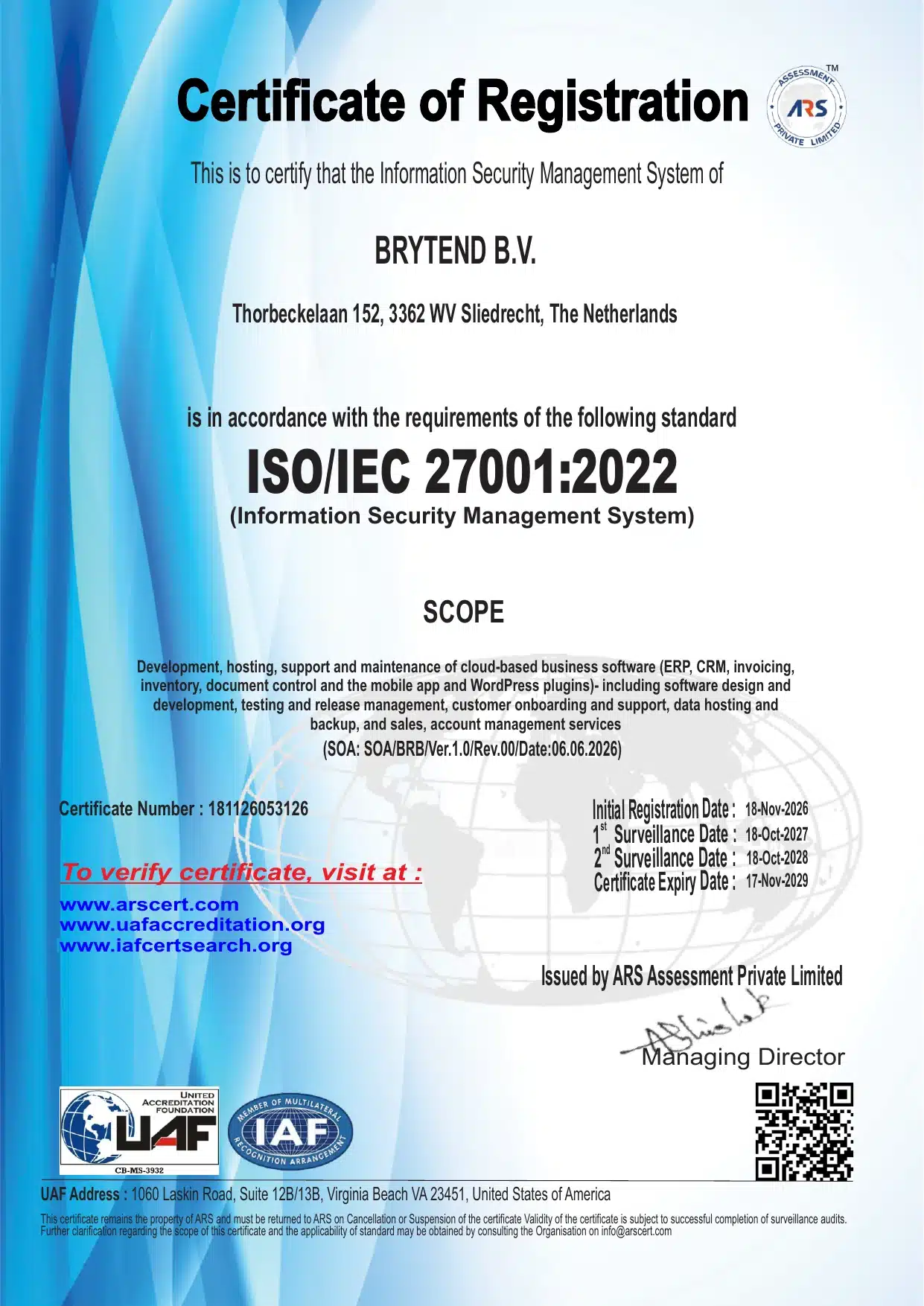
The scope covers the work that matters to you as a customer: development, hosting, support and maintenance of cloud-based business software, including ERP, CRM, invoicing, inventory, document control, the mobile app and WordPress plugins. It includes software design and development, testing and release management, customer onboarding and support, data hosting and backup, and sales and account management.
Brytend also holds ISO 9001 for quality management, ISO 14001 for environmental management and ISO 45001 for occupational health and safety. All four certificates, with download links, are on the Brytend ISO certification page.
What Does Brytend Do to Protect Your Data?
The certificate is the proof. These are the measures behind it that you will see when you use Brytend.
Encryption, in transit and at rest
- Encrypted connections: all traffic between your browser or phone and Brytend uses TLS
- Encryption at rest: switch on database encryption so stored data is unreadable without the key, even if a disk or backup file ends up in the wrong hands. The key is kept safe in the Brytend licence centre, so your data can always be restored
AI that stays inside your own hardware
- Your choice of AI: use Brytend AI, connect your own key for Claude, OpenAI, Google Gemini, Azure OpenAI, Mistral and others, or run AI on your own Ollama server so questions and data do not leave your own infrastructure
- Privacy rule: with the privacy rule on, confidential documents only go to an EU or own-server AI provider
- Same rights as the user: the AI reads data with the rights of the person asking, asks for confirmation before an admin change, and every AI action is logged
Who can get in
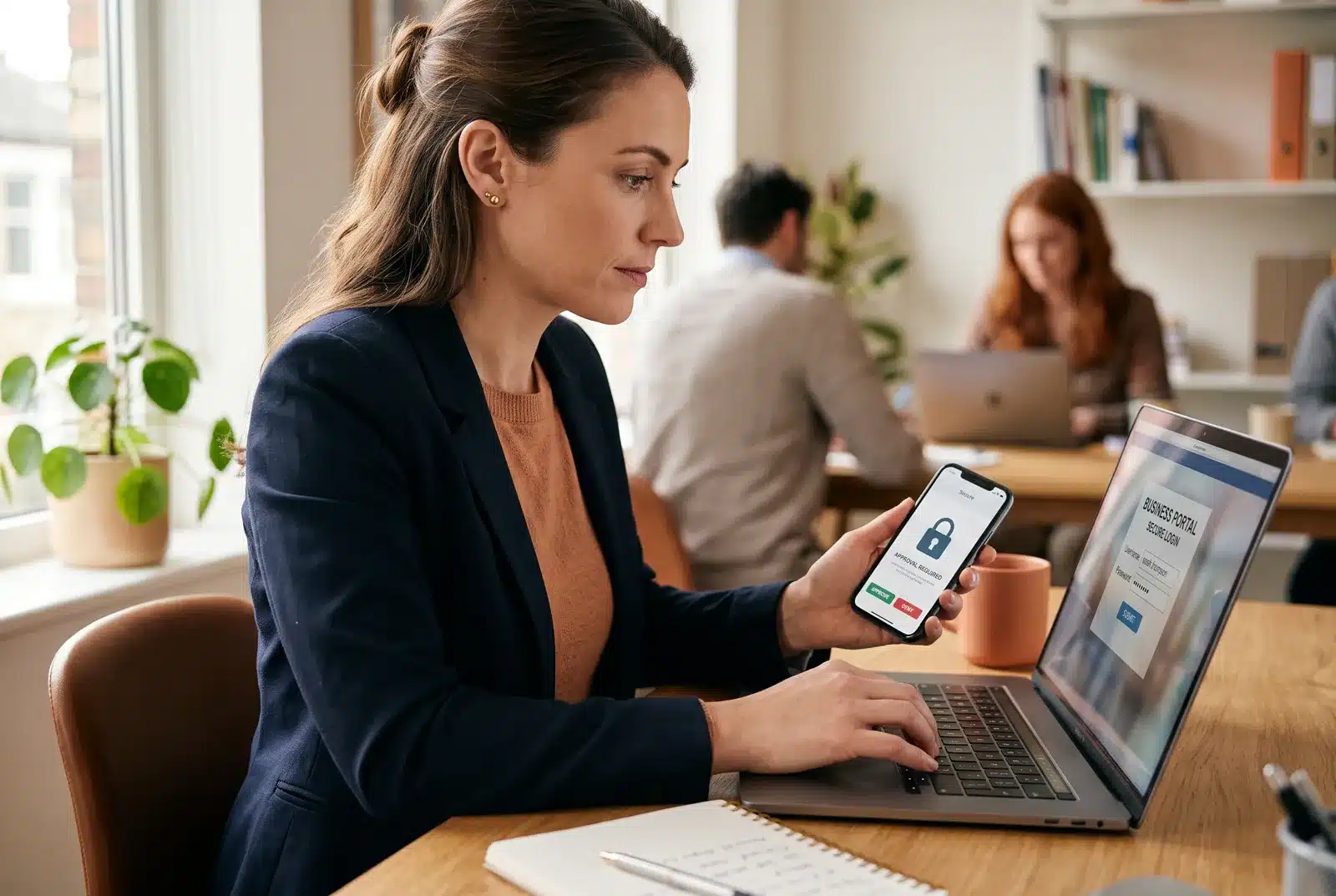
- Two-factor sign-in: sign in with an authenticator app, or use Microsoft 365 single sign-on
- Site firewall: allow sign-ins only from your own addresses, with an unlock link and temporary access for travelling staff
- Sign-in throttling: repeated failed sign-ins are slowed down and locked, and every refused sign-in is logged
- Sign out everywhere: reset 2-step verification and sign a user out on all devices at once
- Support access under your control: you decide whether Brytend support may sign in to your site
Who can see what
- Permission groups: each role gets the rights it needs, so HR data is only visible to users with HR rights
- Document classification: documents carry levels such as internal and confidential, only users with that level can open them, and previews carry a watermark
- Audit trail: document versions, approvals and gas test readings are recorded with the user and the time, and gas test records are hash-chained so later changes are visible
- Retention and legal holds: retention policies and legal holds on documents
- Privacy requests: export or erase all data of one person, with a register of every request
Protection behind the scenes
- Isolated environments: each customer runs in its own container with its own application stack, so one customer cannot reach another customer’s data
- EU hosting: your data stays in the EU
- Daily backups: full daily backups, stored in multiple locations and replicated to a trusted partner in the Netherlands
- Virus scan on uploads: every uploaded file is scanned before anyone can open it
- Request protection: site-wide protection against forged requests, security headers and safer cookies
- Tested updates: updates are tested on our own systems and by alpha and beta testers before they reach customers, so you never have to patch anything yourself
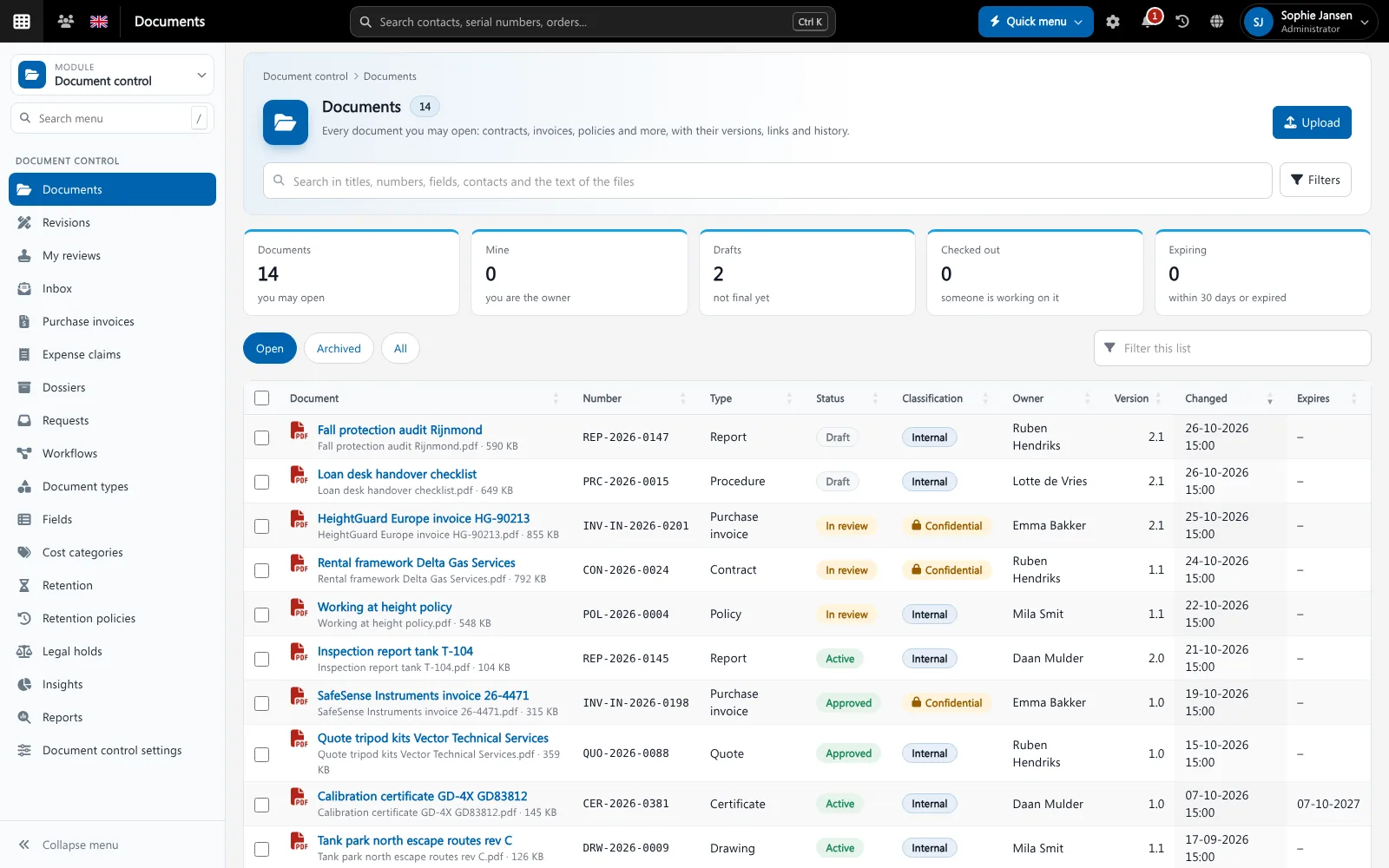
You can read the full list on the Brytend Security and access page. Our data protection policy, data processing agreement template, data breach response plan and IT security policy can be downloaded from the security and data protection page. For an example of how we respond when a new threat appears, read why rapid response matters for security, and for how the platform is hosted, see our hosting architecture. To see how AI works inside the platform, read about Brytend AI.
FAQs
What is ISO 27001 certification for a SaaS supplier?
ISO 27001 certification proves an independent body audited a SaaS supplier’s information security management system. The system covers risk assessment, access control, backups, incident response, secure development and continual improvement. ISO/IEC 27001:2022 references 93 controls across organisational, people, physical and technological areas. Certification normally lasts three years, with surveillance audits annually.
Why does ISO 27001 matter for SaaS suppliers?
ISO 27001 matters because SaaS suppliers store customer data on infrastructure they control. Certification provides independent evidence that access, backups, incidents and supplier risks are managed systematically. It can shorten security reviews by weeks and support GDPR and NIS2 supply-chain assessments. Many business tenders also require certification before accepting a supplier’s bid.
How can you verify a SaaS supplier’s ISO 27001 certificate?
You can verify an ISO 27001 certificate by checking its issuer, accreditation, number, scope, version and dates. Look up the certificate number with the certification body or IAF CertSearch. Confirm the scope covers development, hosting and support. The current standard is ISO/IEC 27001:2022, following the 31 October 2025 transition deadline.
How much does ISO 27001 certification cost for a SaaS supplier?
ISO 27001 certification costs vary according to company size, locations, scope and ISMS maturity. The provided information does not state a fixed certification price. Suppliers should budget for implementation, audit and ongoing surveillance expenses. Certification normally follows a three-year cycle, with annual surveillance audits that create continuing compliance costs.
How does ISO 27001 compare with SOC 2 for SaaS suppliers?
ISO 27001 is an international standard producing a verifiable certificate, while SOC 2 produces an attestation report. ISO 27001 focuses on an information security management system and continual improvement. SOC 2 evaluates trust services criteria over a reporting period. ISO 27001 is common in Europe, whereas SOC 2 is more common in North America.
Can a small SaaS supplier get ISO 27001 certification?
Yes, a small SaaS supplier can obtain ISO 27001 certification through a risk-based information security management system. The supplier must define its scope, assess risks, select applicable controls and demonstrate effective operation. Annex A contains 93 reference controls, but companies do not automatically need every control. An accredited body must independently audit the system.
How long does ISO 27001 certification remain valid for a SaaS supplier?
ISO 27001 certification normally remains valid for three years, provided annual surveillance audits confirm the system continues working. The supplier must maintain controls, address findings and improve its ISMS throughout the cycle. For example, Brytend’s certificate is valid from 18 November 2026 through 17 November 2029, subject to yearly surveillance audits.
Choosing a SaaS supplier means trusting another company with your data, so that trust should be backed by more than a promise. ISO 27001 is the clearest way for a software supplier to show that information security is organised, checked from the outside and improved every year. When you compare suppliers, ask for the certificate, read the scope and verify the number. If you are looking for one platform for CRM, service, assets, rentals, quality, documents and HR, built and hosted by an ISO 27001 certified supplier, take a look at Brytend and start a free 90-day trial.