TL;DR
- A multi-tenant Coolify hosting architecture is a distributed infrastructure model that isolates each customer’s application and data on dedicated Docker containers while centralizing management, backup, and security through a single control plane.
- Brytend’s implementation uses one Coolify Controller to manage multiple Coolify Servers running AlmaLinux across North America, Europe, and Asia Pacific, eliminating single points of failure.
- Every customer environment runs in an isolated Docker container (built by Brytend) with its own CodeIgniter application stack and encrypted-at-rest storage.
- Data protection relies on two independent backup FTP providers outside the supplier network (is*hosting and Versio), combined with Redis-compatible caching and S3-compatible object storage.
- Perimeter security is enforced through Cloudflare CDN and Firewall, IP whitelisting, and explicit allow/deny firewall rules before any request reaches the hardware layer.
What Is a Multi-Tenant Coolify Hosting Architecture?
A multi-tenant Coolify hosting architecture is a server topology where a central management system (Coolify Controller) provisions and monitors multiple physically separate servers, each running isolated customer workloads inside Docker containers. This model separates management, compute, backup, and storage into distinct layers so that a failure or breach in one layer does not cascade into the others.
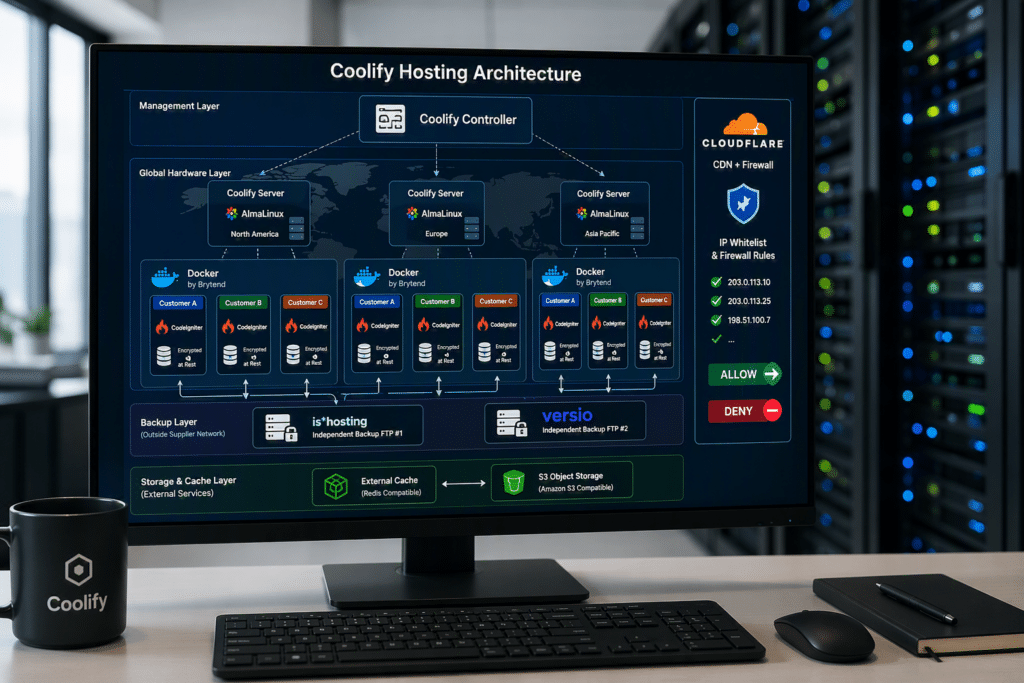
In Brytend’s design, this structure is applied at global scale: the same controller manages servers on three continents, and every customer, regardless of region, receives the same security and backup guarantees. The architecture is built as five discrete layers — security perimeter, management, hardware/compute, backup, and storage/cache — each with a clearly defined responsibility and clearly defined boundaries between them.
Why layering matters: When responsibilities are separated into layers, a compromise or outage in one layer (for example, a single regional server) cannot automatically propagate into another layer (for example, the backup systems), because the layers do not share infrastructure, credentials, or network paths.
How Does the Management Layer Control Global Infrastructure?
The management layer is a single Coolify Controller instance that issues configuration, deployment, and monitoring commands to every Coolify Server worldwide. Centralizing control this way means updates, security patches, and scaling decisions are applied consistently rather than server-by-server.
Why this matters for industrial and B2B operators:
- Consistency — Every regional server (North America, Europe, Asia Pacific) receives identical configuration standards, reducing configuration drift.
- Auditability — A single controller creates one authoritative log of changes across the whole fleet, which simplifies compliance reporting.
- Faster incident response — Engineers manage all regions from one interface instead of logging into each server independently.
- Version control of deployments — Application updates for CodeIgniter environments can be rolled out in a controlled sequence, region by region, reducing the blast radius of a bad deployment.
- Separation of control plane and data plane — The controller issues commands but does not itself store customer data, which means compromising the management layer alone does not expose customer records.
What role does the controller not play? The Coolify Controller is explicitly not a data-storage system and not a backup system. It is a control plane only. This distinction matters because it means the controller can be restored or rebuilt independently of customer data, and customer data can be restored independently of the controller.
Why Is the Global Hardware Layer Distributed Across Regions?
The Global Hardware Layer is distributed across North America, Europe, and Asia Pacific so that no single data center outage can take down the entire platform. Each region runs its own Coolify Server on AlmaLinux, a stable, security-patched Linux distribution commonly used in enterprise and industrial hosting.
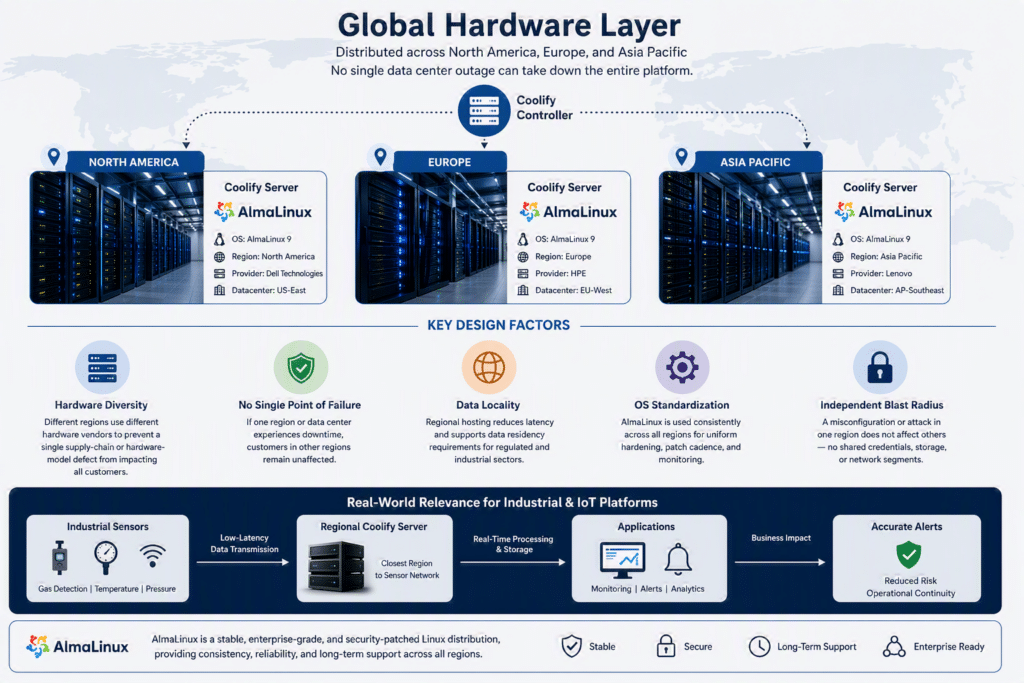
Key design factors:
- Hardware diversity: Different regions can use different underlying hardware vendors, which prevents a single supply-chain or hardware-model defect from affecting every customer simultaneously.
- No single point of failure: If one region’s server or data center experiences downtime, customers hosted in other regions remain unaffected.
- Data locality: Regional hosting reduces latency for customers and can support data residency requirements common in industrial and regulated sectors.
- Operating system standardization: Using AlmaLinux consistently across all regions means the same hardening scripts, patch cadence, and monitoring agents apply everywhere, without region-specific exceptions.
- Independent blast radius per region: A misconfiguration or attack targeting the Asia Pacific server does not automatically expose or affect the North America or Europe servers, because they do not share credentials, storage, or network segments.
This is directly relevant to serialized inventory systems and industrial IoT platforms, where latency and uptime affect real-time tracking accuracy across warehouses or production lines in different countries. A gas detection monitoring platform, for example, depends on low-latency writes from sensors to its regional server; placing that server geographically close to the sensor network reduces the risk of delayed alerts.
How Does Docker-Based Tenant Isolation Protect Customer Data?
Docker-based tenant isolation works by giving each customer (Customer A, Customer B, Customer C) a separate containerized environment running its own CodeIgniter application stack, so no tenant can access another tenant’s code, memory, or data. Brytend builds and manages this Docker layer on top of every AlmaLinux server.
Isolation is enforced at three levels:
- Process isolation — Each container runs as an independent process with its own filesystem view, so one tenant’s process cannot read another tenant’s memory space.
- Application isolation — Each customer runs a dedicated CodeIgniter environment, so a vulnerability or bug in one customer’s application code cannot execute against another customer’s instance.
- Data isolation — Each tenant’s data store is encrypted at rest, meaning that even in the event of unauthorized disk access, the data is unreadable without the corresponding encryption key.
Additional isolation benefits:
- Independent scaling — Customer A’s traffic spike does not require scaling Customer B’s or Customer C’s container; resources can be allocated per tenant.
- Independent patching — A security patch to Customer A’s CodeIgniter environment can be tested and deployed without touching Customer B’s or Customer C’s environment.
- Independent rollback — If a deployment to one tenant’s container fails, only that container is rolled back; the others continue running the previous stable version.
Why this matters for compliance-driven industries: Regulated sectors (industrial equipment tracking, gas detection systems, asset management) often require demonstrable data segregation between clients. Containerized, encrypted-at-rest tenancy provides an auditable answer to “how is our data separated from other customers’ data?”
What Are the Steps in the Backup and Disaster Recovery Workflow?
The backup and disaster recovery workflow follows four steps: containment, replication, offsite storage, and cache/object storage synchronization.
- Containment — Each customer’s encrypted data is generated inside its isolated Docker container.
- Replication to Backup FTP #1 — Data is copied to an independent backup FTP server hosted by is*hosting, located outside the primary supplier’s network.
- Replication to Backup FTP #2 — A second, independent backup copy is sent to a separate FTP provider, Versio, also outside the supplier network.
- Storage and cache synchronization — Data flows into an external Redis-compatible cache for fast retrieval and into S3-compatible object storage for durable, long-term storage, with the two systems kept in sync.
Why two independent backup providers outside the supplier network? If backups were stored inside the same supplier’s infrastructure as production servers, a single supplier-level outage or account compromise could destroy both production data and its backups. Using two separate providers (is*hosting and Versio) outside the primary hosting network removes this shared-fault risk entirely.
What does “outside the supplier network” mean in practice? It means the backup providers use different account credentials, different billing relationships, and different physical infrastructure than the primary Coolify servers. An incident that compromises the primary supplier account (for example, a credential leak) does not automatically grant an attacker access to either backup location.
Recovery point and recovery time considerations:
- Because replication happens to two independent locations, a restoration can proceed from whichever backup is verified as most current, reducing recovery point objective (RPO) risk.
- Because each backup provider is independent, a restoration test can be run against one provider without disrupting the other, supporting non-disruptive disaster recovery drills.
What Are Common Challenges in Multi-Region, Multi-Tenant Hosting?
Common challenges include configuration drift between regions, backup verification at scale, encryption key management, and firewall rule sprawl.
Frequent mistakes to avoid:
- Relying on a single backup location. A single backup target creates a single point of failure — exactly what a distributed hardware layer is designed to prevent.
- Skipping backup restoration tests. A backup that has never been restored is unverified; teams should periodically test recovery from both is*hosting and Versio copies.
- Overly broad firewall rules. Allowing wide IP ranges “temporarily” and forgetting to revoke them expands the attack surface over time.
- Under-monitoring container resource limits. Without limits, one tenant’s traffic spike can degrade performance for co-located tenants on the same Docker Engine.
- Treating encryption at rest as a substitute for access control. Encryption protects data if a disk is stolen or improperly accessed, but it does not replace the need for firewall rules, IP whitelisting, and container isolation — these controls work together, not as alternatives to one another.
- Inconsistent OS patch levels across regions. If one regional AlmaLinux server falls behind on patches, it becomes the weakest link in an otherwise uniform fleet.
How Does the Security Perimeter Control Access Before Reaching Servers?
The security perimeter filters all incoming traffic through Cloudflare’s CDN and Firewall before it reaches any Coolify Server, and a secondary IP whitelist enforces an explicit allow/deny decision for administrative access.
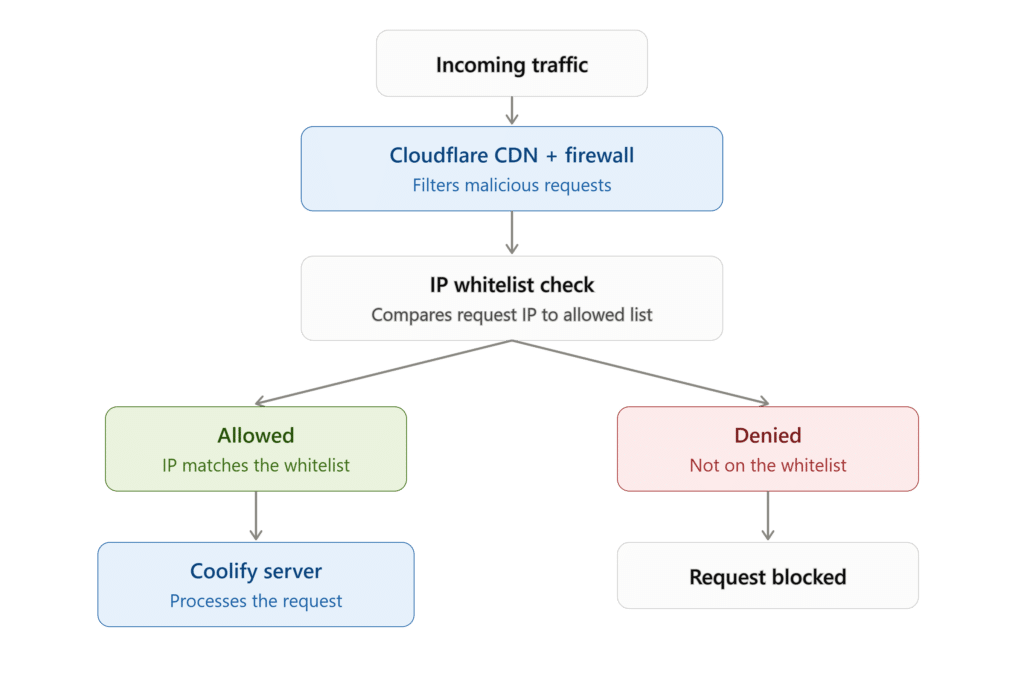
Access control sequence:
- Traffic first passes through Cloudflare CDN + Firewall, which filters malicious requests and distributes legitimate traffic efficiently.
- Administrative or management-layer access is checked against an IP whitelist (e.g., specific registered IP addresses).
- Each IP is matched against explicit firewall rules: recognized IPs are allowed, unrecognized IPs are denied by default.
This “deny by default, allow by exception” model is a recognized best practice in industrial and enterprise network security, since it minimizes the addressable attack surface to only pre-approved administrators.
Why put a CDN and firewall in front of a multi-region architecture? A CDN absorbs and filters traffic before it reaches origin servers, which reduces the load on the Global Hardware Layer and reduces exposure to volumetric attacks such as denial-of-service attempts. Because the CDN sits in front of all three regions, it provides a single, consistent enforcement point rather than three separate, independently configured perimeters.
What Role Does Encryption at Rest Play in This Architecture?
Encryption at rest means that customer data stored on disk — inside Docker containers, on backup FTP servers, and in object storage — is stored in an unreadable, encrypted form and can only be decrypted with the correct key. This protects data confidentiality even if physical storage media, a backup file, or a disk image is accessed without authorization.
Where encryption at rest applies in this architecture:
- Inside each tenant’s Docker container storage (Customer A, B, and C).
- On both independent backup FTP servers (is*hosting and Versio).
- Within the S3-compatible object storage layer.
Why this matters: Firewalls and IP whitelisting protect against unauthorized network access, but they do not protect data if a storage device itself is copied, stolen, or improperly decommissioned. Encryption at rest closes that specific gap, which is why it is applied at every storage point in the architecture rather than only at the primary server.
How Does the Storage and Cache Layer Support Performance and Durability?
The storage and cache layer combines a Redis-compatible external cache for fast, frequently accessed data with S3-compatible object storage for durable, long-term data retention. Separating these two systems allows the architecture to optimize for speed and for durability independently.
Why separate cache from durable storage?
- Speed — A Redis-compatible cache serves frequently requested data (such as session information or lookup tables) from memory, which is faster than reading from disk-based object storage.
- Durability — S3-compatible object storage is designed for long-term retention and high durability, making it suitable for backup archives and infrequently accessed records.
- Independent scaling — Cache capacity can be scaled to handle traffic spikes without needing to resize the underlying object storage, and vice versa.
- External placement — Both systems sit outside the primary compute layer, so a compute-layer incident does not directly threaten cached or stored data.
How Can This Architecture Be Optimized for Reliability?
This architecture can be optimized by adding automated backup verification, rotating encryption keys on a fixed schedule, and monitoring cache-to-object-storage sync latency.
Best practices:
- Automate periodic test restores from both backup FTP providers, not just backup creation.
- Enforce least-privilege IP whitelisting, reviewing entries on a recurring schedule rather than leaving them static indefinitely.
- Monitor Docker Engine resource allocation per tenant to prevent noisy-neighbor performance issues.
- Track cache-object storage synchronization health between the Redis-compatible cache and S3-compatible storage to catch silent data drift early.
- Rotate encryption keys on a defined schedule and store key-management records separately from the data they protect.
- Run regional failover drills on a recurring basis so that a real regional outage is not the first time failover has been exercised.
Case Example: Serialized Inventory Platform Across Three Regions
An industrial equipment company running a serialized inventory and gas detection monitoring platform hosts Customer A in North America, Customer B in Europe, and Customer C in Asia Pacific, using the architecture described above. When a hardware fault affects the Asia Pacific Coolify Server, Customer C’s environment fails over to its encrypted backup data on both is*hosting and Versio, while Customers A and B continue operating without interruption because their environments sit on entirely separate regional servers. Compliance auditors reviewing the incident can confirm data isolation because each customer’s CodeIgniter environment and encrypted storage remained physically and logically separate throughout the event.
Extended scenario — serialized inventory reconciliation: During the same incident, the industrial equipment company needed to reconcile serialized asset records (unique IDs for tracked equipment) that were written to Customer C’s database in the minutes before the hardware fault. Because the S3-compatible object storage layer had already synchronized recent writes from the external cache, the reconciliation team could confirm which serial numbers were successfully committed before the fault occurred, without waiting for a full restore from either backup FTP provider.
Manual vs. Automated Multi-Tenant Hosting: A Comparison
| Factor | Manual Hosting Management | Coolify-Managed Architecture (Brytend) |
|---|---|---|
| Server provisioning | Configured individually per server | Centrally managed via Coolify Controller |
| Tenant isolation | Often shared environments, higher cross-tenant risk | Dedicated Docker container per tenant |
| Backup strategy | Frequently single-location, same-network backups | Dual independent offsite FTP providers (is*hosting, Versio) |
| Firewall management | Ad hoc rule updates per server | Centralized allow/deny rules with IP whitelisting |
| Regional failover | Requires manual intervention | Region-isolated servers limit blast radius automatically |
| Encryption at rest | Inconsistently applied | Enforced per tenant by default |
| OS and patch consistency | Varies server to server | Standardized on AlmaLinux across all regions |
| Incident response | Requires log correlation across separate systems | Centralized visibility through one controller |
Why This Architecture Demonstrates a Strong Security and Reliability Posture
This architecture demonstrates a strong posture because it removes single points of failure at every layer: management, hardware, backup, and storage. Centralized control through Coolify does not create a single point of failure because the controller manages, but does not host, customer data directly — the actual workloads remain distributed across independently isolated regional servers and containers.
Summary of resilience factors:
- Three independent geographic regions prevent one data center incident from affecting the whole platform.
- Per-tenant Docker isolation contains application-level failures and security incidents to a single customer.
- Two independent, off-network backup providers eliminate shared-fault risk in disaster recovery.
- Layered perimeter security (Cloudflare, IP whitelisting, explicit firewall rules) blocks unauthorized access before it reaches infrastructure.
- Encryption at rest across all customer data ensures data confidentiality even under a physical or storage-level breach.
- Separated cache and durable storage ensures performance and long-term data integrity are optimized independently rather than traded off against each other.
Together, these factors reflect an infrastructure model built for organizations that require demonstrable data isolation, verifiable backup redundancy, and regional resilience — requirements common in industrial, compliance-driven, and multi-customer SaaS environments.
FAQs
What is a multi-tenant Coolify hosting architecture?
A multi-tenant Coolify hosting architecture is a server topology that isolates customer applications in dedicated Docker containers. This model enhances security and management by separating workloads and ensuring that issues in one tenant do not affect others.
How does the management layer control global infrastructure?
The management layer uses a single Coolify Controller to issue commands and configurations to all Coolify Servers worldwide. This centralization ensures consistent updates and security across all regions, enhancing operational efficiency.
Can customers access their data in isolated Docker containers?
Yes, customers can access their data in isolated Docker containers, which ensures that no tenant can access another's data. Each environment is secured and encrypted, protecting customer information.
How long does the backup and disaster recovery workflow take?
The backup and disaster recovery workflow follows four steps, including containment and replication, but the exact timeline depends on data size and network speed. Typically, restoration can be initiated quickly from independent backup locations.
Does the architecture use independent backup providers?
Yes, the architecture uses two independent backup providers outside the supplier network. This design eliminates shared-fault risks and ensures that backups remain secure even if the primary infrastructure is compromised.
What role does encryption at rest play in this architecture?
Encryption at rest protects customer data stored on disk by making it unreadable without the correct key. This security measure is applied across all storage locations, ensuring data confidentiality even if unauthorized access occurs.
How can this architecture be optimized for reliability?
This architecture can be optimized by automating backup verification, monitoring resource allocation, and scheduling regular encryption key rotations. These practices enhance security and ensure consistent performance across the system.