
Agile development is a software development methodology that delivers working software through iterative cycles called sprints, emphasizing collaboration, adaptability, and continuous customer feedback over rigid planning and documentation. Organizations implementing agile development report 60% faster time-to-market and 25% higher team productivity compared to traditional waterfall approaches. This methodology has become the dominant framework for custom software development teams worldwide.
TL;DR:
- Agile development breaks projects into 1-4 week sprints with working deliverables at each cycle
- Core practices include daily standups, sprint planning, retrospectives, and continuous integration
- Teams self-organize around user stories prioritized by business value
- Frequent customer feedback drives iterative improvements and reduces rework
- Organizations achieve faster delivery, lower risk, and better alignment with business needs
What Is Agile Development and How Does It Work?
Agile development is an iterative approach to software creation that prioritizes working software over comprehensive documentation, customer collaboration over contract negotiation, and responding to change over following a fixed plan. The methodology emerged from the Agile Manifesto signed by 17 software developers in 2001, establishing four core values and twelve guiding principles.
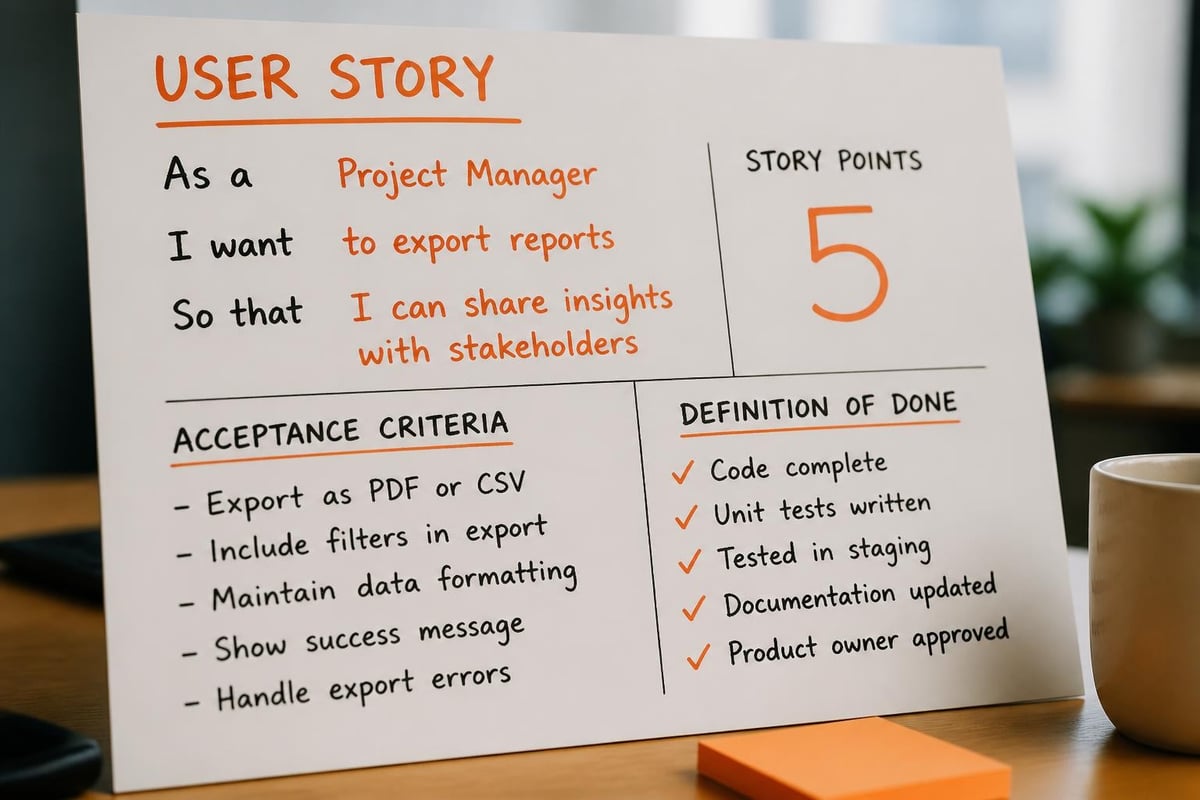
Teams organize work into time-boxed iterations called sprints, typically lasting one to four weeks. Each sprint produces a potentially shippable product increment. At the beginning of each sprint, teams select high-priority items from a backlog of user stories, which describe features from an end-user perspective.
The sprint cycle includes specific ceremonies:
- Sprint Planning: Team selects work and defines sprint goals (2-4 hours)
- Daily Standup: 15-minute synchronization meeting each morning
- Sprint Review: Demonstration of completed work to stakeholders (1-2 hours)
- Sprint Retrospective: Team reflects on process improvements (1 hour)
Between sprints, teams incorporate feedback from stakeholders and adjust priorities. This continuous loop enables rapid course correction based on real-world usage and changing business conditions.

Core Roles in Agile Teams
Three primary roles structure agile development teams. The Product Owner maintains the product backlog, prioritizes features by business value, and serves as the primary stakeholder representative. This person makes final decisions on what gets built and when.
The Scrum Master facilitates ceremonies, removes blockers, and coaches the team on agile practices. Unlike traditional project managers, Scrum Masters do not assign tasks or manage individual performance. They create conditions for self-organization.
The Development Team includes all contributors who build the software: developers, testers, designers, and technical writers. Teams typically range from 5 to 9 members. They self-organize to determine how work gets done and collectively own quality and delivery commitments.
Why Do Organizations Adopt Agile Development?
Organizations adopt agile development to reduce project risk, accelerate time-to-market, and improve alignment between software capabilities and actual business needs. Traditional waterfall methodologies require extensive upfront planning and deliver software only at project completion, often 12-24 months after initiation. By that time, market conditions or business requirements frequently change, rendering portions of the delivered system obsolete.
Agile development addresses this through incremental delivery. Working software reaches users every 2-4 weeks, generating feedback that informs subsequent development. A 2024 study found that agile projects experience 37% fewer defects in production and 42% higher customer satisfaction scores compared to waterfall equivalents.
Key business benefits include:
- Faster ROI: Revenue-generating features reach production months earlier
- Lower Risk: Small increments limit exposure from wrong assumptions
- Better Quality: Continuous testing and integration catch defects early
- Increased Flexibility: Teams pivot quickly based on market feedback
- Higher Morale: Autonomy and visible progress improve team engagement
Organizations choosing custom software development approaches benefit from aligning methodology with project characteristics. Agile development works best when requirements evolve, user feedback is accessible, and business stakeholders can participate throughout development.
When Agile Development Creates Maximum Value
Agile development delivers greatest value in environments with uncertainty or rapid change. New product development, digital transformation initiatives, and competitive markets benefit most from iterative approaches. Research on agile software development demonstrates superior outcomes for innovation projects where the optimal solution cannot be fully specified upfront.
Conversely, projects with fixed regulatory requirements, unchanging specifications, or distributed teams across incompatible time zones may face challenges with pure agile implementation. Hybrid approaches often work better in these contexts.
How Do Teams Implement Agile Development Practices?
Implementation begins with foundational training and organizational buy-in. Successful transitions require executive sponsorship, team education, and patience through initial productivity dips as teams learn new practices.
Step-by-step implementation process:
- Establish the Product Backlog: Document all known requirements as user stories with acceptance criteria
- Form Cross-Functional Teams: Assemble 5-9 people with all skills needed to deliver working software
- Select a Framework: Choose Scrum, Kanban, or hybrid approach based on team needs
- Define Sprint Length: Start with 2-week sprints and adjust based on feedback cycles
- Set Up Tools: Implement board software, version control, and continuous integration pipelines
- Run Sprint Zero: Establish technical infrastructure, coding standards, and definition of done
- Execute First Sprint: Follow all ceremonies even if they feel awkward initially
- Collect Metrics: Track velocity, cycle time, defect rates, and team satisfaction
- Iterate and Improve: Use retrospectives to refine processes every sprint
Teams often struggle with story estimation initially. Planning poker, where team members vote on effort using Fibonacci sequences, creates alignment and surfaces assumptions. A story estimated at 8 points requires roughly twice the effort of a 5-point story.
Common Implementation Mistakes
Organizations frequently make predictable mistakes during agile adoption. The most common error involves treating agile as a process change rather than a cultural transformation. Teams adopt sprint ceremonies without embracing the underlying values of collaboration, transparency, and continuous improvement.
Critical mistakes to avoid:
- Skipping retrospectives when sprints feel successful
- Product Owners who are unavailable for daily questions
- Teams that don't produce working software every sprint
- Management that measures individual productivity instead of team outcomes
- Organizations that claim to be agile but maintain rigid approval processes
Another frequent problem involves poor backlog refinement. Teams that enter sprint planning with vague, unestimated stories waste hours discussing details that should have been clarified earlier. Effective teams spend 5-10% of each sprint refining upcoming stories.
What Tools and Practices Support Agile Development?
Agile development requires specific technical practices to maintain quality while moving quickly. Continuous integration, automated testing, and version control form the technical foundation. Without these, teams cannot sustain the rapid pace of iterative delivery.
| Practice | Purpose | Typical Implementation |
|---|---|---|
| Continuous Integration | Detect integration problems within hours | Jenkins, GitLab CI, GitHub Actions |
| Automated Testing | Verify functionality without manual effort | Jest, Selenium, Pytest, JUnit |
| Pair Programming | Improve code quality and knowledge sharing | Two developers, one workstation |
| Test-Driven Development | Write tests before implementation code | Red-Green-Refactor cycle |
| Code Review | Catch defects and spread knowledge | Pull request approvals |
| Refactoring | Improve code structure without changing behavior | Scheduled technical debt sprints |
Teams also need collaboration tools for distributed work. Digital boards like Jira, Azure DevOps, or Linear track story status and sprint progress. Video conferencing enables daily standups across locations. Documentation wikis maintain shared understanding of architecture and decisions.
Custom software development teams implementing agile practices often integrate specialized tools for their domain. For instance, teams building service management systems might use dedicated modules to track development progress against specific customer workflows and requirements.

Manual Versus Automated Agile Processes
Early agile teams used physical boards with sticky notes to visualize work. This approach maximized transparency and team interaction but created challenges for distributed teams and historical tracking. Modern teams typically use digital tools while preserving the visualization benefits.
The tradeoff involves overhead versus accessibility. Physical boards require no training and encourage spontaneous collaboration when team members work in the same room. Digital tools enable remote participation, automatic metrics, and integration with development systems.
Hybrid approaches work well: maintain a physical board for daily standups but use digital tools as the system of record. This preserves social benefits while ensuring distributed stakeholders can track progress.
How Does Agile Development Compare to Other Methodologies?
Agile development differs fundamentally from waterfall, spiral, and other sequential methodologies in its approach to planning and delivery. Waterfall treats software development as a series of distinct phases: requirements, design, implementation, testing, and deployment. Each phase completes before the next begins.
This approach works well when requirements are stable and well-understood. Construction projects, embedded systems with fixed hardware, and regulatory compliance systems often suit waterfall methodology. However, research on scaling agile development shows that iterative approaches outperform sequential ones when dealing with uncertainty or changing requirements.
Methodology comparison:
| Aspect | Agile Development | Waterfall | DevOps |
|---|---|---|---|
| Planning horizon | 2-4 weeks | Entire project | Continuous |
| Requirements | Evolving backlog | Fixed specification | User feedback driven |
| Testing | Every sprint | After implementation | Continuous automated |
| Delivery frequency | Every 2-4 weeks | At project end | Multiple times daily |
| Documentation | Minimal, just-in-time | Comprehensive upfront | Automated, as-code |
| Change management | Expected and embraced | Controlled and costly | Automated deployment |
DevOps extends agile principles beyond development into operations, emphasizing automation and continuous delivery. Teams practicing both agile development and DevOps can release software to production multiple times per day while maintaining stability.
Combining Agile with Traditional Approaches
Many organizations operate in hybrid environments where some projects suit agile development while others require traditional planning. The key lies in matching methodology to project characteristics rather than mandating a single approach.
Fixed-price contracts with external vendors often require waterfall-style specifications. Internal innovation projects benefit from agile iteration. Organizations can use agile development for the first few sprints to clarify requirements, then transition to fixed-scope delivery once uncertainty resolves.
Understanding these methodological differences helps teams select appropriate practices for their context rather than following frameworks dogmatically.
What Metrics Indicate Successful Agile Development?
Effective measurement focuses on outcomes rather than activity. Traditional metrics like lines of code or hours worked encourage counterproductive behavior. Agile development metrics emphasize delivered value, quality, and team health.
Primary agile metrics:
- Velocity: Story points completed per sprint (trend, not absolute value)
- Sprint Burndown: Remaining work visualized daily throughout sprint
- Cycle Time: Days from story start to production deployment
- Defect Escape Rate: Bugs found in production versus development
- Customer Satisfaction: Net Promoter Score or similar feedback
- Team Happiness: Regular pulse surveys on morale and obstacles
Velocity measures team capacity but should never be used for cross-team comparison or individual performance evaluation. A team averaging 40 story points per sprint cannot be compared to one averaging 60 because point scales differ between teams.
More sophisticated organizations track flow metrics: throughput (stories completed per week), work-in-progress limits, and lead time distributions. These reveal bottlenecks and process inefficiencies that sprint-level metrics miss.
ROI Calculation for Agile Development
Calculating return on investment for methodology changes requires comparing outcomes before and after adoption. Organizations typically measure time-to-market improvements, defect reduction costs, and revenue from earlier feature delivery.
A manufacturing company implementing agile development for their inventory management system might track:
- Baseline: 18 months to first release, 45 defects in first 90 days, $2M development cost
- Agile: 6 months to minimal viable product, 12 defects in first 90 days, $1.8M development cost
- ROI: 12 months earlier revenue, 73% fewer defects, 10% cost reduction
The revenue impact of 12 months earlier delivery typically dwarfs all other factors. A system generating $500K monthly revenue produces $6M additional value through accelerated delivery.
How Do Distributed Teams Practice Agile Development?
Remote and distributed teams face unique challenges with agile development practices designed for co-located collaboration. Time zone differences, communication barriers, and reduced spontaneous interaction require adaptations to standard practices.
Distributed team strategies:
- Maximize Overlap Hours: Schedule ceremonies during time zones shared by all team members
- Over-Communicate Asynchronously: Use written updates, recorded demos, and documentation
- Rotate Meeting Times: Share inconvenience of early/late meetings across team members
- Invest in Tools: High-quality video, digital boards, and persistent chat become essential
- Increase Documentation: Write down decisions that co-located teams handle verbally
- Create Redundancy: Multiple team members in each specialty and location
Daily standups work differently across time zones. Some teams use asynchronous updates in chat channels, while others run multiple standups regionally. The key is maintaining visibility of blockers and progress without forcing everyone into inconvenient schedules.
Research on agile practice characteristics indicates that distributed teams can achieve similar outcomes to co-located ones when they deliberately compensate for reduced face-to-face interaction.
Building Trust in Virtual Teams
Trust develops more slowly in distributed environments. Co-located team members build relationships through casual hallway conversations and shared lunches. Virtual teams must create deliberate opportunities for personal connection.
Effective strategies include starting meetings with personal check-ins, scheduling virtual coffee chats, and organizing occasional in-person gatherings. Video-on meetings humanize remote colleagues. Teams that invest in relationship building report higher satisfaction and lower turnover.
What Challenges Do Teams Face with Agile Development?
Organizations encounter predictable obstacles when implementing agile development. Resistance from management accustomed to detailed long-term plans creates tension. Middle managers whose roles centered on status reporting and coordination feel threatened by self-organizing teams.
Technical debt accumulated under previous methodologies slows initial sprint velocity. Teams cannot deliver working software every two weeks if the codebase lacks automated tests or deployment takes three days. Organizations must invest in technical infrastructure before agile practices can succeed.
Common challenges and solutions:
| Challenge | Impact | Solution |
|---|---|---|
| Unclear Product Owner | Team builds wrong features | Dedicate experienced person full-time |
| No automated testing | Regression bugs slow delivery | Invest 2-3 sprints building test suite |
| Distributed stakeholders | Delayed feedback and decisions | Weekly demos with required attendance |
| Legacy architecture | Cannot deploy incrementally | Parallel modernization efforts |
| Fixed-bid contracts | No flexibility for changes | Time-and-materials agreements |
Another significant challenge involves scaling agile development beyond single teams. Frameworks like SAFe, LeSS, and Scrum@Scale provide structures for coordinating multiple teams working on the same product. However, these introduce additional complexity and ceremony that can slow individual team velocity.
Cultural Barriers to Adoption
The most difficult obstacles are cultural rather than technical. Organizations with hierarchical decision-making structures struggle with empowered teams making autonomous choices. Companies that reward individual performance find collective ownership concepts foreign.
Successful transformations require executive sponsorship and patience. Leadership must model transparency, acknowledge uncertainty, and celebrate learning from failures. Teams need psychological safety to experiment, fail fast, and improve iteratively.
Business solutions built through agile approaches demonstrate how methodology alignment with organizational culture affects outcomes more than framework selection.
Agile development transforms software delivery through iterative cycles, continuous feedback, and adaptive planning that responds to changing business needs. Organizations implementing these practices achieve faster time-to-market, higher quality, and better alignment between software capabilities and actual requirements. Brytend specializes in custom software development using agile methodologies tailored to your specific business goals, providing the technical expertise and collaborative approach needed to deliver solutions that evolve with your needs.