
A download lead is a prospective customer whose contact information is captured when they request access to gated digital content such as whitepapers, ebooks, templates, or software trials. This lead generation method exchanges valuable resources for prospect data, enabling businesses to build qualified contact lists while demonstrating expertise.
TL;DR:
- Download leads are prospects who provide contact information to access gated digital content
- Effective download lead systems require optimized forms, automated delivery, and CRM integration
- Compliance with data privacy regulations like GDPR and CCPA is mandatory for all download lead forms
- Quality content offers generate higher conversion rates than generic resources
- Proper lead scoring and routing maximize conversion from download to customer
What Information Should a Download Lead Form Capture?
A download lead form should collect the minimum viable data needed for qualification and follow-up without creating friction that reduces conversion rates.
Essential fields include full name and business email address. These two data points enable basic identification and communication. Secondary fields depend on your sales process complexity and typical deal size.
Standard download lead form fields:
- Full name (required)
- Business email (required)
- Company name (conditional)
- Job title or role (conditional)
- Phone number (optional)
- Company size or revenue range (optional)
Research shows each additional form field reduces conversion rates by approximately 11%. A well-designed lead generation form balances data collection with user experience. For low-value content like blog templates, limit fields to name and email. For high-value assets like industry reports or ROI calculators, three to five fields remain acceptable.

Include progressive profiling when possible. This technique captures additional information on subsequent downloads rather than overwhelming first-time visitors. The Brytend CRM includes progressive profiling capabilities that automatically track what information you already have about each contact and adjust form fields accordingly.
Hidden Fields and Tracking Parameters
Hidden fields capture valuable context without adding visible form elements. Common hidden fields include:
- Traffic source (organic, paid, referral)
- Campaign identifier
- Landing page URL
- Device type
- Geographic location
- Referring domain
This metadata enables more accurate lead scoring and attribution analysis. When a prospect downloads multiple assets over time, you build a comprehensive behavioral profile showing their interests, timeline, and engagement level.
How Do You Automate Download Lead Delivery and Follow-Up?
Automation ensures immediate content delivery while triggering appropriate nurture sequences based on lead characteristics and behavior.
The basic automation workflow consists of form submission, CRM record creation, content delivery, and follow-up sequence initiation. When a prospect submits a download lead form, the system should create or update their CRM record within seconds, deliver the promised content immediately, and enroll them in a relevant email sequence.
Download lead automation sequence:
- Form submission trigger – Prospect completes download form
- Data validation – System verifies email format and checks for duplicate records
- CRM sync – Contact record created or updated with new information
- Content delivery – Automated email sends download link or PDF attachment
- Lead scoring – System assigns points based on content type and prospect data
- Routing decision – Lead routed to sales or marketing based on score threshold
- Nurture enrollment – Contact added to appropriate email sequence
Immediate delivery is critical. Studies show 78% of customers purchase from the company that responds first. Your download confirmation email should arrive within 60 seconds of form submission. Include the download link prominently, with clear instructions and multiple access methods (direct download button, plain text link, and PDF attachment when file size permits).
The follow-up sequence should provide additional value rather than immediate sales pressure. A typical download lead nurture sequence includes:
- Day 0: Content delivery email
- Day 2: Related resource or use case example
- Day 5: Educational content expanding on download topic
- Day 8: Customer success story or case study
- Day 12: Soft call-to-action (demo invitation, consultation offer)
Lead Scoring for Download Leads
Not all download leads have equal purchase intent. Implement scoring models that weight both explicit data (job title, company size) and implicit behavior (content topic, download frequency).
| Scoring Factor | Points | Rationale |
|---|---|---|
| Director+ title | 20 | Decision-making authority |
| Target company size | 15 | Fit with ideal customer profile |
| Multiple downloads | 10 per additional | Demonstrates engagement |
| Pricing/ROI content | 25 | High purchase intent |
| Technical specs download | 15 | Evaluation stage |
| General educational content | 5 | Early awareness stage |
Set score thresholds that trigger different actions. Leads scoring above 50 points might route directly to sales, while scores of 20-49 remain in marketing nurture, and below 20 receive minimal follow-up. Many lead generation strategies incorporate behavioral scoring to prioritize high-intent prospects.
What Compliance Requirements Apply to Download Leads?
Download lead forms must comply with data privacy regulations including GDPR (Europe), CCPA (California), and similar laws in other jurisdictions.
The fundamental principle is informed consent. Prospects must understand what data you collect, how you will use it, and their rights regarding that data. Creating compliant download forms requires specific legal elements and transparent data handling practices.
Required compliance elements:
- Privacy policy link – Visible on or immediately adjacent to the form
- Purpose statement – Clear explanation of how you will use submitted information
- Consent mechanism – Explicit opt-in for marketing communications (pre-checked boxes are not compliant in most jurisdictions)
- Data retention notice – How long you will store the information
- Access and deletion rights – How prospects can request their data or ask for deletion
- Third-party sharing disclosure – Any partners or vendors who will receive the data
GDPR requires explicit consent for each processing purpose. You cannot bundle consent for content delivery with consent for marketing emails. Use separate checkboxes with clear labels. The content delivery checkbox can be required (legitimate interest applies), but marketing communications must be optional.

CCPA grants California residents the right to know what personal information is collected, the right to delete that information, and the right to opt out of its sale. Include a "Do Not Sell My Personal Information" link in your website footer and honor opt-out requests within 15 days.
Data Security for Download Leads
Beyond legal compliance, implement technical security measures. Download lead data often contains personally identifiable information (PII) requiring protection.
- Encrypt data in transit (HTTPS/SSL required)
- Encrypt data at rest in your database
- Limit employee access to lead data based on role
- Implement audit logging for all data access
- Regularly test forms for vulnerabilities
- Use CAPTCHA or similar bot protection
- Validate and sanitize all input data
One academic study of lead generation ecosystems found significant privacy risks in how lead data is collected, brokered, and used, including exposure to spam and unauthorized third-party access. Implement security practices that exceed minimum legal requirements to protect both your prospects and your reputation.
How Do You Optimize Download Lead Conversion Rates?
Conversion rate optimization for download leads focuses on content value, form design, landing page clarity, and trust signals.
The average conversion rate for B2B download lead forms ranges from 5% to 15%, with top performers exceeding 20%. Multiple factors influence these rates, starting with whether the content offer matches the prospect's current needs and pain points.
High-converting content types by buyer stage:
| Buyer Stage | Effective Content Types | Typical Conversion Rate |
|---|---|---|
| Awareness | Industry reports, trend guides, educational ebooks | 8-12% |
| Consideration | Comparison guides, checklist templates, best practice frameworks | 12-18% |
| Decision | ROI calculators, product specifications, implementation guides | 15-25% |
| Post-purchase | Advanced tutorials, optimization guides, integration instructions | 20-30% |
Content quality directly impacts conversion. Generic, superficial resources generate lower conversion rates than deep, actionable content that prospects cannot easily find elsewhere. One lead generation case study demonstrated a 25% increase in leads by improving content relevance and promotional targeting.
Landing Page Optimization Elements
The download lead landing page must communicate value clearly and remove distractions. Effective landing pages follow a consistent structure:
- Headline – Specific benefit statement, not generic description
- Subheadline – Elaborates on the primary value proposition
- Content preview – Bullets showing key takeaways or chapters
- Social proof – Download count, testimonials, or recognizable client logos
- Form – Minimal fields, clear labels, logical field order
- Trust signals – Privacy policy link, security badges, no-spam promise
- CTA button – Action-oriented text ("Get the Guide" vs. "Submit")
Remove navigation menus, sidebar links, and footer clutter. Every element that does not directly support form completion reduces conversion rates. Test whether a short form above the fold outperforms a longer page with extensive content details and form below the fold. Results vary by industry and content type.
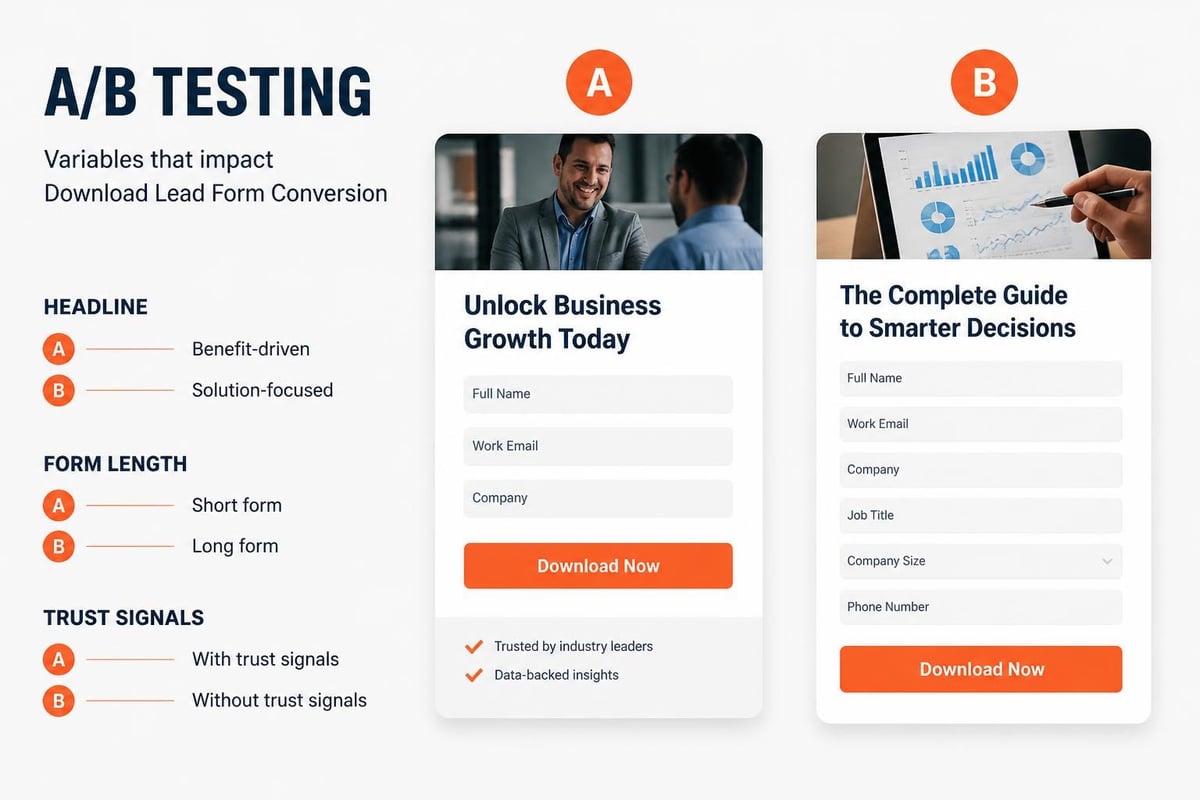
Visual design matters less than clarity and credibility. A simple, professional layout with clear typography typically outperforms elaborate designs with multiple colors, large images, or complex layouts. Focus attention on the content value and the form itself.
What Follow-Up Strategies Convert Download Leads to Customers?
Converting download leads to customers requires multi-channel nurturing that progresses prospects through awareness, consideration, and decision stages.
Most download leads are not immediately ready to purchase. The typical B2B buyer journey involves 7-13 touchpoints before conversion. Your follow-up strategy must provide continued value while gradually introducing commercial offers.
Multi-channel download lead nurture sequence:
- Email series – Educational content building on download topic
- Retargeting ads – Display ads showing related resources or product benefits
- Social media engagement – Connection requests from sales reps, relevant content sharing
- Direct outreach – Personalized emails or calls for high-scoring leads
- Webinar invitations – Live educational sessions with product demonstrations
- Customer story sharing – Case studies relevant to the lead's industry or use case
Segment your nurture sequences based on the downloaded content. Someone who downloaded "Introduction to CRM Systems" needs different follow-up than someone who downloaded "Advanced CRM Integration Strategies." The first is early-stage and requires education; the second shows technical sophistication and implementation intent.
Many businesses implementing CRM systems find that automated lead nurturing increases conversion rates by 50% or more compared to manual follow-up processes. Track engagement metrics for each touchpoint and adjust sequences based on response patterns.
Sales and Marketing Alignment
Download lead conversion requires clear handoff criteria between marketing and sales teams. Define which lead scores, behaviors, or characteristics trigger sales outreach versus continued marketing nurture.
Lead routing decision matrix:
- Hot leads (65+ points) – Immediate sales contact within 24 hours
- Warm leads (40-64 points) – Sales development rep qualification call within 3-5 days
- Cool leads (20-39 points) – Continued marketing nurture with quarterly sales check-in
- Cold leads (below 20) – Automated nurture only, monthly content offers
Implement service level agreements (SLAs) between teams. Marketing commits to delivering a specific quantity and quality of download leads. Sales commits to following up within defined timeframes and providing feedback on lead quality. Regular meetings review conversion metrics and identify optimization opportunities.
According to lead generation best practices, companies with strong marketing-sales alignment achieve 38% higher win rates and 36% higher customer retention rates.
How Do You Measure Download Lead Quality and ROI?
Download lead quality measurement focuses on conversion rates, sales velocity, customer acquisition cost, and lifetime value rather than volume alone.
Vanity metrics like total downloads or form submissions provide limited insight. Focus instead on metrics that indicate business impact and revenue contribution.
Essential download lead metrics:
- Form conversion rate – Percentage of landing page visitors who complete the form
- Lead-to-MQL rate – Percentage of download leads that become marketing qualified leads
- MQL-to-SQL rate – Percentage of MQLs that sales accepts and works
- SQL-to-customer rate – Percentage of sales-qualified leads that close
- Time to conversion – Average days from download to customer
- Customer acquisition cost (CAC) – Total program cost divided by customers acquired
- Lifetime value (LTV) – Average revenue per customer from this channel
- LTV:CAC ratio – Profitability indicator (target 3:1 or higher)
Track these metrics by content type, topic, and promotion channel. You may find that certain content pieces generate high volume but low quality, while others produce fewer leads with higher conversion rates. Optimize your investment toward high-performing assets.
Attribution and Multi-Touch Analysis
Download leads often interact with multiple touchpoints before converting. Implement attribution models that credit the download appropriately without over-crediting first-touch interactions.
| Attribution Model | How It Works | Best Use Case |
|---|---|---|
| First-touch | 100% credit to initial download | Understanding awareness drivers |
| Last-touch | 100% credit to final interaction | Identifying conversion triggers |
| Linear | Equal credit across all touchpoints | Balanced view of entire journey |
| Time-decay | More credit to recent interactions | When deals have long sales cycles |
| Position-based | 40% first, 40% last, 20% middle | Emphasizing awareness and conversion |
| Custom | Weighted based on your data | When you have sufficient historical data |
For businesses using management system software, tracking attribution across complex buyer journeys becomes more manageable with integrated reporting that connects marketing activities to closed revenue.
Calculate ROI by comparing the fully-loaded cost of your download lead program against the revenue it generates. Include content creation costs, design and development, advertising spend, marketing automation platform fees, and staff time. A lead generation case study for MF Freight demonstrated significant lead increases and reduced cost per acquisition through systematic optimization.
What Technology Stack Supports Download Lead Generation?
A complete download lead technology stack includes content management, form builders, marketing automation, CRM, and analytics platforms with proper integration between systems.
The core technology requirements vary based on volume, complexity, and existing infrastructure. Small businesses may start with basic tools, while enterprises need sophisticated platforms with advanced capabilities.
Essential technology components:
- Landing page builder – Create and test download lead landing pages without developer assistance
- Form platform – Design forms with conditional logic, progressive profiling, and spam protection
- Marketing automation – Deliver content, trigger nurture sequences, and score leads
- CRM system – Store contact records, track interactions, and manage sales follow-up
- Email service – Send delivery emails and nurture sequences at scale
- Analytics platform – Track form conversions, engagement metrics, and ROI
- Content delivery network – Host and deliver downloadable files quickly and reliably
Integration quality matters as much as individual tool capabilities. When a prospect submits a download lead form, data should flow automatically from the form to your CRM, trigger content delivery, update lead scoring, and initiate nurture sequences without manual intervention.
Many businesses find that unified platforms reduce integration complexity. Business solutions that combine CRM, marketing automation, and forms in a single system eliminate data sync issues and reduce total cost of ownership.
API Integration and Webhook Configuration
For custom technology stacks, APIs and webhooks enable real-time data synchronization between platforms. When evaluating tools, confirm they offer:
- RESTful APIs with comprehensive documentation
- Webhook support for real-time event notifications
- OAuth or API key authentication options
- Rate limit policies appropriate for your volume
- Error handling and retry logic
- Sandbox environments for testing
Custom software development enables precisely tailored download lead systems. One Brytend case study demonstrates how custom development can address unique workflow requirements that off-the-shelf solutions cannot accommodate.
Test integrations thoroughly before launching download campaigns at scale. Verify that data maps correctly between systems, all required fields transfer properly, and error conditions trigger appropriate alerts. Monitor integration performance continuously, as API changes or platform updates can break previously functional connections.
Effective download lead generation requires strategic content development, optimized forms, compliant data handling, and systematic nurture processes that move prospects toward purchase. By focusing on quality over volume and measuring true business impact rather than vanity metrics, businesses build sustainable lead generation systems that support long-term growth. Brytend specializes in developing custom software solutions that integrate download lead capture, CRM functionality, and automated nurture workflows tailored to your specific business requirements and technical environment.