A solutions business is a commercial model that delivers integrated products and services designed to solve specific customer problems rather than selling standalone products. This approach shifts focus from transactional sales to consultative engagement, where providers analyze client challenges and assemble tailored combinations of technology, expertise, and support. The solutions business model has become essential in B2B markets where customers demand outcomes rather than features.
TL;DR:
- A solutions business integrates products, services, and expertise to address specific customer problems
- Success requires deep customer discovery, consultative selling, and ongoing relationship management
- Revenue models shift from one-time sales to recurring service contracts and performance-based pricing
- Implementation demands organizational alignment across sales, delivery, and support teams
- Solutions providers achieve higher margins and customer retention than product-only competitors
What Is a Solutions Business Model
A solutions business model packages multiple products and services into integrated offerings that solve defined customer problems. Unlike traditional product sales, this model emphasizes customer outcomes and long-term relationships.
The core components include problem diagnosis, customized configuration, implementation support, and ongoing optimization. Providers must understand customer workflows, industry constraints, and success metrics before proposing solutions.
Core Characteristics of Solutions-Based Selling
Solutions businesses operate through consultative engagement rather than transactional sales. Sales teams act as advisors who invest time understanding client operations before recommending solutions.
Key differentiators include:
- Customer-centric discovery: Providers analyze workflows, pain points, and business objectives before proposing solutions
- Integrated delivery: Solutions combine hardware, software, services, and support as unified offerings
- Outcome-based pricing: Contracts align payment with results, performance metrics, or value delivered
- Long-term partnerships: Relationships extend beyond initial sale through maintenance, upgrades, and optimization
Revenue generation shifts from product margins to service fees, subscription models, and performance bonuses. This creates predictable recurring revenue streams and higher customer lifetime value.

Solutions vs. Product Sales Comparison
| Aspect | Product Sales | Solutions Business |
|---|---|---|
| Sales approach | Feature-focused | Problem-focused |
| Engagement duration | Single transaction | Ongoing relationship |
| Customization | Minimal | Extensive |
| Pricing model | Unit price | Value-based or outcome-based |
| Revenue pattern | One-time | Recurring |
| Customer knowledge required | Product specs | Deep operational understanding |
How to Transition to a Solutions Business Model
Transitioning from product sales to a solutions business requires organizational restructuring and capability development. Companies must realign sales processes, delivery methods, and support infrastructure.
The transformation begins with customer problem research. Teams must document common challenges, workflow inefficiencies, and unmet needs across target segments before designing integrated offerings.
Implementation Steps for Solutions Strategy
- Conduct customer discovery research: Interview existing clients to identify recurring problems, workflow gaps, and desired outcomes
- Map solution components: Inventory existing products, services, and partner capabilities that can address identified problems
- Design integrated offerings: Package components into repeatable solutions with clear value propositions and pricing structures
- Retrain sales teams: Shift from product knowledge to consultative selling, problem diagnosis, and business case development
- Establish delivery processes: Create implementation methodologies, project management frameworks, and quality assurance protocols
- Build support infrastructure: Develop ongoing account management, proactive monitoring, and continuous improvement processes
Each step requires executive sponsorship and cross-functional coordination. Sales, engineering, and support teams must collaborate throughout solution design and delivery.
When organizations need software development company expertise to build custom components that complete their solutions, partnering with specialized providers can accelerate time-to-market while maintaining quality.
Common Transition Challenges
Organizations face predictable obstacles when adopting solutions models. Sales teams resist longer sales cycles and complex selling processes. Engineering groups struggle balancing standard platforms with customization demands.
Critical challenges include:
- Sales compensation misalignment with longer sales cycles and team-based selling
- Product development tension between standardization and customization requirements
- Delivery capacity constraints during solution implementation and ongoing support
- Pricing complexity when bundling products, services, and performance guarantees
- Customer expectation management regarding timelines, scope, and responsibilities
Successful transitions address these systematically through pilot programs, iterative refinement, and measured scaling.
Why Businesses Adopt Solutions Models
Solutions business models deliver higher profitability and customer retention than product-only approaches. Customers pay premium prices for integrated offerings that solve complete problems rather than purchasing components separately.
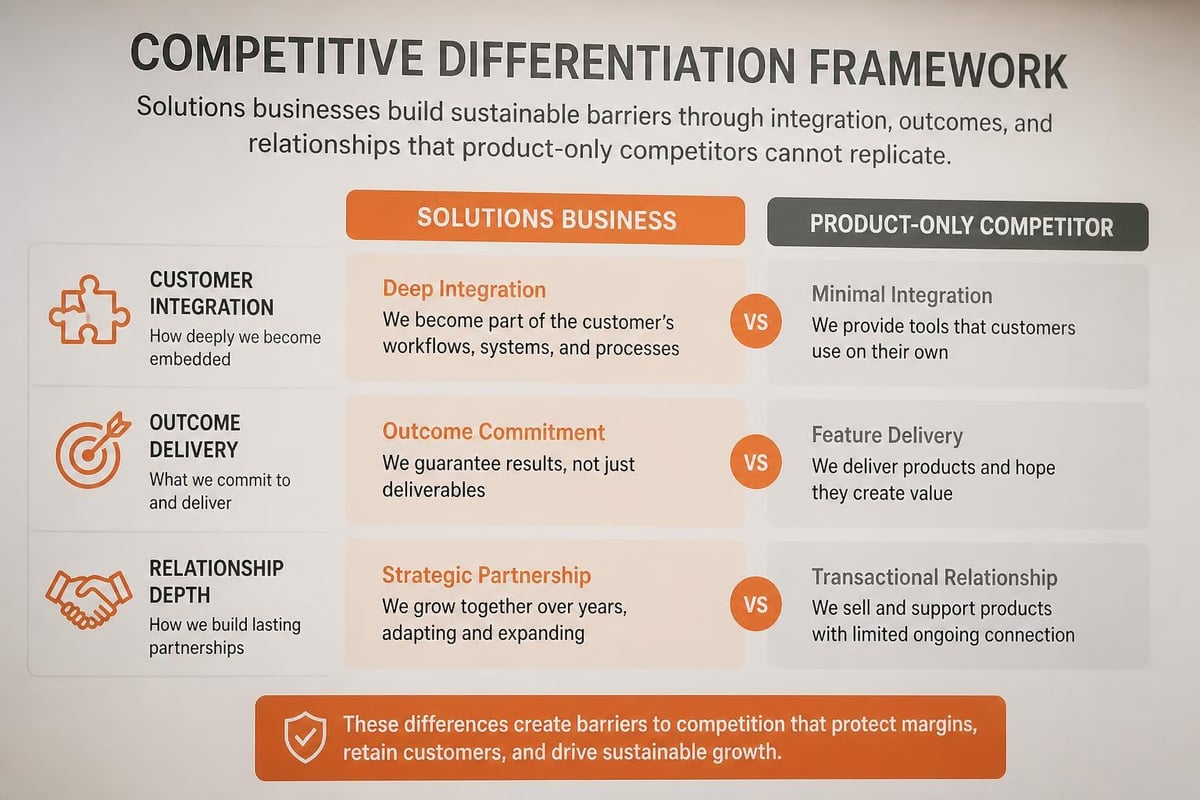
The model creates competitive barriers through deep customer integration. Once solutions providers embed into client operations, switching costs increase substantially.
Financial and Strategic Benefits
Solutions providers achieve 20-40% higher margins than comparable product vendors through value-based pricing and service revenue. Long-term contracts create revenue predictability and improve cash flow management.
Strategic advantages include:
- Reduced price competition: Solutions compete on value and outcomes rather than unit prices
- Higher customer retention: Integrated offerings create switching barriers and relationship dependencies
- Cross-selling opportunities: Deep customer relationships reveal additional problem areas and expansion possibilities
- Market differentiation: Solutions capabilities distinguish providers from commodity product vendors
Organizations using solution selling methodologies report 30-50% higher win rates in competitive situations compared to product-focused competitors.
Industry Applications and Use Cases
Solutions business models apply across industries where customers face complex, multi-faceted problems. Manufacturing, healthcare, financial services, and technology sectors show highest adoption rates.
Manufacturing example: Equipment manufacturers now provide predictive maintenance solutions combining sensors, analytics software, parts inventory, and technician services. Customers purchase uptime guarantees rather than individual components.
Financial advisory firms like Brookwood Investment Group LLC exemplify solutions thinking by integrating retirement planning, investment management, estate planning, and tax strategies into comprehensive wealth management solutions tailored to individual client goals.
Healthcare scenario: Medical device companies bundle hardware, software, training, compliance support, and consumables into complete department solutions. Contracts specify patient outcome improvements rather than equipment specifications.
Home technology providers such as ANR media deliver integrated audio-visual solutions from design consultation through installation and ongoing support, rather than selling individual components separately.
What Makes Solutions Businesses Successful
Successful solutions providers master customer problem discovery and solution design methodology. They invest heavily in understanding customer operations before proposing offerings.
Product discovery practices emphasize understanding underlying problems before designing features or solutions. This prevents premature convergence on suboptimal approaches.
Critical Success Factors
Organizations achieving solutions success share common capabilities and practices. They structure teams around customer outcomes rather than internal product lines.
Essential capabilities:
- Deep domain expertise: Teams understand customer industries, regulations, and operational realities
- Consultative selling skills: Sales professionals diagnose problems before recommending solutions
- Solution architecture ability: Technical teams design integrated offerings from multiple components
- Project delivery excellence: Implementation teams execute complex deployments on time and budget
- Proactive account management: Support teams monitor performance and drive continuous improvement
Measurement systems track customer outcomes and satisfaction metrics rather than only internal operational metrics. Performance reviews evaluate solution success and relationship health.
Customer Engagement Framework
Effective solutions businesses follow structured engagement processes that build trust and demonstrate expertise progressively. Initial conversations focus entirely on customer challenges rather than provider capabilities.
The engagement sequence includes:
- Discovery phase: Document current state, problems, costs, and desired outcomes through interviews and observation
- Analysis phase: Identify root causes, quantify impacts, and develop success criteria with customer stakeholders
- Design phase: Configure solution components, create implementation plan, and model expected outcomes
- Proposal phase: Present integrated solution with clear ROI business case and risk mitigation strategies
- Delivery phase: Execute implementation, train users, and validate outcome achievement
- Optimization phase: Monitor performance, identify improvement opportunities, and evolve solution over time
Each phase produces tangible deliverables that demonstrate value before customers commit to purchases.
How to Price Solutions Offerings
Solutions pricing models align payment with value delivery rather than cost-plus margins. Providers calculate prices based on customer outcomes, problem costs, and competitive alternatives.
Value-based pricing requires quantifying customer benefits in financial terms. Solutions must demonstrate measurable ROI through cost reduction, revenue increase, or risk mitigation.
Pricing Model Options
| Pricing Approach | Structure | Best For |
|---|---|---|
| Fixed project fee | One-time payment for complete solution delivery | Well-defined scope, limited ongoing support |
| Subscription model | Monthly or annual recurring fee for access and support | Software-intensive solutions, continuous value delivery |
| Performance-based | Payment tied to achieved outcomes or metrics | High-confidence solutions, measurable results |
| Tiered packages | Standard/premium/enterprise levels with feature differences | Scalable solutions, diverse customer segments |
| Hybrid model | Base fee plus usage or performance components | Complex solutions with variable utilization |
Custom software providers often combine fixed development fees with ongoing support subscriptions. This balances project funding with long-term relationship economics.
Pricing Strategy Development
Effective pricing starts with customer value quantification. Teams must calculate total cost of customer problems including direct expenses, opportunity costs, and risk exposure.
Pricing framework steps:
- Document all customer costs related to the problem being solved
- Estimate solution impact on revenues, costs, and risks using conservative assumptions
- Calculate net value delivered over 1-3 year timeframes
- Price solutions at 20-40% of total value delivered to ensure strong customer ROI
- Structure payment terms to align with customer cash flow and value realization timing
Solutions addressing compliance requirements or regulatory mandates can command premium pricing due to mandatory nature and penalty avoidance value.
What Organizational Changes Enable Solutions Success
Solutions business models require fundamental organizational restructuring beyond sales process changes. Companies must align compensation, reporting structures, and resource allocation with solution delivery.
Traditional product-centric organizations separate sales, development, and support functions with limited coordination. Solutions models demand integrated teams organized around customer segments or solution types.
Organizational Structure Adaptations
Successful solutions providers create cross-functional solution teams with P&L accountability. These teams include sales, engineering, delivery, and support members working toward shared customer outcome objectives.
Key structural changes:
- Solution-aligned teams: Organize around customer problems or industries rather than product lines
- Shared incentives: Compensate entire teams based on solution success and customer satisfaction
- Integrated planning: Coordinate product roadmaps, sales targets, and support capacity around solution needs
- Customer success roles: Create dedicated positions responsible for outcome achievement and relationship management
Technology infrastructure must support solution delivery through integrated CRM, project management, and support systems. Brytend specializes in building custom platforms that unify customer data, track solution performance, and enable proactive account management across the complete solution lifecycle.

Skills and Capability Development
Solutions selling requires different skills than product sales. Organizations must invest in training programs covering consultative selling, business case development, and solution design.
Technical teams need broader capabilities spanning multiple technologies and integration expertise. Support personnel require proactive problem-solving skills rather than reactive ticket resolution approaches.
Training priorities include:
- Consultative discovery and problem diagnosis techniques for sales teams
- Business financial analysis and ROI modeling for all customer-facing roles
- Solution architecture and systems integration for technical staff
- Project management and change management for delivery teams
- Relationship management and customer success practices for account teams
Ongoing skill development through certification programs, mentoring, and external training maintains competitive capabilities.
How to Measure Solutions Business Performance
Solutions businesses require different metrics than product companies. Success measures emphasize customer outcomes, relationship health, and long-term value creation over transactional volume metrics.
Leading indicators track solution pipeline health, customer engagement quality, and delivery execution. Lagging indicators measure financial performance, customer retention, and outcome achievement.
Key Performance Indicators Framework
Customer outcome metrics:
- Percentage of customers achieving defined success criteria
- Average time to value realization after solution implementation
- Customer-reported ROI and value delivered
- Problem resolution rate and recurrence prevention
Relationship health metrics:
- Net Promoter Score and customer satisfaction ratings
- Executive relationship depth and frequency of strategic discussions
- Contract renewal rate and expansion revenue percentage
- Customer reference willingness and advocacy activities
Business performance metrics:
- Solution revenue growth rate and mix percentage
- Average contract value and deal size trends
- Sales cycle length from discovery to contract signature
- Gross margin by solution type and customer segment
Organizations tracking these metrics can identify improvement opportunities and optimize solution offerings continuously.
Common Solutions Business Mistakes
Solutions providers frequently make predictable errors during model transition and scaling. Understanding these patterns enables proactive mitigation.
Frequent mistakes include:
- Over-customizing solutions creating unsustainable delivery costs and complexity
- Inadequate discovery leading to misaligned solutions and customer disappointment
- Underpricing value delivered due to cost-plus thinking instead of value-based pricing
- Insufficient delivery capacity causing implementation delays and quality problems
- Weak customer success processes failing to demonstrate ongoing value
Avoiding these requires disciplined processes, realistic resource planning, and continuous improvement based on customer feedback.
What Technologies Enable Solutions Delivery
Modern solutions businesses leverage technology platforms that integrate customer data, automate delivery processes, and enable proactive management. These systems provide visibility across the complete solution lifecycle.
Customer relationship management systems must track opportunities through extended sales cycles while documenting discovered problems and proposed solutions. Project management platforms coordinate implementation activities across internal teams and customer stakeholders.
Organizations managing equipment-based solutions benefit from serialized inventory tracking and automated service scheduling. The Brytend Service Module provides comprehensive service management capabilities including asset tracking, maintenance automation, and service documentation that supports solutions delivery at scale.
Integration and Automation Requirements
Solutions businesses require seamless data flow between sales, delivery, and support systems. Disconnected tools create information gaps that degrade customer experience and operational efficiency.
Critical integration points:
- CRM to project management for handoff from sales to delivery teams
- Service systems to customer portals for transparency and self-service
- Billing platforms to contract management for complex pricing model execution
- Performance monitoring to customer success dashboards for outcome tracking
Automation capabilities reduce manual coordination overhead and improve consistency. Workflow engines trigger activities based on contract milestones, service schedules, or performance thresholds.
Solutions providers increasingly rely on cloud platforms that enable scalable delivery and real-time collaboration with distributed customer teams.
How Solutions Models Create Competitive Advantage
Solutions business models create sustainable competitive advantages through customer integration depth and switching cost barriers. Once providers embed solutions into customer operations, displacement becomes difficult and expensive.
The solution business model offers complete ranges of products and services within specific domains, providing customers with comprehensive support that fragment product vendors cannot match.
Differentiation Strategies
Solutions providers differentiate through specialized expertise, proven methodologies, and outcome guarantees. Generic competitors struggle matching domain knowledge and delivery capabilities.
Competitive advantages:
- Industry-specific expertise and regulatory knowledge that generic providers lack
- Proprietary methodologies and frameworks that accelerate value delivery
- Outcome guarantees and performance commitments that demonstrate confidence
- Established partner ecosystems that expand solution breadth without internal investment
- Customer reference base proving solution effectiveness in similar situations
Organizations building custom technology components gain additional differentiation. Partners specializing in field service management software or other vertical applications can enhance solutions with purpose-built tools.
Market Positioning Approaches
Successful solutions providers occupy clear market positions aligned with specific customer segments or problem categories. Broad positioning dilutes expertise perception and complicates sales messaging.
Positioning options include vertical specialization (healthcare, manufacturing, financial services), horizontal process focus (customer service, supply chain, compliance), or outcome emphasis (cost reduction, revenue growth, risk mitigation).
Clear positioning enables targeted marketing, relevant case studies, and credible expertise demonstration. It also focuses product development and partnership strategies on highest-value opportunities.
Solutions business models deliver superior outcomes for both providers and customers by aligning incentives around problem-solving rather than product features. Success requires organizational transformation, capability development, and sustained commitment to customer outcome achievement.
When you need custom technology to complete your solutions offering or unify your delivery processes, Brytend provides the specialized software development expertise to build platforms tailored to your specific business model and customer requirements. Our team delivers ongoing support ensuring your solutions infrastructure scales reliably as your business grows.