

Customer feedback survey software is a digital platform that automates the creation, distribution, analysis, and reporting of customer satisfaction data across multiple touchpoints. Organizations use these systems to collect structured responses, measure sentiment, identify service gaps, and track performance metrics over time. The software replaces manual survey processes with automated workflows, real-time dashboards, and integration capabilities that connect feedback directly to operational systems.
TL;DR:
- Customer feedback survey software automates survey lifecycle from design through analysis and reporting
- Core capabilities include multi-channel distribution, conditional logic, sentiment analysis, and system integration
- Deployment options range from SaaS platforms to custom-built solutions with proprietary data handling
- Selection criteria include response rate optimization, data security compliance, and workflow automation depth
- Integration with CRM, ticketing, and analytics systems determines operational value
What Is Customer Feedback Survey Software
Customer feedback survey software is a specialized application that enables businesses to systematically collect, organize, and analyze customer opinions, satisfaction levels, and behavioral data. The software provides tools for questionnaire design, response collection, data visualization, and trend analysis.
Modern platforms support multiple survey methodologies including Net Promoter Score (NPS), Customer Satisfaction Score (CSAT), Customer Effort Score (CES), and custom rating scales. Users create surveys using drag-and-drop interfaces, apply conditional branching logic, and configure automated distribution rules based on customer actions or lifecycle stages.
Core Components and Architecture
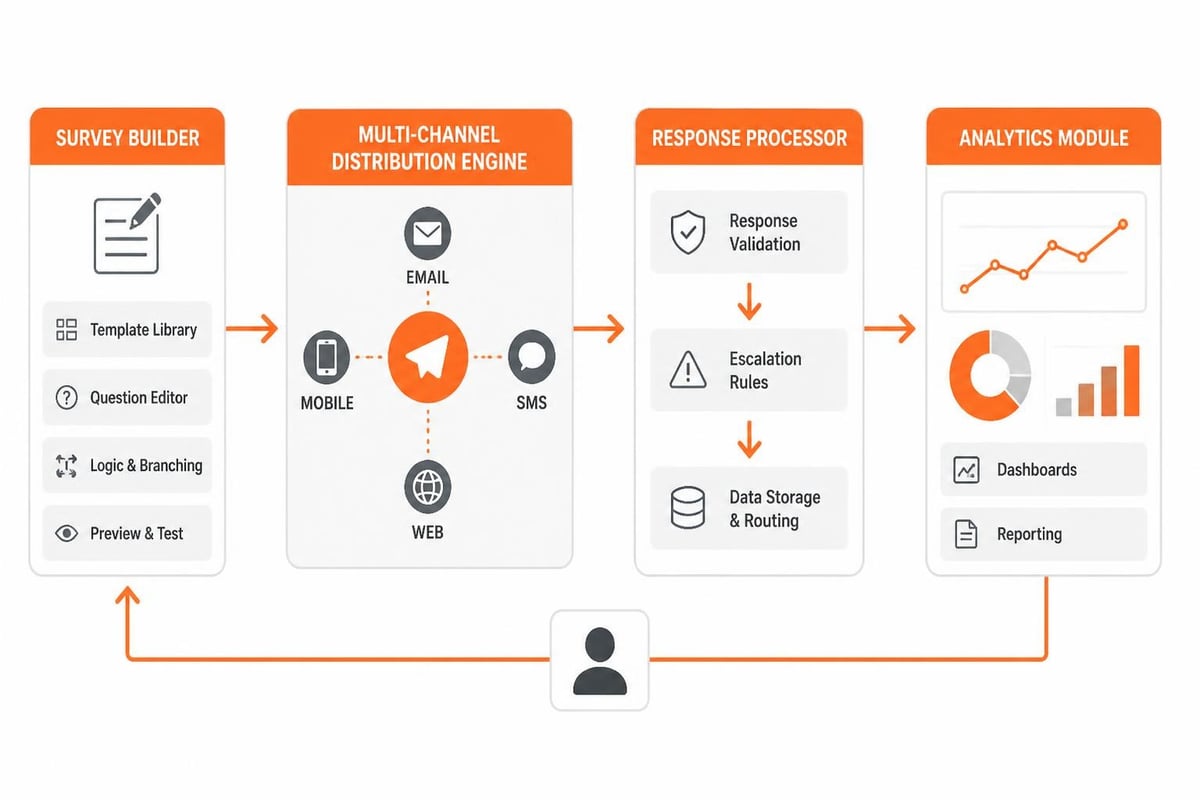
The typical system architecture includes four primary modules. The survey builder provides templates, question libraries, and design controls for branding consistency. The distribution engine manages multi-channel deployment across email, SMS, web intercepts, mobile apps, and QR codes. The response processor captures submissions, validates data, and applies routing rules for escalation or follow-up. The analytics module aggregates responses, calculates metrics, generates visualizations, and produces scheduled reports.
Enterprise implementations add advanced capabilities including role-based access control, multi-language support, custom API endpoints, and data warehouse connectors. Custom software development teams build proprietary solutions when off-the-shelf platforms cannot accommodate specific regulatory requirements, complex workflow integrations, or specialized data models.
How Does Customer Feedback Survey Software Work
Customer feedback survey software operates through a defined sequence of configuration, deployment, collection, and analysis phases. The workflow begins when a user designs a survey by selecting question types, defining logic paths, and configuring distribution parameters.
Survey Creation Workflow:
- Template Selection: Choose industry-specific templates or build from blank canvas
- Question Configuration: Add multiple-choice, rating scales, open-ended, or matrix questions
- Logic Application: Set display conditions, skip patterns, and branching rules based on previous answers
- Design Customization: Apply brand colors, logos, and custom CSS for white-label appearance
- Testing Protocol: Preview surveys across devices and validate logic paths before deployment
- Distribution Setup: Define trigger conditions, audience segments, and delivery channels
Once configured, the system monitors predefined triggers such as support ticket closure, purchase completion, or scheduled intervals. When trigger conditions are met, the distribution engine sends surveys through the designated channel with personalized merge fields and tracking parameters.
Response Collection and Processing
The platform captures responses in real-time, storing data in structured databases with timestamp, source channel, and respondent metadata. Validation rules check for completeness, detect spam patterns, and flag outlier responses for review.
For organizations handling sensitive customer data, the software applies encryption at rest and in transit, maintains audit logs of access events, and supports compliance frameworks including GDPR, CCPA, and HIPAA. Custom deployments allow on-premise hosting with air-gapped databases for regulated industries.
Automated workflows trigger actions based on response content. Low satisfaction scores generate support tickets, assign to account managers, or initiate retention workflows. Positive feedback routes to marketing teams for testimonial requests or case study development.
Why Use Customer Feedback Survey Software
Customer feedback survey software eliminates manual data collection processes that suffer from delayed insights, inconsistent methodologies, and limited scalability. Manual approaches using spreadsheets or paper forms require extensive administrative effort for distribution, consolidation, and analysis.
Automated systems provide measurable advantages:
- Response rate improvement: Automated timing and multi-channel delivery increase completion rates by 40-60% compared to one-time email requests
- Real-time visibility: Dashboards display current sentiment trends, emerging issues, and geographic patterns without data entry lag
- Operational integration: Direct connections to CRM, ERP, and service management systems close the loop between feedback and action
- Trend analysis: Historical data tracking reveals seasonal patterns, improvement trajectories, and correlation with business events
- Resource efficiency: One administrator can manage survey programs that would require dedicated staff using manual methods
Organizations in manufacturing, logistics, and industrial services use these platforms to track equipment performance feedback, service quality ratings, and training effectiveness. A chemical distribution company might deploy post-delivery surveys to capture handling procedure compliance, driver professionalism ratings, and delivery timing accuracy.
Business Impact Metrics
Survey best practices emphasize measurement frameworks that connect feedback data to operational outcomes. Key performance indicators include response rate (target: 15-25% for transactional surveys), completion rate (percentage who finish after starting), time-to-insight (hours between response and dashboard update), and action closure rate (percentage of flagged issues resolved).
| Metric Category | Manual Process | Automated Software |
|---|---|---|
| Average Response Time | 7-14 days | Real-time to 24 hours |
| Data Entry Accuracy | 85-92% | 99.5%+ |
| Distribution Cost per Survey | $2.50-$5.00 | $0.05-$0.25 |
| Analysis Time | 8-16 hours | Instant dashboards |
| Integration Capability | Manual export/import | API-driven automation |
What Features Define Quality Customer Feedback Survey Software
Quality customer feedback survey software must deliver specific technical capabilities that support enterprise-scale deployment, data integrity, and actionable insights. Feature evaluation should prioritize functionality that directly impacts response quality, analysis depth, and operational integration.
Essential Platform Capabilities
Advanced Question Logic: Conditional display rules, question piping (inserting previous answers into subsequent questions), quota management, and randomization for unbiased results. These features ensure respondents see relevant questions while maintaining survey brevity.
Multi-Channel Distribution: Native support for email embedding, SMS with link shortening, website pop-ups with exit intent, in-app notifications, QR code generation, and offline mode for field data collection. Channel-specific optimization adjusts formatting, question count, and interaction patterns.
Sentiment Analysis: Natural language processing algorithms analyze open-ended responses to categorize sentiment (positive, neutral, negative), extract key themes, and identify actionable phrases. Machine learning models improve accuracy as they process more organizational data.
Role-Based Access: Granular permissions control who can create surveys, view responses, export data, or modify system settings. Department-level isolation prevents cross-contamination of customer data across business units.
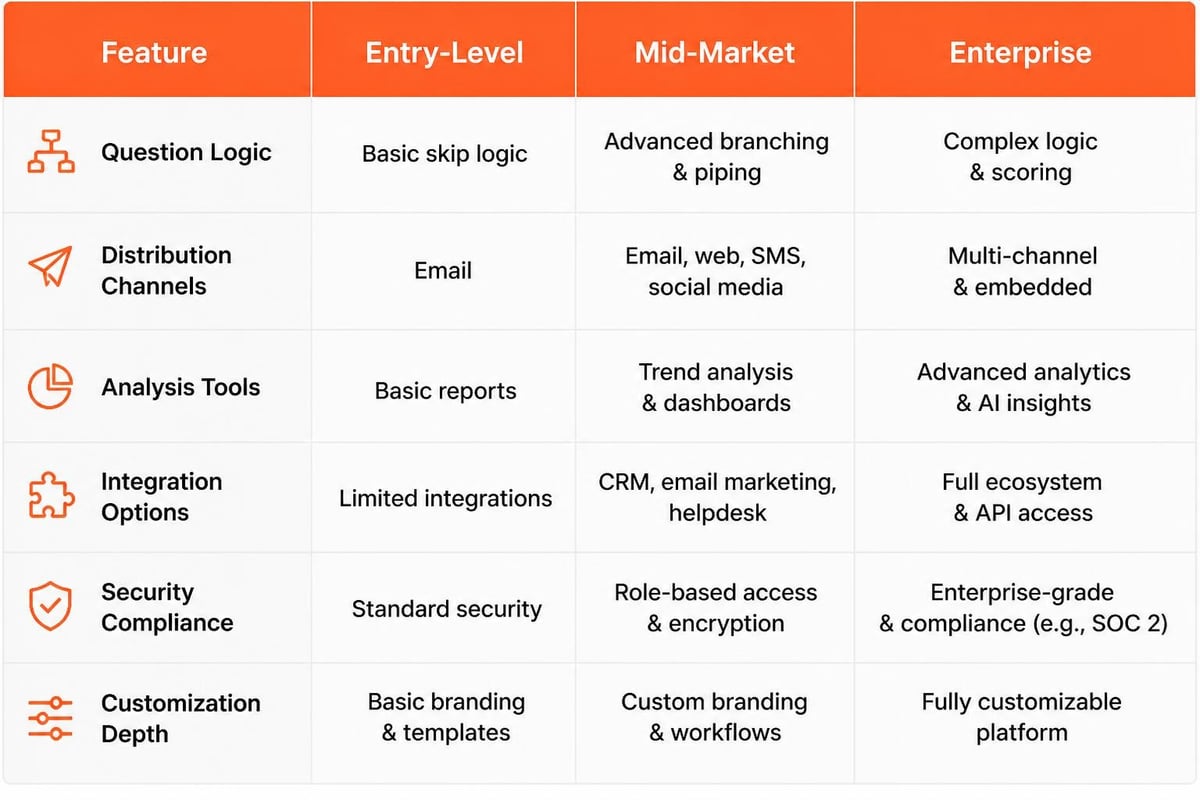
The best survey tools evaluated in 2025 demonstrate clear differentiation in integration capabilities, with enterprise platforms offering 50+ pre-built connectors versus basic tools limited to CSV export.
Brytend's custom software development expertise enables businesses to extend standard survey platforms or build proprietary solutions that integrate feedback collection directly into existing operational workflows, compliance systems, and customer data platforms.

Integration and Automation Requirements
Modern customer feedback survey software must connect bidirectionally with operational systems. CRM integration enables automatic survey triggering based on customer lifecycle events, two-way data sync for feedback history visibility, and closed-loop follow-up tracking.
Critical Integration Points:
- Ticketing Systems: Automatic ticket creation from negative feedback with priority assignment and routing rules
- Marketing Automation: Segment updates based on satisfaction scores, trigger nurture campaigns for promoters, re-engagement for detractors
- Business Intelligence: Data warehouse connections for cross-system analysis, custom report generation, executive dashboard population
- Product Management: Feature request aggregation, bug report correlation, roadmap prioritization inputs
API quality determines integration success. REST APIs with comprehensive documentation, webhook support for real-time notifications, rate limiting that accommodates high-volume operations, and authentication via OAuth 2.0 or API keys represent baseline requirements.
How to Select Customer Feedback Survey Software
Selecting customer feedback survey software requires structured evaluation of technical requirements, operational constraints, and growth projections. The selection process should involve stakeholders from customer service, marketing, IT, and data governance teams.
Evaluation Framework:
- Define Use Cases: Document specific survey types (transactional, relationship, product, event), expected volume (responses per month), and distribution channels required
- Assess Integration Needs: Map current technology stack and identify required data flows between systems
- Establish Security Requirements: Determine data residency needs, compliance frameworks, encryption standards, and access control models
- Calculate Total Cost: Include licensing, implementation services, training, ongoing support, and custom development estimates
- Evaluate Vendor Stability: Review customer feedback software market analysis for vendor financial health, product roadmap, and customer retention rates
- Test with Pilot: Run 30-60 day pilot with real surveys before enterprise-wide deployment
Deployment Model Comparison
Organizations choose between SaaS platforms, on-premise installations, or custom-built solutions based on control requirements, budget constraints, and technical capabilities.
| Deployment Model | Implementation Time | Customization Depth | Data Control | Ongoing Costs |
|---|---|---|---|---|
| SaaS Platform | 1-4 weeks | Limited to platform features | Vendor-managed | Monthly subscription |
| On-Premise Install | 2-6 months | Moderate via configuration | Full on-premise | Annual licensing + infrastructure |
| Custom Development | 3-9 months | Complete application control | Full ownership | Development + maintenance |
SaaS platforms suit organizations prioritizing rapid deployment and predictable costs. On-premise installations serve regulated industries requiring air-gapped systems. Custom development addresses unique workflow requirements that commercial platforms cannot accommodate.
What Are Common Implementation Challenges
Customer feedback survey software implementation fails when organizations underestimate change management requirements, data quality dependencies, and ongoing optimization needs. Common failure patterns emerge across industries and deployment scales.
Survey Fatigue and Response Decline: Over-surveying customers reduces response rates and data quality. Organizations sending more than one survey per customer per quarter typically see completion rates drop below 10%. Best practice limits transactional surveys to critical touchpoints and relationship surveys to semi-annual or annual cadence.
Question Design Errors: Poorly constructed questions yield unusable data. Leading questions bias responses ("How much do you love our service?"), double-barreled questions confuse respondents ("Rate our speed and accuracy"), and overly complex scales reduce reliability. Professional survey design applies validated question formats and pretesting protocols.
Integration Data Mismatch: Automated workflows break when customer records lack required fields for personalization or routing. A survey triggered by order completion fails if the order management system doesn't share customer email addresses or product SKUs with the survey platform.
Technical Obstacles and Solutions
Data Synchronization Delays: Real-time survey triggers depend on immediate data availability from source systems. Batch integration processes that run hourly or daily create survey timing problems. The solution requires event-driven architectures using webhooks or message queues that notify the survey system within seconds of trigger events.
Mobile Rendering Issues: Surveys designed on desktop interfaces often display incorrectly on mobile devices, causing abandonment. Responsive design testing across device types, operating systems, and email clients prevents rendering failures. Progressive disclosure techniques present one question per screen on mobile while showing multiple questions on desktop.
Analysis Paralysis: Dashboards displaying 50+ metrics overwhelm users and delay action. Effective implementations establish 5-7 primary KPIs aligned to business objectives, create role-specific dashboard views, and automate alert thresholds for outlier detection.
How to Optimize Survey Response Quality
Response quality optimization requires systematic attention to survey design, distribution timing, and follow-up processes. Customer service satisfaction surveys achieve higher quality when organizations implement tested methodologies rather than ad-hoc approaches.
Design Optimization Techniques:
- Question Count Reduction: Limit surveys to 5-8 questions for transactional feedback, 15-20 for relationship surveys. Each additional question reduces completion rate by 2-3%.
- Progressive Profiling: Collect different attributes across multiple survey interactions rather than requesting all information at once
- Mobile-First Layout: Design for smartphone screens first, then adapt to larger formats
- Clear Value Proposition: Explain how feedback drives improvements in opening text and follow-up communications
- Incentive Strategy: Use prize drawings, loyalty points, or charitable donations for long-form surveys while keeping transactional surveys incentive-free
Distribution Timing and Channel Selection
Survey timing dramatically affects response rates and sentiment bias. Post-purchase surveys sent within 24 hours capture immediate reaction but miss product performance issues. Surveys delayed 7-14 days allow product experience but suffer from memory decay and lower response rates.
Timing Guidelines by Survey Type:
- Service Interaction: 2-4 hours after ticket closure or service completion
- Product Purchase: 7 days for physical goods, 3 days for digital products
- Relationship Assessment: Mid-quarter to avoid end-of-period bias
- Event Feedback: Within 24 hours while experience remains salient
- Onboarding Success: 30, 60, and 90 days after customer activation
Channel selection depends on customer demographics and interaction context. B2B customers respond better to email surveys (18-25% response rate) than SMS (8-12%). Service technicians completing field work prefer mobile-optimized surveys with offline capability. Equipment operators favor QR codes on machinery that link to condition reporting forms.

What Role Does Analysis Play in Feedback Programs
Analysis transforms raw survey responses into operational insights that drive measurable business improvements. Effective analysis requires both automated pattern detection and human interpretation of context and nuance.
Multi-Level Analysis Framework:
Descriptive Analytics: Calculate basic statistics including mean scores, response distributions, completion rates, and trend lines. These metrics establish baseline performance and track changes over time.
Diagnostic Analytics: Identify correlations between survey responses and customer attributes, purchase behavior, or service history. Cross-tabulation reveals which customer segments report specific issues or satisfaction drivers.
Predictive Analytics: Apply regression models or machine learning algorithms to forecast churn probability, lifetime value changes, or future satisfaction trends based on current feedback patterns.
Prescriptive Analytics: Generate recommended actions based on response patterns, such as account manager assignment for at-risk customers or product team notification for recurring feature requests.
Converting Feedback to Action
The practical approach to converting customer survey feedback into software improvements emphasizes structured workflows that link feedback data directly to development backlogs, testing protocols, and release notes.
Action conversion requires clear ownership assignment and status tracking. When a customer reports slow mobile app performance, the feedback should generate a ticket in the development tracking system, assign to the mobile team, link to the original survey response for context, and trigger follow-up communication when resolved.
Case Example: An industrial equipment manufacturer implemented customer feedback survey software to track service quality across 200 field technicians. The system triggered post-service surveys within 4 hours of work order closure. Analysis revealed technician certification level correlated with satisfaction scores (certified technicians: 4.6/5.0, non-certified: 3.8/5.0). The company revised training requirements, reducing customer complaints by 34% within six months and increasing repeat service requests by 28%.
How Do Custom Solutions Compare to Commercial Platforms
Organizations must evaluate whether commercial customer feedback survey software meets requirements or whether custom development delivers better long-term value. The decision depends on integration complexity, workflow uniqueness, and data sensitivity.
Commercial platforms provide faster deployment, established feature sets, and vendor support. They suit organizations with standard feedback requirements that align with common survey methodologies. Subscription pricing spreads costs over time and includes platform updates.
Custom solutions offer complete control over data models, workflow logic, and user interfaces. They accommodate unique requirements that commercial platforms cannot support through configuration alone. Development teams build exactly the needed functionality without licensing unused features.
Scenarios Favoring Custom Development:
- Survey workflows that integrate with proprietary manufacturing execution systems, quality management systems, or compliance tracking platforms
- Regulatory requirements mandating on-premise deployment with specific security controls unavailable in commercial products
- Complex conditional logic that exceeds commercial platform capabilities, such as surveys that adapt based on real-time equipment sensor data
- Organizations requiring survey functionality embedded within existing customer portals or mobile applications with seamless user experience
Research on the life cycle of user feedback in software development demonstrates that organizations treating feedback as a continuous process rather than periodic activity achieve 2.3x higher customer retention and 1.8x faster issue resolution.
Brytend specializes in building custom software solutions that integrate feedback collection directly into operational workflows, ensuring survey data flows seamlessly into existing business systems without manual intervention or data transformation overhead.
What Security and Compliance Standards Matter
Customer feedback survey software handles personally identifiable information (PII), satisfaction ratings that could indicate contract risk, and proprietary business intelligence. Security architecture and compliance certification directly impact vendor suitability.
Required Security Controls:
- Encryption: TLS 1.2+ for data in transit, AES-256 for data at rest
- Access Management: Single sign-on (SSO) support, multi-factor authentication, session timeout controls
- Data Isolation: Logical separation between customers in multi-tenant SaaS architectures
- Audit Logging: Immutable logs of data access, export events, and configuration changes
- Backup and Recovery: Automated backups with tested restore procedures, geographic redundancy
Compliance frameworks vary by industry and geography. Healthcare organizations require HIPAA compliance with business associate agreements. European customers mandate GDPR compliance including right-to-erasure, data portability, and explicit consent tracking. Financial services need SOC 2 Type II attestation and may require industry-specific certifications.
Data Retention and Privacy Controls
Survey platforms must support configurable retention policies that automatically delete response data after specified periods. Anonymous survey options prevent collection of identifying information when attribution isn't required.
Privacy-by-design principles include minimizing data collection to survey-relevant fields, obtaining explicit consent before distribution, providing opt-out mechanisms in every communication, and honoring do-not-contact preferences across all channels.
Challenges in incorporating customer feedback within large-scale continuous software development highlight validation needs and collaboration requirements between development teams and customer-facing functions to ensure feedback drives meaningful improvements while respecting privacy boundaries.
Customer feedback survey software transforms passive data collection into active insight generation that drives measurable operational improvements across service quality, product development, and customer retention. Organizations that systematically collect, analyze, and act on customer feedback outperform competitors in satisfaction metrics and long-term revenue growth. Brytend builds custom software solutions that embed feedback mechanisms directly into your operational workflows, ensuring customer insights drive continuous improvement across your organization.