TL;DR
- Prospects are qualified leads that demonstrate clear buying intent, budget authority, and alignment with your solution
- Effective prospecting requires systematic lead scoring, engagement tracking, and multi-touch verification workflows
- CRM systems automate prospect qualification through behavioral tracking, predictive scoring, and workflow triggers
- The conversion from lead to prospect typically involves 5-7 touchpoints and explicit qualification criteria
- Organizations that define clear prospect criteria achieve 24-38% higher conversion rates than those using inconsistent methods
A prospect is a qualified lead who has demonstrated genuine purchase intent, possesses budget authority or influence, and meets specific criteria indicating they are likely to become a customer within a defined timeframe.
What Defines a Qualified Prospect in B2B Sales
A prospect is different from a raw lead because specific signs show they are ready to start buying. Understanding sales prospecting begins with establishing clear boundaries between information gatherers and genuine opportunities.
Qualified prospects exhibit three core characteristics that distinguish them from general leads:
- Budget authority: Direct control or significant influence over purchasing decisions within their organization
- Verified need: Documented pain points or requirements that align with your solution capabilities
- Timeline commitment: Defined implementation window or decision deadline within the next 3-12 months
Qualification goes deeper than showing interest. A prospect must have access to necessary resources, including technical infrastructure, stakeholder alignment, and implementation capacity. Organizations frequently encounter individuals who express interest but lack authority to move forward. These contacts remain leads until qualification criteria are met.

Distinguishing Leads from Prospects
The difference between leads and prospects centers on qualification depth and engagement level. A lead represents any contact who has shown initial interest through form submission, content download, or inquiry. A prospect has undergone systematic evaluation and met specific thresholds.
| Criteria | Lead | Prospect |
|---|---|---|
| Qualification Status | Unverified interest | Validated fit and need |
| Budget Information | Unknown | Confirmed or estimated |
| Engagement Level | Single touchpoint | Multiple interactions |
| Timeline | Unspecified | Defined decision window |
| Authority | Unverified role | Confirmed decision influence |
Custom software development projects require particularly rigorous prospect qualification because implementation timelines extend 3-18 months and involve significant technical coordination. A manufacturing director downloading a whitepaper on inventory management remains a lead. That same director becomes a prospect after confirming a Q3 2026 implementation target, $150K budget allocation, and authority to select vendors.
How to Identify High-Quality Prospects Systematically
Systematic prospect identification relies on defined scoring models that assign point values to behavioral signals and firmographic attributes. Sales prospecting strategies emphasize repeatable processes over ad-hoc evaluation.
Implement a multi-dimensional scoring framework:
- Firmographic scoring: Company size, industry vertical, revenue range, technology stack, and growth indicators
- Behavioral scoring: Website visits, content engagement, email responses, demo requests, and feature inquiries
- Engagement recency: Interaction frequency within the past 7, 14, and 30 days
- Authority indicators: Job title, department, organizational chart position, and budget responsibility signals
A prospect scoring threshold of 75+ points (on a 100-point scale) typically indicates qualification readiness. Points accumulate through verified actions. Viewing a pricing page adds 8 points. Requesting a technical architecture consultation adds 25 points. Confirming budget allocation adds 30 points.
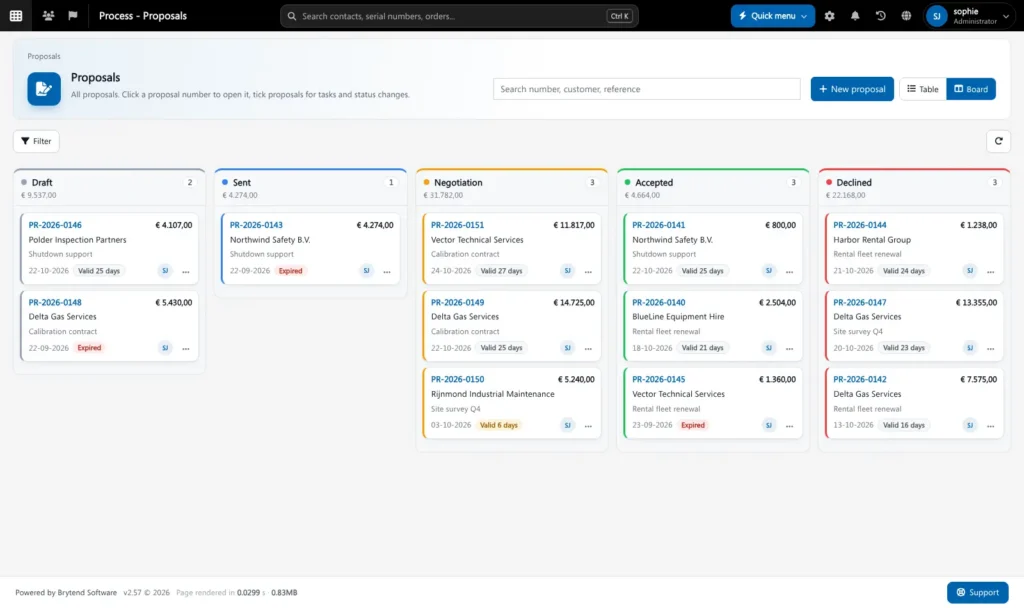
The Brytend CRM enables automated prospect scoring through customizable rules that track engagement patterns, assign point values, and trigger notifications when contacts cross qualification thresholds. Organizations can define industry-specific criteria and adjust scoring weights based on conversion data.

Behavioral Signals That Indicate Prospect Readiness
What people do tells you more about purchase intent than demographic data. Prospects tend to research intensively in a short period.
Watch for these high-intent behaviors:
- Repeat visits to pricing, implementation, or technical documentation pages within 72 hours
- Multiple stakeholders from the same organization engaging with content simultaneously
- Specific feature comparison questions that reference competing solutions
- Requests for custom demonstrations or proof-of-concept proposals
- Downloads of technical specifications, API documentation, or integration guides
A manufacturing operations manager who visits service management content once monthly remains a lead. When that manager visits 12 pages across three sessions in one week, downloads a service workflow template, and emails questions about serialized inventory tracking, they transition to prospect status.
What Steps Convert Leads into Qualified Prospects
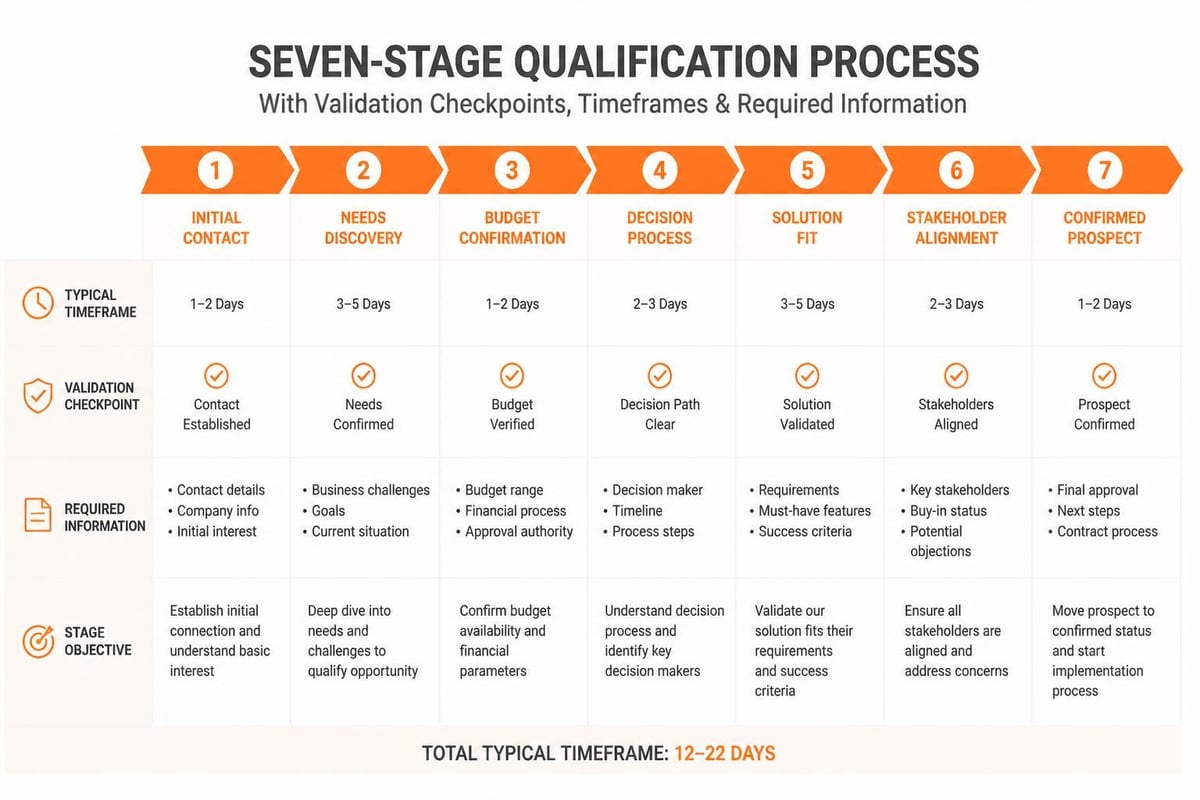
Turning a lead into a prospect means moving through set qualification stages. Each stage confirms specific information and moves the contact closer to a real opportunity.
Follow this seven-step qualification workflow:
- Initial contact response: Acknowledge inquiry within 2 hours and confirm basic information
- Discovery call scheduling: Secure 15-30 minute conversation to understand requirements
- Need validation: Document specific pain points, current solutions, and desired outcomes
- Budget discussion: Confirm investment range and funding approval process
- Timeline establishment: Define decision milestones, implementation start date, and go-live target
- Stakeholder mapping: Identify all decision participants and their roles
- Qualification confirmation: Verify all criteria are met before prospect designation
This progression typically spans 14-45 days depending on solution complexity and organizational decision processes. Custom software projects with $200K+ budgets require longer qualification periods than standardized solutions.
Documentation Requirements for Prospect Status
Consistent documentation keeps every sales team using the same standard and makes forecasts more accurate. Each prospect record must contain verified information in standardized fields.
Required documentation elements include:
- Primary contact name, title, email, phone, and direct authority level
- Company details: size, revenue, industry, locations, and relevant technology stack
- Pain points: specific problems requiring solution with business impact quantification
- Budget range: confirmed or estimated investment capacity with approval timeline
- Decision process: steps required, stakeholders involved, and typical duration
- Competition: alternative solutions under consideration or currently deployed
- Timeline: key dates for evaluation, decision, contracting, and implementation
Missing information in any category indicates incomplete qualification. Organizations implementing prospect qualification standards report 31% shorter sales cycles due to reduced discovery redundancy and more accurate resource allocation.
Why Prospect Qualification Determines Sales Efficiency
How well you qualify prospects affects where your team spends its time, how accurate forecasts are, and how predictable revenue is. Sales teams that advance unqualified leads waste 40-60% of selling time on contacts unlikely to convert.
Effective qualification delivers measurable business outcomes:
- Improved conversion rates: Qualified prospects convert at 15-25% versus 2-5% for unqualified leads
- Shorter sales cycles: Focused effort on ready buyers reduces average cycle time by 20-35%
- Better forecast accuracy: Pipeline based on qualified prospects achieves 85%+ forecast reliability
- Optimized resource allocation: Sales effort concentrates on high-probability opportunities
- Higher average deal value: Qualified prospects with confirmed budgets close at 18-30% higher values
A software development team evaluating ten unqualified leads might schedule five discovery calls, conduct three demonstrations, and close zero deals. The same team evaluating ten qualified prospects schedules eight calls, conducts six demonstrations, and closes two deals. The prospect-focused approach yields 200% better results with 20% less total effort.
Cost Impact of Poor Qualification
Chasing unqualified leads wastes effort across the whole sales team. Every hour spent on one is an hour not spent on a real prospect.
Typical cost breakdown per unqualified lead pursued to final proposal:
| Activity | Time Investment | Opportunity Cost |
|---|---|---|
| Discovery calls | 2-3 hours | $150-300 |
| Demonstration preparation | 3-4 hours | $200-400 |
| Custom proposal development | 5-8 hours | $400-800 |
| Follow-up communications | 2-4 hours | $150-350 |
| Technical consultation | 4-6 hours | $350-650 |
| Total per unqualified lead | 16-25 hours | $1,250-2,500 |
Organizations pursuing 50 unqualified leads annually waste $62,500-$125,000 in direct opportunity cost. This calculation excludes morale impact, forecast inaccuracy, and delayed revenue from missed genuine prospects.
How CRM Systems Automate Prospect Management
A CRM turns manual qualification into automated workflows that scale. Modern CRM systems track engagement, apply scoring rules, and trigger qualification actions without human intervention.
Core CRM automation capabilities for prospect management include:
- Behavioral tracking: Automatic capture of website visits, email opens, content downloads, and event attendance
- Lead scoring: Real-time point calculation based on configurable rules and machine learning models
- Workflow triggers: Automated task creation, email sequences, and notification delivery when score thresholds are met
- Data enrichment: Automatic population of firmographic data from third-party sources
- Multi-touch attribution: Tracking which interactions contributed to qualification and conversion
Organizations using automated prospect management reduce time-to-qualification by 45-60% compared to manual methods. Automation applies the same criteria every time, so results don’t depend on who on the team looked at the lead.
Integration Requirements for Effective Prospect Tracking
Prospect management systems require integration with multiple data sources to maintain accurate, current information. A CRM on its own misses the behavior data you need to qualify reliably.
Essential integration points include:
- Website analytics platforms for page view, session duration, and navigation pattern tracking
- Marketing automation systems for email engagement, campaign responses, and content interaction data
- Calendar and communication tools for meeting scheduling, call logging, and correspondence tracking
- Financial systems for deal value, payment history, and credit status information
- Support ticketing platforms for issue frequency, resolution time, and satisfaction scores
A manufacturing prospect researching service management solutions generates signals across multiple systems. Website analytics shows pricing page visits. Marketing automation tracks service workflow template downloads. Calendar integration logs discovery call scheduling. Brytend custom integrations unify these signals into a single prospect view that enables accurate qualification decisions.
17 questions · 3 minutes
Is Brytend right for your business?
Answer 17 quick questions. See how Brytend solves each problem, and finish with your own Brytend plan.
Question 1 of 17 · Microsoft 365 and CRM
Want to keep Outlook for email, tasks, notes and calendar, without copying anything by hand?
Keep working the way you already do. Brytend does the filing for you.
Brytend solves this
Your Microsoft 365 tenant, synced into one CRM
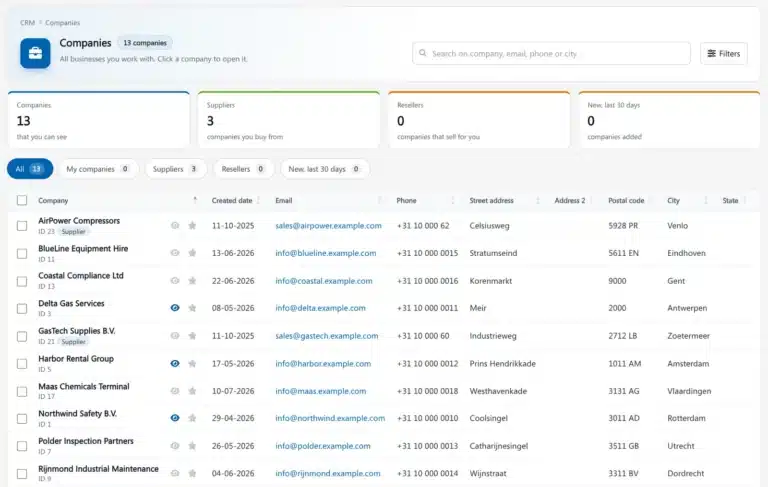
Brytend connects to your Office 365 tenant and syncs email, notes, calendar and SharePoint into the CRM, so every customer conversation sits in one place.
- Email, calendar, notes and SharePoint in one CRM
- Outlook add-in to file mail with one click
- Sales activity shows who talks to which customer
Modules
- Copy-pasting emails
- Calendars out of sync
- Files in five places
- Microsoft 365
- Outlook
- SharePoint
Question 2 of 17 · Quote to cash
Are you still typing quotes in Word and retyping them as invoices?
Every retype is another chance for a wrong price or a missed order.
Brytend solves this
From quote to cash in one flow
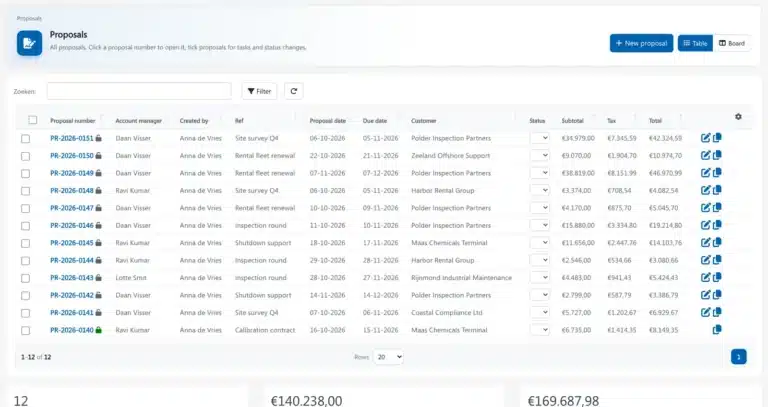
Build a quote from your price list, turn it into an order with one click and invoice it without retyping a thing. Finance shows what is open, overdue and paid.
- Quotes, orders and invoices from one record
- E-invoicing with Peppol and bank payments
- Open and overdue amounts at a glance
Modules
- Word templates
- Double data entry
- Invoices sent late
- Peppol e-invoicing
- Bank payments
Question 3 of 17 · Finance
Do you only see your cash position when the accountant sends the numbers?
By then it is too late to act on late payers or rising costs.
Brytend solves this
Live finance, linked to every invoice
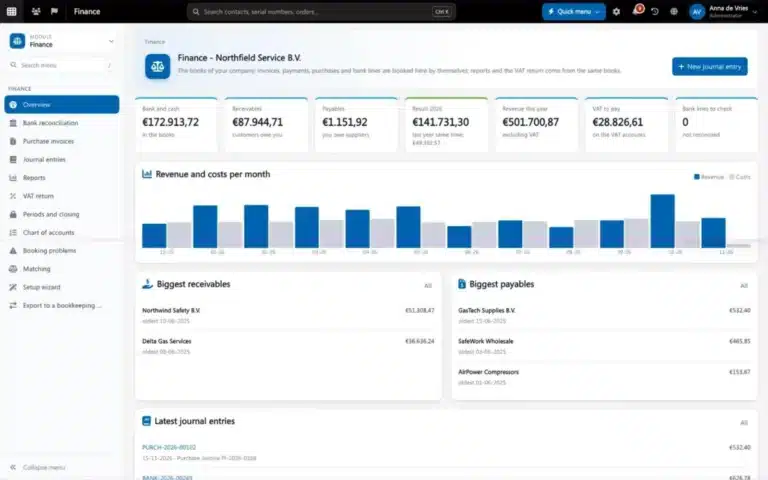
Finance shows cash, open items and results as they happen, with bank transactions and VAT next to the invoices they belong to.
- Cash, open and overdue items, live
- Bank transactions matched to invoices
- VAT overview ready for your return
Modules
- Numbers a month late
- Bank in another tool
- VAT stress
- Bank payments
- Peppol e-invoicing
Question 4 of 17 · Service and inspections
Do you still register customer devices in Excel or your own Access database?
Serial numbers, service dates and certificates deserve better than a spreadsheet.
Brytend solves this
Every customer device, its history and its next service date
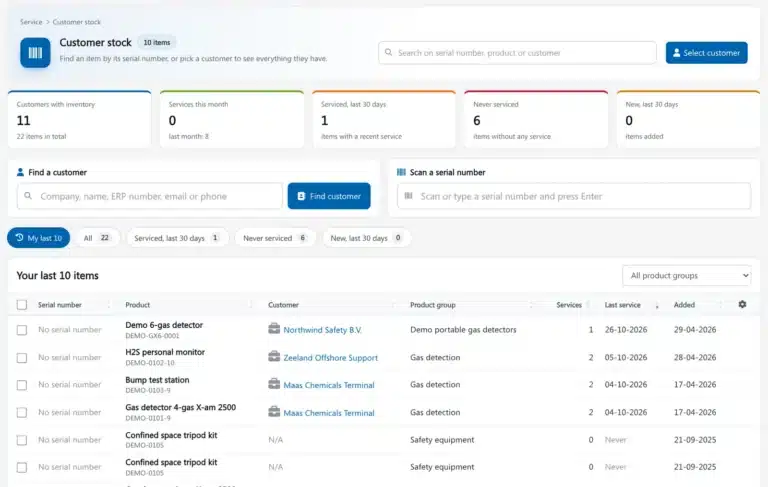
The Service module keeps the installed base per customer: serial numbers, inspections, calibrations and certificates. Plan visits, report on site and never miss a due date.
- Installed base per customer, with full history
- Inspections and certificates from the field
- Due dates planned automatically
Modules
- Excel sheets
- Home-made Access database
- Missed service dates
Question 5 of 17 · Gas testing and cylinders
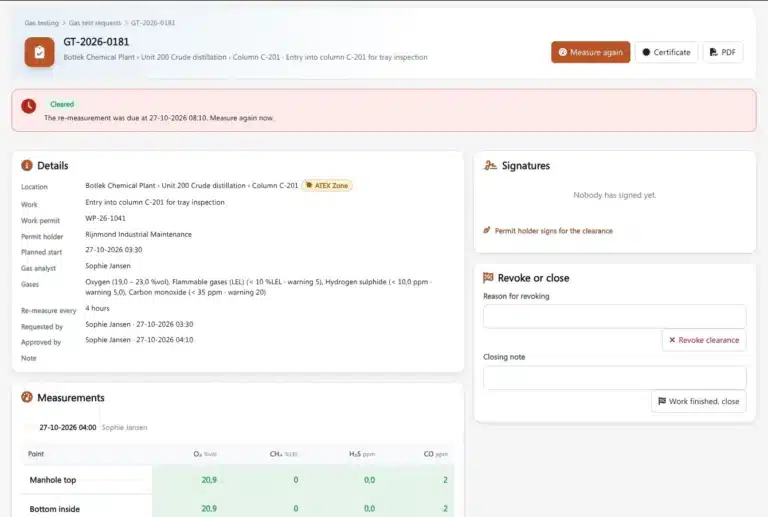
Are gas test requests and clearances still done on paper or by phone?
A lost permit or an untested space is a safety risk you cannot afford.
Brytend solves this
Gas tests and cylinders, safe and on record
Request a gas test, let the tester record the readings on the phone and issue the clearance in one flow. Gas cylinder tracking shows where every cylinder is and when it is due.
- Test requests and clearances in one flow
- Readings recorded on the phone
- Every gas cylinder tracked by location
Modules
- Paper permits
- Requests by phone
- Cylinders gone missing
Question 6 of 17 · Rental
Do you plan rental equipment on a whiteboard and hope nothing is double-booked?
Double bookings and missed returns cost money and customers.
Brytend solves this
Rental planning that never double-books
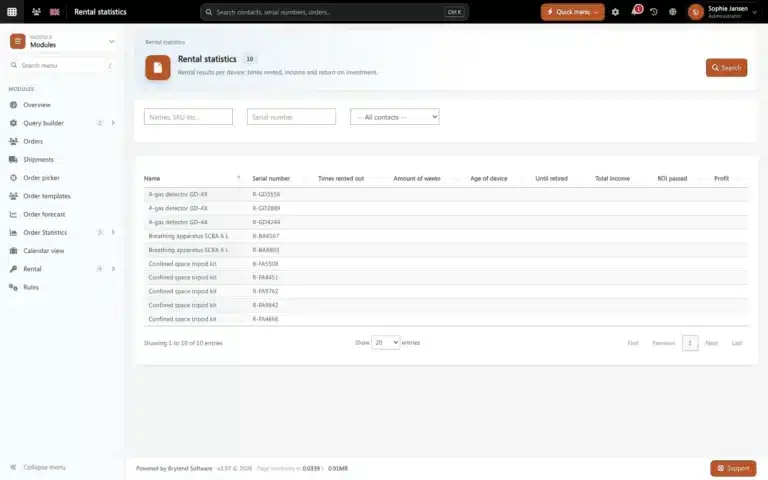
See which equipment is available, reserved or out, book it in a few clicks and invoice the rental period automatically.
- Availability per item at a glance
- Bookings, pick-up and returns
- Rental invoices without retyping
Modules
- Whiteboard planning
- Double bookings
- Late returns
Question 7 of 17 · Loan out
Do you lend demo units or replacement devices and lose track of who has them?
Loan units that never come back are pure loss.
Brytend solves this
A loan desk that knows where every unit is
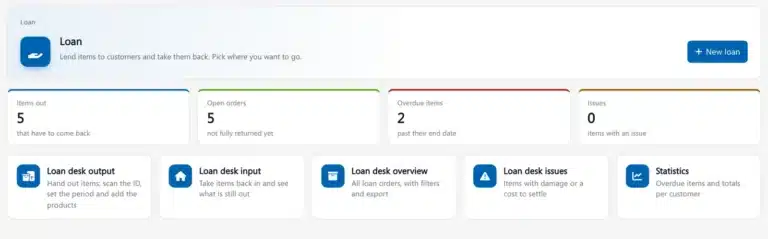
Lend out demo units, replacement devices and tools with a return date. The loan desk is part of the Rental and loans module: it reminds you before a loan is due and shows what is still out.
- Every loan with customer and return date
- Reminders before the due date
- Overview of everything that is still out
- Who has it?
- No return date
- Lost loan units
Question 8 of 17 · After sales
Do you only hear that a customer is unhappy when they leave?
Feedback after every job keeps customers coming back.
Brytend solves this
Feedback and follow-up after every job
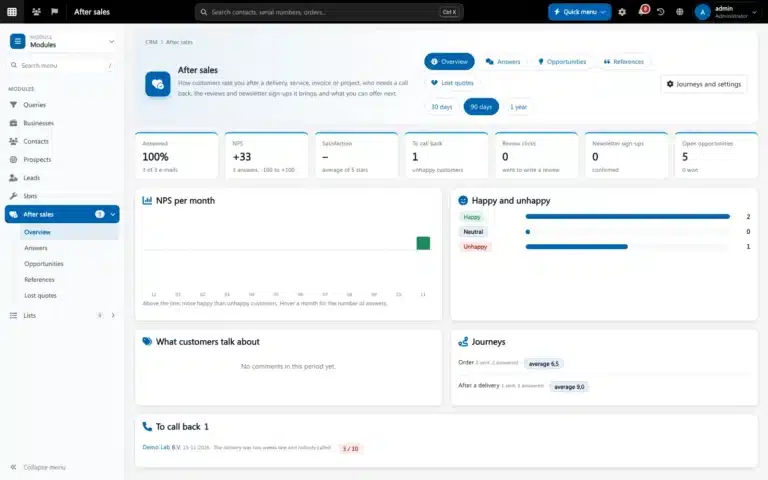
After sales sends a short survey after each delivery or service job, tracks NPS and turns follow-ups into tasks for your team.
- NPS and feedback after each job
- Follow-ups as tasks
- Spot unhappy customers early
Modules
- No feedback
- Silent churn
- Missed upsell
Question 9 of 17 · Stock and warehouse
Are you never quite sure what is on the shelf until someone counts it?
Stock-outs and surprise counts cost you sales and time.
Brytend solves this
Live stock across every warehouse
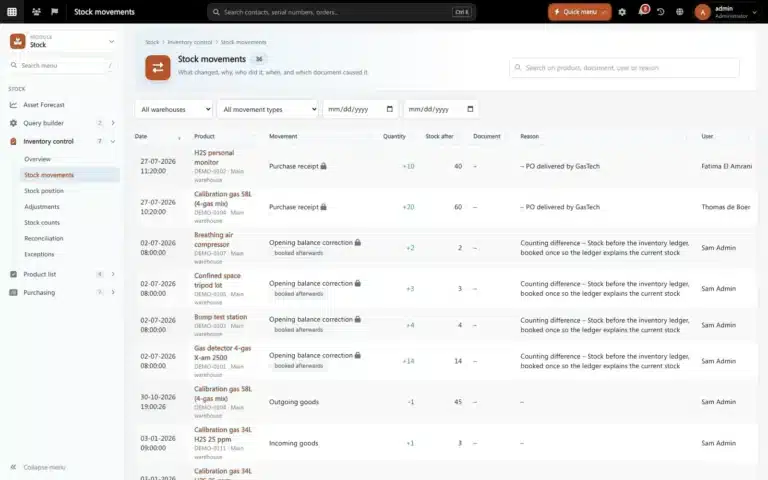
See stock, value and movements per warehouse in real time. Count with your phone and move stock between locations.
- Stock and value per warehouse, live
- Counts and stock movements on your phone
- Reorder before you run out
Modules
- Counting on paper
- Stock-outs
- Unknown stock value
Question 10 of 17 · Logistics
Are deliveries and shipments planned with spreadsheets and phone calls?
Every call to ask where something is costs time on both sides.
Brytend solves this
Operations and logistics in one control centre
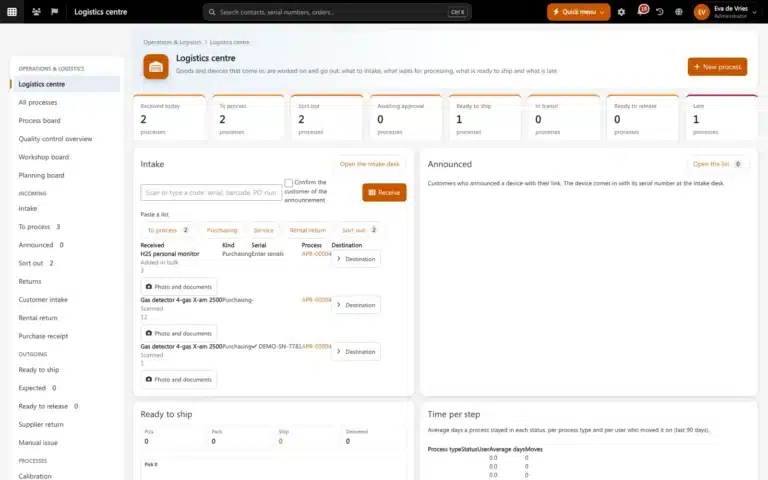
Plan intake, processing and shipments in one logistics centre, with carriers connected and status visible to your team.
- Intake, process and shipment steps
- Shipping carriers connected
- Live status for every order
Modules
- Spreadsheet planning
- Where is my order?
- Manual labels
Question 11 of 17 · Quality and compliance
Are your procedures spread over folders, and is every audit a scramble?
An old version in circulation is an auditor's favourite finding.
Brytend solves this
Controlled documents, ready for any audit
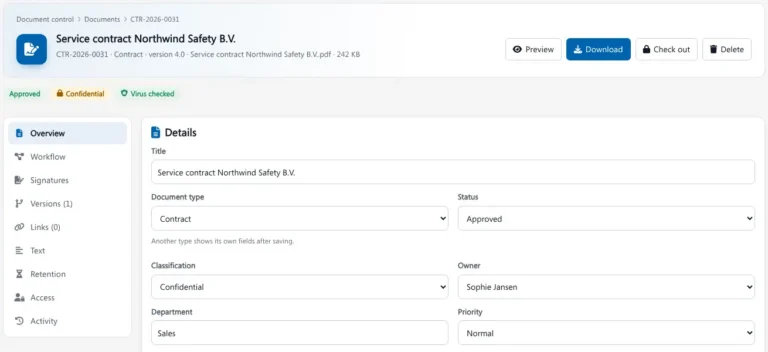
Document control gives every procedure one current version, an approval workflow and a full audit trail, with role-based access to who can see and sign what.
- Versions and approval workflows
- Full audit trail on every change
- Role-based access and two-factor sign-in
Modules
- Outdated versions
- Approvals by email
- Audit stress
Question 12 of 17 · Projects and tasks
Do your projects live in spreadsheets while to-dos get lost in email?
When nobody sees the whole plan, deadlines slip quietly.
Brytend solves this
Plans, tasks and deadlines everyone can see
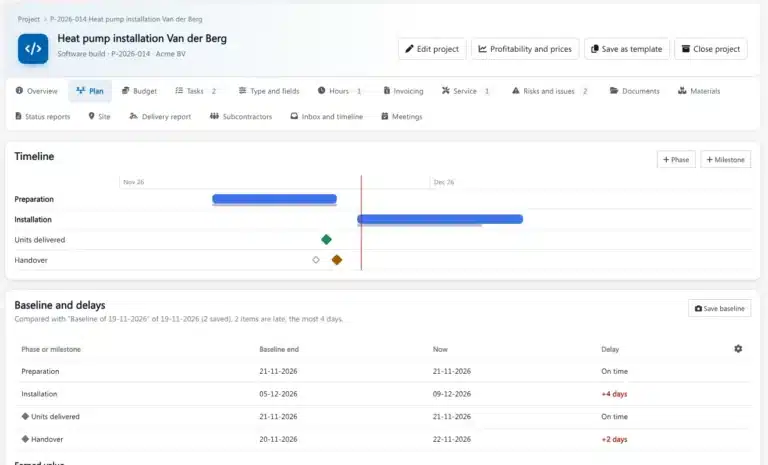
Plan projects on a timeline, assign tasks to people and see what is due today. Everything links back to the customer, quote or service job it belongs to.
- Project plans with milestones
- Tasks with owners and due dates
- Linked to customers, orders and jobs
Modules
- Spreadsheet plans
- Lost to-dos
- Missed deadlines
Question 13 of 17 · HR and intranet
Are leave requests sent by email, and does company news get lost in the inbox?
HR admin should not eat up your week.
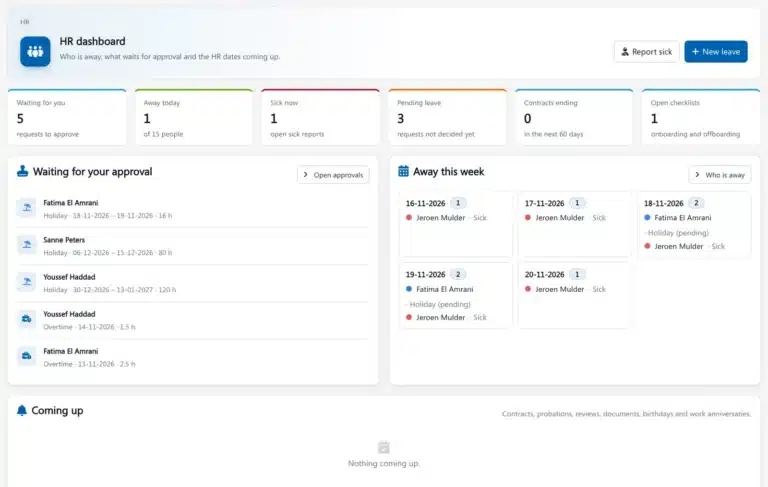
- Leave by email
- Absence in a spreadsheet
- News nobody reads
Question 14 of 17 · Academy
Do you track training and certificates in spreadsheets?
An expired certificate shows up at the worst moment: during an audit or on site.
Brytend solves this
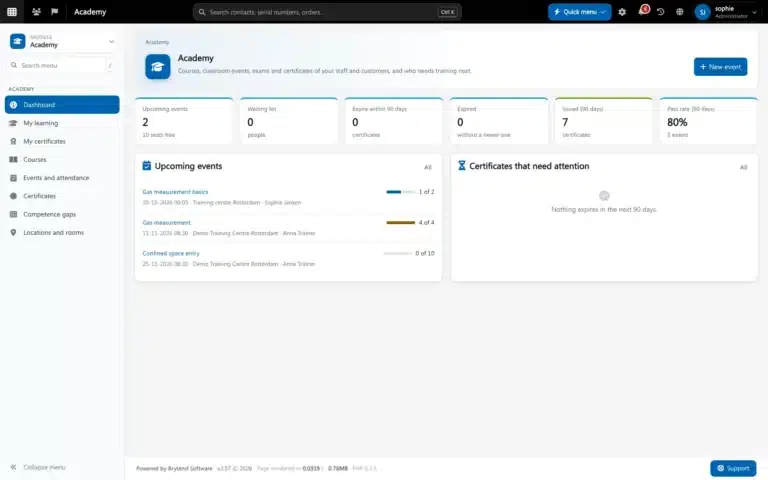
Courses, attendance and certificates in one Academy
Academy runs online and classroom courses, records attendance and issues certificates, with a reminder before one expires.
- Online and classroom courses
- Attendance and results recorded
- Certificates with expiry reminders
Modules
- Expired certificates
- Training by email
- No attendance record
Question 15 of 17 · Help desk and support
Do customer questions get lost in a shared inbox?
Slow answers are the fastest way to lose a customer.
Brytend solves this
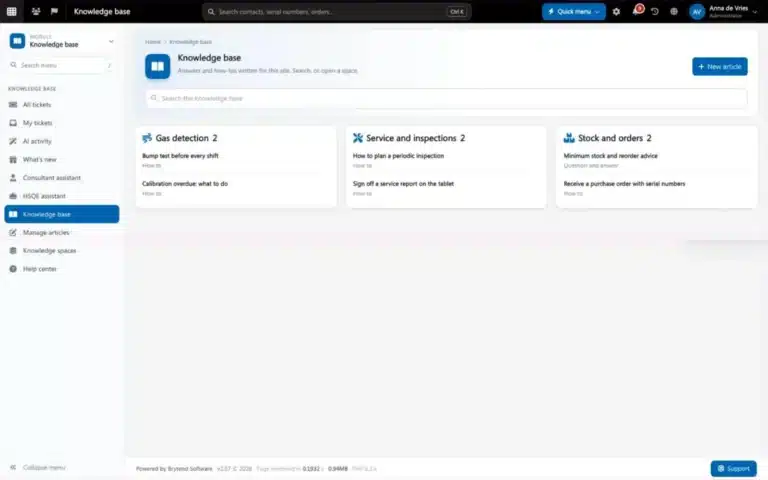
Every question answered, and answered once
Help desk turns emails into tickets with an owner and a deadline. Support intelligence builds a knowledge base from solved tickets, so your team finds the answer faster next time.
- Tickets with owners, priorities and history
- Knowledge base built from solved tickets
- Brytend AI helps find the right answer
Modules
- Shared inbox chaos
- No ticket history
- Same question, again
- Brytend AI
Question 16 of 17 · Platform
Looking for an online tool that is safe and always available on your phone, tablet and PC?
GDPR at the core, AI driven, with a native app, and an ISO certified SaaS solution.
Brytend solves this
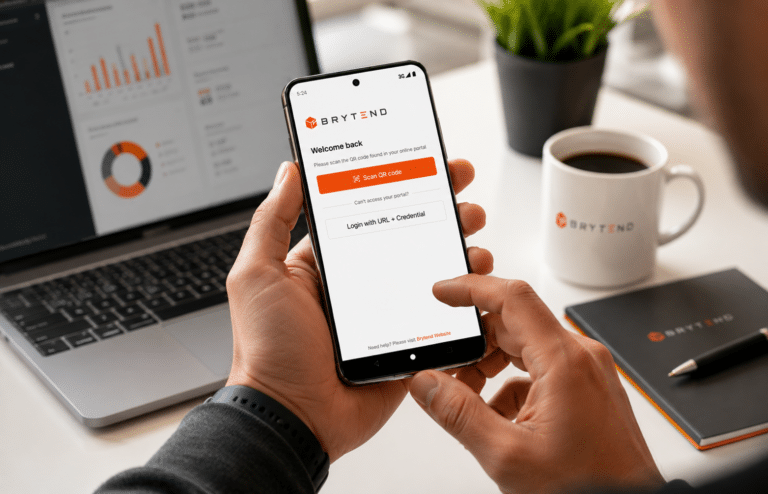
One secure platform, on every screen
Brytend is an ISO 9001 and ISO 27001 certified SaaS platform with GDPR built in from day one. Work in the browser on any device or in the native mobile app, with Brytend AI in every module.
- ISO 9001 and ISO 27001 certified
- GDPR at the core, with two-factor sign-in
- Native app plus any browser, on any device
Modules
- Data stuck on one PC
- No access on the road
- GDPR worries
- GDPR
- iPhone & iPad
- Android
- Brytend AI
Question 17 of 17 · Growth
Do you want Brytend to start finding new customers for you?
Let the Growth module search, enrich and score prospects while you focus on selling.
Brytend solves this
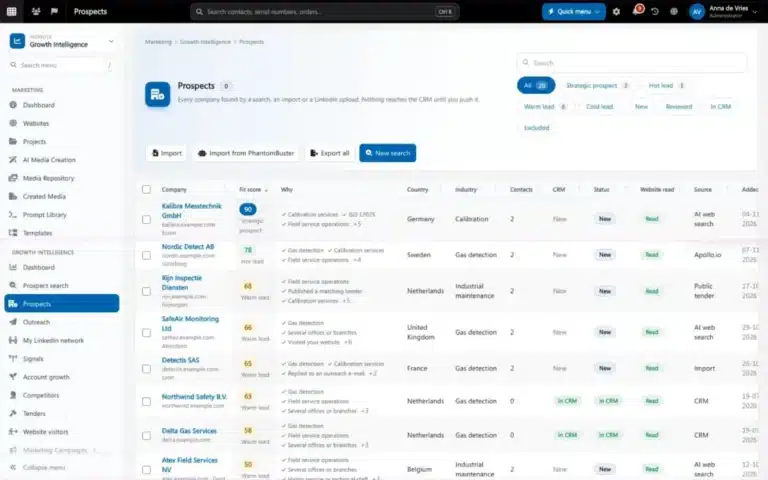
Growth Intelligence finds and warms up prospects
Connect LinkedIn, pull in leads from PhantomBuster and let Brytend AI enrich and score every company. Marketing then follows up with campaigns and surveys.
- Find contacts on LinkedIn from inside Brytend
- Import PhantomBuster leads straight into prospect lists
- AI scoring, campaigns and surveys to follow up
Modules
- Cold lists
- Searching LinkedIn by hand
- Leads without follow-up
- PhantomBuster
- Brytend AI
- MailerLite
Your Brytend
Brytend is a strong fit for you
One platform for everything you said yes to. Try it with your own data, or let us show you around in 30 minutes.
No credit card. Demo slots on weekdays 09:00-11:00 and 14:00-16:00.
 17 of 17 areas · 30 modules
- Microsoft 365 and CRM
- Quote to cash
- Finance
- Service and inspections
- Gas testing and cylinders
- Rental
- Loan out
- After sales
- Stock and warehouse
- Logistics
- Quality and compliance
- Projects and tasks
- HR and intranet
- Academy
- Help desk and support
- Platform
- Growth
What Challenges Complicate Prospect Qualification
A few recurring obstacles make qualification less accurate and slow down conversion. Knowing them helps you get ahead of them.
Primary qualification challenges include:
- Incomplete information: Prospects withhold budget, timeline, or authority details during early interactions
- Committee decisions: Multiple stakeholders with varying priorities complicate authority assessment
- Extended timelines: Enterprise decisions spanning 6-18 months blur qualification boundaries
- Competitor engagement: Prospects simultaneously evaluating 3-5 solutions reduce commitment signals
- Technical complexity: Custom software requirements resist standardized qualification criteria
Organizations implementing prospecting best practices address these challenges through structured discovery frameworks that systematically extract necessary information across multiple touchpoints.
Managing Multi-Stakeholder Prospect Dynamics
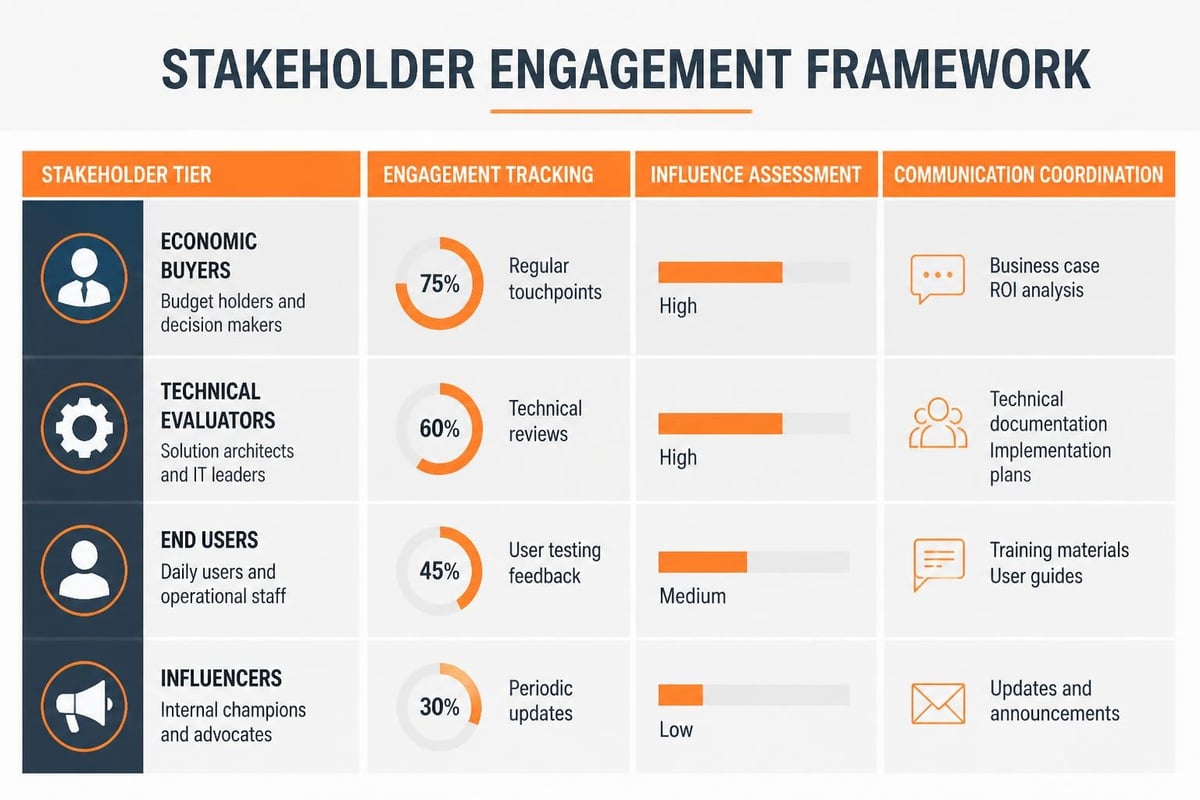
Complex B2B purchases involve 6-10 stakeholders with different priorities, evaluation criteria, and decision influence levels. Qualifying prospects requires understanding the complete stakeholder ecosystem.
Map prospect organizations using a four-tier structure:
- Economic buyer: Final authority over budget allocation and vendor selection
- Technical evaluator: Assesses solution capabilities, integration requirements, and implementation feasibility
- End users: Daily system operators who influence adoption success and satisfaction
- Influencers: Internal advocates or external consultants who shape decision criteria
A qualified prospect identification includes all tier 1 and tier 2 contacts with documented engagement from each. Manufacturing prospects evaluating service management platforms require confirmation from operations directors (economic buyers), IT managers (technical evaluators), maintenance supervisors (end users), and potentially external consultants (influencers).
How to Optimize Prospect Nurturing Workflows
Good nurturing keeps prospects engaged and moves qualification forward without pushing too early. It mixes education, relationship building, and steady information gathering.
Implement a stage-based nurturing framework:
Early-stage prospects (qualification score 40-60)
- Educational content: Industry reports, best practice guides, and capability overviews
- Engagement frequency: Weekly email touchpoints with monthly direct outreach
- Call-to-action focus: Content downloads, webinar registration, and newsletter subscription
Mid-stage prospects (qualification score 61-80)
- Solution-specific content: Case studies, technical documentation, and implementation guides
- Engagement frequency: Bi-weekly email with bi-weekly direct contact
- Call-to-action focus: Demonstration requests, consultation scheduling, and assessment tools
Late-stage prospects (qualification score 81-100)
- Decision-support content: ROI calculators, comparison frameworks, and proposal templates
- Engagement frequency: Weekly direct contact with customized follow-up
- Call-to-action focus: Proposal review, stakeholder meetings, and contracting discussions
This graduated approach aligns resource intensity with conversion probability. Early-stage prospects receive automated nurturing while late-stage prospects justify direct sales involvement.
Common Prospect Nurturing Mistakes
Many nurturing workflows push good prospects away instead of moving them forward. Avoiding these mistakes improves conversion.
Critical mistakes to prevent:
- Excessive contact frequency that triggers prospect disengagement or opt-out
- Generic content that fails to address specific prospect pain points or use cases
- Premature pricing discussions before value establishment and need confirmation
- Inconsistent follow-up that creates prospect uncertainty about process and timeline
- Single-channel communication that misses prospect preferences for phone, email, or video
A custom software development firm nurturing prospects evaluating service management solutions should provide serialized inventory tracking examples, preventive maintenance workflow templates, and compliance documentation capabilities rather than generic “increase efficiency” messaging. Specific examples show you know the field and back up the research the prospect is doing.
Comparison: Manual vs. Automated Prospect Management
| Aspect | Manual Methods | Automated Systems |
|---|---|---|
| Lead scoring | Subjective, inconsistent | Rule-based, consistent |
| Engagement tracking | Incomplete, delayed | Real-time, comprehensive |
| Qualification time | 30-45 days average | 15-25 days average |
| Team coordination | Email, meetings | Shared dashboards, alerts |
| Data accuracy | 60-70% | 85-95% |
| Scalability | Linear with headcount | Exponential with automation |
What Metrics Measure Prospect Quality and Pipeline Health
Effective prospect management requires quantitative measurement of qualification accuracy, pipeline progression, and conversion performance. Vital prospecting metrics enable continuous improvement through data-driven refinement.
Monitor these core prospect performance indicators:
Qualification metrics
- Lead-to-prospect conversion rate: Percentage of leads meeting qualification criteria
- Average qualification time: Days from initial contact to prospect status confirmation
- Qualification score accuracy: Correlation between score and actual conversion
- Disqualification reasons: Categories and frequency of prospects that fail to convert
Pipeline metrics
- Prospect-to-opportunity conversion: Percentage advancing from prospect to active deal
- Pipeline velocity: Average days prospects spend in qualification before advancing or disqualifying
- Stage progression rates: Conversion percentages between each pipeline stage
- Pipeline value coverage: Total prospect value relative to revenue targets
Outcome metrics
- Win rate by prospect source: Conversion rates by initial acquisition channel
- Average deal size by prospect type: Revenue variation across qualification segments
- Sales cycle length: Time from prospect status to closed deal
- Customer acquisition cost: Total expense divided by conversions from prospect stage
Organizations should establish baseline metrics, set improvement targets, and implement monthly reviews. A typical optimization goal increases lead-to-prospect conversion from 15% to 22% while reducing qualification time from 35 to 25 days.
Case Example: Manufacturing Equipment Service Prospects
A precision manufacturing equipment provider implemented systematic prospect qualification for their service contract renewals and expansions. Previously, the sales team treated all service inquiries as equal opportunities, resulting in 8% conversion rates and 60-day sales cycles.
The organization established qualification criteria including:
- Equipment serial numbers and current service status verification
- Annual service budget confirmation exceeding $25,000
- Authority confirmation for service contract decisions
- Identified pain points related to downtime, compliance, or preventive maintenance
- Implementation timeline within next 90 days
After implementing these standards, prospects received structured nurturing based on qualification scores. High-scoring prospects engaged with technical consultants for customized service plans. Low-scoring contacts entered automated education workflows.
Results after six months:
- Lead-to-prospect conversion increased to 28%
- Prospect-to-customer conversion reached 35%
- Average sales cycle decreased to 38 days
- Average contract value increased 23%
- Sales team capacity expanded 40% through better focus
The framework let the team focus on buyers who were ready while keeping in touch with contacts at an earlier stage.
How Prospect Qualification Adapts for Complex Solutions
Custom software development and technical implementation projects require qualification frameworks that address unique complexity factors. Standard B2B qualification models fall short when a project takes 6-18 months, involves custom development, and changes how the organization works.
Enhanced qualification criteria for complex solutions include:
- Technical environment assessment: Current systems, integration requirements, data migration scope, and infrastructure capacity
- Implementation resources: Internal technical staff availability, project management capability, and change management support
- Scope definition clarity: Documented requirements, success criteria, and acceptance standards
- Risk tolerance: Organizational capacity for custom development uncertainty and iterative refinement
- Post-implementation support: Long-term maintenance expectations, upgrade plans, and enhancement budgets
A manufacturing organization seeking custom service management software represents a qualified prospect only after confirming technical prerequisites, dedicated implementation resources, documented workflow requirements, realistic timeline expectations, and ongoing support commitment. Missing any element indicates premature qualification.
Technical Discovery Requirements
Complex solution prospects require deeper technical discovery than standard product sales. It confirms the project is feasible and surfaces obstacles before anyone commits serious resources.
Conduct technical qualification through:
- System architecture review: Document current technology stack, hosting environment, security requirements, and integration endpoints
- Data assessment: Evaluate data volume, structure, quality, migration complexity, and historical retention needs
- User environment analysis: Identify user locations, device types, network conditions, and accessibility requirements
- Compliance verification: Confirm regulatory requirements, industry standards, audit needs, and documentation obligations
- Scalability planning: Project growth trajectories, capacity requirements, and performance thresholds
This technical qualification runs parallel to commercial qualification. A prospect with confirmed budget and timeline but unresolved technical blockers remains unqualified until feasibility confirmation. Organizations that separate commercial and technical qualification experience 35-40% higher project success rates.
FAQs
What is a qualified prospect in B2B sales?
A qualified prospect indicates genuine purchase intent, budget authority, and specific criteria for buying engagement. Identifying qualified prospects is crucial for sales success.
How can organizations define clear prospect criteria?
Organizations define clear prospect criteria by setting characteristics like budget authority, verified need, and timeline commitment. This clarity enhances conversion rates and identifies qualified prospects.
What is the typical cost impact of poor prospect qualification?
Pursuing unqualified leads can cost organizations between $62,500 and $125,000 annually. These losses stem from wasted resources and missed opportunities with qualified prospects.
Can CRM systems automate prospect management effectively?
Yes, CRM systems effectively automate prospect management through behavioral tracking and lead scoring. They can reduce qualification time by 45-60%, helping identify qualified prospects faster.
How long does the qualification process typically take?
The qualification process typically takes 14-45 days. Duration depends on solution complexity and organizational decision-making, impacting the identification of qualified prospects.
What challenges complicate prospect qualification in B2B sales?
Challenges include incomplete information, committee decisions, and extended timelines. These factors complicate the accuracy of identifying qualified prospects in B2B sales.
How do organizations measure prospect quality and pipeline health?
Organizations measure prospect quality using metrics like lead-to-prospect conversion rate and average qualification time. These metrics help assess the health of their pipeline and identify qualified prospects.
Key Takeaways on Prospect Qualification
These are the core facts about B2B prospect qualification that every sales organization needs to apply consistently.
- A prospect is a contact with confirmed need, budget, authority, and a defined purchase timeline. Any contact missing one of these criteria is not yet a prospect.
- A lead is unqualified. A prospect is qualified. Treating them as the same category wastes sales resources and inflates pipeline values.
- Organizations that define clear prospect criteria achieve 24 to 38 percent higher conversion rates than those using inconsistent methods.
- Sales teams that pursue unqualified leads waste 40 to 60 percent of their selling time on contacts unlikely to convert.
- Pursuing 50 unqualified leads annually costs an organization between $62,500 and $125,000 in direct opportunity cost.
- CRM systems with automated prospect scoring reduce time-to-qualification by 45 to 60 percent compared to manual methods.
- A prospect scoring threshold of 75 points or higher on a 100-point scale typically indicates readiness for active sales engagement.
- The qualification process spans 14 to 45 days depending on solution complexity and organizational decision-making structure.
- Prospect records must be updated at least every 30 days. Stale data invalidates qualification and distorts forecasting.
- Technical qualification must run parallel to commercial qualification. A prospect with confirmed budget but unresolved technical blockers is not yet fully qualified.
Good prospect management makes sales far more efficient: qualify consistently, track automatically, and keep refining based on conversion data. Teams with clear criteria, structured nurturing, and a connected CRM do better than competitors who qualify on gut feel. Brytend develops custom CRM solutions and prospect management systems tailored to your specific qualification requirements, integration needs, and sales processes. Contact us to talk about how custom software can help you find and convert prospects.