
Healthcare organizations face mounting pressure to deliver better patient outcomes while managing complex regulatory requirements, operational inefficiencies, and growing data volumes. Solutions for healthcare address these challenges by automating workflows, integrating disparate systems, and providing decision support tools that enable clinicians and administrators to focus on patient care rather than manual processes. Custom software solutions tailored to specific healthcare workflows deliver measurable improvements in operational efficiency, compliance adherence, and clinical outcomes.
TL;DR:
- Solutions for healthcare automate clinical and administrative workflows to reduce manual errors and improve efficiency
- Integration of electronic health records, inventory systems, and compliance tools creates unified operational platforms
- Clinical decision support systems provide evidence-based guidance at the point of care
- Custom healthcare software addresses organization-specific workflows and regulatory requirements
- Automated service management and asset tracking reduce equipment downtime and ensure compliance
What Are Solutions for Healthcare?
Solutions for healthcare are integrated software systems designed to automate clinical workflows, manage patient data, ensure regulatory compliance, and optimize operational efficiency across healthcare organizations. These solutions include electronic health record (EHR) systems, clinical decision support tools, inventory management platforms, compliance tracking systems, and patient engagement applications.
Healthcare solutions encompass both commercial off-the-shelf products and custom-developed software tailored to specific organizational needs. Custom solutions address unique workflows, legacy system integration requirements, and specialized clinical protocols that generic products cannot accommodate. The scope ranges from departmental tools managing specific processes to enterprise-wide platforms coordinating care across multiple facilities.
Effective healthcare solutions share common characteristics: interoperability with existing systems, compliance with healthcare regulations (HIPAA, HITECH, state-specific requirements), scalability to handle growing data volumes, and user interfaces designed for clinical workflows. Clinical decision support tools embedded in these solutions provide evidence-based recommendations at the point of care.
Core Components of Healthcare Solutions
Modern healthcare platforms integrate multiple functional modules:
- Patient data management – centralized electronic health records with version control and audit trails
- Clinical workflow automation – automated order entry, result delivery, and care coordination
- Inventory and asset tracking – serialized equipment monitoring, automated reordering, and maintenance scheduling
- Compliance documentation – automated regulatory reporting, consent management, and audit preparation
- Analytics and reporting – real-time dashboards, outcome tracking, and operational metrics
| Component | Primary Function | Key Benefit |
|---|---|---|
| EHR Integration | Unified patient data access | Eliminates duplicate data entry |
| Decision Support | Evidence-based recommendations | Reduces clinical errors |
| Asset Management | Equipment tracking and maintenance | Minimizes downtime |
| Compliance Tools | Automated regulatory reporting | Ensures audit readiness |

How Do Healthcare Solutions Improve Patient Outcomes?
Healthcare solutions improve patient outcomes by reducing clinical errors, accelerating diagnosis and treatment, and ensuring adherence to evidence-based protocols. Automated clinical decision support systems flag potential medication interactions, contraindications, and treatment deviations before they reach patients.
Real-time data integration allows clinicians to access complete patient histories, lab results, imaging studies, and medication lists from a single interface. This comprehensive view eliminates information gaps that contribute to diagnostic errors and treatment delays. Evidence-based health collections integrated into clinical workflows provide systematic reviews and guidelines at the point of decision-making.
Workflow automation ensures critical steps are never skipped. Automated reminders prompt preventive care interventions, follow-up appointments, and medication reconciliation. Electronic prescribing eliminates handwriting interpretation errors and automatically checks for drug interactions. Care coordination tools track patient transitions between departments, facilities, and care settings, reducing communication breakdowns.
Measurable Impact on Clinical Quality
Documented improvements from healthcare solution implementation include:
- Medication error reduction – 50-80% decrease in prescribing errors through automated checking
- Diagnostic accuracy – 15-25% improvement through integrated imaging and lab result access
- Treatment adherence – 30-40% increase through automated patient reminders and education
- Hospital-acquired infection reduction – 20-35% decrease through protocol compliance monitoring
- Emergency response time – 25-45% improvement through automated alerting and resource coordination
Patient engagement tools within healthcare solutions enable direct communication between patients and care teams. Secure messaging, appointment scheduling, test result access, and educational resources improve patient participation in their own care. Higher engagement correlates with better medication adherence, lifestyle modification success, and chronic disease management outcomes.
Why Custom Healthcare Solutions Outperform Generic Systems?
Custom healthcare solutions outperform generic systems by aligning precisely with established workflows, integrating seamlessly with legacy infrastructure, and addressing organization-specific regulatory requirements. Generic systems force process adaptation to software constraints, while custom solutions adapt to proven clinical and operational processes.
Healthcare organizations operate with diverse technology ecosystems built over decades. Legacy imaging systems, laboratory information systems, billing platforms, and departmental databases must continue functioning while new solutions are deployed. Custom development enables integration bridges that connect these systems without replacement costs or workflow disruption.
Specialized clinical protocols vary significantly across organizations, specialties, and patient populations. Custom solutions encode these protocols directly into workflow automation, decision support logic, and documentation templates. This specificity eliminates the workarounds and manual adaptations required when using generic systems designed for broad markets.
Regulatory and Compliance Advantages
Healthcare regulations extend beyond HIPAA to include state-specific requirements, specialty-specific standards (CLIA for laboratories, FDA for medical devices), and payer-specific documentation rules. Custom solutions implement these requirements at the code level, making compliance automatic rather than procedural.
Common compliance requirements addressed through custom development:
- Audit trail granularity matching specific regulatory requirements
- Consent management workflows reflecting state-specific laws
- Automated reporting formatted for regulatory submission
- Role-based access controls mapped to organizational hierarchy
- Data retention policies enforcing regulatory timelines
Organizations using custom solutions report 40-60% reduction in compliance preparation time and significantly fewer audit findings compared to those adapting generic systems. The ability to modify compliance rules as regulations evolve provides long-term risk mitigation.
What Steps Are Required to Implement Healthcare Solutions?
Implementing healthcare solutions requires systematic planning, stakeholder engagement, infrastructure preparation, staged deployment, and continuous optimization. Success depends on executive sponsorship, clinical champion involvement, and dedicated implementation resources.
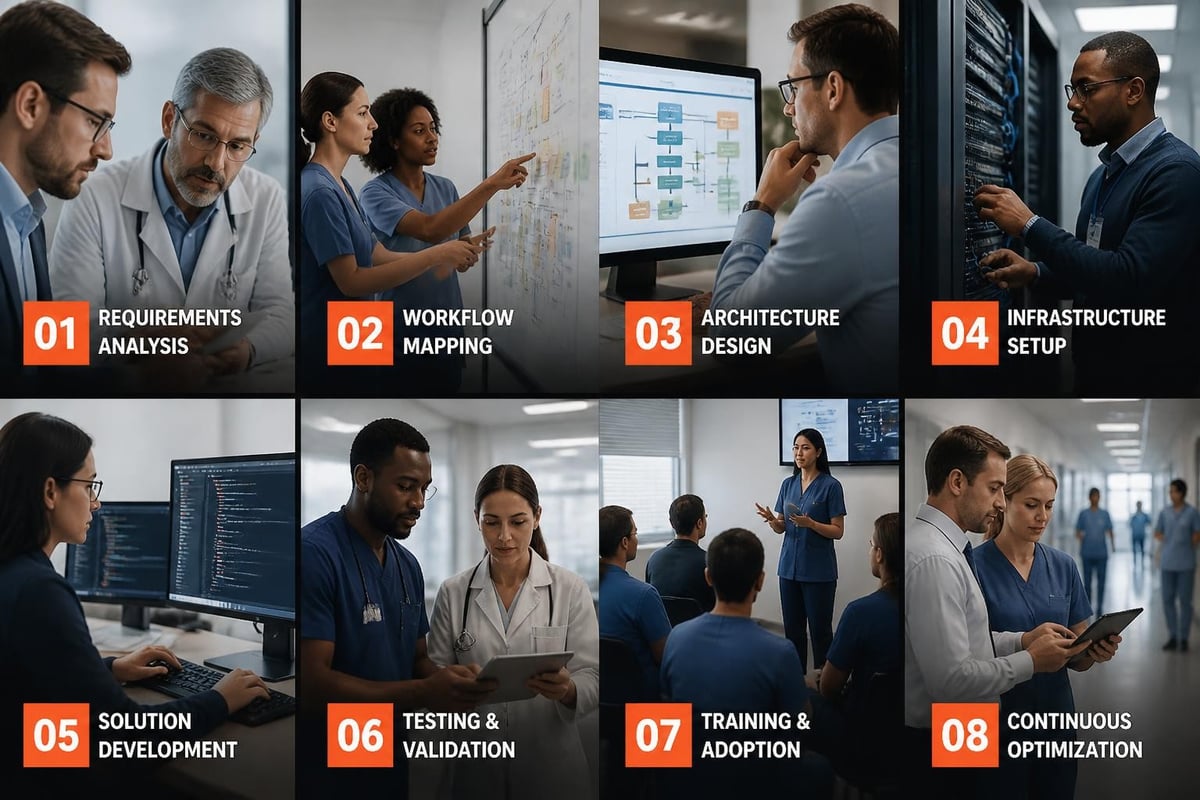
Step 1: Requirements Analysis and Workflow Mapping
Document current processes, identify pain points, and define desired future state. Engage clinical staff, administrative personnel, IT teams, and compliance officers. Map patient journeys, information flows, decision points, and handoffs. Identify integration points with existing systems and data migration requirements.
Step 2: Solution Architecture and Design
Select or design solutions based on documented requirements. For custom development, create detailed technical specifications including data models, integration specifications, user interface designs, and security architecture. Establish performance requirements, scalability targets, and disaster recovery plans.
Step 3: Infrastructure and Security Preparation
Provision servers, network capacity, and backup systems. Implement security controls including encryption, access management, intrusion detection, and audit logging. Complete HIPAA security risk assessment and implement required safeguards. Establish development, testing, and production environments.
Step 4: Development and Integration
Build or configure solutions according to specifications. Develop integration interfaces to existing systems. Implement data migration processes with validation and reconciliation. Create automated testing suites covering functional requirements, integration points, and security controls.
Step 5: Testing and Validation
Conduct unit testing, integration testing, user acceptance testing, and performance testing. Validate clinical decision support logic against evidence-based guidelines. Test disaster recovery and business continuity procedures. Document test results and remediation of identified issues.
Step 6: Training and Change Management
Develop role-specific training materials and deliver hands-on training sessions. Create quick reference guides, video tutorials, and support resources. Identify super users who can provide peer support. Communicate implementation timeline, expected changes, and support resources.
Step 7: Staged Deployment
Deploy solutions in phases, starting with limited departments or facilities. Monitor closely for issues, gather user feedback, and make adjustments. Expand deployment incrementally while maintaining support resources. Validate performance metrics and user satisfaction before full rollout.
Step 8: Optimization and Continuous Improvement
Monitor system usage, performance metrics, and user feedback. Identify optimization opportunities and implement refinements. Track outcome metrics against baseline. Plan enhancements based on evolving needs and regulatory changes.
How Do Healthcare Organizations Manage Medical Equipment and Assets?
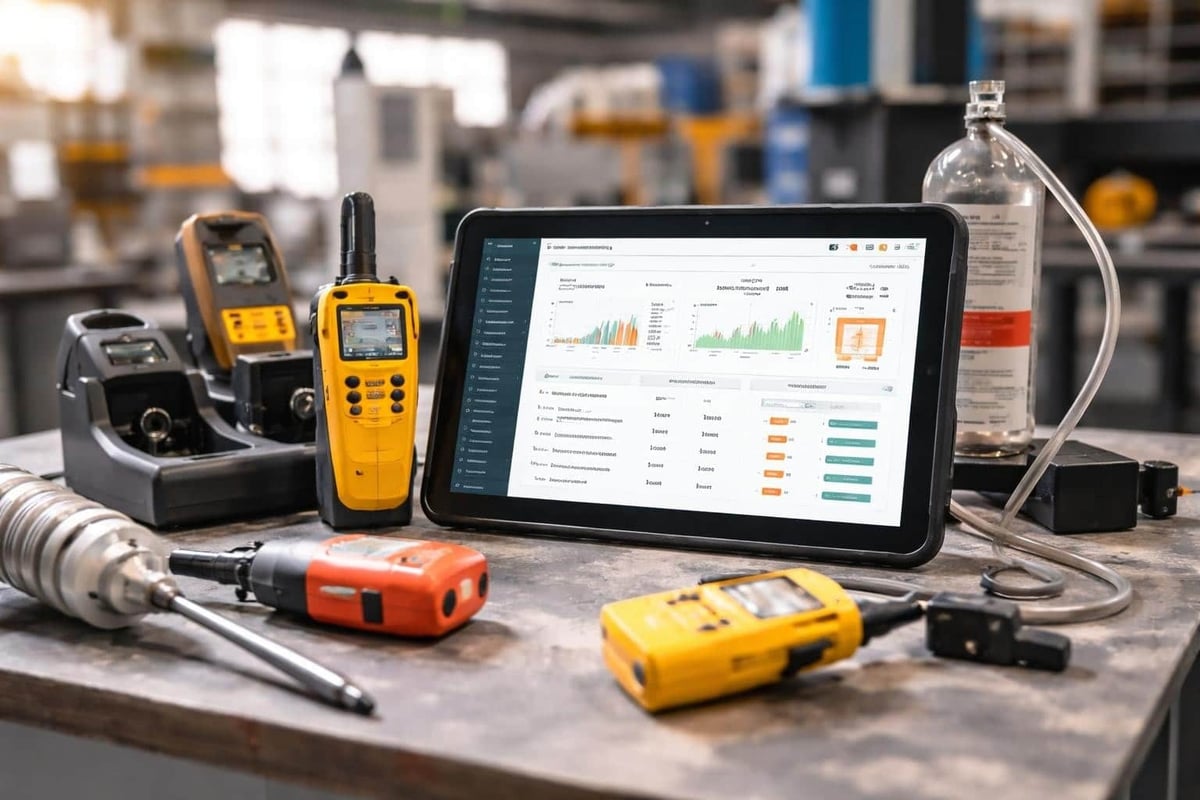
Healthcare organizations manage medical equipment and assets through serialized inventory tracking, automated maintenance scheduling, compliance documentation, and lifecycle management platforms. Solutions for healthcare integrate asset management with clinical workflows to ensure equipment availability, safety, and regulatory compliance.
Each medical device receives a unique identifier linking to its complete lifecycle record: purchase date, warranty information, maintenance history, calibration records, safety inspections, and usage tracking. This granular tracking enables predictive maintenance, reduces unplanned downtime, and ensures audit readiness.
Automated service reminder systems generate maintenance tasks based on manufacturer specifications, regulatory requirements, and usage patterns. For equipment requiring periodic calibration, testing, or inspection, automated workflows assign tasks to appropriate personnel, track completion, and generate compliance certificates.
Brytend's approach to healthcare asset management extends beyond simple inventory tracking. Organizations need systems that integrate equipment status with clinical scheduling, automatically flag devices approaching maintenance windows, and generate detailed service documentation. The Brytend Service Module provides structured service management capabilities, allowing healthcare facilities to register serialized inventory, configure custom service protocols, automate maintenance reminders, and generate compliance certificates that satisfy regulatory auditors.
Asset Management Best Practices
Healthcare organizations achieving optimal equipment uptime implement these practices:
- Preventive maintenance prioritization – schedule based on criticality, not just calendar dates
- Usage-based service intervals – adjust maintenance frequency based on actual equipment utilization
- Automated compliance tracking – link service completion to regulatory requirement satisfaction
- Mobile service documentation – enable technicians to update records at point of service
- Predictive replacement planning – analyze failure patterns to forecast capital equipment needs
| Manual Asset Management | Automated Solution |
|---|---|
| Spreadsheet tracking prone to errors | Centralized database with audit trails |
| Calendar-based reminders easily missed | Automated task generation and escalation |
| Paper service documentation | Digital certificates with searchable history |
| Reactive equipment replacement | Predictive analytics for capital planning |
| Compliance gaps discovered during audits | Real-time compliance dashboard |
Organizations implementing automated asset management report 30-50% reduction in equipment downtime, 40-60% decrease in compliance preparation time, and 20-35% extension in equipment useful life through optimized maintenance.
What Challenges Do Healthcare Solutions Address?
Healthcare solutions address data fragmentation, workflow inefficiency, compliance complexity, resource coordination challenges, and clinical decision support gaps. These challenges create operational friction, increase costs, and compromise patient safety when left unresolved.
Data Fragmentation and Interoperability
Healthcare data exists in isolated systems: EHRs, laboratory systems, imaging platforms, billing databases, and departmental applications. Clinicians waste 15-25% of their time searching for information across multiple systems. Solutions for healthcare create unified data access layers that aggregate information from disparate sources into single-view interfaces.
Interoperability standards (HL7, FHIR, DICOM) enable system-to-system communication, but implementation requires custom integration work. Healthcare organizations using advanced integration techniques connect legacy systems without expensive replacements, preserving technology investments while improving data accessibility.
Workflow Inefficiency and Manual Processes
Manual processes dominate healthcare operations: paper-based documentation, manual appointment scheduling, phone-based referral coordination, and spreadsheet-based resource tracking. Each manual step introduces delay, error risk, and staff frustration.
Workflow automation eliminates manual steps: electronic ordering triggers automatic fulfillment processes, completed procedures trigger billing automatically, discharge orders initiate pharmacy notifications, and appointment scheduling checks resource availability in real-time. Automation reduces administrative time by 40-60%, allowing staff reallocation to direct patient care.
Regulatory Compliance Complexity
Healthcare organizations navigate overlapping regulatory frameworks with specific documentation, reporting, and security requirements. Compliance consumes significant resources: policy maintenance, staff training, audit preparation, and remediation tracking.
Automated compliance systems embed regulatory requirements into workflows: required documentation becomes impossible to skip, access controls enforce privacy rules automatically, audit trails capture required information, and reporting tools generate submissions in regulatory formats. Organizations reduce compliance staffing by 30-50% while improving audit performance.
Common Implementation Mistakes to Avoid
Healthcare solution implementations fail when organizations make these mistakes:
- Insufficient clinical involvement – IT-led implementations without clinical champion engagement produce solutions clinicians avoid
- Inadequate training resources – rushed training creates user frustration and resistance to adoption
- Underestimating integration complexity – legacy system integration requires more time and expertise than anticipated
- Neglecting workflow analysis – automating broken processes produces automated inefficiency
- Ignoring change management – technical success without user adoption delivers no value
Successful implementations allocate 30-40% of budget to training, change management, and post-deployment support rather than focusing exclusively on technical development.

How Do Clinical Decision Support Systems Work?
Clinical decision support systems work by analyzing patient data against evidence-based guidelines, best practices, and clinical protocols to generate recommendations, alerts, and reminders at the point of care. These systems integrate with EHRs to access real-time patient information and deliver actionable guidance within clinical workflows.
Decision support logic operates through rules engines, machine learning models, or hybrid approaches. Rule-based systems encode clinical guidelines as if-then logic: if patient meets specific criteria, then recommend specific actions. Advanced decision support platforms incorporate continuously updated evidence bases, ensuring recommendations reflect current best practices.
Effective decision support balances sensitivity and specificity. Overly sensitive systems generate excessive alerts, leading to alert fatigue where clinicians ignore warnings. Overly specific systems miss important interventions. Optimal systems target high-risk situations where intervention significantly improves outcomes.
Decision Support Use Cases
Medication Safety
Drug interaction checking, dosing guidance based on patient characteristics (age, weight, renal function), allergy contraindication alerts, and duplicate therapy warnings. Systems analyze medication orders against patient data and evidence databases before reaching pharmacy or administration.
Diagnostic Assistance
Differential diagnosis suggestions based on presenting symptoms, clinical findings, and test results. Systems prompt consideration of diagnoses that might be overlooked, particularly for rare conditions or atypical presentations.
Preventive Care
Automated reminders for age-appropriate screening tests, immunizations, and risk assessments. Systems track patient age, gender, medical history, and prior interventions to identify gaps in preventive services.
Protocol Compliance
Guidance ensuring adherence to evidence-based treatment protocols for specific conditions. For sepsis, heart failure, stroke, and other time-sensitive conditions, systems prompt specific interventions at appropriate intervals.
Resource Optimization
Recommendations for appropriate test ordering, specialist referrals, and care setting selection. Systems identify low-value care opportunities and suggest more cost-effective alternatives with equivalent outcomes.
Organizations implementing comprehensive clinical decision support report 25-40% reduction in adverse drug events, 15-30% improvement in preventive care delivery, and 20-35% reduction in unnecessary testing.
What Integration Requirements Do Healthcare Solutions Demand?
Healthcare solutions demand bidirectional data exchange with electronic health records, laboratory information systems, radiology platforms, billing systems, and medical device interfaces. Integration architecture must support real-time data access, maintain data integrity, ensure security, and provide audit capabilities.
HL7 and FHIR Standards
HL7 (Health Level 7) messages enable system-to-system communication for admissions, discharges, transfers, orders, results, and billing events. FHIR (Fast Healthcare Interoperability Resources) provides modern API-based access to healthcare data using standard web technologies. Solutions must support both standards due to varying capabilities across existing systems.
Database Integration
Direct database integration accesses information not available through standard interfaces. This approach requires careful security implementation, read-only access constraints, and query optimization to avoid performance impact on source systems.
API Development
Custom APIs expose healthcare solution functionality to other systems. Well-designed APIs use authentication, rate limiting, input validation, and comprehensive error handling. API documentation enables third-party integration development.
Integration Architecture Components
Interface Engine
Centralized integration platform managing all system-to-system connections. Interface engines provide message routing, transformation, error handling, and monitoring. They isolate individual systems from integration complexity.
Data Transformation Logic
Maps data formats, terminology, and structures between systems. Transformation includes code translation (converting between different medication coding systems), unit conversion, and data structure reformatting.
Error Handling and Monitoring
Automated error detection, alerting, and recovery procedures. Integration failures must be identified immediately, with clear escalation paths and fallback procedures ensuring operational continuity.
Healthcare organizations requiring sophisticated integration capabilities benefit from custom development that addresses their specific ecosystem. Brytend’s expertise in healthcare integration enables connection of legacy systems, modern cloud platforms, and specialized medical devices into unified operational environments.
How Do Healthcare Solutions Handle Data Security and Privacy?
Healthcare solutions handle data security and privacy through encryption, access controls, audit logging, network segmentation, and regular security assessments. HIPAA compliance requires administrative, physical, and technical safeguards protecting patient information throughout its lifecycle.
Encryption Implementation
Data encryption at rest protects information stored on servers, databases, and backup media using AES-256 or equivalent algorithms. Encryption in transit protects data moving between systems using TLS 1.2 or higher. Key management systems control encryption key generation, distribution, rotation, and destruction.
Access Control Architecture
Role-based access control (RBAC) limits data access based on job function and clinical necessity. Users receive minimum necessary permissions to perform assigned duties. Multi-factor authentication (MFA) strengthens authentication beyond passwords alone. Session management enforces automatic logout after inactivity periods.
Audit Trail Requirements
Comprehensive logging captures all data access, modifications, deletions, and security events. Audit logs record user identity, timestamp, action performed, and data accessed. Immutable audit trails prevent tampering and support forensic investigation.
Security Best Practices
- Network segmentation – isolate healthcare applications from general corporate networks
- Vulnerability management – regular scanning, patching, and remediation tracking
- Penetration testing – annual third-party security assessments identifying exploitable weaknesses
- Incident response planning – documented procedures for detecting, containing, and recovering from breaches
- Staff security training – regular education on phishing, social engineering, and security protocols
Healthcare organizations experiencing data breaches face average costs exceeding $10 million when accounting for notification, credit monitoring, legal expenses, regulatory fines, and reputation damage. Proactive security investment delivers significant risk reduction at a fraction of potential breach costs.
Case Example: Specialty Clinic Service Management
A multi-location specialty clinic managing 450 pieces of medical equipment across five facilities implemented automated service management to address compliance gaps and equipment downtime issues. Prior to implementation, maintenance tracking used spreadsheets maintained separately at each location, resulting in missed service intervals, incomplete documentation, and failed audit findings.
The custom solution registered each device with manufacturer specifications, regulatory requirements, and location-specific protocols. Automated workflows generated service tasks 30 days before due dates, assigned them to appropriate personnel, and escalated overdue items to facility managers. Mobile interfaces enabled technicians to document service completion, capture photos, and generate PDF certificates on-site.
Within six months, the clinic achieved 98% on-time maintenance completion (up from 67%), reduced equipment-related patient delays by 73%, and passed regulatory inspection with zero equipment-related findings. The system paid for itself within 18 months through avoided equipment replacement costs and improved operational efficiency.
Solutions for healthcare transform operational efficiency, clinical quality, and regulatory compliance through systematic workflow automation and data integration. Custom development addressing organization-specific requirements delivers superior results compared to generic systems requiring extensive adaptation. Brytend specializes in developing tailored healthcare solutions that integrate seamlessly with existing infrastructure, automate complex workflows, and ensure regulatory compliance while improving patient outcomes and operational efficiency.