
Inventory system software enables organizations to track, manage, and control physical assets throughout their lifecycle using digital records, automation rules, and real-time data synchronization. Modern inventory system software extends beyond simple stock counting to include serialized asset tracking, maintenance scheduling, compliance documentation, and integration with enterprise resource planning (ERP) systems. Organizations implementing inventory system software gain operational visibility, reduce manual errors, and establish audit trails required for regulatory compliance across industries including manufacturing, healthcare, field services, and distribution.
What Is Inventory System Software and How Does It Function
Inventory system software is a database-driven application that records, monitors, and manages physical items through digital identifiers such as barcodes, RFID tags, or serial numbers. The system maintains real-time records of item location, quantity, condition, custodian, and transaction history.
At its core, inventory system software operates through several interconnected components:
- Database layer: Stores item master data, transaction logs, location hierarchies, and relationship mappings
- Input mechanisms: Barcode scanners, mobile devices, API integrations, and manual entry interfaces
- Business logic engine: Processes transactions, enforces validation rules, triggers notifications, and updates dependent records
- Reporting module: Generates compliance documents, analytical reports, variance analysis, and audit trails
- Integration layer: Connects to ERP systems, procurement platforms, maintenance systems, and accounting software
The functional workflow begins when an item enters the system through a receiving transaction. The inventory system software assigns unique identifiers, records specifications, establishes location assignments, and sets reorder parameters. As items move through operations, each transaction-whether issue, transfer, return, or adjustment-creates timestamped records that maintain complete traceability.
Advanced inventory system software implementations include predictive analytics that forecast demand patterns, automated replenishment triggers based on consumption rates, and mobile applications that enable field technicians to update asset status in real-time. Understanding inventory management systems requires recognizing how these components work together to create operational visibility.

Architecture Patterns for Enterprise Deployment
Enterprise inventory system software typically follows either centralized or distributed architecture patterns, each offering distinct advantages for different operational models.
Centralized architecture maintains a single database instance that all locations access through network connections. This pattern ensures data consistency, simplifies reporting across the organization, and reduces infrastructure complexity. Organizations with stable network connectivity and centralized decision-making structures benefit most from this approach.
Distributed architecture deploys database instances at individual locations with scheduled synchronization to a central repository. This pattern supports operations in remote areas with unreliable connectivity, reduces network latency for local transactions, and provides operational continuity during network outages.
| Architecture Type | Best Use Case | Primary Advantage | Key Challenge |
|---|---|---|---|
| Centralized | Corporate warehouses, urban facilities | Real-time global visibility | Network dependency |
| Distributed | Remote sites, field operations | Local transaction resilience | Synchronization complexity |
| Hybrid | Multi-site with mixed connectivity | Balanced resilience and visibility | Configuration management |
How Do You Implement Inventory System Software Across Multiple Locations
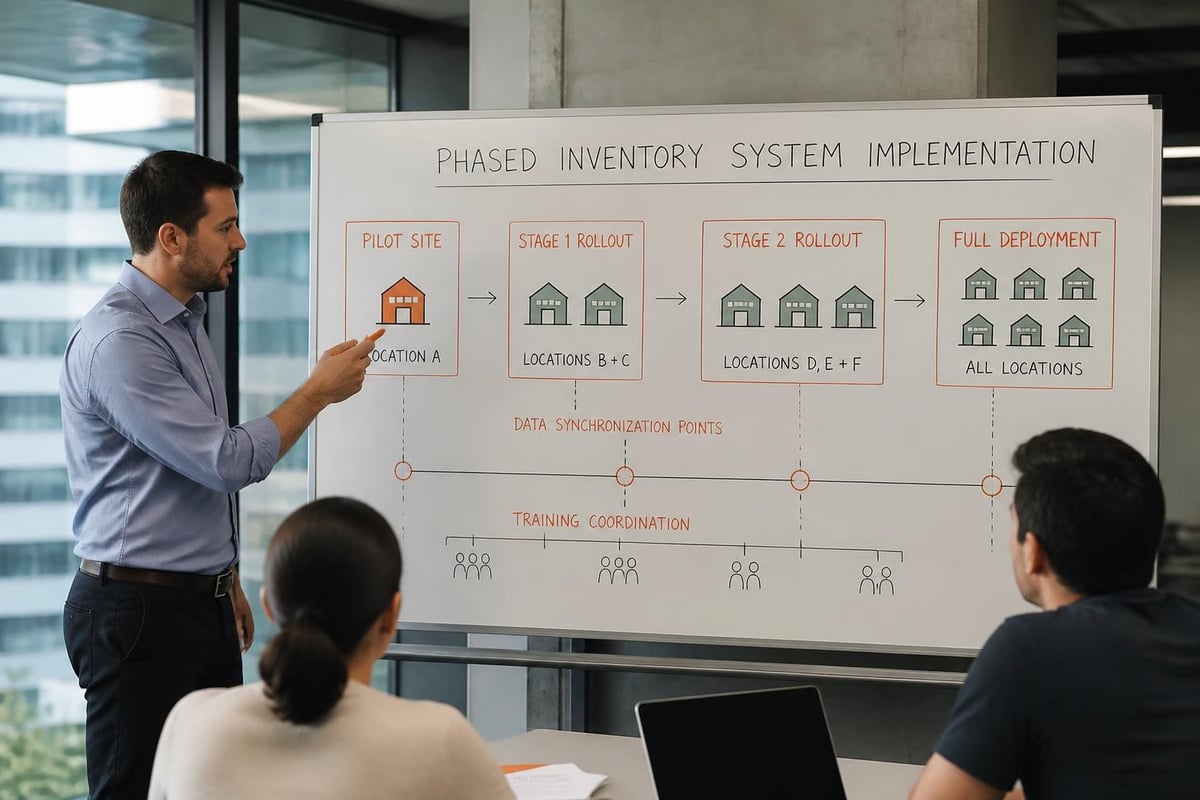
Implementing inventory system software across multiple locations requires a phased approach that establishes data standards, trains personnel, validates accuracy, and synchronizes operations before full deployment.
The implementation process follows these critical stages:
Phase 1: Data Foundation and Standardization
Begin by establishing consistent item identification standards across all locations. Create a master item catalog that includes standardized descriptions, classification codes, and unique identifiers. This foundational work prevents duplicate records and ensures accurate reporting.
Critical data elements to standardize:
- Item nomenclature and description format
- Unit of measure definitions and conversion rules
- Location coding hierarchies and naming conventions
- Category taxonomies and classification schemes
- Attribute fields and validation parameters
Document existing inventory through a comprehensive physical count that reconciles actual quantities against current records. This baseline establishes starting accuracy metrics and identifies discrepancies requiring investigation before system migration.
Phase 2: Pilot Location Deployment
Select a representative pilot location that includes typical operational complexity without excessive scale. Configure the inventory system software to match established data standards, import cleansed item records, and train a core user group on transaction workflows.
During the pilot phase, monitor these performance indicators:
- Transaction completion rate and error frequency
- Data accuracy compared to physical verification
- User adoption metrics and workflow bottlenecks
- Integration performance with connected systems
- Report accuracy and timeliness
The pilot phase typically runs for 30-60 days, allowing users to encounter most operational scenarios and identify configuration adjustments before broader rollout.
Phase 3: Staged Multi-Site Rollout
Deploy to additional locations in waves rather than simultaneous implementation. This staged approach allows support resources to focus on each location during critical go-live periods and incorporates lessons learned from previous deployments.
Establish a standardized rollout procedure that includes:
- Pre-deployment data validation and cleansing
- System configuration replication from pilot template
- Customization for location-specific requirements
- User training with role-based curriculum
- Go-live support with on-site assistance
- Post-deployment verification and optimization
Effective inventory management requires addressing the unique challenges each location presents while maintaining standardized core processes across the organization.
What Features Distinguish Professional-Grade Inventory System Software
Professional-grade inventory system software provides advanced capabilities that extend beyond basic quantity tracking to support complex operational requirements, regulatory compliance, and strategic decision-making.
Serialized asset tracking assigns unique identifiers to individual items rather than managing them as fungible quantities. This capability is essential for high-value equipment, regulated products, and items requiring maintenance history. Each serialized item maintains its own record including acquisition date, warranty information, service history, current custodian, and condition status.
Lot and batch management groups items produced or received together, enabling trace-forward and trace-back investigations required in quality incidents or regulatory recalls. The inventory system software maintains associations between lot numbers and source materials, production dates, expiration dates, and final destinations.
Multi-dimensional tracking records inventory across multiple attributes simultaneously, including location, condition code, project allocation, and ownership status. This granularity supports complex operations where the same item SKU might exist in different states requiring separate management rules.
Advanced Workflow Automation
Professional inventory system software automates routine processes through configurable business rules that reduce manual intervention and enforce operational policies.
Automated replenishment monitors consumption patterns and triggers purchase requisitions when inventory levels reach predetermined thresholds. The system calculates optimal order quantities based on lead times, economic order quantities, and forecast demand.
Reservation management allocates inventory to specific projects, work orders, or customers before physical issue, preventing commitment conflicts and ensuring availability for planned activities. Reserved quantities appear as unavailable for alternative allocation while remaining in their current physical location.
Approval workflows route transactions through defined authorization chains based on transaction type, value, or item classification. The inventory system software queues transactions pending approval, notifies designated approvers, and enforces timeout escalation rules.
The Brytend Service Module demonstrates these professional capabilities through its ability to register serialized inventory, automate service reminders based on usage or time intervals, and generate certificates documenting completed maintenance activities. This structured approach to service management ensures compliance with maintenance schedules while maintaining complete asset histories.

Compliance and Audit Capabilities
Professional inventory system software maintains comprehensive audit trails that document all transactions, modifications, and system access. Each record includes user identification, timestamp, transaction type, previous values, and justification codes where applicable.
Compliance reporting generates documentation required by industry regulations, including FDA-regulated industries requiring lot traceability, government contractors maintaining property accountability, and organizations subject to financial auditing standards. The system produces reports matching regulatory formats and includes all required data elements.
Cycle counting programs schedule systematic physical verification of inventory subsets, distributing counting workload across the year rather than requiring complete annual physical inventories. The inventory system software assigns count schedules based on item value, movement frequency, or error history, generates count sheets, and processes variance resolution.
| Feature Category | Basic Systems | Professional Systems |
|---|---|---|
| Asset Tracking | Quantity by SKU | Serialized individual items |
| Transaction History | Current quantity only | Complete audit trail with timestamps |
| Approval Workflow | Manual approvals | Automated routing with escalation |
| Compliance | Generic reports | Regulatory-specific documentation |
| Integration | Limited exports | Real-time API connectivity |
| Mobile Access | Web browser only | Native apps with offline capability |
How Does Inventory System Software Integrate With Field Service Operations
Inventory system software integration with field service operations enables technicians to access parts inventory, document service activities, and update asset status from customer locations using mobile devices connected through cellular networks or offline synchronization.
Field service integration addresses the operational reality that service technicians work at customer sites rather than centralized warehouses. The inventory system software must support:
Mobile inventory transactions that allow technicians to issue parts to service tickets, return unused materials, and request replenishment from truck stock without returning to a central facility. These transactions synchronize automatically when network connectivity is available or queue for batch upload when working offline.
Vehicle inventory management tracks parts assigned to individual service vehicles, establishing each truck as a mobile inventory location within the system hierarchy. This visibility prevents stockouts during service calls and enables efficient replenishment based on actual consumption patterns.
Service documentation workflow connects inventory transactions to work order records, creating associations between parts consumed and specific maintenance activities. This linkage supports warranty claims, customer billing, and asset maintenance history.
Real-World Scenario: Gas Detection Equipment Service
Consider an industrial services company maintaining gas detection equipment across multiple customer facilities. Each detector requires annual calibration using specific gas cylinders and replacement sensors based on exposure hours.
The inventory system software implementation includes:
- Serialized equipment tracking: Each gas detector maintains a unique record including model, serial number, customer location, installation date, and calibration history
- Service interval automation: System generates work orders 30 days before calibration due dates based on last service timestamp
- Required parts association: Work orders automatically include calibration gas cylinders and sensors specific to detector model
- Technician inventory allocation: Required parts reserve from technician truck stock when work order is assigned
- Service completion documentation: Mobile app records calibration readings, parts consumed, and generates service certificate
- Asset record update: Completed service updates detector record with new calibration date and next service due date
This integrated workflow ensures compliance with calibration schedules, maintains complete service history for each asset, and provides visibility into parts consumption patterns supporting inventory optimization.
Organizations managing field service operations benefit from connecting their inventory system software to customer relationship management platforms. Solutions like call center outsourcing services can handle appointment scheduling and customer notifications while the inventory system software ensures parts availability for scheduled service calls.
What Security Considerations Apply to Inventory System Software
Inventory system software security requires protecting both data integrity and transaction authenticity through access controls, audit mechanisms, and integration safeguards.
Role-based access control (RBAC) assigns system permissions based on job function rather than individual users. Organizations define roles such as warehouse clerk, inventory manager, and system administrator, each with specific transaction authorities and data visibility. Users inherit permissions from assigned roles, simplifying administration and ensuring consistent access policies.
Transaction authorization rules enforce approval requirements based on transaction characteristics including value thresholds, item categories, or location transfers. The inventory system software prevents unauthorized users from completing restricted transactions and maintains records of approval chains.
Data Protection and Audit Requirements
Professional inventory system software implements multiple layers of data protection addressing confidentiality, integrity, and availability requirements.
Encryption standards protect data both in transit and at rest. Network communications use TLS protocols preventing interception of transaction data. Database encryption protects stored information from unauthorized access at the storage layer.
Audit logging captures comprehensive records of system activity including successful transactions, failed access attempts, configuration changes, and data exports. Software asset inventory practices extend beyond physical items to include the inventory management system itself as a tracked asset requiring security monitoring.
Backup and recovery procedures establish regular data backup schedules with offsite storage and documented restoration procedures. The inventory system software configuration includes recovery time objectives (RTO) and recovery point objectives (RPO) that define acceptable downtime and data loss parameters.
Integration Security Protocols
When inventory system software connects to external systems through APIs or data exchanges, security protocols prevent unauthorized access and ensure data integrity.
Authentication mechanisms verify the identity of connecting systems through certificates, API keys, or OAuth tokens before permitting data exchange. The inventory system software validates credentials for each API request and logs all integration activity.
Data validation rules verify that imported information meets expected formats, value ranges, and business logic before updating database records. This validation prevents corrupt data from external sources from compromising inventory accuracy.
Network segmentation isolates inventory system software on protected network segments with firewall rules restricting access to authorized systems. This architecture reduces attack surface and contains potential security breaches.
Organizations should also consider security control frameworks that provide structured approaches to managing software assets and maintaining security inventories as part of comprehensive cybersecurity programs.
What Implementation Mistakes Should Organizations Avoid
Organizations implementing inventory system software commonly encounter preventable failures that result from inadequate planning, unrealistic expectations, or insufficient change management.
Insufficient data cleansing before migration leads to perpetuating inaccurate records in the new system. Organizations must reconcile physical inventory against existing records, investigate variances, correct errors, and establish verified baseline data before system go-live. Migrating dirty data creates immediate accuracy problems that undermine user confidence and require extensive correction efforts.
Customization without documentation creates technical debt when organizations modify standard inventory system software functionality without maintaining current documentation of changes, business justifications, and affected processes. Future upgrades become complex, troubleshooting requires reverse-engineering, and knowledge transfer to new personnel fails.
Inadequate user training focuses on software navigation rather than business processes and decision-making within the new system. Effective training addresses why transactions matter, how errors impact operations, and what constitutes correct process execution, not merely which buttons to click.
Common Configuration Errors
Incorrect unit of measure conversions between purchasing units, storage units, and issue units create quantity errors that compound across transactions. The inventory system software must maintain accurate conversion factors and apply them consistently in all calculations.
Poorly defined location hierarchies that don't match physical layouts or operational workflows force users to record items in incorrect locations, defeating the purpose of location tracking. Location structures should reflect how personnel actually think about and navigate physical spaces.
Missing validation rules allow users to complete transactions that violate business policies, such as issuing materials to unauthorized projects, receiving goods without purchase orders, or adjusting inventory without proper documentation. The inventory system software should enforce organizational policies through system controls rather than relying on user discipline.
Process and Change Management Failures
Organizations fail when they view inventory system software as purely a technology project rather than an operational transformation requiring process redesign and behavioral change.
Lack of executive sponsorship results in competing priorities, inadequate resources, and inability to enforce adoption across organizational boundaries. Successful implementations require visible executive support that communicates the strategic importance and mandates user participation.
Insufficient pilot testing before full deployment prevents identification of workflow issues, configuration errors, and training gaps in a controlled environment. Organizations should validate all critical processes in the pilot location before expanding implementation.
No defined success metrics prevent objective assessment of whether the inventory system software delivers intended value. Organizations should establish baseline measurements before implementation and track improvements in inventory accuracy, transaction efficiency, stockout frequency, and carrying costs.
Custom software development teams like Brytend address these implementation risks through structured methodologies that include requirements validation, iterative testing, user acceptance verification, and knowledge transfer before production deployment.
How Do You Measure Inventory System Software Effectiveness
Measuring inventory system software effectiveness requires tracking operational metrics, financial indicators, and process compliance that demonstrate return on investment and identify optimization opportunities.
Inventory accuracy measures the percentage agreement between system records and physical counts. Calculate accuracy as the number of items with matching quantities divided by total items counted, measured both by item count and by value. Professional operations target 95% accuracy or higher, with high-value or critical items requiring 99%+ accuracy.
Cycle count completion rate tracks adherence to planned counting schedules, indicating whether the organization maintains systematic verification programs. Calculate as completed counts divided by scheduled counts within the period. Rates below 90% suggest resource constraints or process issues preventing consistent execution.
Transaction error rate measures the frequency of corrections, adjustments, or reversals indicating incorrect initial entries. Lower error rates reflect better training, clearer procedures, and more effective system design. Track errors by transaction type to identify specific problem areas requiring intervention.
Financial Performance Indicators
Inventory carrying costs as a percentage of total inventory value should decrease as the inventory system software enables optimization of stock levels, reduction of obsolete materials, and improved turnover rates. Calculate total carrying costs including storage, insurance, taxes, obsolescence, and capital costs divided by average inventory value.
Stockout frequency measures how often required items are unavailable when needed, causing operational delays or emergency purchases. The inventory system software should reduce stockouts through better visibility, automated replenishment, and improved demand forecasting.
Order fulfillment cycle time tracks the duration from request initiation to material delivery, reflecting both inventory availability and process efficiency. Shorter cycle times indicate that inventory system software enables faster location identification, picking, and transaction processing.
| Metric Category | Key Indicator | Target Performance | Measurement Frequency |
|---|---|---|---|
| Accuracy | System vs. physical agreement | 95%+ | Monthly cycle counts |
| Efficiency | Transaction completion time | <2 minutes average | Weekly sampling |
| Financial | Carrying cost percentage | <25% of value | Quarterly |
| Service Level | Stockout incidents | <2% of requests | Monthly |
| Compliance | Audit findings | Zero material findings | Annual audit |
Process Maturity Assessment
Beyond quantitative metrics, assess inventory system software effectiveness through process maturity indicators that reflect organizational capability evolution.
Ad hoc stage: Inventory transactions occur inconsistently, procedures vary by individual, and system usage is sporadic with many manual workarounds.
Defined stage: Documented procedures exist, training is standardized, and users follow consistent transaction workflows within the inventory system software.
Managed stage: Performance metrics are regularly reviewed, process improvements are implemented based on data analysis, and preventive controls reduce errors.
Optimized stage: Automated workflows handle routine transactions, predictive analytics inform decisions, and continuous improvement is embedded in operations.
Organizations should assess current maturity levels and establish roadmaps for advancement to higher capability stages that maximize inventory system software value delivery.
FAQ About Inventory System Software
What is the difference between inventory system software and warehouse management systems?
Inventory system software tracks item quantities, locations, and transactions across an organization. Warehouse management systems (WMS) add directed putaway, optimized picking routes, labor management, and yard management specific to warehouse operations. WMS includes inventory functions but extends to operational execution within distribution facilities.
Can inventory system software operate offline in remote locations?
Professional inventory system software offers offline capabilities that cache data locally, allow transaction entry without network connectivity, and synchronize changes when connection resumes. Offline functionality requires careful configuration to handle potential conflicts when multiple users modify the same records during disconnected periods.
How long does typical inventory system software implementation require?
Implementation timelines range from 2-3 months for small single-location deployments to 12-18 months for complex multi-site enterprise implementations. Duration depends on data quality, integration complexity, customization requirements, and organizational readiness for process change rather than purely software installation time.
What data migration challenges occur when replacing existing inventory systems?
Data migration requires mapping field definitions between old and new systems, cleansing inaccurate records, consolidating duplicate entries, and validating conversions before go-live. Transaction history migration presents particular challenges when date formats, status codes, or relational structures differ between systems. Organizations must decide what historical depth to migrate versus archiving for reference.
How does inventory system software handle items with expiration dates?
Professional systems track expiration dates as item attributes, enforce first-expiry-first-out (FEFO) issue rules, generate alerts for approaching expiration, and prevent transactions involving expired materials. The inventory system software maintains lot-level expiration tracking rather than aggregate quantities, supporting industries like pharmaceuticals, food service, and chemicals requiring expiration management.
What mobile device requirements exist for field inventory transactions?
Mobile inventory applications require devices with barcode scanning capability (either integrated scanners or camera-based reading), sufficient screen size for data entry forms (typically 5+ inch displays), and operating system compatibility with inventory system software mobile clients. Industrial environments may require ruggedized devices with specific environmental ratings for dust, moisture, and drop protection. Inventory management resources provide detailed guidance on mobile hardware selection criteria.
Can inventory system software automatically create purchase orders?
Advanced inventory system software generates purchase requisitions automatically when stock levels reach reorder points, based on consumption forecasts, or triggered by project material requirements. The system can auto-populate supplier information, pricing from contracted rates, and delivery locations. However, most organizations require human approval before requisitions convert to committed purchase orders, maintaining financial controls over procurement commitments.
How does inventory system software support asset depreciation tracking?
Inventory system software focused on consumable materials typically does not include depreciation calculation, which is an accounting function handled by fixed asset or financial systems. For equipment inventory requiring depreciation tracking, integration between inventory system software and financial systems passes acquisition cost, date in service, and asset classification to enable proper depreciation calculation in the appropriate system of record.
Modern inventory system software transforms operational visibility and accuracy when implemented with proper planning, data discipline, and process alignment. Organizations that establish clear success metrics, invest in user training, and maintain data quality realize measurable improvements in efficiency, cost control, and regulatory compliance. Brytend develops custom inventory management solutions tailored to unique operational requirements, integrating with existing systems and scaling to support organizational growth. Contact Brytend to discuss how custom software development can address your specific inventory management challenges.


