Trade shows generate hundreds of booth interactions, but most exhibitors lose 80% of potential value by failing to implement structured lead capture processes. Capturing leads at trade shows is a systematic process that converts booth visitors into qualified sales opportunities through standardized data collection, real-time qualification scoring, and immediate CRM integration. Successful lead capture requires coordinated technology, trained booth staff, and clearly defined qualification criteria that separate casual browsers from decision-makers ready to engage.
TL;DR
- Lead capture systems must collect contact data, qualification scores, and interaction notes in real time to prevent data loss
- Digital forms and badge scanners reduce manual entry errors and enable instant CRM routing based on lead quality
- Pre-show planning, booth staff training, and defined qualification criteria determine lead capture effectiveness
- Post-show follow-up within 24-48 hours increases conversion rates by 300% compared to delayed outreach
- Integration between capture tools and CRM platforms automates lead distribution and tracks conversion metrics
Capturing leads at trade shows is a structured data collection and qualification system that transforms booth conversations into actionable sales opportunities through standardized forms, scoring criteria, and automated routing workflows.
What Is Trade Show Lead Capture and Why Does It Matter?
Trade show lead capture is the process of systematically collecting visitor information, qualifying their buying intent, and routing their data to sales teams through digital or manual systems. This process separates exhibitors who generate measurable ROI from those who simply collect business cards.
Effective lead capture answers three critical questions: Who visited your booth? What specific products or services interested them? When should sales follow up? Without standardized answers to these questions, sales teams waste time chasing unqualified contacts while high-value prospects receive delayed responses.
Key components of a lead capture system include:
- Contact data fields: name, email, phone, company, title, industry
- Qualification questions: budget authority, timeline, current solutions, pain points
- Interaction tracking: products discussed, demos completed, literature requested
- Lead scoring: A/B/C categorization or numerical scores based on fit and intent
- Routing rules: automated assignment to regional reps, account managers, or inside sales
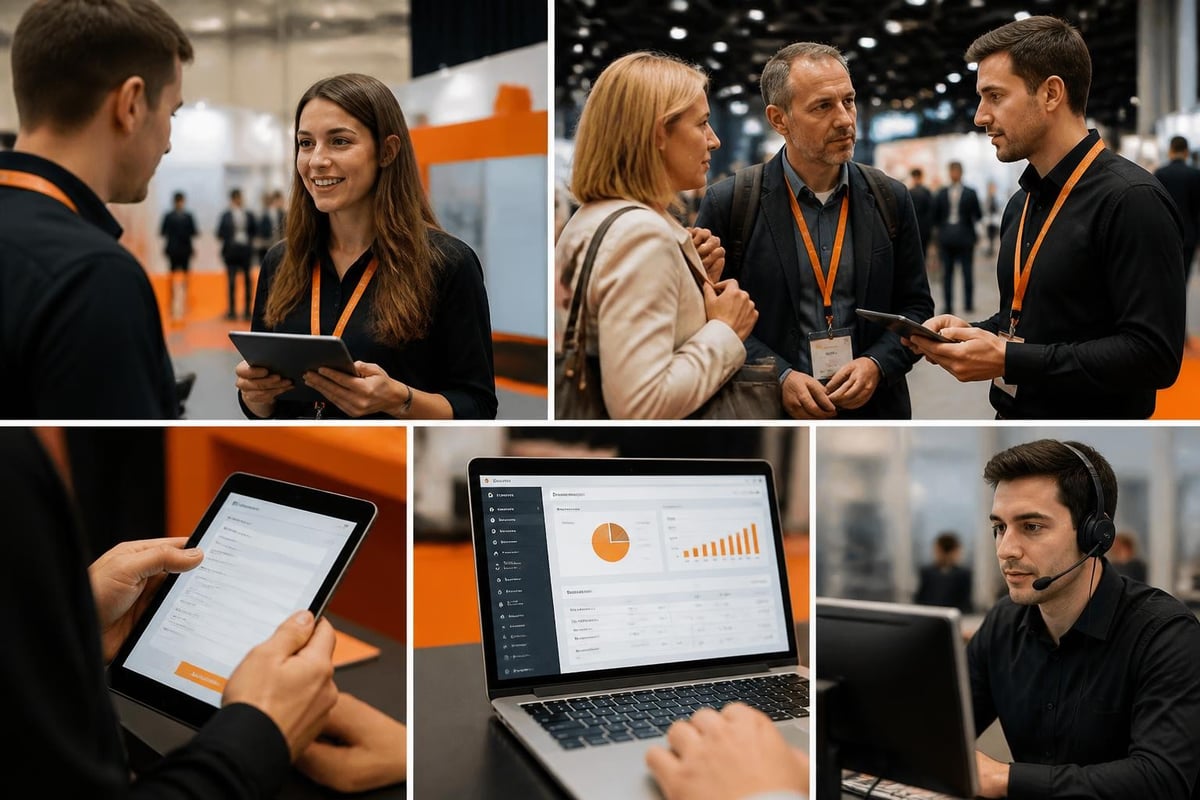
Digital capture tools reduce human error and accelerate follow-up compared to manual methods. Effective lead collection strategies emphasize pre-show targeting and structured booth workflows that prioritize qualification over volume.
How Do You Set Up a Lead Capture System Before the Show?
Pre-show preparation determines whether your team captures 30% or 90% of booth interactions. Setup begins 4-6 weeks before the event and involves technology configuration, staff training, and process documentation.
Configure Your Digital Forms and Scoring Criteria
Start by defining your qualification framework. Create a simple A/B/C rating system where A-leads have budget, authority, need, and timeline within six months. B-leads lack one qualifier. C-leads are gathering information or outside your target market.
Build your digital form with mandatory fields (name, email, company) and conditional logic that displays follow-up questions based on initial responses. For example, if a visitor selects "currently evaluating solutions," show timeline and budget questions. If they select "gathering information," skip to content preferences.
| Lead Grade | Criteria | Follow-up Timeline | Assigned To |
|---|---|---|---|
| A | Budget + Authority + 0-6 month timeline | Within 24 hours | Account Executive |
| B | Missing one qualifier or 6-12 month timeline | Within 72 hours | Business Development |
| C | No current need or outside ICP | Monthly nurture | Marketing automation |
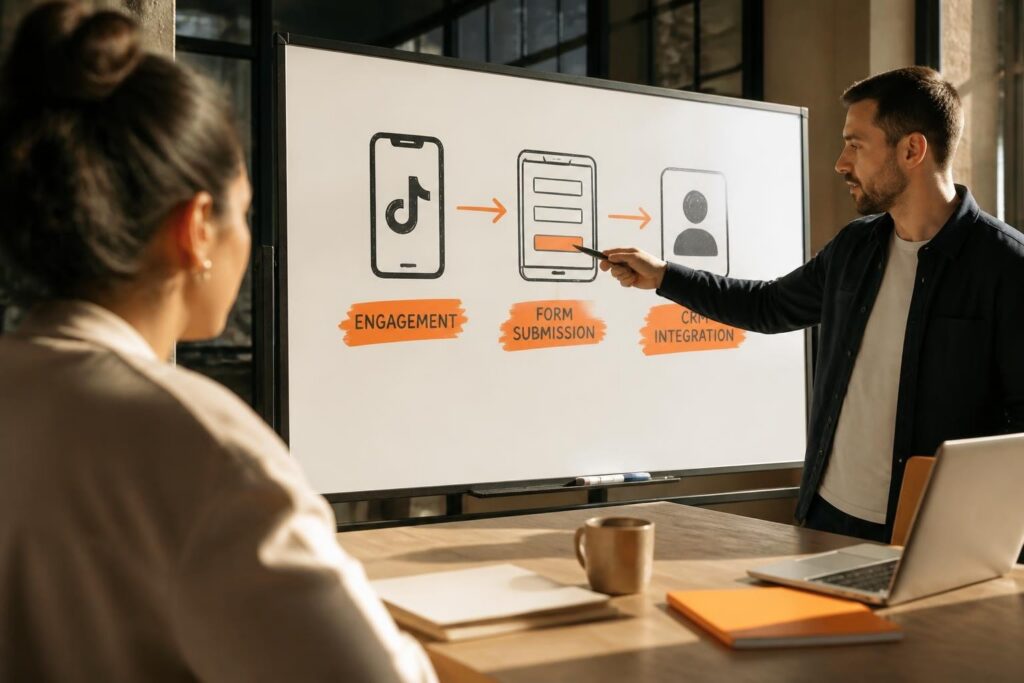
Configure your form to sync with your CRM automatically. Test the integration by submitting sample leads and verifying they appear with correct field mapping and lead scores. For businesses tracking complex qualification data, custom CRM solutions enable tailored workflows that match specific sales processes.
Train Booth Staff on Qualification Workflows
Every booth representative must understand when to qualify, when to collect basic contact info, and when to let visitors leave without capture. Train staff to ask open-ended discovery questions before requesting contact information.
Standard booth conversation flow:
- Greet visitor and ask what brought them to your booth
- Determine their role and company type through conversation
- Identify their current solution and pain points
- Ask about evaluation timeline and decision process
- Request contact information and complete qualification form
- Confirm next steps and expected follow-up date
Practice this flow through role-playing exercises. Staff should be able to complete the qualification process in 3-5 minutes for serious prospects while politely collecting only contact information from casual visitors.
What Lead Capture Tools Should You Use at Trade Shows?
Tool selection depends on budget, technical requirements, booth traffic volume, and sales process complexity. Most exhibitors choose between badge scanners, dedicated lead capture apps, or custom web forms accessed via QR codes.
Badge Scanners vs Lead Capture Apps vs QR Code Forms
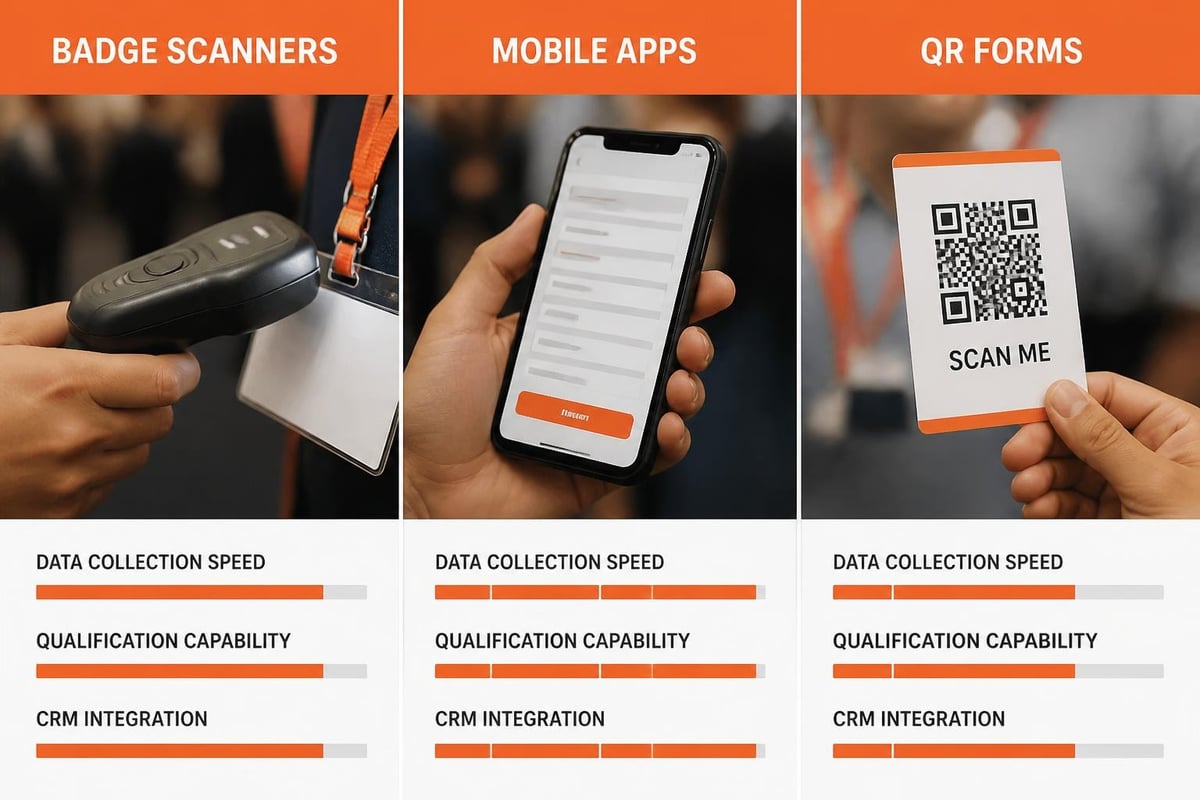
Badge scanners read attendee information from event-issued RFID or barcode badges. They capture name, company, title, and contact details in seconds but provide no qualification data unless paired with a follow-up form. Scanners work best for high-traffic booths where speed matters more than immediate qualification.
Lead capture apps offer customizable forms, offline data collection, and instant CRM sync. Reps use tablets or smartphones to guide conversations while completing qualification fields. Apps like those designed for trade show lead management include real-time scoring and integration with major CRM platforms.
QR code forms allow visitors to self-register using their own devices. Display QR codes on banners, tabletops, or demo stations. This method works for tech-savvy audiences and reduces the need for multiple tablets, but requires visitors to take initiative rather than booth staff driving the process.
| Method | Speed | Qualification Depth | Cost | Best For |
|---|---|---|---|---|
| Badge Scanner | Fastest | None (unless paired with form) | $500-2000/event | High traffic, quick capture |
| Lead Capture App | Medium | High | $50-300/month | Qualified conversations |
| QR Code Form | Slow | Medium | Free-$50/month | Self-service, budget-conscious |
Comparing these methods shows that combination approaches often outperform single-method systems. Use badge scanners for initial capture, then follow with tablet-based qualification for serious prospects.
Integration Requirements and Data Flow
Your lead capture tool must connect to your CRM without manual export/import steps. Verify that the tool supports your CRM platform (Salesforce, HubSpot, Microsoft Dynamics, or custom systems) and can map custom fields correctly.
Define your data flow before the event:
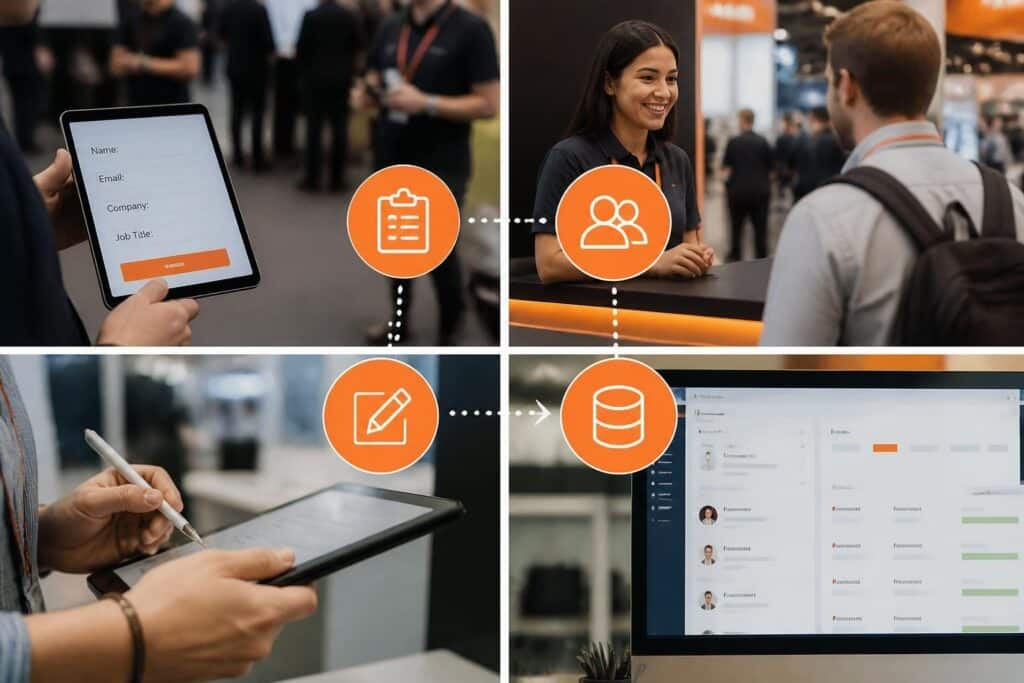
- Rep completes form on tablet or scans badge
- Lead data transmits to CRM within 60 seconds
- CRM applies lead scoring rules and routing logic
- Assigned rep receives notification with full context
- First follow-up occurs within agreed timeline
Test this flow end-to-end at least one week before the show. Submit test leads and verify they reach the correct reps with accurate data. For organizations with specialized needs, custom software development ensures capture systems integrate seamlessly with existing business platforms.
How Do You Qualify Leads Effectively During Booth Conversations?
Qualification separates capturing leads at trade shows from simply collecting contacts. Effective qualification identifies buying intent, decision authority, budget availability, and timeline constraints within a brief conversation.
Ask the Right Discovery Questions
Begin with open-ended questions that reveal visitor motivation and context. "What challenges are you trying to solve?" provides more insight than "Are you interested in our product?" Layer specific qualification questions based on initial responses.
Essential qualification questions:
- What solution are you currently using?
- What's driving you to explore alternatives?
- Who else is involved in the evaluation process?
- What's your timeline for making a decision?
- Do you have budget allocated for this type of solution?
Frame questions conversationally rather than interrogatively. "Walk me through your current process" feels more natural than "Do you have authority to purchase?" Extract the same information through dialogue rather than checklist-style questioning.
Apply Real-Time Scoring and Categorization
Score leads immediately while context is fresh. Don't defer qualification decisions until after the show when you've forgotten conversation details. Use your predefined A/B/C framework or numerical scoring model consistently across all booth staff.
Sample scoring criteria for software solutions:
- Current pain point severity: 0-3 points
- Budget confirmed: 0-3 points
- Decision authority: 0-3 points
- Timeline within 6 months: 0-3 points
- Company fits ICP: 0-3 points
Leads scoring 12-15 points receive A-level priority. 8-11 points earn B-level status. Below 8 points enter nurture campaigns rather than immediate sales follow-up. This scoring prevents sales teams from treating all leads equally and helps them focus on high-probability opportunities.
Document specific interests and next steps in your capture form notes field. "Interested in inventory management module, wants demo of serialized asset tracking, currently using spreadsheets" provides actionable context for follow-up. Custom lead capture forms can include industry-specific fields that match your qualification criteria.
What Are Common Mistakes in Trade Show Lead Capture?
Most lead capture failures stem from poor planning, inadequate training, or technology problems rather than ineffective booth design or marketing messaging.
Critical mistakes that reduce lead quality and volume:
- Collecting cards instead of using structured forms: Business cards lack qualification data and require manual CRM entry
- Waiting until after conversations to capture data: Reps forget details and lose 40-60% of qualifying information
- Failing to test technology connectivity: Wi-Fi failures, battery depletion, and sync errors destroy capture efforts
- Using different qualification criteria across booth staff: Inconsistent scoring makes lead prioritization impossible
- Delaying CRM entry until after the show: Data entry errors increase and follow-up opportunities expire
- Skipping lead scoring entirely: Sales teams receive unsorted lists and waste time on low-quality contacts
One software company captured 400 leads at a healthcare technology show but lost 75% of potential revenue because they used a simple fishbowl entry form. Leads received no qualification scoring. Sales reps spent three weeks chasing cold contacts while A-level prospects, who expected immediate follow-up, selected competitors.
After implementing a structured lead capture app with qualification questions and automated A/B/C routing, the same company reduced lead volume to 200 but increased qualified opportunities by 300%. Sales closed 18% of captured leads versus 2% from the previous show. The difference was qualification rigor, not booth traffic.
Technology Failures and Backup Systems
Plan for connectivity failures, device malfunctions, and software crashes. Always maintain offline capability through backup devices or paper forms with identical qualification questions.
Essential backup procedures:
- Download offline mode for lead capture apps before arriving at the venue
- Carry portable battery packs and charging cables for all devices
- Print 50 paper qualification forms matching digital version exactly
- Designate one team member to monitor data sync status throughout each day
- Schedule hourly sync checks to catch failures before they compound
Designing effective lead capture systems requires balancing qualification depth with capture speed to maximize both quantity and quality.
How Do You Optimize Post-Show Follow-Up Based on Captured Data?
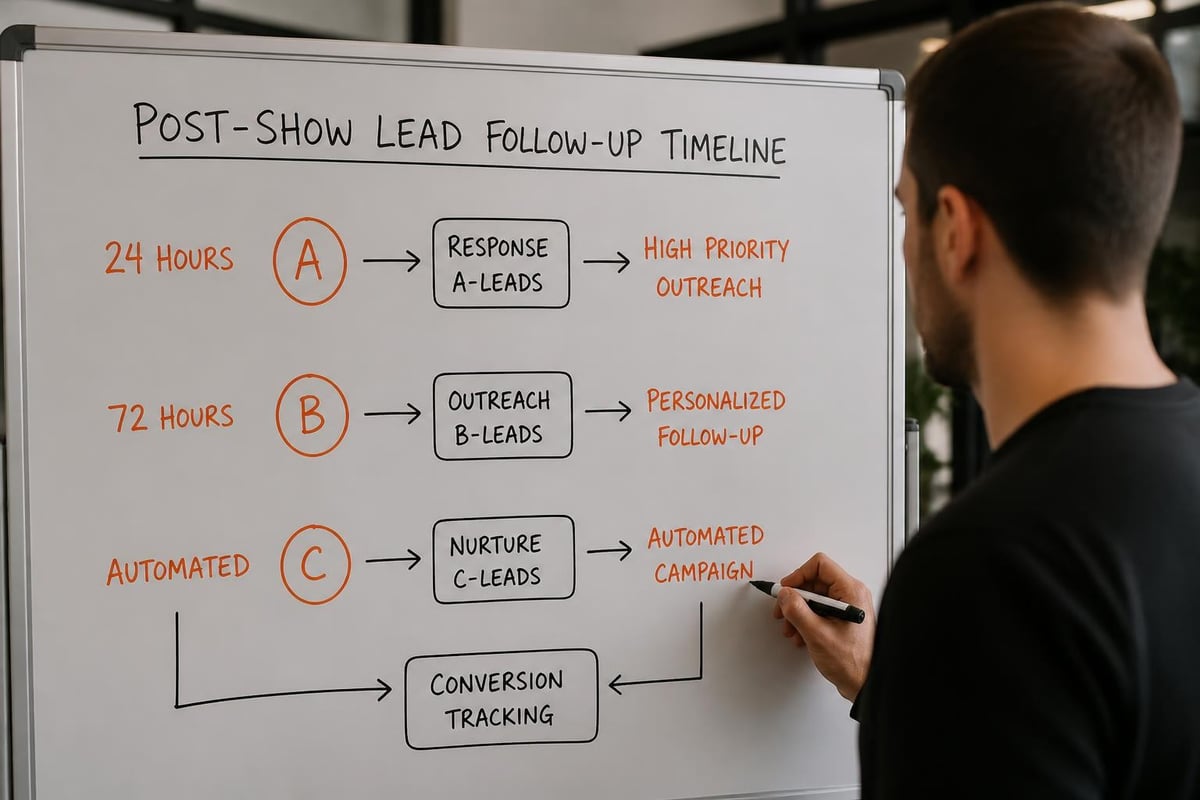
Capturing leads at trade shows creates value only when followed by systematic, timely outreach. The follow-up process should begin within 24 hours for A-level leads and within 72 hours for B-level prospects.
Segment Leads by Score and Route Appropriately
Use qualification scores and notes to personalize outreach. A-level leads receive calls from senior reps who reference specific conversation points. B-level leads get targeted emails with relevant content. C-level contacts enter automated nurture sequences.
Lead routing and follow-up workflow:
- A-leads: Phone call within 24 hours + personalized email + calendar invite for demo
- B-leads: Personalized email within 72 hours + targeted content + follow-up call in one week
- C-leads: Add to monthly newsletter + educational content series + quarterly check-in
Reference booth conversation details in all follow-up communications. "You mentioned struggling with manual inventory tracking" demonstrates attentiveness and builds credibility. Generic "nice to meet you" emails waste the context captured during qualification.
Track Conversion Metrics and ROI
Measure lead capture effectiveness by tracking conversion rates at each stage: captured to qualified, qualified to opportunity, opportunity to closed deal. Compare these metrics across shows to identify which events generate the highest-quality leads.
| Metric | Definition | Target Benchmark |
|---|---|---|
| Capture Rate | Leads captured ÷ booth visitors | 40-60% |
| Qualification Rate | A+B leads ÷ total captured | 35-50% |
| Opportunity Rate | Opportunities ÷ A+B leads | 25-40% |
| Close Rate | Deals won ÷ opportunities | 15-25% |
| Cost Per Lead | Show cost ÷ qualified leads | Varies by industry |
Calculate your trade show ROI by dividing revenue from closed deals by total show investment (booth, travel, staff time, technology). Events generating 3:1 ROI or better justify continued participation. Below 2:1 suggests either poor lead capture processes or wrong show selection.
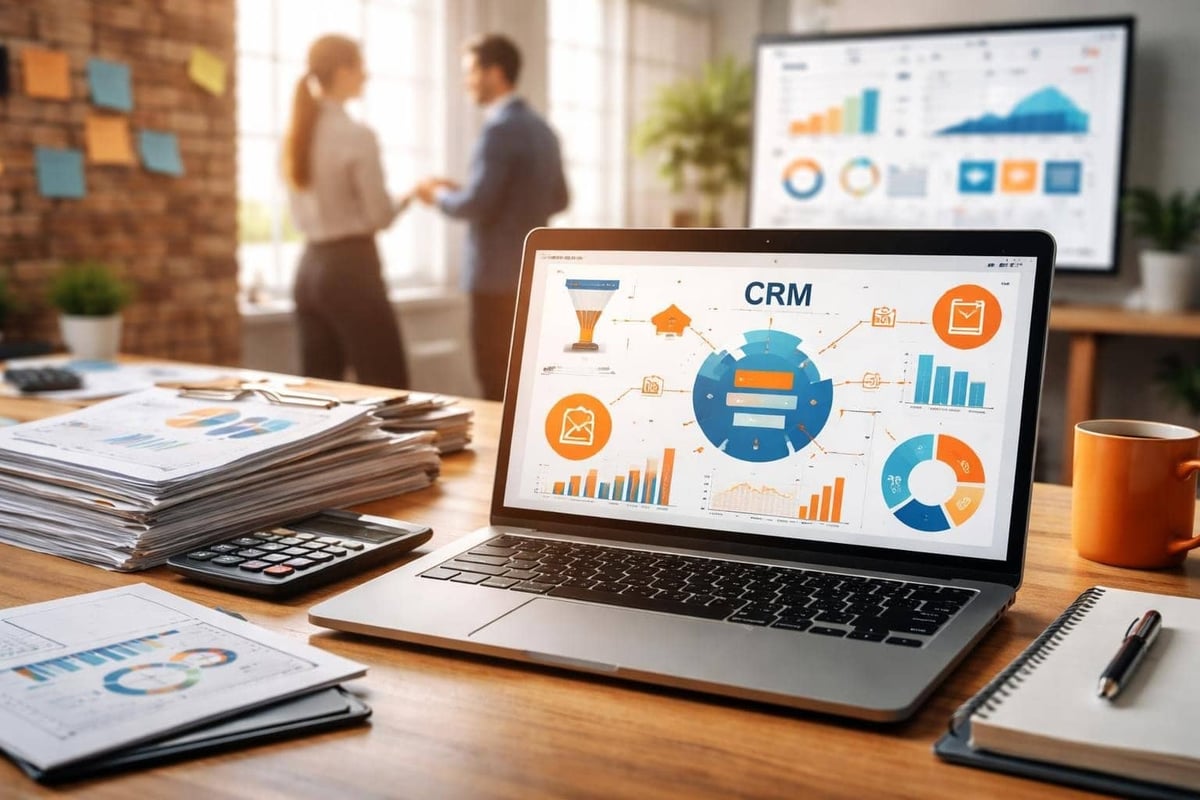
For companies managing complex sales cycles and customer relationships, customer management platforms provide the infrastructure needed to track leads from initial capture through final purchase and ongoing support.
What Advanced Strategies Improve Lead Capture Performance?
Advanced exhibitors implement pre-show outreach, booth gamification, and progressive profiling to increase both lead volume and quality simultaneously.
Pre-Show Targeting and Appointment Setting
Contact registered attendees before the show to schedule booth meetings. Event organizers often provide attendee lists 2-4 weeks in advance. Filter this list by title, company size, and industry to identify high-value prospects.
Send personalized emails inviting prospects to schedule 15-minute booth consultations. Offer incentives like exclusive product previews, one-on-one sessions with executives, or premium giveaways for confirmed appointments. Pre-qualified appointments convert at 3-5x the rate of walk-up traffic.
Pre-show email sequence:
- Week 3: Initial invitation with value proposition and calendar link
- Week 2: Reminder to non-responders highlighting show-exclusive content
- Week 1: Final invitation with booth location and meeting confirmation
- Day before: Confirmation email with booth number and contact phone
Progressive Profiling for Returning Visitors
For visitors who attended previous shows or engaged with your brand before, use progressive profiling to deepen qualification without repeating basic questions. Pre-populate known fields in your capture form and ask new questions that advance understanding.
If your CRM shows a prospect attended last year and expressed interest in inventory management, this year's form should skip basic company info and instead ask: "Have you implemented a new inventory system since we last spoke?" and "What challenges remain in your current approach?"
This approach respects the visitor's time, demonstrates your organizational memory, and captures incremental qualification data with each interaction. Project task management tools can help coordinate follow-up activities across multiple team members handling different lead segments.
Manual vs Automated Lead Capture Comparison
Manual capture using business cards and note-taking reduces upfront technology costs but increases post-show labor and error rates. Automated systems require investment in software and devices but deliver higher data quality and faster follow-up.
Manual approach: Rep collects business card, writes notes on back, enters data into spreadsheet after show. Average time: 5 minutes per lead for capture + 3 minutes per lead for post-show entry. Error rate: 15-25% due to illegible handwriting and lost cards.
Automated approach: Rep completes digital form during conversation, data syncs to CRM instantly. Average time: 3 minutes per lead for capture + 0 minutes for entry. Error rate: 2-5% due to typos and field mismatches.
For a 200-lead show, manual capture requires 26+ hours of total work. Automated capture requires 10 hours. The time saved enables faster follow-up and higher conversion rates. Strategies for capturing high-quality leads emphasize the importance of selecting tools that match both booth traffic patterns and sales process complexity.
How Do You Measure and Improve Lead Capture Over Time?
Continuous improvement requires tracking performance metrics, gathering booth staff feedback, and testing different qualification approaches across multiple events.
Key Performance Indicators to Track
Monitor both volume metrics (total leads, booth traffic) and quality metrics (qualification rates, conversion rates, revenue generated). Volume without quality creates busywork. Quality without volume limits growth potential.
Essential tracking metrics:
- Booth visitors vs leads captured (capture rate)
- A/B/C distribution (qualification accuracy)
- Average time per lead capture (efficiency)
- CRM sync success rate (technology reliability)
- Follow-up contact rate within SLA (process compliance)
- Opportunity creation rate by lead grade (sales alignment)
- Revenue per qualified lead (ROI accuracy)
Compare these metrics across shows to identify trends. Declining capture rates may indicate booth placement issues or inadequate staffing. Shifting lead grade distribution suggests changing show demographics or evolving qualification criteria.
Post-Event Debrief and Process Refinement
Conduct a structured debrief within one week of show conclusion. Gather booth staff, sales leaders, and marketing team to review what worked and what needs adjustment.
Debrief agenda items:
- Review lead volume and quality metrics against goals
- Identify technology issues and user experience problems
- Discuss qualification questions that worked vs those that confused visitors
- Analyze conversion rates by lead source and booth staff member
- Define specific process changes for next show
Document decisions and update your lead capture playbook. This living document should include form templates, qualification criteria, training materials, technology setup instructions, and follow-up workflows. Each show provides data to refine the playbook further.
For organizations seeking to improve their lead management processes across all channels, not just trade shows, web-to-lead forms create consistent capture experiences that feed the same CRM workflows and qualification standards.
Capturing leads at trade shows transforms booth conversations into measurable revenue when supported by structured qualification processes, reliable technology, and disciplined follow-up workflows. Organizations that invest in proper planning, staff training, and integrated systems consistently outperform competitors who rely on manual methods and delayed outreach. Brytend builds custom software solutions that integrate trade show lead capture with existing CRM platforms, ensuring seamless data flow and automated routing that accelerates sales cycles and improves conversion rates.