
Portable gas detection technology protects workers in industrial environments by identifying hazardous atmospheric conditions before they cause harm. These devices measure concentrations of toxic gases, oxygen deficiency, and combustible vapors in confined spaces, manufacturing facilities, and field operations. Organizations implementing portable gas detection systems reduce incident rates, maintain regulatory compliance, and create verifiable safety records through systematic monitoring and documentation.
What is Portable Gas Detection and Why Industrial Facilities Need It
Portable gas detection refers to handheld or wearable instruments that continuously monitor air quality for specific hazardous gases. These devices alert operators when gas concentrations exceed predetermined threshold limits, enabling immediate evacuation or corrective action. Unlike fixed detection systems mounted permanently in facilities, portable units move with workers into varying environments where atmospheric hazards may exist but remain undetected by human senses.
Industrial facilities require portable gas detection because many dangerous gases are colorless, odorless, and imperceptible until concentrations reach immediately dangerous levels. Hydrogen sulfide, carbon monoxide, methane, and dozens of other compounds pose risks in petrochemical plants, wastewater treatment facilities, confined space operations, and manufacturing processes. The National Institute of Justice evaluation of portable hazmat sensors demonstrates that first responders rely on these devices to make critical safety decisions in unknown environments.
Core Components of Portable Gas Detection Systems
Modern portable gas detectors integrate several technical elements that determine performance and reliability:
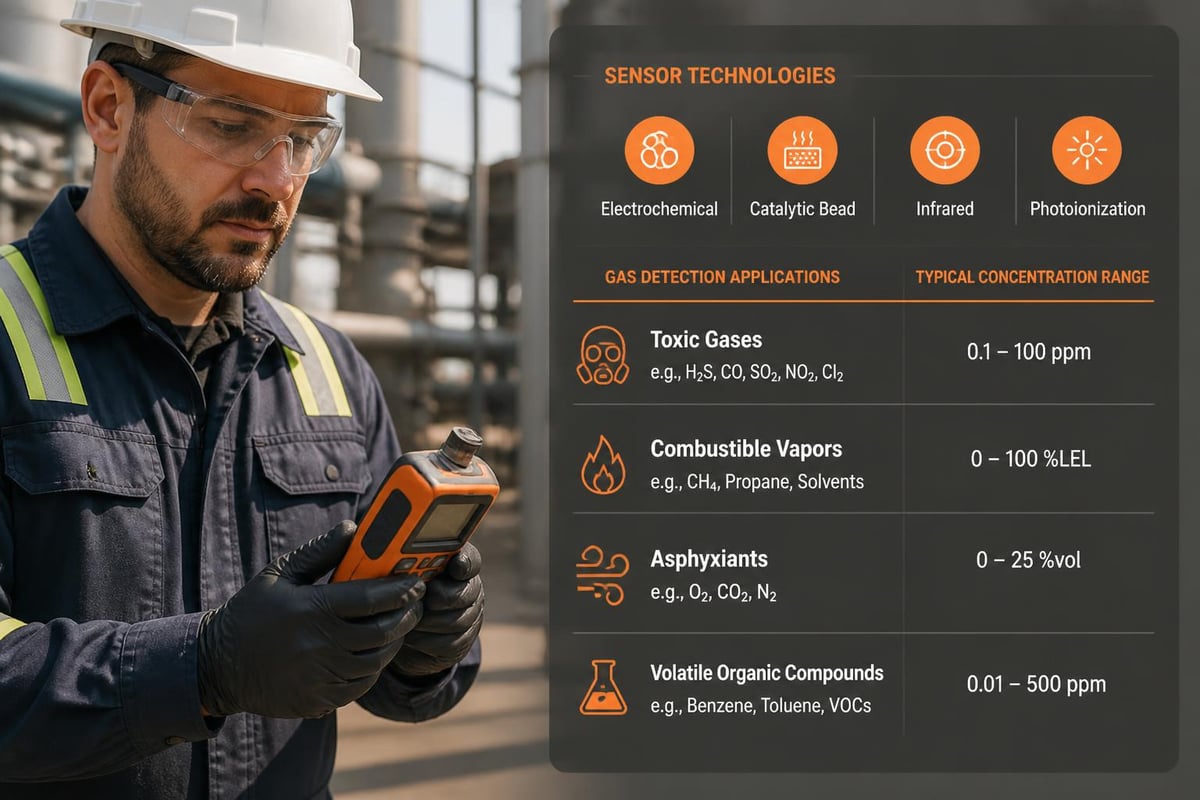
- Sensor technology (electrochemical, catalytic bead, infrared, photoionization) matched to target gases
- Sampling method (diffusion or pump-driven) affecting response time and range
- Alarm systems (audible, visual, vibration) providing multi-sensory warnings
- Data logging capabilities recording time-stamped exposure events
- Calibration protocols ensuring measurement accuracy over instrument lifespan
- Battery systems supporting full-shift operation in hazardous areas
The sensor selection directly impacts detection capabilities. Electrochemical sensors excel at measuring toxic gases like hydrogen sulfide and chlorine at parts-per-million concentrations. Catalytic bead sensors detect combustible gases as percentages of Lower Explosive Limit (LEL). Infrared sensors provide drift-resistant measurements for carbon dioxide and hydrocarbons. UL 2075 establishes requirements that validate detector performance across these sensor types.
How Do You Select the Right Portable Gas Detector for Your Operation
Selection starts with comprehensive hazard assessment identifying all potential gas exposures in your specific operations. Document each work location, process chemistry, and credible release scenarios. This assessment drives detector configuration, not generic equipment catalogs.
Organizations systematically evaluate these selection criteria:
Environmental factors determine housing requirements. Temperature extremes, humidity, dust, and explosive atmosphere classifications (Class I Division 1 or Zone 0/1) mandate specific enclosure ratings. Detectors rated for intrinsically safe operation prevent ignition in flammable atmospheres.
Gas-specific requirements define sensor combinations. Single-gas monitors measure one compound, while multi-gas detectors simultaneously track four or five gases. Typical four-gas configurations measure oxygen, combustible gases, hydrogen sulfide, and carbon monoxide. Specialized applications may require volatile organic compound (VOC) detection or refrigerant monitoring.
Operational duration and mobility influence power and sampling design. Eight-hour shifts require battery capacity exceeding ten hours to account for alarm conditions and peak power draw. Pump-equipped models extend detection range but consume more power and add weight. Diffusion models suit stationary monitoring or personal exposure tracking.
| Detector Type | Application | Advantages | Limitations |
|---|---|---|---|
| Single-gas | Hydrogen sulfide in petrochemical | Compact, low cost, simple operation | Limited scope, multiple units needed |
| Four-gas | Confined space entry | Comprehensive protection, standard configuration | Higher cost, larger size |
| Multi-gas (5+) | Complex chemical operations | Maximum flexibility, custom sensor arrays | Premium pricing, complex calibration |
| Area monitor | Perimeter surveillance | Covers large zones, pump sampling | Not personnel-attached, requires positioning |
Integration with Existing Safety Management Systems
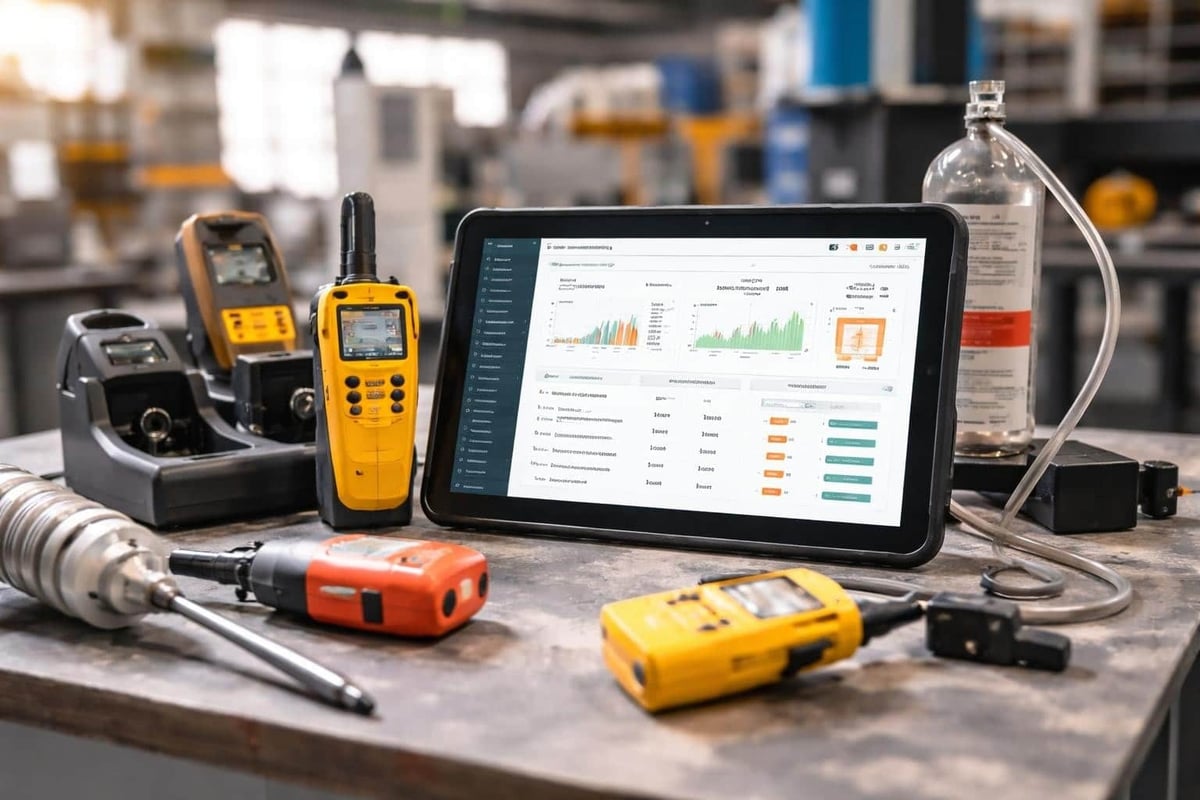
Portable gas detection generates safety-critical data that must integrate with broader safety management infrastructure. Workers perform bump tests before each use and full calibrations at specified intervals. These activities create records demonstrating instrument readiness.
Leading organizations implement systematic tracking of detector inventory, calibration due dates, and incident response events. When detector serial number 4521 alarms at 15:23 on May 15, 2026, the event links to work permit 2026-0515-CS-04, employee badge 8847, and location coordinates in Building 7, Tank Farm. This creates an auditable trail connecting equipment performance to specific work activities.
Software platforms designed for industrial asset management track these relationships. Organizations managing fifty or more detectors benefit from automated calibration scheduling, compliance reporting, and lifecycle cost analysis. The Brytend Service Module provides structured equipment tracking with serialized inventory management, automated service reminders, and certificate generation capabilities that address these portable gas detection fleet management requirements.
What Are the Calibration Requirements and Procedures for Portable Gas Detectors
Calibration establishes and verifies the relationship between sensor output and actual gas concentration. Manufacturers specify calibration intervals based on sensor type, target gas, and exposure conditions. Standard practice requires full calibration every 180 days or according to manufacturer specifications, whichever is more frequent. Electrochemical sensors exposed to high concentrations may require monthly calibration.
The calibration process follows a documented procedure:
- Pre-calibration functional test verifies battery charge, physical condition, and alarm functionality
- Zero calibration establishes baseline reading in clean air or certified zero gas
- Span calibration exposes sensor to certified gas concentration (typically 25% or 50% LEL for combustibles, specific ppm values for toxics)
- Response verification confirms alarm activation at preset thresholds
- Documentation records calibration date, technician ID, gas concentrations used, and pass/fail results
- Label update affixes next-due date to instrument
Certified calibration gases must have known concentrations traceable to national standards. Typical combustible gas calibration uses methane or pentane at 25% LEL (1.25% volume for methane). Hydrogen sulfide calibration typically uses 25 ppm concentration. Gas cylinders expire and require periodic recertification.
Bump Testing vs Full Calibration
Bump testing exposes the detector to target gas concentrations sufficient to trigger alarms, verifying that sensors respond and alarms activate. This functional check takes 30 seconds and precedes each work shift. Organizations implement bump-test-before-use policies enforced through accountability systems.
Full calibration adjusts sensor output to match known gas concentrations when drift exceeds acceptable limits. IEC 60079-29-1 provides test methods for gas detection equipment used in explosive atmospheres, establishing performance criteria that calibration must maintain.
How Should Organizations Implement a Portable Gas Detection Program
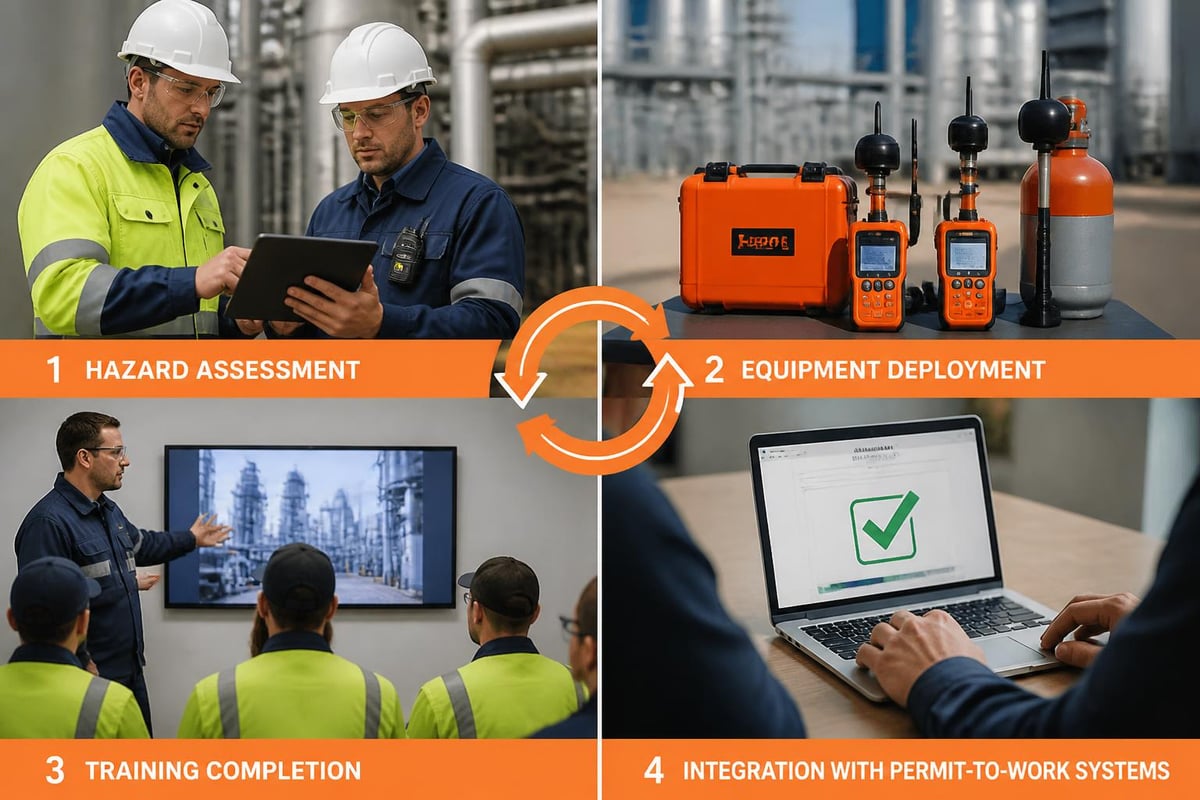
Implementation requires systematic planning across equipment procurement, training, maintenance infrastructure, and operational protocols. Successful programs integrate portable gas detection into existing permit systems, hazard assessments, and emergency response procedures.
Phase 1: Hazard Assessment and Equipment Specification (Weeks 1-4)
Safety teams conduct facility-wide gas hazard assessments documenting potential exposures by location and activity. Chemical inventories, process flow diagrams, and historical incident data identify credible release scenarios. This assessment produces detector specifications including gas types, concentration ranges, alarm setpoints, and environmental ratings.
Phase 2: Policy and Procedure Development (Weeks 3-6)
Written programs establish detector assignment, pre-use inspection requirements, bump testing frequency, calibration intervals, alarm response procedures, and data management protocols. Organizations define authority levels for confined space entry decisions and evacuation triggers. Maintenance procedures specify calibration gas procurement, technician qualification, and record retention periods.
Phase 3: Infrastructure and Inventory Setup (Weeks 5-8)
Calibration stations equipped with certified gases, flow regulators, and documentation systems support maintenance operations. Organizations establish detector assignment systems linking units to departments, shifts, or individual workers. Asset tracking systems record serial numbers, purchase dates, calibration history, and repair records.
Phase 4: Training Deployment (Weeks 7-10)
Training programs address four competency levels:
- End users learn pre-use inspection, bump testing, alarm recognition, and emergency response
- Supervisors master permit authorization, hazard assessment, and incident investigation
- Maintenance technicians develop calibration, repair, and sensor replacement skills
- Program administrators understand compliance requirements, data analysis, and continuous improvement
Phase 5: Pilot Operations and Refinement (Weeks 9-12)
Limited deployment in representative operations identifies implementation gaps. Organizations refine procedures based on practical experience, addressing detector availability, calibration workflow efficiency, and data collection feasibility.
Common Implementation Mistakes and Prevention Strategies
Organizations frequently encounter predictable challenges during portable gas detection program deployment. Insufficient calibration gas inventory creates compliance gaps when cylinders expire before scheduled calibrations. Maintain three-month forward inventory with automated reorder triggers.
Inadequate bump testing compliance results from inconvenient testing locations or time pressures. Position bump testing stations at shift start locations and implement scan-based accountability requiring documented tests before equipment issue.
Poor alarm response protocols leave workers uncertain about evacuation criteria versus investigation procedures. Establish clear action levels: immediate evacuation at IDLH (Immediately Dangerous to Life or Health) concentrations, investigation at TWA (Time-Weighted Average) exceedances, and documentation at any alarm activation.
Data management failures lose critical exposure information. Implement systematic data download schedules, assign responsibility for review, and integrate findings into hazard reassessment cycles.
What Role Does Portable Gas Detection Play in Regulatory Compliance
Occupational safety regulations mandate atmospheric testing before confined space entry and during work in potentially hazardous atmospheres. OSHA 1910.146 (Permit-Required Confined Spaces) requires testing for oxygen content, flammable gases and vapors, and potential toxic air contaminants before employee entry. Portable gas detection provides the measurement capability that satisfies these regulatory requirements.
Compliance extends beyond initial testing. Continuous monitoring throughout work activities detects changing conditions caused by process upsets, ventilation failures, or unexpected chemical reactions. Documentation of atmospheric testing results becomes part of the entry permit record, creating evidence of regulatory compliance and due diligence.
Record Retention and Audit Readiness
Regulatory agencies and insurance carriers examine gas detection records during compliance audits and incident investigations. Organizations maintain multiple record types:
- Equipment calibration logs demonstrating instrument accuracy
- Bump test records proving pre-use functional verification
- Atmospheric test data from confined space permits and work authorizations
- Alarm event logs capturing exposure incidents and response actions
- Training documentation verifying worker competency
Electronic record systems improve accessibility and prevent record loss. Time-stamped data automatically captured by modern detectors eliminates manual transcription errors and provides superior audit trails compared to handwritten logs.
Advanced Detection Technologies and Future Developments
Sensor technology continues advancing, enabling detection of previously challenging compounds at lower concentrations. Miniaturized photoionization detectors now measure volatile organic compounds in compact multi-gas configurations. Recent research in ultra-sensitive refractive index gas sensors demonstrates potential for next-generation detection capabilities using functionalized photonic circuits.
Wireless connectivity transforms portable gas detectors into networked safety systems. Real-time data transmission to central monitoring stations enables immediate response to developing hazards. Location tracking combined with gas concentration data creates spatial hazard maps identifying high-risk zones requiring engineering controls.
Artificial intelligence integration analyzes detection patterns, predicting equipment failures and identifying baseline drift requiring calibration. Machine learning algorithms trained on thousands of alarm events distinguish genuine hazards from sensor malfunctions, reducing false alarm rates that cause worker desensitization.
Internet of Things Integration in Gas Detection Fleets
Connected detector fleets generate massive datasets revealing exposure trends across facilities, shifts, and operations. Analytics platforms identify correlations between process conditions and gas releases, enabling proactive hazard elimination. Organizations track fleet-wide calibration compliance, battery replacement needs, and sensor lifecycle costs through centralized dashboards.
Portable chemical detection platforms for on-site monitoring demonstrate practical applications in natural gas odorant level verification, combining portability with analytical precision previously limited to laboratory instruments.
| Technology Generation | Key Features | Deployment Timeline |
|---|---|---|
| Current (2026) | Multi-gas electrochemical/IR sensors, data logging, Bluetooth connectivity | Widespread deployment |
| Near-term (2027-2028) | AI-assisted alarm validation, cloud integration, predictive maintenance | Early adoption phase |
| Emerging (2029-2031) | Photonic sensors, real-time spectrometry, autonomous calibration verification | Research/pilot programs |
Mini Case Example: Chemical Manufacturing Facility Implementation
A specialty chemical manufacturer with 240 employees across three shift operations implemented a comprehensive portable gas detection program in Q1 2026. The facility processes chlorinated solvents, ammonia refrigeration, and produces various chemical intermediates creating exposure risks to chlorine, ammonia, hydrogen chloride, and combustible vapors.
Initial Assessment Findings: Hazard assessment identified 47 permit-required confined spaces, 12 areas with potential ammonia releases, and 8 chlorine handling locations. Previous program relied on 15 aging single-gas detectors with inconsistent calibration and no data logging.
Equipment Selection: Organization deployed 35 four-gas monitors (O2, LEL, H2S, CO) for general confined space work, 12 chlorine-specific monitors, and 8 ammonia monitors. All units featured data logging, man-down alarms, and wireless connectivity.
Implementation Approach: Systematic rollout included calibration station setup with automated documentation, bump test stations at three shift change locations, and integrated software tracking all 55 instruments by serial number. Training addressed 180 end users, 24 supervisors, and 6 maintenance technicians.
Results After Six Months: The facility documented 1,247 confined space entries with zero atmospheric test failures to perform required monitoring. Calibration compliance reached 100% through automated scheduling. Data analysis revealed three process areas with elevated background combustible gas readings, prompting engineering investigation and ventilation improvements. Workers reported increased confidence in hazard control effectiveness.
Frequently Asked Questions About Portable Gas Detection
How often should portable gas detectors be calibrated?
Calibration frequency depends on manufacturer specifications, sensor type, and exposure conditions. Standard practice requires full calibration every 180 days. Electrochemical sensors exposed to high target gas concentrations may require monthly calibration. Organizations performing frequent bump tests may extend calibration intervals if manufacturer data supports detector stability, but never exceed manufacturer maximum intervals.
What is the difference between TWA and STEL alarm setpoints?
TWA (Time-Weighted Average) represents average exposure over an eight-hour shift. STEL (Short-Term Exposure Limit) measures 15-minute average exposures. Detectors configured for toxic gas monitoring typically alarm at STEL values, providing warning before exposures reach levels causing acute health effects. Some units display both values simultaneously, tracking cumulative exposure and peak short-term concentrations.
Can one detector model cover all gas hazards in a facility?
No single detector addresses all possible gas hazards. Different sensor technologies measure specific gas classes. Organizations typically deploy multiple detector types: multi-gas units for routine confined space work, specialized toxic gas monitors for process-specific hazards, and combustible gas indicators for flammable vapor monitoring. Comprehensive programs maintain equipment variety matching facility hazard profiles.
What factors affect portable gas detector battery life?
Operating temperature, alarm frequency, pump operation, and wireless transmission significantly impact battery runtime. Cold temperatures reduce lithium-ion battery capacity by 20-40%. Continuous alarm conditions drain batteries faster than normal monitoring. Pump-equipped detectors consume substantially more power than diffusion units. Most manufacturers specify 10-14 hour runtime under normal conditions, but real-world performance varies.
How do you verify a portable gas detector is working properly before use?
Pre-use verification combines visual inspection, functional testing, and bump testing. Inspect for physical damage, check battery charge level, verify alarm activation through self-test routines, and perform bump test exposing sensors to target gases. The detector must alarm at appropriate concentrations for each sensor. Failed bump tests require immediate calibration before the unit returns to service.
What documentation must accompany portable gas detectors during regulatory inspections?
Inspectors examine calibration records showing dates, technician identity, gases used, and pass/fail results for each instrument. Bump test logs document pre-use functional verification. Atmospheric monitoring data from permits demonstrates actual field use. Maintenance records track repairs and sensor replacements. Training documentation proves user competency. Organizations should maintain three years of records minimum, though some jurisdictions require longer retention.
How does temperature affect gas detector accuracy?
Sensor performance varies with temperature. Electrochemical sensors experience sensitivity changes outside their specified operating range, typically -20°C to 50°C. Catalytic bead sensors require minimum temperatures for combustion reactions. Organizations operating in extreme environments select instruments rated for expected conditions and apply temperature compensation factors when specified by manufacturers. Advanced sensor research addresses detection challenges in varying environmental conditions.
Portable gas detection protects industrial workers through systematic monitoring, proper equipment selection, rigorous maintenance, and integrated safety management. Organizations implementing comprehensive programs combine appropriate technology with documented procedures, competent personnel, and continuous improvement based on exposure data analysis. Brytend develops custom software solutions that integrate equipment tracking, calibration scheduling, compliance reporting, and data management capabilities into unified platforms supporting industrial safety operations and regulatory requirements.