
TL;DR
- Prospects are qualified leads that demonstrate clear buying intent, budget authority, and alignment with your solution
- Effective prospecting requires systematic lead scoring, engagement tracking, and multi-touch verification workflows
- CRM systems automate prospect qualification through behavioral tracking, predictive scoring, and workflow triggers
- The conversion from lead to prospect typically involves 5-7 touchpoints and explicit qualification criteria
- Organizations that define clear prospect criteria achieve 24-38% higher conversion rates than those using inconsistent methods
A prospect is a qualified lead who has demonstrated genuine purchase intent, possesses budget authority or influence, and meets specific criteria indicating they are likely to become a customer within a defined timeframe.
What Defines a Qualified Prospect in B2B Sales
A prospect differs fundamentally from a raw lead through specific qualification markers that indicate readiness to engage in the buying process. Understanding sales prospecting begins with establishing clear boundaries between information gatherers and genuine opportunities.
Qualified prospects exhibit three core characteristics that distinguish them from general leads:
- Budget authority: Direct control or significant influence over purchasing decisions within their organization
- Verified need: Documented pain points or requirements that align with your solution capabilities
- Timeline commitment: Defined implementation window or decision deadline within the next 3-12 months
The qualification framework extends beyond surface-level interest. A prospect must have access to necessary resources, including technical infrastructure, stakeholder alignment, and implementation capacity. Organizations frequently encounter individuals who express interest but lack authority to move forward. These contacts remain leads until qualification criteria are met.

Distinguishing Leads from Prospects
The difference between leads and prospects centers on qualification depth and engagement level. A lead represents any contact who has shown initial interest through form submission, content download, or inquiry. A prospect has undergone systematic evaluation and met specific thresholds.
| Criteria | Lead | Prospect |
|---|---|---|
| Qualification Status | Unverified interest | Validated fit and need |
| Budget Information | Unknown | Confirmed or estimated |
| Engagement Level | Single touchpoint | Multiple interactions |
| Timeline | Unspecified | Defined decision window |
| Authority | Unverified role | Confirmed decision influence |
Custom software development projects require particularly rigorous prospect qualification because implementation timelines extend 3-18 months and involve significant technical coordination. A manufacturing director downloading a whitepaper on inventory management remains a lead. That same director becomes a prospect after confirming a Q3 2026 implementation target, $150K budget allocation, and authority to select vendors.
How to Identify High-Quality Prospects Systematically
Systematic prospect identification relies on defined scoring models that assign point values to behavioral signals and firmographic attributes. Sales prospecting strategies emphasize repeatable processes over ad-hoc evaluation.
Implement a multi-dimensional scoring framework:
- Firmographic scoring: Company size, industry vertical, revenue range, technology stack, and growth indicators
- Behavioral scoring: Website visits, content engagement, email responses, demo requests, and feature inquiries
- Engagement recency: Interaction frequency within the past 7, 14, and 30 days
- Authority indicators: Job title, department, organizational chart position, and budget responsibility signals
A prospect scoring threshold of 75+ points (on a 100-point scale) typically indicates qualification readiness. Points accumulate through verified actions. Viewing a pricing page adds 8 points. Requesting a technical architecture consultation adds 25 points. Confirming budget allocation adds 30 points.
The Brytend CRM enables automated prospect scoring through customizable rules that track engagement patterns, assign point values, and trigger notifications when contacts cross qualification thresholds. Organizations can define industry-specific criteria and adjust scoring weights based on conversion data.

Behavioral Signals That Indicate Prospect Readiness
Specific behavioral patterns reveal purchase intent more reliably than demographic data alone. Prospects exhibit concentrated research activity within compressed timeframes.
Watch for these high-intent behaviors:
- Repeat visits to pricing, implementation, or technical documentation pages within 72 hours
- Multiple stakeholders from the same organization engaging with content simultaneously
- Specific feature comparison questions that reference competing solutions
- Requests for custom demonstrations or proof-of-concept proposals
- Downloads of technical specifications, API documentation, or integration guides
A manufacturing operations manager who visits service management content once monthly remains a lead. When that manager visits 12 pages across three sessions in one week, downloads a service workflow template, and emails questions about serialized inventory tracking, they transition to prospect status.
What Steps Convert Leads into Qualified Prospects
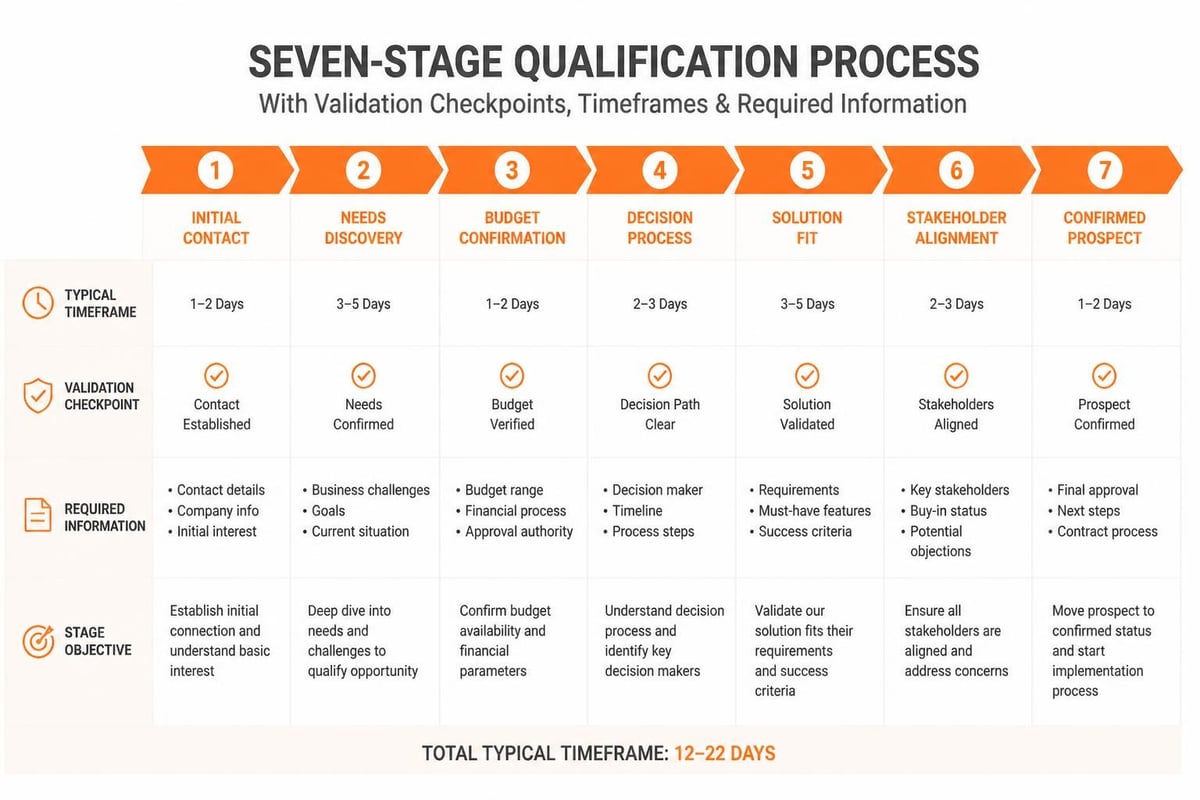
Converting leads to prospects requires a structured progression through defined qualification stages. Each stage validates specific information and moves contacts closer to opportunity status.
Follow this seven-step qualification workflow:
- Initial contact response: Acknowledge inquiry within 2 hours and confirm basic information
- Discovery call scheduling: Secure 15-30 minute conversation to understand requirements
- Need validation: Document specific pain points, current solutions, and desired outcomes
- Budget discussion: Confirm investment range and funding approval process
- Timeline establishment: Define decision milestones, implementation start date, and go-live target
- Stakeholder mapping: Identify all decision participants and their roles
- Qualification confirmation: Verify all criteria are met before prospect designation
This progression typically spans 14-45 days depending on solution complexity and organizational decision processes. Custom software projects with $200K+ budgets require longer qualification periods than standardized solutions.
Documentation Requirements for Prospect Status
Systematic documentation ensures consistent qualification standards across sales teams and enables accurate forecasting. Each prospect record must contain verified information in standardized fields.
Required documentation elements include:
- Primary contact name, title, email, phone, and direct authority level
- Company details: size, revenue, industry, locations, and relevant technology stack
- Pain points: specific problems requiring solution with business impact quantification
- Budget range: confirmed or estimated investment capacity with approval timeline
- Decision process: steps required, stakeholders involved, and typical duration
- Competition: alternative solutions under consideration or currently deployed
- Timeline: key dates for evaluation, decision, contracting, and implementation
Missing information in any category indicates incomplete qualification. Organizations implementing prospect qualification standards report 31% shorter sales cycles due to reduced discovery redundancy and more accurate resource allocation.
Why Prospect Qualification Determines Sales Efficiency
Prospect qualification directly impacts resource allocation, forecast accuracy, and revenue predictability. Sales teams that advance unqualified leads waste 40-60% of selling time on contacts unlikely to convert.
Effective qualification delivers measurable business outcomes:
- Improved conversion rates: Qualified prospects convert at 15-25% versus 2-5% for unqualified leads
- Shorter sales cycles: Focused effort on ready buyers reduces average cycle time by 20-35%
- Better forecast accuracy: Pipeline based on qualified prospects achieves 85%+ forecast reliability
- Optimized resource allocation: Sales effort concentrates on high-probability opportunities
- Higher average deal value: Qualified prospects with confirmed budgets close at 18-30% higher values
A software development team evaluating ten unqualified leads might schedule five discovery calls, conduct three demonstrations, and close zero deals. The same team evaluating ten qualified prospects schedules eight calls, conducts six demonstrations, and closes two deals. The prospect-focused approach yields 200% better results with 20% less total effort.
Cost Impact of Poor Qualification
Pursuing unqualified leads creates cascading inefficiencies throughout the sales organization. Each unqualified contact consumes resources that could address genuine prospects.
Typical cost breakdown per unqualified lead pursued to final proposal:
| Activity | Time Investment | Opportunity Cost |
|---|---|---|
| Discovery calls | 2-3 hours | $150-300 |
| Demonstration preparation | 3-4 hours | $200-400 |
| Custom proposal development | 5-8 hours | $400-800 |
| Follow-up communications | 2-4 hours | $150-350 |
| Technical consultation | 4-6 hours | $350-650 |
| Total per unqualified lead | 16-25 hours | $1,250-2,500 |
Organizations pursuing 50 unqualified leads annually waste $62,500-$125,000 in direct opportunity cost. This calculation excludes morale impact, forecast inaccuracy, and delayed revenue from missed genuine prospects.
How CRM Systems Automate Prospect Management
Customer relationship management platforms transform manual qualification processes into automated workflows that scale efficiently. Modern CRM systems track engagement, apply scoring rules, and trigger qualification actions without human intervention.
Core CRM automation capabilities for prospect management include:
- Behavioral tracking: Automatic capture of website visits, email opens, content downloads, and event attendance
- Lead scoring: Real-time point calculation based on configurable rules and machine learning models
- Workflow triggers: Automated task creation, email sequences, and notification delivery when score thresholds are met
- Data enrichment: Automatic population of firmographic data from third-party sources
- Multi-touch attribution: Tracking which interactions contributed to qualification and conversion
Organizations using automated prospect management reduce time-to-qualification by 45-60% compared to manual methods. Automation ensures consistent criteria application and eliminates subjective judgment variations across team members.
Integration Requirements for Effective Prospect Tracking
Prospect management systems require integration with multiple data sources to maintain accurate, current information. Isolated CRM platforms lack behavioral context necessary for reliable qualification.
Essential integration points include:
- Website analytics platforms for page view, session duration, and navigation pattern tracking
- Marketing automation systems for email engagement, campaign responses, and content interaction data
- Calendar and communication tools for meeting scheduling, call logging, and correspondence tracking
- Financial systems for deal value, payment history, and credit status information
- Support ticketing platforms for issue frequency, resolution time, and satisfaction scores
A manufacturing prospect researching service management solutions generates signals across multiple systems. Website analytics shows pricing page visits. Marketing automation tracks service workflow template downloads. Calendar integration logs discovery call scheduling. Brytend custom integrations unify these signals into a single prospect view that enables accurate qualification decisions.
What Challenges Complicate Prospect Qualification
Prospect qualification faces systematic obstacles that reduce accuracy and slow conversion processes. Understanding common challenges enables proactive mitigation strategies.
Primary qualification challenges include:
- Incomplete information: Prospects withhold budget, timeline, or authority details during early interactions
- Committee decisions: Multiple stakeholders with varying priorities complicate authority assessment
- Extended timelines: Enterprise decisions spanning 6-18 months blur qualification boundaries
- Competitor engagement: Prospects simultaneously evaluating 3-5 solutions reduce commitment signals
- Technical complexity: Custom software requirements resist standardized qualification criteria
Organizations implementing prospecting best practices address these challenges through structured discovery frameworks that systematically extract necessary information across multiple touchpoints.
Managing Multi-Stakeholder Prospect Dynamics
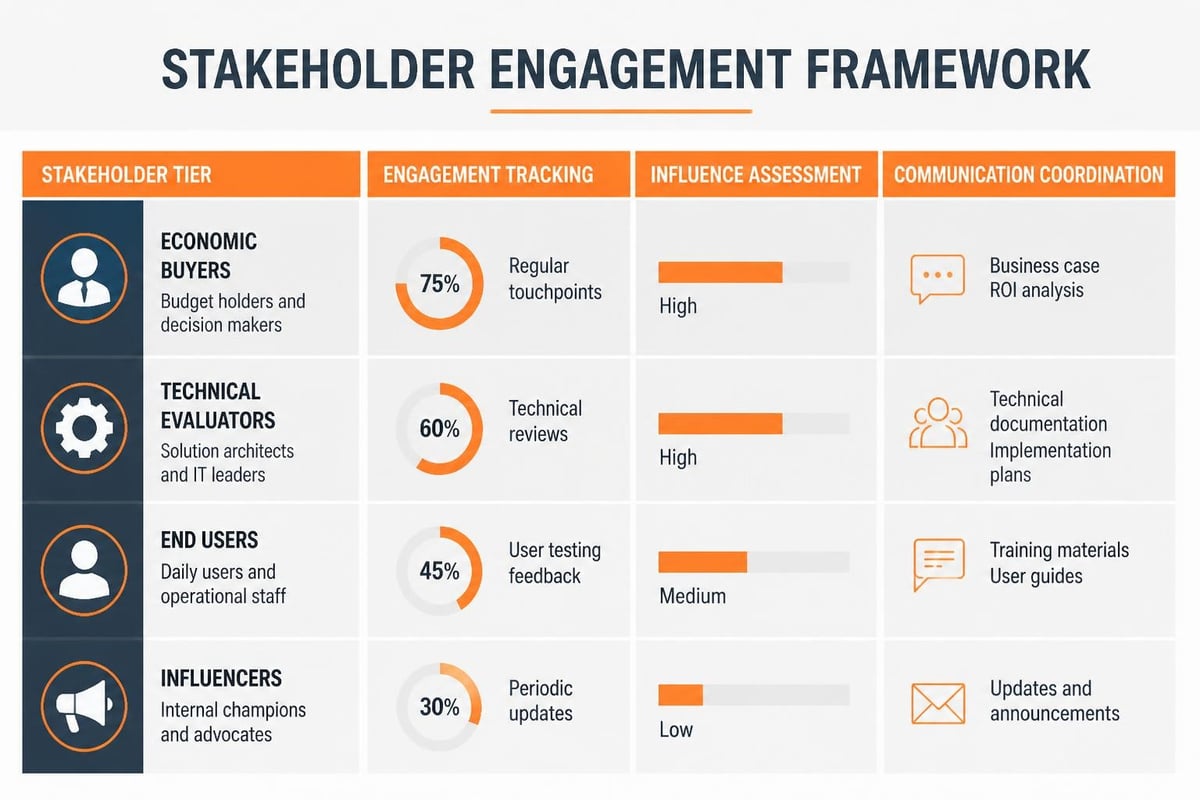
Complex B2B purchases involve 6-10 stakeholders with different priorities, evaluation criteria, and decision influence levels. Qualifying prospects requires understanding the complete stakeholder ecosystem.
Map prospect organizations using a four-tier structure:
- Economic buyer: Final authority over budget allocation and vendor selection
- Technical evaluator: Assesses solution capabilities, integration requirements, and implementation feasibility
- End users: Daily system operators who influence adoption success and satisfaction
- Influencers: Internal advocates or external consultants who shape decision criteria
A qualified prospect identification includes all tier 1 and tier 2 contacts with documented engagement from each. Manufacturing prospects evaluating service management platforms require confirmation from operations directors (economic buyers), IT managers (technical evaluators), maintenance supervisors (end users), and potentially external consultants (influencers).
How to Optimize Prospect Nurturing Workflows
Effective prospect nurturing maintains engagement while advancing qualification without premature pressure. Optimization balances education, relationship building, and systematic information gathering.
Implement a stage-based nurturing framework:
Early-stage prospects (qualification score 40-60)
- Educational content: Industry reports, best practice guides, and capability overviews
- Engagement frequency: Weekly email touchpoints with monthly direct outreach
- Call-to-action focus: Content downloads, webinar registration, and newsletter subscription
Mid-stage prospects (qualification score 61-80)
- Solution-specific content: Case studies, technical documentation, and implementation guides
- Engagement frequency: Bi-weekly email with bi-weekly direct contact
- Call-to-action focus: Demonstration requests, consultation scheduling, and assessment tools
Late-stage prospects (qualification score 81-100)
- Decision-support content: ROI calculators, comparison frameworks, and proposal templates
- Engagement frequency: Weekly direct contact with customized follow-up
- Call-to-action focus: Proposal review, stakeholder meetings, and contracting discussions
This graduated approach aligns resource intensity with conversion probability. Early-stage prospects receive automated nurturing while late-stage prospects justify direct sales involvement.
Common Prospect Nurturing Mistakes
Organizations frequently implement nurturing workflows that accelerate disqualification rather than advance genuine prospects. Avoiding these errors improves conversion efficiency.
Critical mistakes to prevent:
- Excessive contact frequency that triggers prospect disengagement or opt-out
- Generic content that fails to address specific prospect pain points or use cases
- Premature pricing discussions before value establishment and need confirmation
- Inconsistent follow-up that creates prospect uncertainty about process and timeline
- Single-channel communication that misses prospect preferences for phone, email, or video
A custom software development firm nurturing prospects evaluating service management solutions should provide serialized inventory tracking examples, preventive maintenance workflow templates, and compliance documentation capabilities rather than generic "increase efficiency" messaging. Specificity demonstrates expertise and validates prospect research.
Comparison: Manual vs. Automated Prospect Management
| Aspect | Manual Methods | Automated Systems |
|---|---|---|
| Lead scoring | Subjective, inconsistent | Rule-based, consistent |
| Engagement tracking | Incomplete, delayed | Real-time, comprehensive |
| Qualification time | 30-45 days average | 15-25 days average |
| Team coordination | Email, meetings | Shared dashboards, alerts |
| Data accuracy | 60-70% | 85-95% |
| Scalability | Linear with headcount | Exponential with automation |
What Metrics Measure Prospect Quality and Pipeline Health
Effective prospect management requires quantitative measurement of qualification accuracy, pipeline progression, and conversion performance. Vital prospecting metrics enable continuous improvement through data-driven refinement.
Monitor these core prospect performance indicators:
Qualification metrics
- Lead-to-prospect conversion rate: Percentage of leads meeting qualification criteria
- Average qualification time: Days from initial contact to prospect status confirmation
- Qualification score accuracy: Correlation between score and actual conversion
- Disqualification reasons: Categories and frequency of prospects that fail to convert
Pipeline metrics
- Prospect-to-opportunity conversion: Percentage advancing from prospect to active deal
- Pipeline velocity: Average days prospects spend in qualification before advancing or disqualifying
- Stage progression rates: Conversion percentages between each pipeline stage
- Pipeline value coverage: Total prospect value relative to revenue targets
Outcome metrics
- Win rate by prospect source: Conversion rates by initial acquisition channel
- Average deal size by prospect type: Revenue variation across qualification segments
- Sales cycle length: Time from prospect status to closed deal
- Customer acquisition cost: Total expense divided by conversions from prospect stage
Organizations should establish baseline metrics, set improvement targets, and implement monthly reviews. A typical optimization goal increases lead-to-prospect conversion from 15% to 22% while reducing qualification time from 35 to 25 days.
Case Example: Manufacturing Equipment Service Prospects
A precision manufacturing equipment provider implemented systematic prospect qualification for their service contract renewals and expansions. Previously, the sales team treated all service inquiries as equal opportunities, resulting in 8% conversion rates and 60-day sales cycles.
The organization established qualification criteria including:
- Equipment serial numbers and current service status verification
- Annual service budget confirmation exceeding $25,000
- Authority confirmation for service contract decisions
- Identified pain points related to downtime, compliance, or preventive maintenance
- Implementation timeline within next 90 days
After implementing these standards, prospects received structured nurturing based on qualification scores. High-scoring prospects engaged with technical consultants for customized service plans. Low-scoring contacts entered automated education workflows.
Results after six months:
- Lead-to-prospect conversion increased to 28%
- Prospect-to-customer conversion reached 35%
- Average sales cycle decreased to 38 days
- Average contract value increased 23%
- Sales team capacity expanded 40% through better focus
The qualification framework enabled resource concentration on genuinely ready buyers while maintaining long-term relationships with earlier-stage contacts.
How Prospect Qualification Adapts for Complex Solutions
Custom software development and technical implementation projects require qualification frameworks that address unique complexity factors. Standard B2B qualification models prove insufficient for solutions involving 6-18 month implementations, custom development, and significant organizational change.
Enhanced qualification criteria for complex solutions include:
- Technical environment assessment: Current systems, integration requirements, data migration scope, and infrastructure capacity
- Implementation resources: Internal technical staff availability, project management capability, and change management support
- Scope definition clarity: Documented requirements, success criteria, and acceptance standards
- Risk tolerance: Organizational capacity for custom development uncertainty and iterative refinement
- Post-implementation support: Long-term maintenance expectations, upgrade plans, and enhancement budgets
A manufacturing organization seeking custom service management software represents a qualified prospect only after confirming technical prerequisites, dedicated implementation resources, documented workflow requirements, realistic timeline expectations, and ongoing support commitment. Missing any element indicates premature qualification.
Technical Discovery Requirements
Complex solution prospects require deeper technical discovery than standard product sales. This investigation validates feasibility and identifies implementation obstacles before significant resource commitment.
Conduct technical qualification through:
- System architecture review: Document current technology stack, hosting environment, security requirements, and integration endpoints
- Data assessment: Evaluate data volume, structure, quality, migration complexity, and historical retention needs
- User environment analysis: Identify user locations, device types, network conditions, and accessibility requirements
- Compliance verification: Confirm regulatory requirements, industry standards, audit needs, and documentation obligations
- Scalability planning: Project growth trajectories, capacity requirements, and performance thresholds
This technical qualification runs parallel to commercial qualification. A prospect with confirmed budget and timeline but unresolved technical blockers remains unqualified until feasibility confirmation. Organizations that separate commercial and technical qualification experience 35-40% higher project success rates.
Effective prospect management transforms sales efficiency through systematic qualification, automated tracking, and continuous refinement based on conversion data. Organizations that implement clear prospect criteria, structured nurturing workflows, and integrated CRM systems consistently outperform competitors using ad-hoc methods. Brytend develops custom CRM solutions and prospect management systems tailored to your specific qualification requirements, integration needs, and sales processes. Contact us to discuss how custom software can optimize your prospect identification and conversion workflows.


