
The healthcare industry continues its digital transformation at an unprecedented pace, with medical software development services playing a critical role in improving patient care, streamlining operations, and ensuring regulatory compliance. From electronic health records (EHR) to telemedicine platforms and diagnostic tools, custom software solutions are reshaping how healthcare providers deliver services. Understanding the scope, requirements, and best practices for developing medical software has become essential for organizations seeking to modernize their operations while maintaining the highest standards of safety and compliance.
Understanding the Scope of Medical Software Development
Medical software development services encompass a wide range of applications designed to support healthcare delivery, administration, and patient engagement. These solutions must balance technical innovation with strict regulatory requirements and patient safety considerations.
Healthcare software falls into several distinct categories, each serving specific clinical or administrative needs. Practice management systems handle scheduling, billing, and resource allocation. Clinical decision support tools assist physicians in diagnosis and treatment planning. Patient portals enable individuals to access their medical records and communicate with providers. Medical imaging software processes and analyzes diagnostic scans. Each category requires specialized expertise and understanding of healthcare workflows.
The development process for medical applications differs significantly from general software projects. Developers must navigate complex regulatory frameworks, implement robust security measures, and ensure interoperability with existing healthcare systems. Medical software development lifecycle involves extensive planning, risk assessment, and validation to meet industry standards.
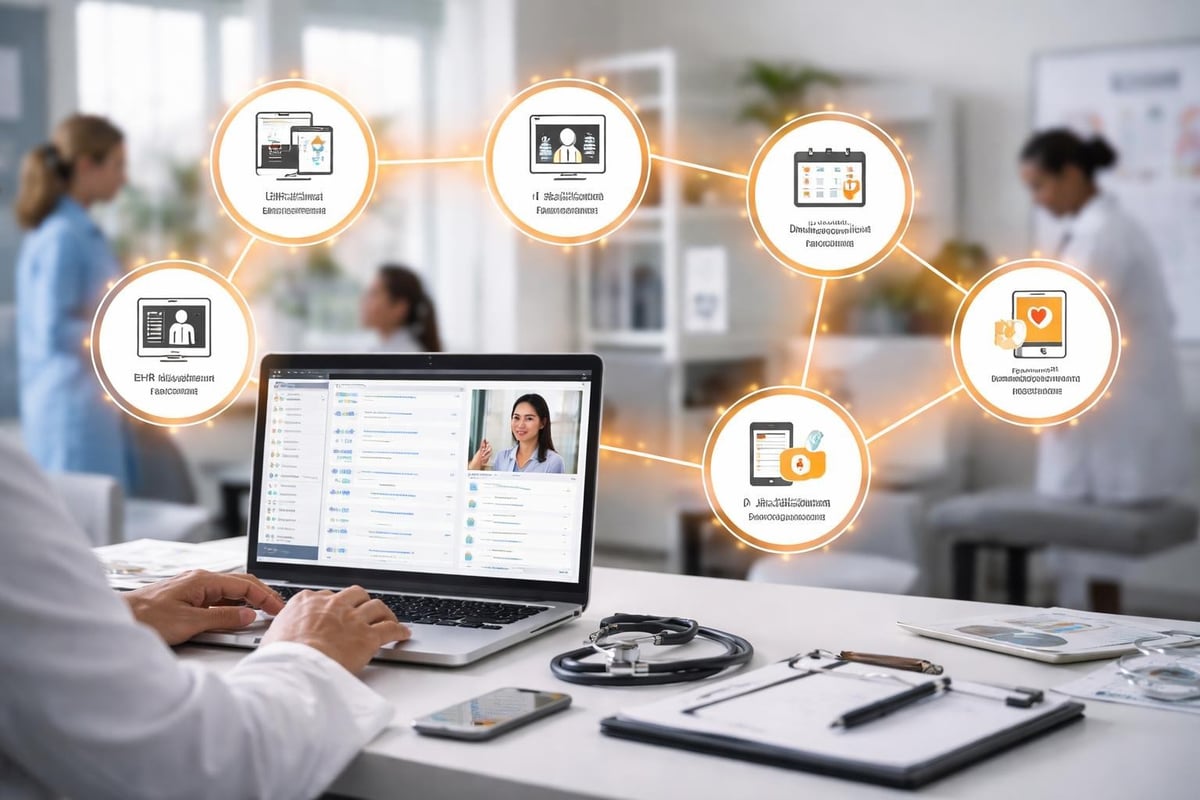
Key Components of Healthcare Software Solutions
- Electronic Health Records (EHR) serve as the foundation of modern healthcare IT infrastructure, storing comprehensive patient information accessible to authorized providers
- Interoperability frameworks enable seamless data exchange between different systems using standards like HL7 FHIR and DICOM
- Security architecture protects sensitive health information through encryption, access controls, and audit logging
- User interface design prioritizes clinical workflows and reduces cognitive load for healthcare professionals
- Analytics capabilities transform patient data into actionable insights for improved outcomes and operational efficiency
Medical software development services must address these components while maintaining compliance with evolving standards and regulations. The best electronic health record software solutions demonstrate how technical excellence and clinical utility converge to create valuable tools for healthcare providers.
Regulatory Compliance and Quality Standards
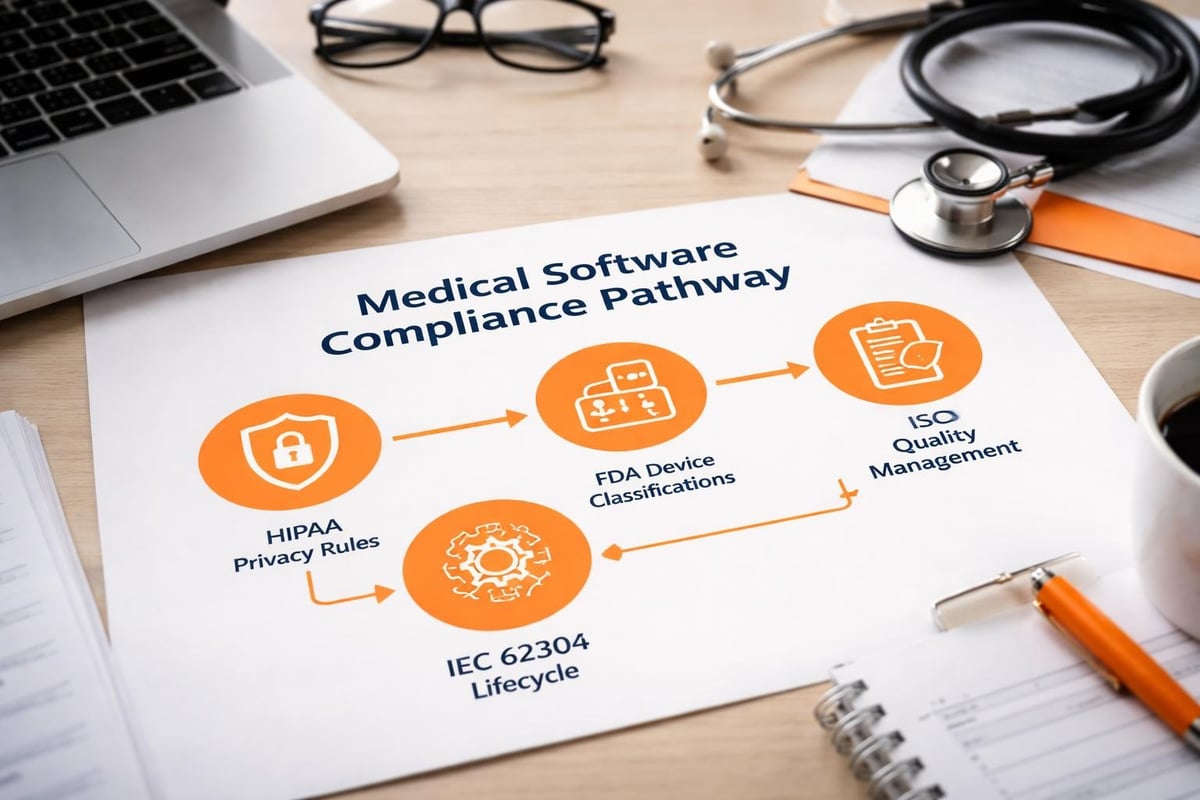
The regulatory landscape for medical software development services presents one of the most challenging aspects of healthcare technology projects. Multiple governing bodies establish requirements that developers must satisfy before deploying solutions in clinical settings.
HIPAA and Data Privacy Requirements
The Health Insurance Portability and Accountability Act (HIPAA) establishes strict standards for protecting patient health information. Software developers must implement technical safeguards including encryption at rest and in transit, secure authentication mechanisms, and comprehensive audit trails. Administrative safeguards require policies for workforce training, access management, and incident response. Physical safeguards protect the infrastructure hosting sensitive data.
Privacy requirements extend beyond technical implementation to encompass business processes and contractual obligations. Development teams must understand the distinction between Protected Health Information (PHI) and de-identified data, implement minimum necessary access controls, and establish breach notification procedures.
| Regulatory Framework | Primary Focus | Geographic Scope | Key Requirements |
|---|---|---|---|
| HIPAA | Patient data privacy | United States | Encryption, access controls, audit logs |
| FDA regulations | Device safety and effectiveness | United States | Risk management, clinical validation |
| IEC 62304 | Software lifecycle processes | International | Development planning, verification, maintenance |
| ISO 13485 | Quality management systems | International | Design controls, documentation, traceability |
| GDPR | Data protection and privacy | European Union | Consent management, data minimization, right to erasure |
FDA Approval and Software as a Medical Device
Software that diagnoses, treats, or prevents disease may qualify as a medical device requiring FDA oversight. The classification determines the level of regulatory scrutiny and the approval pathway. Class I devices pose minimal risk and typically require only general controls. Class II devices need premarket notification through the 510(k) process. Class III devices demand rigorous premarket approval demonstrating safety and effectiveness.
Official guidelines for medical software development emphasize risk-based approaches to quality management. Development teams must conduct hazard analysis, implement risk controls, and validate that software performs as intended across anticipated use scenarios.
Technical Architecture and Development Practices
Building robust medical software requires architectural decisions that prioritize security, scalability, and reliability. The technical foundation determines whether applications can meet clinical demands while protecting patient information.
Security-First Design Principles
Medical software development services incorporate security throughout the development lifecycle rather than treating it as an afterthought. Threat modeling identifies potential vulnerabilities before writing code. Secure coding practices prevent common exploits like SQL injection and cross-site scripting. Penetration testing validates defensive measures against realistic attack scenarios.
Authentication and authorization mechanisms must balance security with clinical usability. Multi-factor authentication protects against credential theft while single sign-on reduces password fatigue. Role-based access control ensures users see only information relevant to their responsibilities. Session management prevents unauthorized access through abandoned workstations.
Data encryption protects information throughout its lifecycle. Transport Layer Security (TLS) secures data in transit between clients and servers. Advanced Encryption Standard (AES) protects data at rest in databases and file systems. Key management procedures prevent unauthorized decryption while enabling authorized access.
Interoperability and Integration Standards
Healthcare organizations operate numerous specialized systems that must exchange information seamlessly. Medical software development services implement standardized interfaces enabling this interoperability.
- HL7 FHIR (Fast Healthcare Interoperability Resources) provides a modern REST-based API for exchanging clinical data
- HL7 v2 messaging supports legacy systems with structured text-based transactions
- DICOM (Digital Imaging and Communications in Medicine) handles medical images and related information
- IHE (Integrating the Healthcare Enterprise) profiles specify how to combine standards for specific clinical scenarios
- CDA (Clinical Document Architecture) structures clinical documents in XML format for exchange and persistence
Best practices in medical application development emphasize designing for integration from the project's inception. APIs should follow RESTful principles with comprehensive documentation. Data models should align with industry standards while accommodating organizational requirements. Error handling must provide meaningful feedback without exposing security vulnerabilities.
Cloud Infrastructure and Deployment
Cloud platforms offer scalability and reliability advantages for medical software, but implementation requires careful consideration of compliance requirements. HIPAA-compliant cloud services provide Business Associate Agreements and technical safeguards for PHI. Redundancy and failover ensure availability during infrastructure failures. Backup and disaster recovery procedures protect against data loss.
Brytend's expertise in cloud computing enables healthcare organizations to leverage modern infrastructure while maintaining compliance with regulatory requirements. By implementing proper security controls and architectural patterns, custom software solutions can harness cloud capabilities for improved performance and reduced operational overhead.

Development Methodology and Project Management
The complexity of medical software demands rigorous project management and development methodologies that accommodate regulatory requirements while maintaining development velocity.
Agile Approaches in Regulated Environments
Traditional waterfall methodologies aligned well with regulatory documentation requirements but struggled to accommodate changing requirements and iterative refinement. Agile frameworks adapted to healthcare contexts enable flexibility within compliance constraints.
Iterative development delivers working software in short cycles while maintaining traceability to requirements. Continuous integration automates testing to detect defects early. Retrospectives improve processes while documenting lessons learned. Product backlogs prioritize features based on clinical value and regulatory necessity.
Documentation remains essential but shifts from comprehensive upfront specifications to iterative refinement. Requirements traceability matrices link features to design documents, test cases, and validation evidence. Version control systems maintain audit trails of code changes. Automated testing frameworks validate functionality while generating compliance evidence.
| Development Phase | Key Activities | Compliance Artifacts | Timeline Considerations |
|---|---|---|---|
| Requirements | Stakeholder interviews, workflow analysis | Requirements specification, use cases | 2-4 weeks |
| Design | Architecture planning, risk analysis | Design documents, risk management file | 3-6 weeks |
| Implementation | Coding, unit testing, integration | Source code, test results | 8-16 weeks |
| Verification | System testing, usability evaluation | Test protocols, validation reports | 4-8 weeks |
| Validation | Clinical evaluation, regulatory review | Clinical data, submission documents | 4-12 weeks |
Risk Management Throughout Development
Medical device software development requires systematic risk management as specified in ISO 14971. The process identifies hazards, estimates risks, implements controls, and evaluates residual risk.
- Hazard identification examines how software might cause harm through malfunction, misuse, or security breaches
- Risk analysis estimates severity and probability for each identified hazard
- Risk evaluation determines whether risks are acceptable or require additional controls
- Risk control implements measures to reduce unacceptable risks through design changes, protective measures, or warnings
- Risk-benefit analysis justifies residual risks against clinical benefits
- Risk management report documents the entire process and conclusions
Development teams must update risk assessments as software evolves and new hazards emerge. Security vulnerabilities discovered in third-party components may introduce new risks requiring evaluation and mitigation.
Testing and Validation Strategies
Medical software development services invest significant resources in testing and validation to ensure software performs safely and effectively across diverse clinical scenarios.
Comprehensive Testing Approaches
Testing methodologies for healthcare applications extend beyond functional verification to encompass usability, security, and performance under realistic conditions.
Unit testing validates individual components in isolation. Integration testing verifies that modules work together correctly. System testing confirms the complete application meets requirements. Regression testing ensures changes don't break existing functionality. Performance testing validates response times under anticipated load. Security testing attempts to exploit vulnerabilities.
Usability testing deserves particular attention in medical software. Clinical workflows operate under time pressure with frequent interruptions. Poor interface design can lead to errors with serious consequences. Testing with representative users in simulated clinical environments identifies usability issues before deployment.
Clinical Validation and Real-World Evidence
Software intended to support clinical decisions requires validation with real patient data and clinical outcomes. Retrospective studies apply software to historical cases with known outcomes. Prospective studies evaluate software performance in current clinical practice. Randomized controlled trials provide the highest level of evidence for clinical effectiveness.
MedTech software development emphasizes the importance of clinical evidence in regulatory submissions and market acceptance. Validation data demonstrates that software performs accurately across diverse patient populations and clinical settings.
User Experience and Clinical Workflow Integration
The most technically sophisticated medical software fails if healthcare professionals cannot use it effectively during patient care. Medical software development services must prioritize user experience design that supports clinical workflows.
Design for Clinical Environments
Healthcare settings present unique challenges for software interfaces. Providers work under time pressure with frequent interruptions. They need rapid access to critical information while maintaining awareness of patient context. Information density must balance completeness with readability. Navigation patterns should minimize clicks to complete common tasks. Visual hierarchy directs attention to clinically significant data.
Responsive design enables access across devices from desktop workstations to tablets and smartphones. Offline functionality maintains productivity when network connectivity fails. Voice interfaces reduce manual data entry in sterile environments.
- Contextual awareness surfaces relevant information based on current patient, task, and user role
- Streamlined data entry uses templates, auto-completion, and default values to reduce documentation burden
- Visual cues highlight abnormal values, pending actions, and time-sensitive alerts
- Customization options allow users to configure layouts and preferences matching their workflow
- Accessibility features support users with visual, auditory, or motor impairments
Training and Adoption Strategies
Even well-designed software requires effective training and change management for successful adoption. Medical software development services should consider implementation support from initial planning.
Role-based training teaches features relevant to each user group. Workflow demonstrations show how software integrates with existing processes. Sandbox environments allow practice without affecting production data. Super-user programs develop internal champions who support colleagues. Ongoing education addresses new features and evolving best practices.
Emerging Technologies in Healthcare Software
Medical software development services increasingly incorporate advanced technologies that enhance diagnostic accuracy, personalize treatment, and improve operational efficiency.
Artificial Intelligence and Machine Learning
AI applications in healthcare range from image analysis to predictive analytics and clinical decision support. Diagnostic algorithms detect patterns in medical images, pathology slides, and genomic data. Risk stratification models identify patients likely to develop complications. Natural language processing extracts structured data from clinical notes.
Developing AI-powered medical software introduces additional validation challenges. Models must demonstrate accuracy across diverse patient populations and clinical settings. Software as a Medical Device considerations become more complex when algorithms learn from data rather than following explicit rules.
Transparency and explainability requirements ensure clinicians understand how AI reaches conclusions. Bias detection and mitigation prevent algorithms from perpetuating healthcare disparities. Continuous monitoring validates that model performance remains stable as patient populations and clinical practices evolve.
Telemedicine and Remote Patient Monitoring
The expansion of virtual care creates demand for medical software development services supporting remote consultations and continuous monitoring. Video conferencing platforms must meet HIPAA requirements for secure transmission. Remote monitoring devices collect and transmit physiological data. Alert management systems notify providers of concerning trends.
Integration challenges arise when connecting disparate devices and data sources. Standardized APIs and data formats facilitate interoperability between monitoring devices, EHR systems, and clinical workflow tools. Edge computing processes data locally on devices, reducing latency and bandwidth requirements.
Maintenance and Continuous Improvement
Medical software development services extend beyond initial deployment to encompass ongoing maintenance, updates, and enhancement based on user feedback and evolving requirements.
Post-Market Surveillance and Updates
Regulatory frameworks require monitoring software performance after release and addressing issues that emerge. Adverse event reporting documents problems that could affect patient safety. Software updates fix bugs, address security vulnerabilities, and add features. Change control procedures ensure modifications maintain regulatory compliance.
Version management becomes complex when supporting multiple installations across different healthcare organizations. Backward compatibility allows gradual migration to new versions. Feature flags enable selective activation of functionality. Rollback procedures restore previous versions if updates cause problems.
Security patches demand particular attention given the sensitivity of healthcare data. Development teams must balance rapid response to vulnerabilities against validation requirements. Risk-based approaches prioritize patches based on threat severity and exploitability.
Performance Optimization and Scalability
Healthcare organizations grow and workflows evolve, requiring medical software to scale accordingly. Database optimization maintains query performance as data volumes increase. Caching strategies reduce load on backend systems. Load balancing distributes traffic across servers. Monitoring tools identify performance bottlenecks before they affect users.
| Optimization Strategy | Implementation Approach | Expected Benefit | Considerations |
|---|---|---|---|
| Database indexing | Create indexes on frequently queried fields | 50-80% query speed improvement | Increases storage requirements |
| Results caching | Store computed results for reuse | 60-90% reduction in computation time | Requires cache invalidation strategy |
| Asynchronous processing | Move heavy tasks to background jobs | Improves user interface responsiveness | Adds complexity to error handling |
| Content delivery networks | Distribute static assets geographically | 40-70% reduction in page load times | Increases infrastructure costs |
| Code profiling | Identify performance bottlenecks | Targets optimization efforts effectively | Requires specialized tools and expertise |
Teams experienced in custom software solutions for healthcare understand that performance optimization requires ongoing attention as usage patterns change and data accumulates.
Frequently Asked Questions
What makes medical software development different from other software projects?
Medical software development services must navigate strict regulatory requirements including HIPAA privacy rules, FDA device regulations, and international standards like IEC 62304. Development processes emphasize risk management, extensive testing, and comprehensive documentation to ensure patient safety. Clinical validation demonstrates that software performs accurately in real healthcare settings. Security requirements exceed typical business applications due to the sensitivity of health information.
How long does it typically take to develop medical software?
Development timelines vary based on complexity and regulatory classification. Simple administrative tools may require 3-6 months while sophisticated diagnostic systems can take 18-24 months or longer. Regulatory approval processes add significant time, with FDA 510(k) submissions typically requiring 3-6 months and premarket approval taking 12-18 months. Ongoing maintenance and updates continue throughout the software lifecycle.
What are the costs associated with medical software development?
Medical software development services costs depend on scope, complexity, and regulatory requirements. Simple applications may start around $50,000-$100,000 while comprehensive EHR systems can exceed $1,000,000. Regulatory compliance activities including risk management, validation testing, and submission preparation add 20-40% to development costs. Ongoing maintenance typically costs 15-25% of initial development expenses annually.
Which programming languages and frameworks are best for medical software?
Technology choices depend on application requirements and existing infrastructure. Java and C# provide enterprise-grade reliability with extensive healthcare libraries. Python excels for data analysis and machine learning applications. JavaScript frameworks like React and Angular enable rich user interfaces. Mobile development uses Swift for iOS and Kotlin for Android. Cloud platforms like AWS and Azure offer HIPAA-compliant hosting infrastructure.
How do medical software projects handle changing requirements during development?
Agile methodologies adapted for regulated environments allow flexibility while maintaining compliance. Requirements changes undergo formal change control procedures assessing impact on design, testing, and regulatory submissions. Traceability matrices document relationships between requirements, design elements, and test cases. Risk assessments evaluate whether changes introduce new hazards. Iterative development delivers working software incrementally while accommodating evolving needs.
What security measures are essential for medical software?
Essential security controls include encryption for data at rest and in transit, multi-factor authentication, role-based access controls, comprehensive audit logging, and regular security testing. Intrusion detection systems monitor for unauthorized access attempts. Vulnerability management addresses weaknesses in software dependencies. Incident response procedures define actions when security breaches occur. Employee training reduces risks from social engineering and phishing attacks.
How do medical software developers ensure interoperability with existing healthcare systems?
Developers implement standardized interfaces including HL7 FHIR for clinical data exchange, DICOM for medical imaging, and RESTful APIs for modern integrations. Testing with realistic data validates compatibility with popular EHR systems. Integration engines like Mirth Connect facilitate connections with legacy systems. Documentation provides implementation guides for IT departments. Ongoing support addresses integration issues that emerge during deployment.
Medical software development services require specialized expertise spanning technical development, regulatory compliance, and clinical workflows. The complexity of healthcare IT demands partners who understand both software engineering principles and the unique requirements of patient care environments. Brytend's experienced development team creates custom software solutions that address healthcare organizations' specific challenges while maintaining the highest standards of security and compliance. Ready to modernize your healthcare technology? Contact Brytend to discuss how custom software can transform your clinical operations and patient care delivery.


