TikTok lead forms are in-app data capture tools that collect prospect information directly within the TikTok platform without requiring users to leave the app. These forms appear as native ad units, enabling businesses to capture leads through pre-filled fields that draw from user profile data, reducing friction and increasing submission rates. TikTok lead forms integrate with customer relationship management systems and marketing automation platforms to transfer lead data in real time. The format supports customizable fields, privacy compliance controls, and conversion tracking mechanisms designed specifically for mobile-first audiences.
TL;DR
- TikTok lead forms capture prospect data within the app using pre-filled fields from user profiles
- Forms integrate directly with CRM systems for automated lead routing and qualification workflows
- Mobile-optimized design reduces form abandonment by eliminating external landing pages
- Custom field configuration supports industry-specific data requirements including B2B qualification criteria
- Real-time conversion tracking enables cost-per-lead optimization across campaign variants
What Are TikTok Lead Forms and How Do They Function
TikTok lead forms are advertising units within TikTok Ads Manager that enable businesses to collect structured prospect information through an interactive in-app experience. When a user engages with a lead generation ad, the platform presents a form overlay populated with data from the user's TikTok profile, including name, email address, and phone number.
The form operates through a three-stage interaction model. First, users encounter video creative with a clear call-to-action button. Second, tapping the CTA triggers the form overlay with pre-populated fields. Third, users review and submit their information without navigating to an external website or landing page.
Technical Architecture and Data Flow
TikTok lead forms utilize the platform's Lead Generation objective within Ads Manager. Advertisers configure form fields, privacy policies, and confirmation messages during campaign setup. The system supports standard fields (name, email, phone) and custom fields for industry-specific requirements such as company size, job title, or project timeline.
Data transfer occurs through two primary methods:
- Manual download: CSV export from Ads Manager dashboard
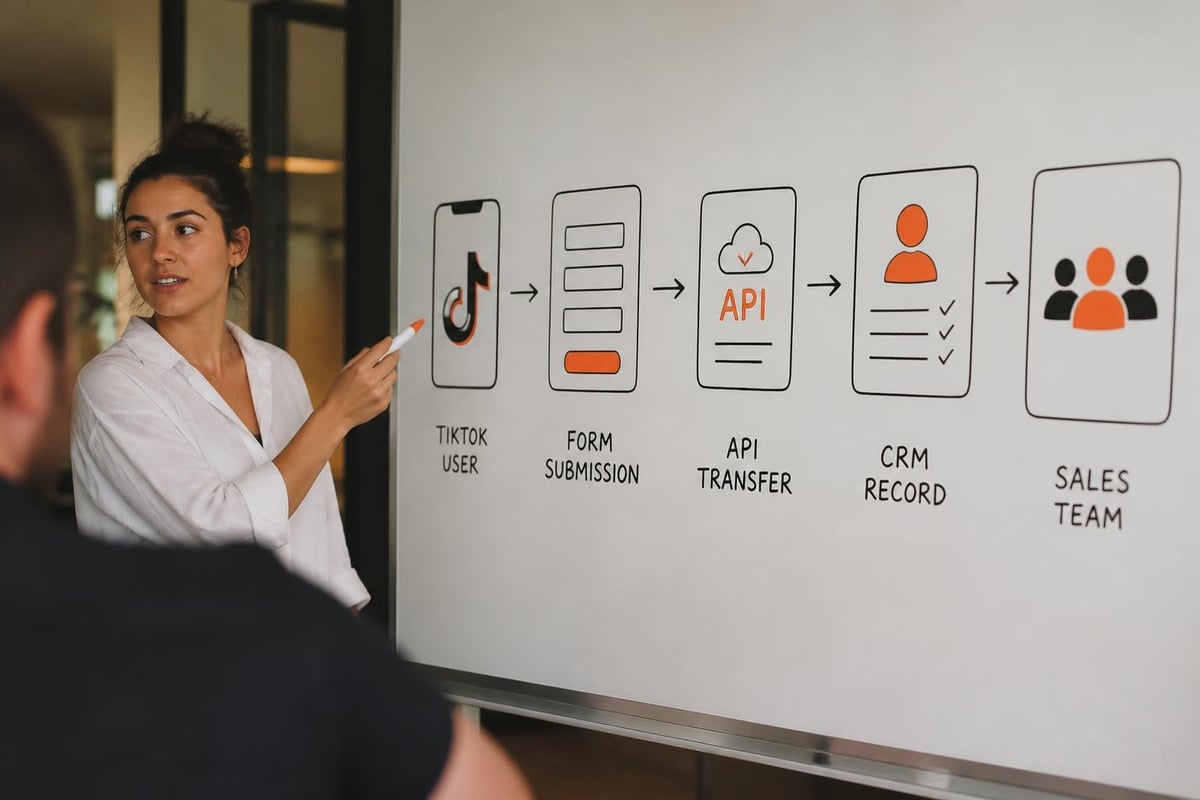
- API integration: Automated transfer to CRM platforms via webhooks or partner integrations
- Third-party connectors: Integration platforms that map TikTok fields to CRM record types
The Lead Generation objective tracks conversion events including form opens, form submissions, and qualified leads based on advertiser-defined criteria.
How to Set Up TikTok Lead Forms for B2B Campaigns
Setting up tiktok lead forms requires configuration in TikTok Ads Manager with specific attention to form design, field selection, and integration endpoints. TikTok’s Instant Form setup provides the technical framework for creating these campaigns.
Campaign Configuration Steps:
- Create a new campaign in Ads Manager and select "Lead Generation" as the objective
- Define your target audience using demographic, interest, and behavioral parameters
- Set daily budget and bid strategy (Cost Per Result or Cost Cap recommended for lead forms)
- Design the Instant Form including form name, headline, description, and privacy policy link
- Configure form fields selecting from standard options or creating custom fields
- Add a confirmation message that appears after form submission
- Set up conversion tracking pixel on your website for post-lead behavior monitoring
- Connect CRM integration or configure manual download schedule
- Launch campaign and monitor form open rate, submission rate, and cost per lead
Form Field Selection and Custom Data Requirements
Form complexity directly affects completion rates. Standard B2B lead forms capture 5-8 fields including name, company email, company name, job title, phone number, and one qualification question. Custom fields enable industry-specific data collection such as software budget range, current system vendor, or implementation timeline.
Field types supported:
| Field Type | Use Case | Completion Impact |
|---|---|---|
| Single-line text | Name, company name | Minimal |
| Contact information | Pre-filled, minimal | |
| Phone | Direct outreach | Pre-filled, minimal |
| Multiple choice | Budget range, company size | Low |
| Dropdown | Industry, job function | Low |
| Checkbox | Consent, preferences | Minimal |
For software development companies targeting enterprise clients, custom qualification fields might include current technology stack, development timeline, or specific functionality requirements.
Why TikTok Lead Forms Outperform Traditional Landing Pages
TikTok lead forms reduce friction in the conversion path by eliminating the need for users to navigate to external websites. Traditional landing page workflows require users to leave TikTok, wait for page load, find the form, and manually enter all information. This multi-step process creates abandonment opportunities at each transition point.
In-app forms maintain user context within the TikTok environment. Pre-filled fields reduce manual data entry from 8-10 form fields to 2-3 review and confirmation actions. This reduction in cognitive load and physical interaction directly improves conversion rates.
Performance Benchmarks and Cost Efficiency
ReminderMedia’s case study demonstrates measurable improvements from TikTok lead forms, achieving significant cost per lead reductions compared to traditional digital advertising formats. The campaign generated higher-quality leads through improved targeting and reduced form abandonment.
Comparative Performance Metrics:
- Form open rate: 40-60% of users who click the CTA open the form
- Form submission rate: 60-80% of users who open the form complete submission
- Overall conversion rate: 25-45% from ad click to lead submission
- Mobile optimization impact: 85-90% of TikTok users access the platform via mobile devices
Landing page conversion rates typically range from 5-15% for cold traffic, making tiktok lead forms 2-3x more effective for mobile-first audiences.
Integration With CRM Systems and Lead Management Workflows
TikTok lead forms deliver maximum value when integrated with CRM platforms for automated lead routing, scoring, and follow-up workflows. Integration eliminates manual data entry, reduces lead response time, and enables sophisticated qualification processes.
The platform supports native integrations with major CRM systems including Salesforce, HubSpot, Marketo, and Pardot. Third-party integration platforms provide connections to custom CRM implementations and industry-specific systems.
Implementation Architecture for Custom Software Projects
For businesses offering custom software development services, lead qualification requires technical assessment beyond standard contact information. Integration workflows should map TikTok form data to CRM fields that trigger specific actions:
- Lead creation: Form submission creates new lead record with source attribution
- Qualification scoring: Custom fields populate scoring model based on project scope, budget, timeline
- Routing logic: High-score leads route to senior sales staff; lower scores enter nurture sequences
- Follow-up automation: Email sequences deploy based on industry, project type, or technology mentioned
- Task generation: Sales team receives notification with lead summary and recommended next steps
Brytend CRM offers AI-driven lead processing that automatically analyzes form submissions and matches prospects with relevant service offerings. The system integrates with TikTok lead forms through API connections, enabling real-time lead scoring based on software development requirements, technology preferences, and project complexity. This automation reduces manual qualification time and ensures high-priority prospects receive immediate attention from technical sales staff.

Optimization Strategies for Higher Quality Leads
Lead quality depends on targeting precision, creative relevance, and form design decisions. Poor targeting generates high submission volumes with low qualification rates, wasting budget and sales team capacity.
Targeting Refinement Methods:
- Audience layering: Combine interest targeting (technology, software, business tools) with behavior signals (app engagement patterns)
- Exclusion lists: Suppress existing customers, job seekers, students, or other non-qualified segments
- Lookalike audiences: Build audiences based on existing customer data or website visitor profiles
- Geographic targeting: Focus on regions with concentration of target industries or business sizes
- Device targeting: Prioritize newer device models as proxy for business user vs. consumer
Creative Strategy and Form Design Best Practices
Video creative should address specific business problems and demonstrate clear value propositions relevant to the target audience. Generic brand awareness content generates curiosity clicks but low-quality leads.
Effective B2B creative elements:
- Problem statement: First 3 seconds identify specific business challenge
- Solution preview: Show software interface, workflow improvement, or outcome metric
- Social proof: Client logos, case results, or certification badges
- Clear CTA: Specific action language like "Get Custom Quote" vs. generic "Learn More"
Form design impacts both submission rates and lead quality. Best practices for TikTok lead generation emphasize mobile-friendly layouts, clear value exchange statements, and progressive disclosure of field requirements.

Common Challenges and Technical Limitations
TikTok lead forms present specific implementation challenges that affect data quality, integration reliability, and campaign performance measurement.
Data Quality and Validation Issues
Pre-filled form fields improve completion rates but reduce data accuracy. Users may submit forms without reviewing auto-populated information, resulting in outdated email addresses, incorrect phone numbers, or personal accounts instead of business contacts.
Data validation approaches:
| Challenge | Solution | Implementation |
|---|---|---|
| Personal email addresses | Email verification on CRM side | Reject free email domains (gmail, yahoo) |
| Inactive phone numbers | SMS verification step | Send confirmation code via text |
| Duplicate submissions | Deduplication logic | Match on email + phone combination |
| Incomplete information | Required field enforcement | Mark critical fields as mandatory |
| Invalid company names | Business database lookup | Verify against company registry |
Integration Reliability and API Limitations
TikTok’s Lead Generation introduction outlines platform capabilities, but real-world implementation encounters technical constraints. API rate limits restrict the frequency of data pulls, potentially delaying lead delivery during high-volume campaigns. Webhook failures require backup polling mechanisms to ensure no leads are lost.
System architecture should include:
- Redundant data capture: Both webhook and scheduled API polling
- Error logging: Track failed transfers for manual review and reprocessing
- Data retention: Maintain backup copies in TikTok Ads Manager for 90 days
- Validation rules: Pre-CRM data cleaning to filter test submissions and invalid entries
Advanced Use Cases for Technology and Software Companies
Software development firms leverage tiktok lead forms for specific acquisition scenarios where traditional B2B channels underperform. The platform's younger demographic skews toward decision-makers in emerging technology companies and fast-growth startups.
Project Scoping and Requirements Gathering
Custom software projects require detailed requirement specifications before accurate proposals. Standard lead forms capture initial interest, but qualification demands technical information about existing systems, integration needs, and feature priorities.
Multi-stage form sequences enable progressive data collection:
- Initial capture: Name, email, company, project type
- Technical assessment: Current technology stack, system integrations, user volume
- Scope definition: Feature requirements, timeline expectations, budget range
- Qualification: Decision timeline, stakeholder involvement, procurement process
Software asset management implementations and custom CRM development projects benefit from this structured approach, ensuring sales teams engage prospects with sufficient context for productive discovery conversations.
Measurement Framework and Performance Analysis
Campaign success requires tracking metrics beyond basic cost per lead. Lead quality, sales conversion rates, and customer lifetime value determine true campaign ROI.
Essential Tracking Metrics:
- Top-of-funnel: Impressions, click-through rate, cost per click
- Form engagement: Form open rate, field completion rate, submission rate
- Lead quality: Sales accepted lead rate, SQL conversion rate, average lead score
- Pipeline impact: Opportunity creation rate, average deal size, sales cycle length
- Revenue attribution: Customer acquisition cost, first-year revenue, lifetime value
Attribution modeling tracks leads from TikTok through the sales pipeline to closed revenue. UTM parameters embedded in form submissions enable source tracking across multiple touchpoints. CRM integration passes conversion data back to TikTok for campaign optimization via the Conversions API.
Comparative Analysis: Manual vs. Automated Lead Processing
| Process Stage | Manual Workflow | Automated Workflow |
|---|---|---|
| Data capture | CSV download from Ads Manager | Real-time API transfer to CRM |
| Lead creation | Manual CRM record entry | Automatic record creation with field mapping |
| Qualification | Sales rep reviews and scores | Automated scoring based on form responses |
| Routing | Manager assigns based on availability | Rule-based routing to specialized teams |
| Follow-up | Rep initiates outreach when assigned | Automated email sequence begins immediately |
| Response time | 24-48 hours average | <5 minutes for high-priority leads |
BMW Spain’s TikTok Lead Generation campaign achieved 47% lower cost per lead through automated integration and optimized form design, demonstrating measurable impact of proper implementation.
Industry-Specific Applications and Use Cases
Different industries require customized approaches to tiktok lead forms based on sales cycle complexity, qualification criteria, and regulatory requirements.
B2B Technology Sector Applications:
- SaaS platforms: Free trial signups, demo requests, feature comparison inquiries
- Enterprise software: Discovery call scheduling, ROI calculator access, technical documentation downloads
- Development services: Project estimation requests, technology consultation bookings
- IT consulting: Assessment tool access, audit requests, compliance checklists
Healthcare technology companies using solutions for healthcare face HIPAA compliance requirements that restrict form field types and mandate specific privacy disclosures. Financial services require additional consent language and opt-in mechanisms for marketing communications.
Case Example: Custom Software Lead Generation Campaign
A mid-market software development firm targeting e-commerce companies launched a TikTok lead generation campaign focused on inventory management system modernization. The campaign used video creative showing outdated spreadsheet workflows vs. automated inventory tracking, targeting e-commerce directors and operations managers.
Form configuration included:
- Standard fields: Name, email, company name, phone
- Custom fields: Current inventory system, number of SKUs, integration requirements
- Qualification question: Implementation timeline (dropdown: <3 months, 3-6 months, 6-12 months, exploring options)
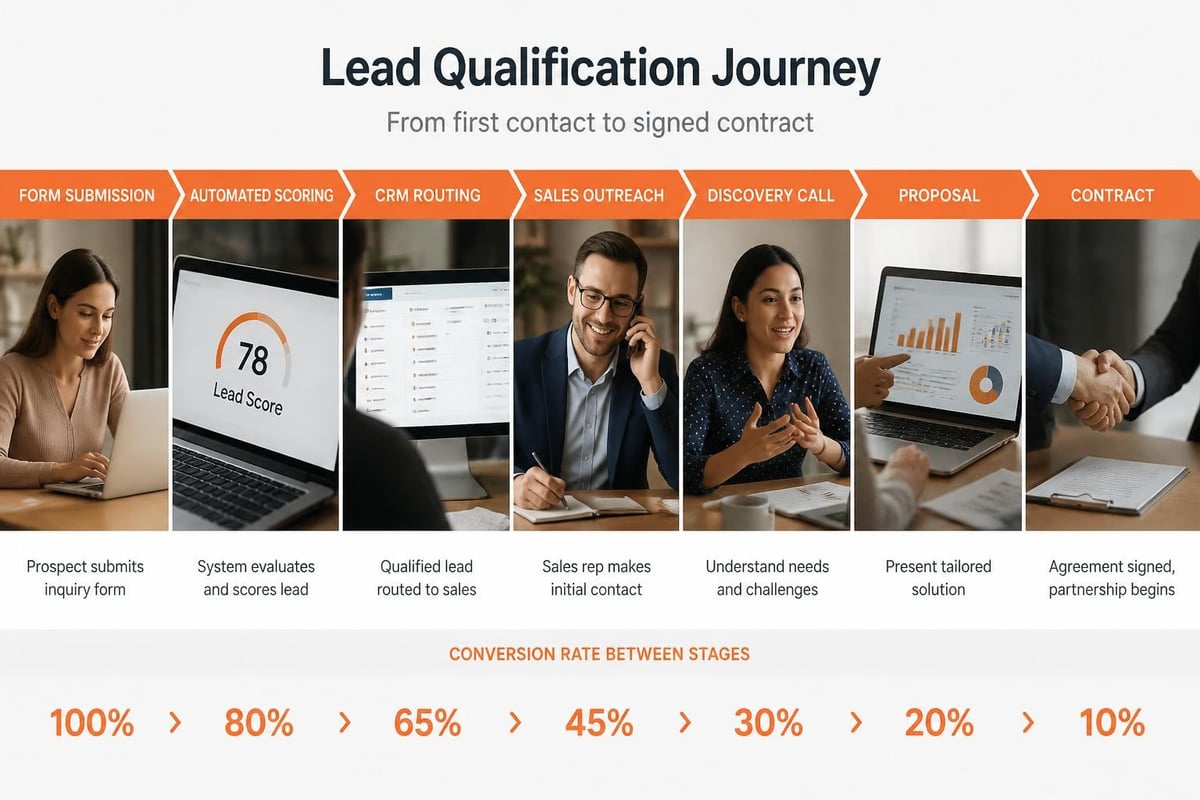
Results over 90 days: 847 form submissions, 312 sales-qualified leads (37% qualification rate), 28 discovery calls scheduled, 6 proposals delivered, 2 contracts signed. Average cost per qualified lead: $67. Customer acquisition cost: $4,238. Average project value: $45,000.
Privacy Compliance and Data Governance
TikTok lead forms must comply with data protection regulations including GDPR, CCPA, and industry-specific requirements. Form configuration includes mandatory privacy policy links and optional consent checkboxes for marketing communications.
Compliance Requirements:
- Privacy policy: Clear link to comprehensive data handling practices
- Consent language: Explicit opt-in for email marketing, phone contact, data sharing
- Data retention: Documented policies for lead data storage and deletion
- User rights: Processes for data access, correction, and deletion requests
- Geographic restrictions: Form availability limited to compliant jurisdictions
Data governance extends beyond initial collection to include CRM storage, third-party transfers, and sales team access controls. Integration configurations should specify data residency requirements, encryption standards, and access logging for audit purposes.
Marketing automation platforms processing TikTok leads must maintain compliance with platform terms of service and applicable regulations. Documentation of data flows, processing purposes, and legal bases supports regulatory audits and privacy impact assessments.
TikTok lead forms deliver measurable improvements in mobile conversion rates and lead acquisition costs when properly configured with CRM integration and quality-focused optimization strategies. The platform's pre-filled form technology and in-app experience reduce friction while supporting sophisticated qualification workflows for B2B campaigns. Brytend helps businesses implement custom software solutions that integrate TikTok lead data with existing sales systems, automating lead routing and enabling real-time response to high-value prospects. Contact our development team to design a lead management system optimized for your specific acquisition channels and sales processes.