
Software company development is a structured process that encompasses the planning, creation, deployment, and maintenance of software products through coordinated team efforts, established methodologies, and quality assurance practices. Successful software company development requires alignment across technical, operational, and strategic dimensions. Companies that implement clear development frameworks reduce time-to-market by 30-40% while maintaining code quality and team productivity. This article examines the core practices, workflows, and organizational structures that define effective software company development in 2026.
TL;DR:
- Software company development requires defined roles, repeatable processes, and continuous integration practices
- High-performing teams use version control, automated testing, and code review workflows to maintain quality
- Common challenges include technical debt, scope creep, and communication gaps between stakeholders
- Best practices emphasize modular architecture, documentation standards, and iterative delivery cycles
- Tools like CRM systems and project management platforms streamline client communication and requirement tracking
What Is Software Company Development and How Does It Work?
Software company development refers to the systematic creation and delivery of software products through coordinated team activities, standardized processes, and quality control mechanisms. The process operates through distinct phases: requirement gathering, architecture design, implementation, testing, deployment, and maintenance.
Development workflows typically follow established methodologies such as Agile, Scrum, or DevOps. Teams organize work into sprints (2-4 week cycles) with defined deliverables and review checkpoints. Each sprint includes planning sessions, daily standups, development work, code reviews, testing, and retrospectives.
Core Components of Development Workflows
Every software company development workflow includes several mandatory elements that ensure consistency and quality:
- Version control systems (Git, SVN) that track every code change with author attribution and timestamps
- Continuous integration pipelines that automatically build and test code on each commit
- Issue tracking platforms that document bugs, feature requests, and technical tasks
- Code review processes requiring peer approval before merging changes to main branches
- Deployment automation reducing manual steps and human error during releases
Development environments split into at least three tiers: development (local workstations), staging (pre-production testing), and production (live customer environment). This separation prevents untested code from affecting end users.

How Do You Structure Software Development Teams?
Software development teams require clearly defined roles with distinct responsibilities to avoid overlap and ensure accountability. The core team structure includes developers, quality assurance engineers, project managers, and technical architects.
Standard team composition:
| Role | Primary Responsibility | Team Interaction |
|---|---|---|
| Backend Developer | Server logic, databases, APIs | Works with frontend developers and architects |
| Frontend Developer | User interfaces, client-side code | Coordinates with designers and backend developers |
| QA Engineer | Test planning, automation, bug verification | Validates work from all developers |
| DevOps Engineer | Infrastructure, deployments, monitoring | Supports entire team with tools and environments |
| Technical Architect | System design, technology decisions | Guides developers on implementation approach |
| Project Manager | Timeline, scope, stakeholder communication | Coordinates across all roles |
Team size matters significantly. Research shows optimal team size ranges from 5 to 9 members for most projects. Smaller teams communicate more efficiently but may lack specialized skills. Larger teams require additional coordination overhead and formal communication channels.
Defining Clear Ownership and Accountability
Each component, module, or service needs an identified owner responsible for its quality, performance, and maintenance. Ownership assignment prevents the "tragedy of the commons" where shared codebases deteriorate because no individual feels responsible.
Development teams establish ownership through several mechanisms:
- Code ownership files (CODEOWNERS) that automatically assign reviewers based on file paths
- Service catalogs documenting which team maintains each microservice or system
- On-call rotations ensuring 24/7 responsibility for production systems
- Technical debt registers tracking known issues with assigned remediation owners
High-performing teams implement these best practices for building software development teams to maintain clear accountability while enabling collaboration.
What Are the Essential Development Practices for Quality Software?
Quality software emerges from repeatable practices applied consistently across all development activities. These practices prevent defects, reduce technical debt, and accelerate delivery velocity over time.
Test-driven development (TDD) requires writing automated tests before implementing features. Developers first create failing tests that define expected behavior, then write minimal code to pass those tests. This approach produces higher test coverage (typically 80-95%) and clearer interfaces.
Continuous integration and deployment (CI/CD) automates the path from code commit to production release. Every code change triggers automated builds, runs test suites, performs security scans, and deploys to staging environments. Teams using mature CI/CD pipelines deploy to production 10-100 times more frequently than those relying on manual processes.
Code Review and Quality Gates
Code reviews serve as the primary quality control mechanism before changes enter the main codebase. Effective reviews check for correctness, readability, security vulnerabilities, and architectural consistency.
Reviewers evaluate code against established criteria:
- Functionality: Does the code solve the stated problem correctly?
- Tests: Are there sufficient automated tests covering normal and edge cases?
- Security: Does the code introduce vulnerabilities like SQL injection or XSS?
- Performance: Will this code handle expected load without degradation?
- Maintainability: Can another developer understand and modify this code in six months?
Teams typically require at least one approval from a senior developer before merging changes. Critical systems may require two approvals or specific domain expert review.

How Do Software Companies Manage Requirements and Scope?
Requirement management separates successful projects from failed ones. Clear, documented requirements prevent scope creep, reduce rework, and align stakeholder expectations with technical realities.
Software company development begins with requirement elicitation through stakeholder interviews, user research, competitive analysis, and technical feasibility studies. Requirements are categorized as functional (what the system does) or non-functional (performance, security, scalability constraints).
Requirement Documentation and Tracking
Requirements exist in multiple formats depending on audience and purpose:
- User stories describe features from end-user perspective: "As a [role], I want [capability] so that [benefit]"
- Acceptance criteria define testable conditions that must be met for a story to be complete
- Technical specifications detail implementation approach, data models, API contracts, and integration points
- Architecture decision records document significant technical choices with context and rationale
Many development teams use Customer Relationship Management systems to capture and track requirements from initial client contact through implementation. Brytend CRM enables teams to manage requirements through AI-driven lead forms and customizable questionnaires that fit specific development workflows, ensuring nothing gets lost between sales conversations and technical implementation.

Common requirement management mistakes:
- Accepting vague requirements like "the system should be fast" without quantifiable metrics
- Failing to document assumptions that stakeholders consider obvious
- Not versioning requirements as they evolve through development cycles
- Skipping traceability between requirements, code, and test cases
Software companies mitigate these risks by implementing formal change control processes. Any requirement modification after approval requires impact analysis, timeline adjustment, and stakeholder sign-off.
What Challenges Do Software Development Companies Face?
Software company development confronts recurring challenges that impact timeline, budget, and quality. Understanding these obstacles enables proactive mitigation strategies.
Technical debt accumulates when teams choose expedient solutions over sustainable ones. Debt manifests as hardcoded values, duplicated logic, missing tests, outdated dependencies, and inadequate documentation. Companies typically spend 20-40% of development capacity servicing technical debt rather than building new features.
Scaling challenges emerge as teams and codebases grow. Monolithic applications become difficult to modify safely. Build times extend to 30+ minutes. Test suites require hours to complete. Database queries slow under production load. These issues require architectural refactoring, which diverts resources from feature development.
Communication and Knowledge Transfer
Communication breakdowns cause significant waste in software company development. Developers implement features that don't match stakeholder intent. Teams duplicate work because they're unaware of existing solutions. New team members struggle to orient themselves without adequate documentation.
| Challenge Type | Symptom | Solution Approach |
|---|---|---|
| Requirement ambiguity | Frequent rework, missed expectations | Structured requirement workshops with acceptance criteria |
| Knowledge silos | Only one person understands critical systems | Pair programming, documentation, code reviews |
| Process inconsistency | Different teams follow different practices | Standardized workflows, templates, checklists |
| Tool proliferation | Developers lose time switching contexts | Consolidated toolchain with integrated platforms |
Software companies implement proven development best practices to address these challenges systematically rather than reactively.
How Do You Optimize Development Velocity Without Sacrificing Quality?
Development velocity measures the rate at which teams deliver working software. Optimization requires balancing speed against quality, maintainability, and technical sustainability.
Automation eliminates repetitive manual work that consumes developer time without adding value. Teams automate testing, deployment, environment provisioning, database migrations, and monitoring setup. Initial automation investment pays returns within 3-6 months through reduced cycle times and fewer production incidents.
Modular architecture enables parallel development by reducing dependencies between components. Teams can work on separate modules simultaneously without constant coordination. Well-defined interfaces allow module replacement or upgrade without system-wide changes.
Measuring and Improving Development Metrics
Software companies track specific metrics to identify bottlenecks and improvement opportunities:
- Lead time: Time from requirement definition to production deployment (target: under 2 weeks for typical features)
- Deployment frequency: How often code reaches production (target: daily or multiple times per day)
- Change failure rate: Percentage of deployments causing production incidents (target: under 15%)
- Mean time to recovery: How quickly teams restore service after incidents (target: under 1 hour)
Teams review these metrics weekly or biweekly to identify trends. Increasing lead time might indicate growing technical debt or insufficient test automation. High change failure rates suggest inadequate testing or review processes.
Case example: A fintech software company reduced deployment lead time from 6 weeks to 3 days by implementing automated testing, feature flags, and continuous deployment. The team eliminated manual approval steps, created comprehensive test suites covering 87% of code, and deployed small changes incrementally rather than large batches.
What Role Does Documentation Play in Software Company Development?
Documentation serves as the permanent knowledge base that outlives individual team members. Effective documentation reduces onboarding time, enables independent problem-solving, and provides context for future maintenance.
Software company development requires multiple documentation types targeting different audiences:
- API documentation describes endpoints, parameters, request/response formats, authentication, and error codes
- Architecture diagrams illustrate system components, data flows, integration points, and deployment topology
- Runbooks provide step-by-step instructions for common operational tasks and incident response
- Code comments explain non-obvious logic, business rules, and algorithmic choices
- Decision logs capture why specific approaches were chosen over alternatives
Documentation Standards and Maintenance
Documentation becomes outdated quickly without active maintenance. Teams implement several practices to keep documentation current:
- Documentation as code: Store docs in version control alongside source code
- Review requirements: Documentation updates required for code reviews involving interface changes
- Automated validation: Tools check that code examples in docs compile and execute correctly
- Regular audits: Quarterly reviews identify and update stale documentation
Many companies adopt the principle of using their own tools internally before releasing to customers. This "dogfooding" practice reveals documentation gaps and usability issues that external users would encounter.
How Do Software Companies Handle Security and Compliance?
Security integration throughout the development lifecycle prevents vulnerabilities from reaching production. Software company development in 2026 treats security as a shared responsibility across all team members, not just specialized security engineers.
Secure coding practices include input validation, output encoding, parameterized queries, principle of least privilege, and defense in depth. Developers receive training on OWASP Top 10 vulnerabilities and participate in regular security workshops.
Security Testing and Vulnerability Management
Security testing occurs at multiple stages:
| Testing Type | When Applied | What It Finds |
|---|---|---|
| Static analysis | During development, before code review | Code patterns indicating vulnerabilities |
| Dependency scanning | On each build | Known vulnerabilities in third-party libraries |
| Dynamic testing | In staging environment | Runtime security flaws, misconfigurations |
| Penetration testing | Before major releases | Complex vulnerabilities requiring manual exploitation |
Companies establish vulnerability remediation timelines based on severity. Critical vulnerabilities require fixes within 24-48 hours. High-severity issues need resolution within one week. Medium and low-severity findings follow standard sprint planning.
Compliance requirements vary by industry and geography. Healthcare software must satisfy HIPAA regulations. Financial services need SOC 2 certification. European customers require GDPR compliance. Software company development processes incorporate compliance checks, audit trails, and data protection measures from project initiation.
What Tools Support Modern Software Development?
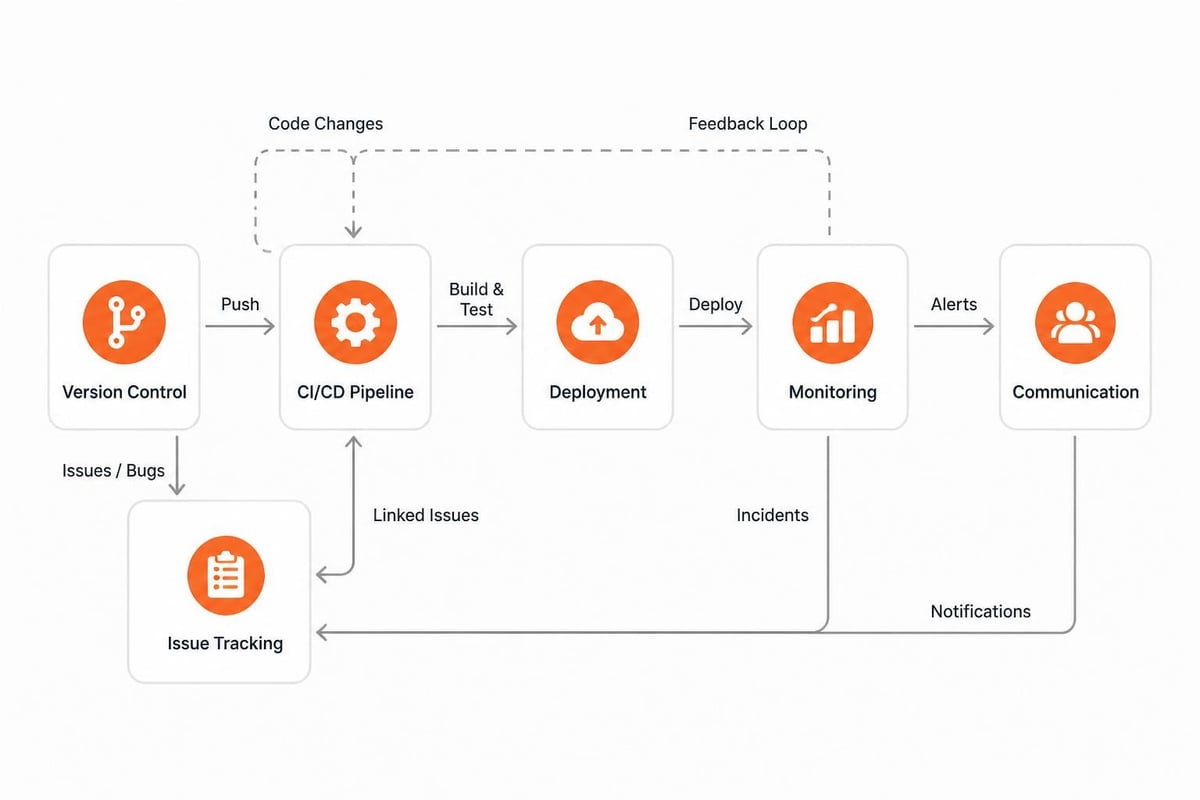
Tool selection significantly impacts development efficiency and team collaboration. Software companies standardize on integrated toolchains that minimize context switching and data silos.
Version control and collaboration:
- Git repositories (GitHub, GitLab, Bitbucket) for source code management
- Pull request workflows for code review and discussion
- Branch protection rules enforcing review and testing requirements
Continuous integration and deployment:
- Jenkins, CircleCI, GitHub Actions, GitLab CI for build automation
- Docker and Kubernetes for containerization and orchestration
- Terraform or CloudFormation for infrastructure as code
Project management and communication:
- Jira, Linear, or Azure DevOps for issue tracking and sprint planning
- Slack or Microsoft Teams for real-time communication
- Confluence or Notion for documentation and knowledge management
Monitoring and observability:
- Application performance monitoring (New Relic, Datadog)
- Log aggregation and analysis (ELK stack, Splunk)
- Error tracking (Sentry, Rollbar)
- Uptime monitoring and alerting (PagerDuty, Opsgenie)
Companies evaluate tools based on integration capabilities, learning curve, cost, and vendor stability. The best tools fit naturally into existing workflows rather than requiring process changes to accommodate tool limitations.
How Do Startups Approach Software Company Development Differently?
Startup software development prioritizes speed and market validation over comprehensive documentation and process formality. Startups face unique challenges including resource constraints, evolving requirements, and pressure to achieve product-market fit quickly.
Early-stage startups often skip formal requirements documentation, relying instead on direct communication between founders and developers. Teams deploy code multiple times daily without extensive testing infrastructure. This approach enables rapid iteration but accumulates technical debt that must be addressed as the company matures.
Transitioning from Startup to Scale-Up
As startups grow beyond 10-15 developers, informal processes break down. The company must implement:
- Formal code review requirements to maintain quality across larger teams
- Automated testing to prevent regressions as feature complexity increases
- Documentation standards so knowledge isn't concentrated in individual developers
- Security practices to protect growing customer data and maintain trust
- On-call rotations to ensure 24/7 system reliability
This transition typically occurs when reaching 50-100 customers or $1-5 million in annual revenue. Companies that delay process implementation face increasing incident rates, customer churn, and developer burnout.
What Is the Difference Between Manual and Automated Development Processes?
Manual software development relies on human execution of repetitive tasks: running tests, deploying code, checking security vulnerabilities, and validating configurations. Automated processes use tools and scripts to perform these activities consistently without human intervention.
Manual testing requires QA engineers to execute test cases by hand, clicking through interfaces and verifying behavior. A comprehensive manual test cycle for a medium-complexity application takes 40-80 hours. Automated test suites run the same validation in 10-30 minutes.
Manual deployment involves developers executing commands, copying files, updating configurations, and restarting services. Each step introduces error risk. Automated deployment codifies the process in scripts that execute identically every time.
| Aspect | Manual Process | Automated Process |
|---|---|---|
| Execution time | Hours to days | Minutes to hours |
| Error rate | 5-15% human error | <1% with proper implementation |
| Repeatability | Varies by person and conditions | Identical every execution |
| Scalability | Linear with team size | Handles increased volume without additional staff |
| Documentation | Often incomplete or outdated | Process itself is documentation |
Software company development in 2026 treats automation as mandatory infrastructure rather than optional enhancement. The initial time investment (typically 2-4 weeks for basic CI/CD) returns value within the first quarter through reduced errors and faster delivery cycles.
How Do You Scale Software Development Operations?
Scaling software company development requires both technical and organizational adaptations. Small-team practices that work with 5 developers fail catastrophically at 50 developers.
Microservices architecture splits monolithic applications into independent services with clear boundaries. Each service has a dedicated team responsible for its entire lifecycle. Teams deploy independently without coordinating with other teams. This autonomy enables parallel development but introduces complexity in service orchestration, data consistency, and distributed debugging.
Platform engineering creates internal tools and infrastructure that development teams consume. Platform teams build deployment pipelines, observability dashboards, development environments, and self-service capabilities. This centralization prevents every team from solving identical problems independently.
Organizational Scaling Patterns
Growing software companies reorganize teams to maintain communication efficiency:
- Functional teams (early stage): Backend team, frontend team, infrastructure team
- Feature teams (growth phase): Cross-functional teams owning complete features
- Product teams (scale phase): Autonomous teams owning specific products or domains
- Platform teams (maturity): Shared services supporting product teams
Each transition requires deliberate planning. Moving too quickly creates chaos. Delaying too long constrains growth and creates bottlenecks. Companies typically reorganize when communication overhead exceeds productivity gains from specialization.
Real-world development case studies demonstrate how companies successfully navigate scaling challenges across different industries and technical stacks.
Software company development succeeds through systematic application of proven practices, clear team structures, and continuous process improvement. High-performing development organizations balance speed with quality, automation with human judgment, and flexibility with consistency. Brytend specializes in building custom software solutions that incorporate these best practices from project inception, delivering maintainable systems with ongoing support to ensure your software scales with your business needs.