
A software dev company is a specialized organization that designs, builds, tests, and maintains custom software applications for businesses and organizations. These companies provide technical expertise across multiple technologies, platforms, and domains, delivering solutions ranging from web applications and mobile apps to cloud infrastructure and enterprise systems. In 2026, the software development industry has shifted toward AI-augmented workflows, cloud-native architectures, and outcome-based engagement models that prioritize measurable business results over traditional billable hours.
TL;DR:
- A software dev company builds custom applications using specialized technical teams and proven development methodologies
- Selection criteria include domain expertise, technology stack alignment, development process transparency, and proven delivery track records
- Modern software dev companies integrate AI tools, DevOps automation, and continuous delivery practices into standard workflows
- Engagement models range from fixed-price projects to dedicated teams and outcome-based partnerships
- Quality assurance, security practices, and post-launch support differentiate professional software dev companies from amateur providers
What Is a Software Dev Company?
A software dev company provides end-to-end software development services through dedicated teams of engineers, designers, project managers, and quality assurance specialists. These organizations maintain expertise across programming languages, frameworks, databases, cloud platforms, and development tools necessary to transform business requirements into functional software products.
The core value proposition centers on specialized technical knowledge that most businesses cannot economically maintain in-house. A software dev company invests continuously in training, certifications, tooling, and process refinement to deliver solutions faster and with higher quality than internal teams lacking dedicated focus.
Core Service Offerings
Professional software development firms typically provide several interconnected service categories:
- Custom application development for web, mobile, desktop, and embedded systems
- Cloud architecture and migration for AWS, Azure, Google Cloud, and hybrid environments
- API development and integration connecting disparate systems and third-party services
- Database design and optimization for relational, NoSQL, and graph databases
- DevOps implementation including CI/CD pipelines, containerization, and infrastructure as code
- Quality assurance and testing covering unit, integration, performance, and security testing
- Maintenance and support providing bug fixes, updates, and technical assistance post-launch

The specific mix varies by company size and specialization. Boutique firms may focus narrowly on mobile apps or SaaS platforms, while full-service software dev companies handle projects across all categories.
How Do Software Dev Companies Structure Their Teams?
Team composition directly impacts project outcomes, communication efficiency, and development velocity. Most software dev companies organize around either project-based squads or dedicated client teams, depending on engagement model and project scope.
A typical project team includes:
| Role | Responsibility | Team Ratio |
|---|---|---|
| Software Engineers | Write code, implement features, conduct code reviews | 3-6 per team |
| UI/UX Designer | Create user interfaces, conduct usability research | 1 per team |
| Project Manager | Coordinate timeline, manage scope, facilitate communication | 1 per 2-3 teams |
| QA Engineer | Test functionality, automate testing, verify requirements | 1-2 per team |
| DevOps Engineer | Manage infrastructure, deployment pipelines, monitoring | 1 per 3-4 teams |
| Technical Lead | Guide architecture decisions, mentor developers, review code | 1 per team |
Team size scales with project complexity. Simple applications may require 2-3 developers, while enterprise systems often involve 10-15 specialists across multiple disciplines.
Agile vs Waterfall Development Models
Modern software dev companies predominantly use agile methodologies with two-week sprints, daily standups, and iterative releases. According to Deloitte’s 2026 software industry outlook, AI-first engineering approaches are reshaping traditional agile practices with automated code generation and testing.
Waterfall remains appropriate for projects with fixed requirements, regulatory constraints, or hardware dependencies that prevent iterative changes. Most B2B software development follows hybrid approaches combining upfront architecture planning with iterative feature delivery.
What Should Businesses Look for When Selecting a Software Dev Company?
Selection criteria should prioritize demonstrated competence over marketing promises. Request case studies, reference calls, and code samples that prove capability in your specific domain and technology requirements.
Critical evaluation factors include:
- Relevant domain experience in your industry with understanding of compliance, workflows, and business models
- Technology stack expertise matching your current systems or strategic platform choices
- Development process transparency with clear communication protocols, progress tracking, and change management procedures
- Quality assurance practices including automated testing, code review standards, and security scanning
- Post-launch support capabilities for bug fixes, feature enhancements, and infrastructure management
- Team stability and continuity with low turnover and consistent personnel throughout engagement
- Intellectual property clarity defining ownership of code, documentation, and related assets
Portfolio diversity signals adaptability, but concentrated experience in adjacent domains often delivers better results than generalist backgrounds. A software dev company with 15 healthcare projects understands HIPAA compliance and clinical workflows better than one with scattered experience across unrelated industries.
Technical Due Diligence Questions
Ask specific technical questions to assess depth:
- What version control workflows do you use for branching and merging?
- How do you handle database schema migrations in production environments?
- What monitoring and alerting tools track application performance and errors?
- How frequently do you deploy updates to production systems?
- What security testing happens before code reaches production?
Vague answers signal limited technical maturity. Professional teams provide concrete tool names, specific frequencies, and documented procedures.
How Do Software Dev Companies Price Their Services?
Pricing models vary based on project predictability, client risk tolerance, and engagement duration. Understanding the tradeoffs helps businesses select appropriate commercial structures for their specific needs.
Common Pricing Approaches
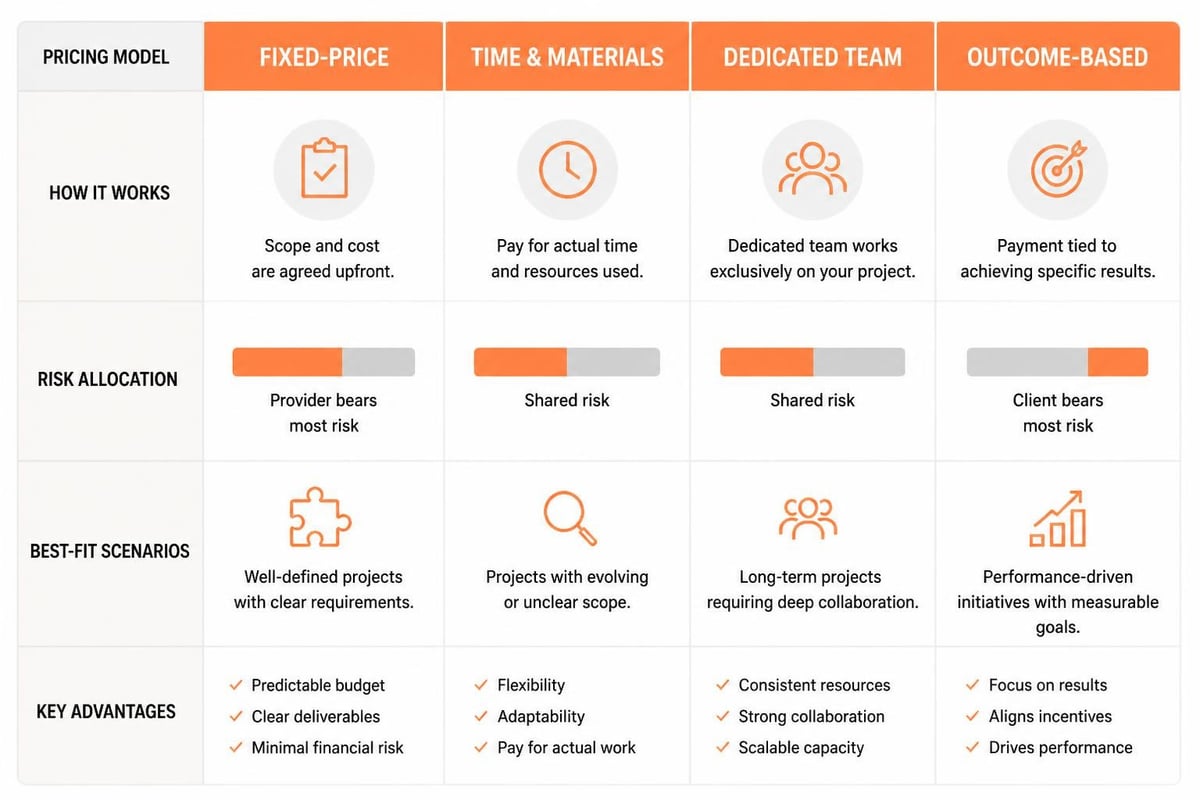
Fixed-price contracts establish total cost upfront based on detailed specifications. This model works when requirements are stable, scope is well-defined, and acceptance criteria are measurable. Clients gain cost certainty but sacrifice flexibility for mid-project changes.
Time and materials billing charges hourly or daily rates for actual work performed. This approach suits exploratory projects, evolving requirements, or long-term partnerships where scope emerges iteratively. Clients maintain flexibility but assume budget risk.
Dedicated team arrangements provide exclusive access to defined team members for monthly retainers. This model supports ongoing development, maintenance, and feature additions with predictable costs and stable team composition.
Outcome-based pricing ties compensation to measurable business results like user adoption, transaction volume, or revenue generation. As West Monroe’s 2026 software outlook notes, software companies increasingly adopt value-based models that align vendor success with client outcomes.
| Pricing Model | Best For | Client Risk | Vendor Risk |
|---|---|---|---|
| Fixed Price | Well-defined projects with stable requirements | Low budget risk | High scope risk |
| Time & Materials | Exploratory or evolving projects | High budget risk | Low scope risk |
| Dedicated Team | Ongoing development and maintenance | Medium budget risk | Medium scope risk |
| Outcome-Based | Strategic partnerships with measurable KPIs | Low budget risk | High outcome risk |
Hybrid models combining elements often provide optimal balance. A project might use fixed-price for initial build and time-and-materials for post-launch enhancements.
What Development Practices Define Professional Software Dev Companies?
Professional development practices separate competent software dev companies from amateur providers. These practices directly impact code quality, security, maintainability, and long-term total cost of ownership.
Code Quality Standards
Best practices for high-quality software development include:
- Clean code principles with meaningful variable names, single-responsibility functions, and minimal complexity
- Code review processes requiring peer approval before merging changes
- Automated testing with minimum 70-80% code coverage for critical paths
- Static analysis tools detecting bugs, security vulnerabilities, and style violations
- Documentation standards covering API contracts, architecture decisions, and deployment procedures
Professional teams treat these as non-negotiable minimums, not optional enhancements. Despite AI tools gaining adoption, nearly half of developers still don’t trust AI-generated code accuracy, making human code review essential even with AI assistance.
Continuous Integration and Deployment
Modern software dev companies implement CI/CD pipelines that automatically build, test, and deploy code changes. This automation reduces manual errors, accelerates release cycles, and enables rapid response to production issues.
A typical CI/CD workflow executes these steps:
- Developer commits code to version control repository
- Automated build process compiles code and resolves dependencies
- Automated test suite runs unit, integration, and end-to-end tests
- Security scanning checks for vulnerabilities and licensing issues
- Staging deployment pushes passing builds to test environment
- Manual approval gate allows stakeholder review before production
- Production deployment releases changes to live environment
- Monitoring activation tracks performance metrics and error rates
This pipeline runs multiple times daily for active projects, enabling incremental improvements instead of risky big-bang releases.
How Are AI and Automation Changing Software Development?
AI tools now assist with code generation, bug detection, test creation, and documentation writing. According to Tech-Stack’s 2026 trends analysis, AI-augmented development increases developer productivity by 25-40% for routine tasks while raising new challenges around code quality and security.
Practical AI Integration
Professional software dev companies integrate AI selectively:
- GitHub Copilot or Amazon CodeWhisperer for code completion and boilerplate generation
- Automated testing tools that generate test cases from requirements
- Security scanning platforms that identify vulnerabilities faster than manual review
- Documentation generators that create API documentation from code annotations
- Performance optimization tools that suggest efficiency improvements
Human oversight remains critical. AI suggestions require validation, security review, and architectural alignment before integration into production systems.
Managing AI-Generated Code Risks
As risk management practices evolve, software dev companies establish governance frameworks for AI-generated code:
- All AI suggestions undergo same code review as human-written code
- Security scanning specifically targets AI-generated sections
- Licensing compliance tools verify AI suggestions don't include copyrighted code
- Knowledge transfer ensures team members understand AI-generated logic
Companies that blindly accept AI output without review accumulate technical debt and security vulnerabilities that surface months later.
What Are Common Challenges When Working with Software Dev Companies?
Communication gaps, requirement ambiguity, and technical misalignment cause most project failures. Addressing these proactively prevents costly delays and scope disputes.
Requirement Definition Problems
Vague requirements like "user-friendly interface" or "fast performance" create mismatched expectations. Professional teams document specific, measurable acceptance criteria:
- Poor requirement: "The system should be secure"
- Good requirement: "The system must enforce role-based access control with OAuth 2.0 authentication, encrypt data at rest using AES-256, and log all access attempts for audit trails"
Brytend approaches requirement definition through collaborative workshops that translate business needs into technical specifications. Their custom software development process includes prototyping and iterative refinement to validate understanding before significant development investment. Brytend CRM, for example, includes AI-driven lead forms and customizable questionnaires that adapt to specific business workflows, demonstrating how precise requirement gathering produces tools that match actual operational needs.

Technical Debt Accumulation
Short-term shortcuts create long-term maintenance burdens. Common sources include:
- Skipped automated tests to meet deadlines
- Hard-coded values instead of configuration management
- Duplicated code instead of reusable components
- Outdated dependencies with known security vulnerabilities
- Insufficient documentation for complex business logic
Software dev companies should provide technical debt assessments quarterly, identifying areas requiring refactoring before problems escalate.
What Post-Launch Support Should Software Dev Companies Provide?
Launch day begins operational responsibility, not ends development engagement. Comprehensive support agreements prevent emergency situations and maintain system reliability.
Essential support components:
- Bug fix response times with SLA definitions for critical vs minor issues
- Performance monitoring tracking response times, error rates, and resource utilization
- Security patch management applying updates for frameworks, libraries, and dependencies
- Infrastructure scaling adjusting capacity for traffic growth or seasonal spikes
- Feature enhancement pipeline for iterative improvements based on user feedback
- Documentation updates reflecting system changes and operational procedures
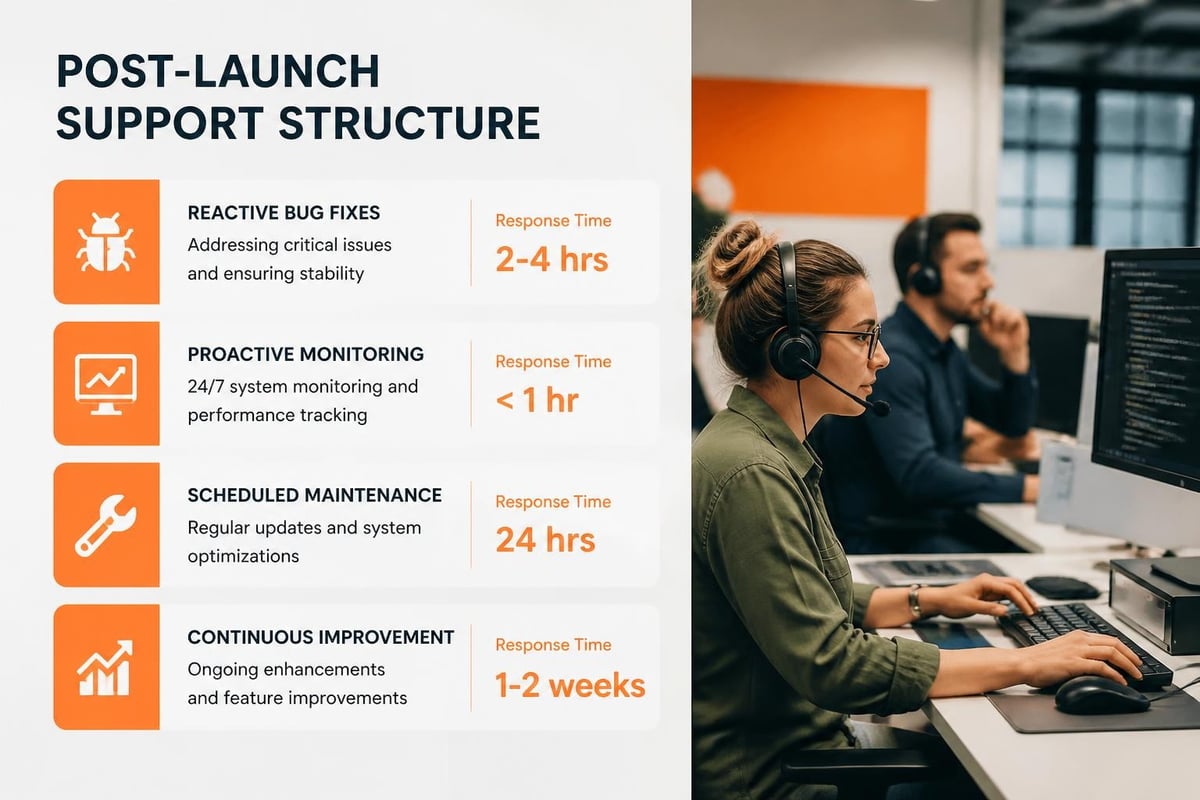
Support quality differentiates professional software dev companies from project-only contractors. Systems degrade without active maintenance, accumulating security vulnerabilities and performance issues that eventually force expensive rewrites.
Maintenance vs Enhancement
Maintenance preserves existing functionality while enhancements add new capabilities. Support agreements should explicitly define boundaries:
| Activity Type | Examples | Typical Coverage |
|---|---|---|
| Corrective Maintenance | Bug fixes, error corrections | Included in support |
| Adaptive Maintenance | OS updates, framework upgrades | Included in support |
| Perfective Maintenance | Performance optimization, code refactoring | Often billable |
| Feature Enhancement | New functionality, integrations | Separately scoped |
Clear definitions prevent scope disputes when clients request changes they assume are "just fixes."
How Do Cloud-Native Architectures Impact Development Approaches?
Cloud-native development fundamentally changes application design, deployment, and scaling. The Docker 2024 State of Application Development Report highlights expanding cloud and containerization adoption as developers build for distributed, resilient environments.
Modern software dev companies architect applications as:
- Microservices instead of monolithic applications, enabling independent scaling and deployment
- Containerized workloads using Docker and Kubernetes for consistent environments
- API-first designs treating integration as primary interface
- Serverless functions for event-driven, usage-based execution
- Managed services leveraging cloud provider databases, queues, and storage
This approach increases operational complexity while improving scalability, resilience, and cost efficiency for variable workloads.
Infrastructure as Code
Professional teams define infrastructure through version-controlled code using Terraform, AWS CloudFormation, or Azure Resource Manager templates. This practice enables:
- Reproducible environments for development, testing, and production
- Automated disaster recovery through infrastructure rebuilding
- Change tracking and audit trails for compliance requirements
- Reduced configuration drift across environments
Manual infrastructure configuration creates undocumented dependencies that break during scaling or disaster recovery scenarios.
What Distinguishes Enterprise-Grade from Startup-Focused Software Dev Companies?
Enterprise and startup clients have fundamentally different priorities, risk tolerances, and success metrics. Software dev companies typically specialize in one segment due to divergent process requirements.
Enterprise-focused companies emphasize:
- Compliance frameworks (SOC 2, ISO 27001, HIPAA, GDPR)
- Integration with legacy systems and existing tool chains
- Extensive documentation and knowledge transfer procedures
- Change management processes with approval workflows
- Long-term support commitments spanning years
- Risk mitigation over rapid experimentation
Startup-focused companies prioritize:
- Speed to market over comprehensive documentation
- Iterative validation with minimal viable products
- Flexible architecture that evolves with business model
- Cost efficiency with managed services over custom infrastructure
- Product-market fit discovery over enterprise scalability
- Rapid pivots based on user feedback
Neither approach is superior. Misalignment causes friction when enterprise clients expect startup agility or startups expect enterprise process rigor.
Case Example: Manufacturing Compliance System
A manufacturing client needed serialized inventory tracking with automated service reminders and compliance documentation. The software dev company built a system that assigned unique identifiers to each equipment unit, tracked maintenance history, triggered scheduled service alerts, and generated certificates proving regulatory compliance.
This solution replaced manual spreadsheets prone to errors and audit failures. By structuring data relationships between equipment, service schedules, and compliance requirements, the system reduced compliance preparation time from weeks to hours while providing auditable trails for regulatory inspections.
How Do Manual vs Automated Development Practices Compare?
| Practice Area | Manual Approach | Automated Approach |
|---|---|---|
| Testing | Developers manually test features | Automated suites run on every commit |
| Deployment | Manual file transfers and configuration | CI/CD pipelines deploy automatically |
| Code Review | Optional or inconsistent | Required before merging |
| Security Scanning | Periodic manual audits | Continuous automated scanning |
| Documentation | Created separately if remembered | Generated from code annotations |
| Performance Monitoring | Reactive investigation after problems | Proactive alerting on metric thresholds |
Automation requires upfront investment but pays dividends through consistency, speed, and reduced human error. Professional software dev companies build automation into standard workflows rather than treating it as optional enhancement.
Selecting and partnering with a software dev company requires evaluating technical capabilities, process maturity, and cultural alignment beyond portfolio reviews and pricing comparisons. The software development landscape in 2026 demands expertise in AI-augmented workflows, cloud-native architectures, and security-first practices that extend far beyond basic coding skills. Brytend delivers custom software solutions through experienced development teams who combine technical depth with practical understanding of business workflows, providing ongoing support that ensures your applications evolve alongside changing requirements and emerging technologies.