A customer interaction management system is a software platform that records, organizes, and analyzes all communications between a business and its customers across multiple channels to improve service quality and relationship outcomes. Businesses use these systems to maintain consistent service standards, reduce response times, and create unified customer profiles that inform every interaction. As customer expectations rise and communication channels multiply, organizations need structured tools to manage the complexity of modern customer engagement.
TL;DR:
- A customer interaction management system centralizes all customer communications across phone, email, chat, social media, and in-person channels into one unified platform
- Core components include omnichannel integration, interaction history tracking, workflow automation, analytics dashboards, and customer profile management
- Implementation requires clear objectives, data migration planning, staff training, and integration with existing CRM and ERP systems
- Best practices include maintaining consistent terminology across channels, automating routine responses, and using data to predict customer needs
- Organizations typically see 25-40% reduction in response times and improved customer satisfaction scores within six months of deployment
What Is a Customer Interaction Management System
A customer interaction management system tracks every touchpoint between an organization and its customers to deliver consistent, informed service regardless of channel or department. The system creates a unified record of phone calls, emails, live chats, social media messages, support tickets, and face-to-face interactions.
These platforms differ from basic CRM systems by focusing specifically on the mechanics of communication rather than just contact records and sales pipelines. Customer interaction management encompasses the technology, processes, and strategies that govern how businesses engage with customers throughout the entire lifecycle.
Key Components of Modern Systems
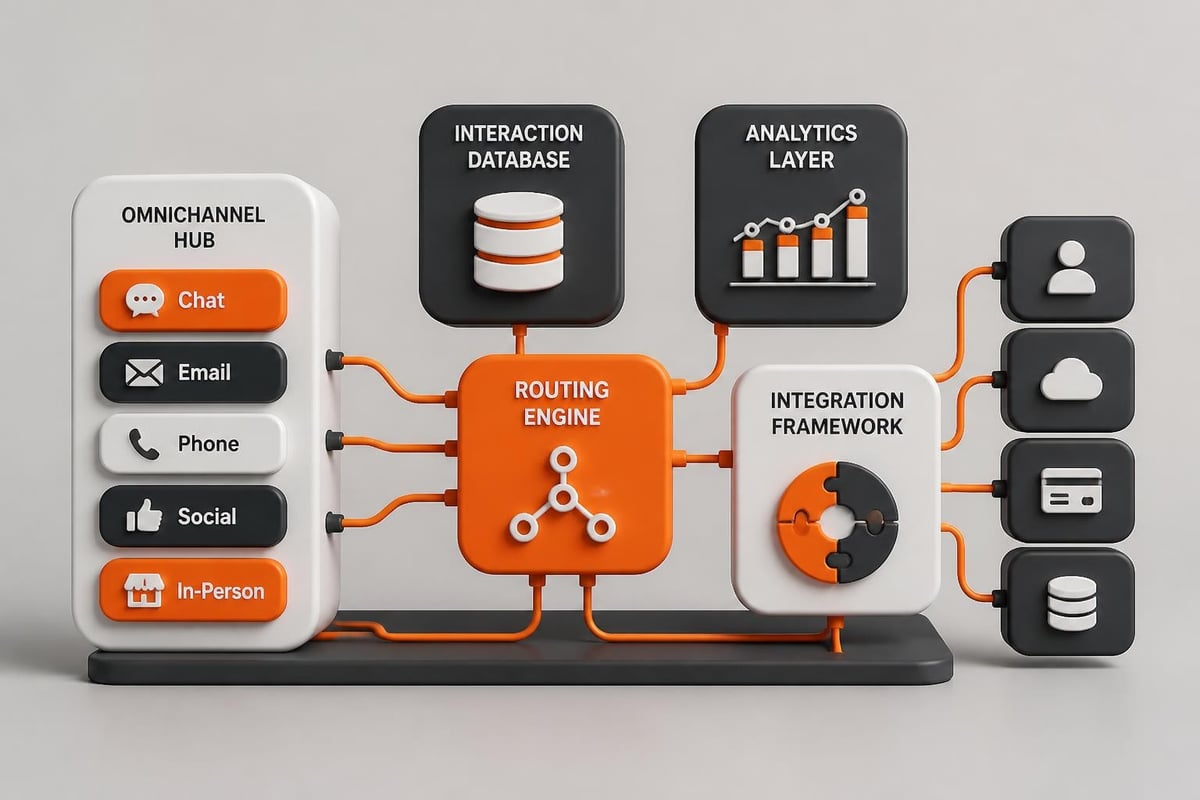
Modern customer interaction management platforms include five essential components that work together to optimize engagement:
- Omnichannel integration hub that connects phone systems, email servers, chat platforms, social media APIs, and SMS gateways
- Centralized interaction database that stores complete communication history with timestamps, content, outcomes, and metadata
- Intelligent routing engine that directs inquiries to appropriate agents based on skills, availability, customer value, and interaction context
- Real-time analytics dashboard that displays metrics such as response times, resolution rates, channel performance, and customer sentiment
- Workflow automation tools that trigger actions based on interaction patterns, customer behavior, or predefined business rules
The system maintains a single customer profile that updates automatically as new interactions occur. When a customer contacts support through any channel, agents see the complete history including recent purchases, previous issues, communication preferences, and notes from prior conversations.
How Does a Customer Interaction Management System Work
A customer interaction management system operates by capturing incoming communications, enriching them with contextual data, routing them to appropriate resources, and recording outcomes for future reference. The process begins when a customer initiates contact through any channel.
The system identifies the customer using phone number, email address, social media handle, or account login credentials. It retrieves the customer profile and interaction history from the central database. The routing engine evaluates factors including customer priority, agent expertise, current queue status, and business rules to assign the interaction to the best-available resource.
Technical Workflow Sequence
- Capture: System detects incoming interaction via integrated channel (phone switch, email server, chat widget, social media monitoring tool)
- Identify: Platform matches contact information to existing customer record or creates new profile for first-time contacts
- Enrich: System appends customer data including account status, purchase history, previous interactions, and any open issues or tasks
- Route: Engine applies business logic to direct interaction to appropriate queue, department, or individual agent based on predefined criteria
- Present: Agent interface displays customer profile, interaction history, relevant knowledge base articles, and suggested responses
- Document: System automatically records interaction details, agent notes, resolution status, and any follow-up tasks created
- Analyze: Platform updates performance metrics, sentiment scores, and trend data that feed into reporting dashboards
The workflow happens in seconds, ensuring agents have complete context before they engage with the customer. Effective customer interaction management systems integrate seamlessly with existing business applications to pull data from order management, inventory systems, billing platforms, and service databases.
Why Implement a Customer Interaction Management System
Organizations implement customer interaction management systems to eliminate information silos that create inconsistent customer experiences and operational inefficiencies. Without unified interaction tracking, customers must repeat information when switching channels or speaking with different departments.
The financial impact is significant. Businesses lose revenue when customers abandon transactions due to poor service experiences. Service costs rise when agents spend extra time searching for information or resolving issues that could have been prevented with better context.
Measurable Business Outcomes
| Metric | Typical Improvement | Timeline |
|---|---|---|
| Average response time | 25-40% reduction | 3-6 months |
| First-contact resolution rate | 15-30% increase | 6-12 months |
| Customer satisfaction score | 10-25 point gain | 6-12 months |
| Agent productivity | 20-35% improvement | 3-6 months |
| Service cost per interaction | 15-25% reduction | 12-18 months |
A customer interaction management system provides strategic advantages beyond operational efficiency. The unified data enables businesses to identify patterns in customer behavior, predict future needs, and personalize communications at scale.

Companies can segment customers based on interaction patterns rather than just demographics or purchase history. For example, customers who consistently use chat for quick questions but call for complex issues receive different support paths than those who prefer email for all interactions.
What Are the Steps to Implement a Customer Interaction Management System
Implementation follows a structured sequence that typically spans three to nine months depending on organization size and system complexity. Rushed deployments create adoption problems and data quality issues that undermine system value.
Step 1: Define Objectives and Success Metrics
Establish specific, measurable goals such as reducing average response time from 4 hours to 90 minutes or increasing first-contact resolution from 65% to 80%. Identify which customer segments, interaction types, or channels require immediate improvement. Document current baseline metrics for accurate before-and-after comparison.
Step 2: Map Current Interaction Flows
Document how customers currently contact the organization across all channels. Identify where information gaps occur, where handoffs fail, and which processes cause customer friction. Create process maps showing the complete journey from initial contact through resolution for common interaction scenarios.
Step 3: Select System Components and Integration Points
Choose platforms that integrate with existing technology infrastructure including CRM systems, phone systems, email servers, and business applications. Implementing customer interaction management solutions requires clear technical specifications for API connections, data synchronization schedules, and authentication protocols.
Step 4: Plan Data Migration and Cleanup
Audit existing customer data for completeness, accuracy, and duplication. Establish data quality standards before migration. Create mapping rules that consolidate customer records from multiple systems into unified profiles. Plan for historical interaction data that provides value versus archival storage.
Step 5: Configure Workflows and Business Rules
Build routing logic based on customer priority tiers, agent skills matrices, and interaction complexity. Define escalation paths for time-sensitive issues. Create automated responses for common inquiries. Establish validation rules that ensure data consistency.
Step 6: Train Staff and Establish Governance
Develop role-specific training for agents, supervisors, and administrators. Create standard operating procedures for common scenarios. Assign data stewardship responsibilities for maintaining customer information accuracy. Establish quality assurance processes that monitor interaction handling.
Step 7: Deploy in Phases with Monitoring
Start with a pilot group using one or two channels before full rollout. Monitor performance metrics daily during initial deployment. Collect user feedback and address technical issues quickly. Gradually expand to additional channels and user groups as stability improves.
For custom software development teams, Brytend CRM offers a comprehensive customer relationship management platform that includes advanced interaction tracking, workflow automation, and AI-driven lead management capabilities tailored to specific business requirements.

How Can Organizations Optimize Customer Interaction Management
Optimization requires continuous refinement based on performance data, customer feedback, and evolving business requirements. Strategies for effective customer interaction management emphasize creating integrated experiences that feel seamless to customers regardless of which channel they use.
Best Practices for System Operation
Maintain Consistent Terminology
Use identical language, field names, and status codes across all channels and departments. When a customer sees "order pending" in an email, the same terminology should appear in the portal, on phone calls, and in chat interactions. Inconsistent terminology creates confusion and requires agents to translate between systems.
Automate Routine Interactions
Configure the system to handle common, predictable inquiries without human intervention. Examples include order status updates, password resets, appointment confirmations, and basic product information. Route only complex or unusual interactions to agents, maximizing their time for high-value work.
Use Interaction Data for Proactive Engagement
Analyze patterns to identify customers who may need assistance before they contact support. If a customer repeatedly visits a help article about a specific feature but hasn't submitted a support ticket, trigger a proactive outreach offering guidance. Managing customer interactions effectively includes anticipating needs based on behavior signals.
Implement Feedback Loops
Collect customer satisfaction ratings immediately after interactions while the experience is fresh. Share feedback data with agents and use it for coaching and process improvement. Track sentiment trends across channels to identify emerging issues or successful practices worth replicating.
Maintain Agent Skill Profiles
Document each agent's expertise, language capabilities, certification levels, and performance metrics. Update skill profiles as agents complete training or demonstrate proficiency in new areas. Route interactions to agents whose skills match the customer's specific need rather than using simple round-robin distribution.
Common Implementation Mistakes
Organizations frequently make avoidable errors that reduce system effectiveness:
- Implementing technology before defining clear process improvements, resulting in automated chaos rather than automated efficiency
- Failing to clean and consolidate customer data before migration, creating duplicate profiles and incomplete interaction histories
- Neglecting integration with existing business systems, forcing agents to switch between multiple applications during customer interactions
- Setting unrealistic timeline expectations that rush deployment and skip essential testing phases
- Providing insufficient training that leaves agents uncertain about system capabilities and correct usage procedures
What Challenges Arise in Customer Interaction Management
Technical integration complexity represents the most common implementation challenge. Legacy systems often lack modern APIs or use proprietary data formats that complicate integration. Building robust customer interaction management systems requires addressing data synchronization, real-time updates, and maintaining consistency across platforms.
Technical and Organizational Obstacles
Data Quality and Consolidation
Merging customer records from multiple systems reveals inconsistencies in how information was captured, stored, and maintained. Addresses have different formatting conventions. Names include spelling variations. Duplicate accounts exist with partial information in each. Resolving these issues requires both automated matching algorithms and manual review processes.
Channel-Specific Limitations
Each communication channel has unique technical constraints. Phone systems provide limited metadata compared to digital channels. Social media platforms restrict data access through API limitations. Email lacks real-time delivery confirmation. The customer interaction management system must accommodate these differences while presenting unified information to agents.
Organizational Silos
Different departments often resist sharing customer data or following common processes. Sales teams want flexibility in how they record interactions. Support teams need structured data for reporting. Marketing requires specific tagging for campaign attribution. Reconciling these competing requirements demands executive sponsorship and clear governance policies.
Privacy and Compliance Requirements
Customer interaction management systems store sensitive personal information subject to regulations including GDPR, CCPA, HIPAA, and industry-specific requirements. The platform must support data retention policies, consent management, right-to-erasure requests, and audit trails that document data access and modifications.

Comparison: Manual vs. Automated Interaction Management
| Aspect | Manual Process | Customer Interaction Management System |
|---|---|---|
| Information access | Agents search email, notes, spreadsheets | Complete history displayed automatically |
| Response consistency | Varies by agent knowledge and memory | Standardized responses and workflows |
| Performance tracking | Periodic manual sampling | Real-time metrics and trend analysis |
| Channel switching | Customer repeats information | Context transfers seamlessly |
| Capacity planning | Reactive based on visible queues | Predictive based on historical patterns |
| Knowledge retention | Lost when agents leave | Captured in interaction records |
How Do Specialized Industries Use Customer Interaction Management Systems
Manufacturing and industrial organizations implement customer interaction management systems with specific requirements that differ from retail or consumer services. These systems must integrate with serialized inventory tracking, service history databases, and compliance documentation platforms.
Industrial Equipment Service Scenario
A gas detection equipment manufacturer uses a customer interaction management system integrated with their service management platform. When a facility manager calls about a calibration issue with unit #GD-2847-A, the system immediately retrieves:
- Complete service history including last calibration date, technician notes, and parts replaced
- Current warranty status and coverage details for that specific serialized unit
- Pending service reminders or scheduled maintenance for other equipment at that customer location
- Compliance certificates and inspection records required by safety regulations
- Technical specifications and troubleshooting guides specific to that model
The agent sees that the unit is due for annual recertification in 14 days and proactively schedules both the calibration service and the compliance inspection during one site visit. The system automatically generates the service order, assigns it to a technician with gas detection expertise in that region, and adds required parts to the work order based on the service history pattern.
This integration between customer interaction management and service operations eliminates redundant data entry, ensures regulatory compliance, and improves customer satisfaction by demonstrating proactive attention to their equipment needs.
Project-Based Professional Services
Engineering consulting firms use customer interaction management systems to track all communications related to specific projects rather than just customer accounts. When a client contacts the firm, the system routes them based on which project they're calling about and presents the project manager with:
- All previous interactions about that specific project across phone, email, and in-person meetings
- Current project status, open issues, and upcoming milestones
- Budget utilization and any change orders in process
- Team members assigned to the project with their roles and availability
- Relevant project documents, drawings, and specifications
The system differentiates between inquiries about active projects, proposal follow-ups, and general relationship conversations. It applies different routing rules and service level agreements based on project phase and client tier.
What Technologies Enable Customer Interaction Management Systems
Modern customer interaction management platforms combine multiple technologies to deliver unified functionality. Cloud infrastructure provides scalability and accessibility while reducing on-premise hardware requirements. Customer interaction management technology has evolved from simple call logging to sophisticated platforms using artificial intelligence and machine learning.
Core Technology Stack
Communication APIs and Integration Frameworks
Systems connect to communication channels through standardized APIs including SIP trunking for voice, SMTP/IMAP for email, WebSocket for chat, and OAuth-based social media integrations. Middleware platforms translate between different protocol standards and data formats to enable unified processing.
Natural Language Processing
AI engines analyze interaction content to extract intent, sentiment, entities, and key topics. The system identifies urgent issues, angry customers, or opportunities for upselling based on conversation content rather than just metadata. Sentiment analysis tracks emotional tone across interactions to identify deteriorating customer relationships.
Predictive Analytics
Machine learning models analyze historical interaction patterns to forecast future contact volume, optimal staffing levels, and customer churn risk. Predictive routing assigns interactions to agents most likely to achieve successful outcomes based on similar past scenarios.
Identity Resolution
The platform uses probabilistic matching algorithms to connect interactions from different channels to the same customer profile even when exact identifiers are missing. This technology handles variations in email addresses, multiple phone numbers, and partial name matches.
Workflow Orchestration
Business process management engines execute complex multi-step workflows triggered by interaction events. These workflows coordinate activities across multiple systems, assign follow-up tasks, send automated communications, and escalate issues based on time-based rules.
Integration Architecture Patterns
Customer interaction management systems typically integrate with existing business applications using three primary patterns:
- Real-time API integration for systems requiring immediate data synchronization such as CRM platforms, inventory databases, and order management systems
- Scheduled batch synchronization for less time-sensitive data including customer master records, product catalogs, and historical reporting data
- Event-driven messaging using message queues for asynchronous processing of high-volume activities like logging interactions, updating analytics, and triggering workflows
The architecture must support both inbound data flows that enrich customer profiles with information from source systems and outbound flows that share interaction data with analytics platforms, data warehouses, and business intelligence tools.
Customer interaction management systems provide the infrastructure necessary for delivering consistent, informed customer service across all communication channels and organizational touchpoints. Implementation requires careful planning, clean data, and commitment to ongoing optimization based on performance metrics and customer feedback. Brytend develops custom customer interaction management solutions that integrate seamlessly with existing business systems, providing the exact functionality your organization needs without unnecessary complexity or features you won't use.