TL;DR
- Gas detection software is a monitoring platform that centralizes sensor data, automated alerting, calibration tracking, and compliance reporting for facilities with gas hazard exposure.
- Core functions include real-time concentration monitoring, multi-channel alerting, calibration scheduling, and regulatory report generation.
- A facility running 100 sensors at one-minute intervals generates more than five million data points per month, requiring integration with existing building and safety systems.
- Implementation requires role-specific training for safety managers, operators, maintenance technicians, and emergency responders.
- Device registration and service management modules extend gas detection software into full equipment lifecycle tracking, from serialized registration to automated certificate generation.
Gas detection software is a monitoring platform that collects, analyzes, and reports data from gas sensors to support workplace safety, regulatory compliance, and equipment maintenance.
What Is Gas Detection Software
Gas detection software is a specialized monitoring system that processes real-time data from fixed and portable gas sensors to identify hazardous concentrations, trigger alerts, and maintain compliance records.
The software sits between physical sensor hardware and the personnel who respond to safety events. It replaces manual log sheets and standalone sensor displays with a centralized system that timestamps every reading, flags threshold violations, and stores historical data for audits.
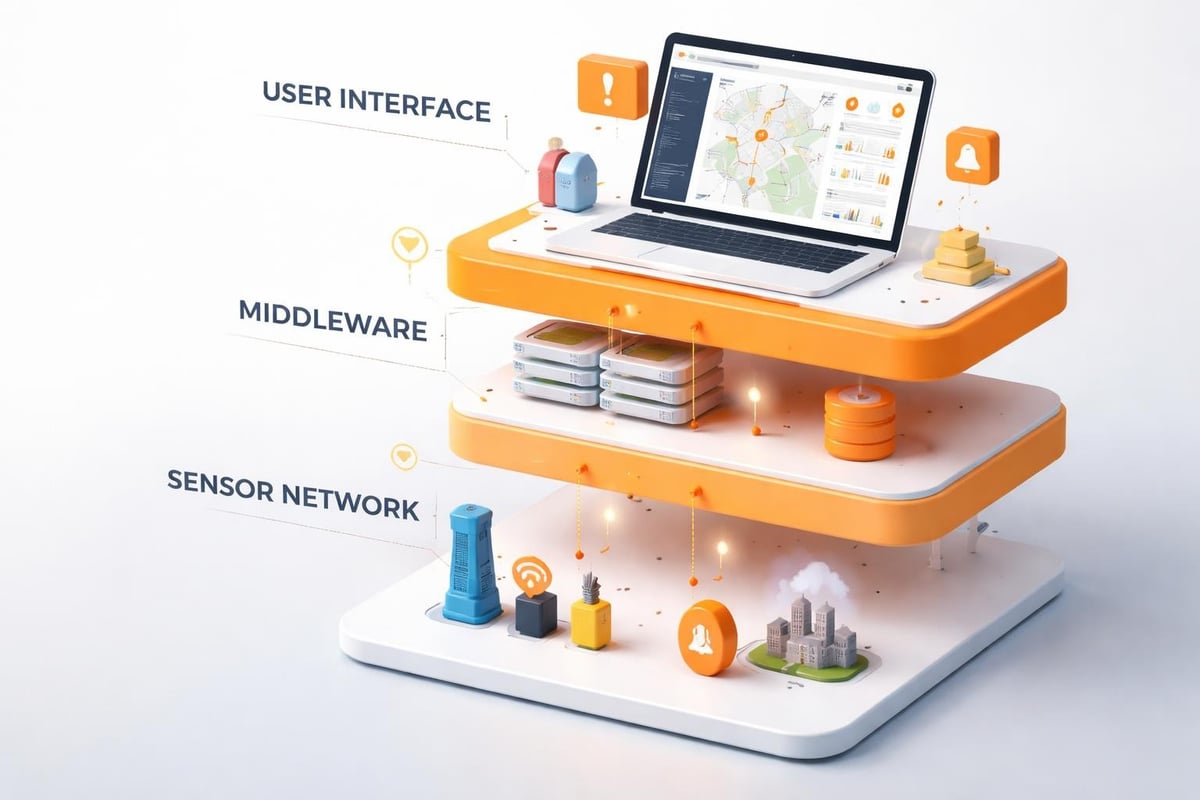
Three system layers define most gas detection software deployments:
- Sensor layer: Fixed detectors, portable monitors, and gateway devices that measure gas concentration in parts per million (ppm) or percentage of lower explosive limit (%LEL)
- Software layer: The monitoring platform that aggregates sensor data, applies alert logic, and generates reports
- Response layer: Notification systems, mobile applications, and integration points that route alerts to safety managers, operators, and emergency responders
Facilities that handle ammonia, hydrogen sulfide, carbon monoxide, or combustible gases rely on this software to meet OSHA, EPA, and industry-specific safety standards. Regulatory bodies increasingly require documented, timestamped monitoring records rather than self-reported logs, making software-based systems a compliance necessity rather than an optional upgrade.
Understanding gas detection software requires familiarity with a small set of consistent terms used throughout implementation and operation:
- Ppm (parts per million): The standard unit for measuring toxic gas concentration, such as hydrogen sulfide or carbon monoxide
- %LEL (percentage of lower explosive limit): The standard unit for measuring combustible gas concentration relative to the threshold at which ignition becomes possible
- Fixed sensor: A permanently installed detector monitoring a specific location continuously
- Portable monitor: A handheld or wearable device used by personnel entering variable or confined space environments
- Calibration: The process of verifying and adjusting sensor accuracy against a known reference gas concentration
Consistent use of these terms across documentation, training materials, and software configuration reduces confusion during incident response and simplifies communication between safety managers, technicians, and regulatory auditors.
How Does Gas Detection Software Work
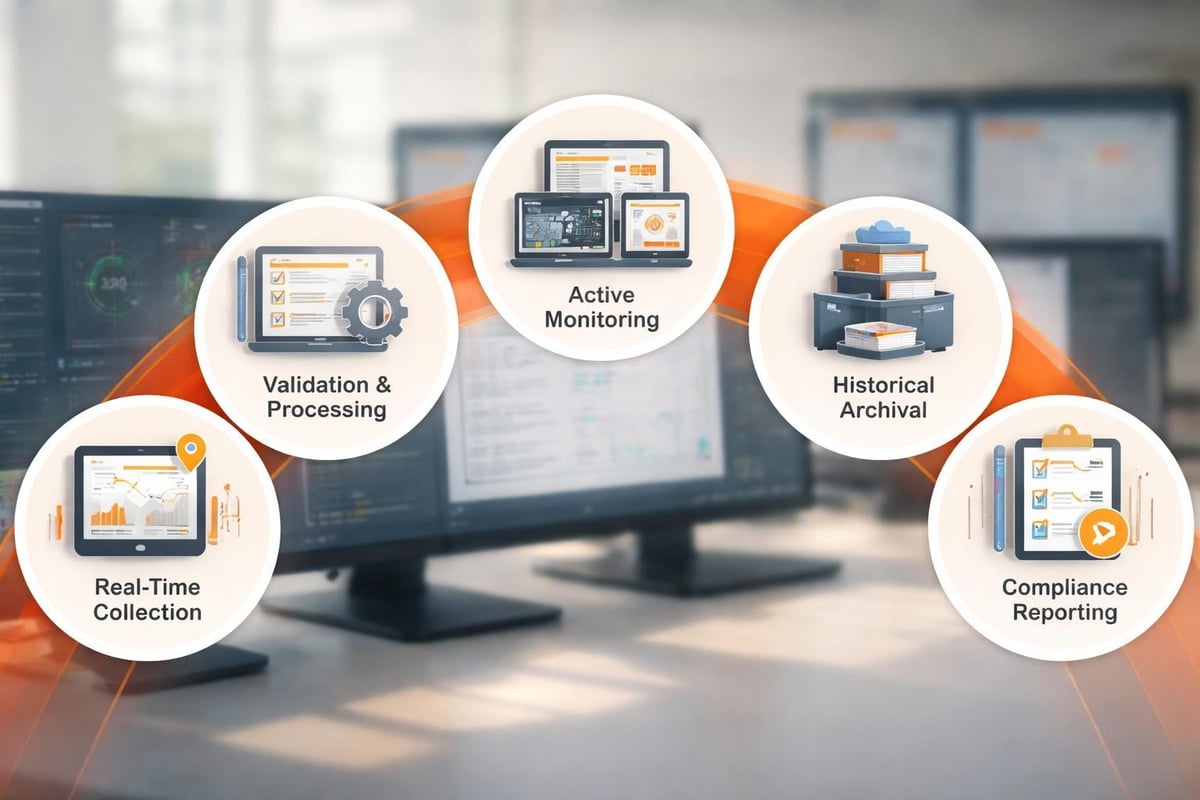
Gas detection software works by continuously polling connected sensors, comparing readings against configured thresholds, and executing predefined response actions when a reading exceeds a safe limit.
Sensors transmit data to the software platform through wired connections, wireless gateways, or cellular modules. The platform records each reading with a timestamp, location tag, and sensor identifier. When a reading crosses a warning or alarm threshold, the system executes rules configured by a safety manager.
Typical automated workflow sequence:
- Sensor detects gas concentration above the configured threshold
- Software logs the reading and timestamp against the sensor identifier
- Alert routes to on-duty safety personnel through SMS, email, or a dedicated mobile application
- System escalates the alert if no acknowledgment occurs within a defined time window
- Software generates an incident record for compliance documentation
- Maintenance workflow triggers automatically if the sensor requires calibration or service
This process removes the delay inherent in manual monitoring, where personnel must physically check gauges or rely on an audible alarm without a documented response chain. Automated escalation also ensures that an unacknowledged alert does not go unresolved during shift changes or personnel absences.
What Features Should Gas Detection Software Include
Gas detection software should include real-time monitoring, automated alerting, calibration management, data logging, and regulatory reporting as baseline features.
Monitoring and Alerting
- Real-time dashboard showing sensor status and current readings across all monitored locations
- Configurable warning and alarm thresholds by gas type and facility zone
- Multi-channel alert delivery, including SMS, email, mobile push notifications, and audible or visual on-site alarms
- Escalation rules that route unacknowledged alerts to secondary personnel
Calibration and Maintenance
- Calibration schedule tracking by sensor and gas type
- Automated reminders issued before calibration due dates
- Service history logging for each individual device
- Integration with device registration systems for serialized equipment tracking
System Architecture Components
Gas detection software architecture typically separates into distinct functional layers, each with a defined role in the monitoring workflow.
- Data ingestion layer: Receives raw sensor readings through wired protocols, wireless mesh networks, or cellular gateways and normalizes the data into a consistent format
- Rules engine: Evaluates incoming readings against configured thresholds and determines whether an alert, escalation, or maintenance trigger applies
- Storage layer: Retains historical readings, alert logs, and calibration records for the duration required by applicable regulations, often five to seven years for industrial facilities
- Presentation layer: Dashboards, mobile applications, and reporting interfaces used by safety managers, operators, and auditors
- Integration layer: APIs and protocol adapters, such as Modbus, BACnet, or MQTT, that connect the platform to building management systems, industrial control systems, and equipment registration databases
Facilities evaluating gas detection software should confirm that each layer scales independently. A platform that stores five years of continuous readings from hundreds of sensors requires different database architecture than a platform designed for a handful of sensors with monthly reporting.
Compliance and Reporting
- Automated incident reports formatted for regulatory submission
- Complete audit trail of all readings, alerts, and acknowledgments
- Certificate generation for calibration and inspection records
- Exportable data formatted for OSHA, EPA, or industry-specific audits
Organizations managing serialized gas detection equipment require registration systems that track each device from deployment through decommissioning. Brytend’s Device Registration & Service module, for example, allows organizations to register serialized detectors, assign instrument-specific service protocols, and generate compliance certificates automatically once calibration is complete. This type of integration connects the physical equipment lifecycle directly to the monitoring platform’s compliance records, rather than treating registration and monitoring as separate, disconnected processes.
How Do Organizations Implement Gas Detection Software
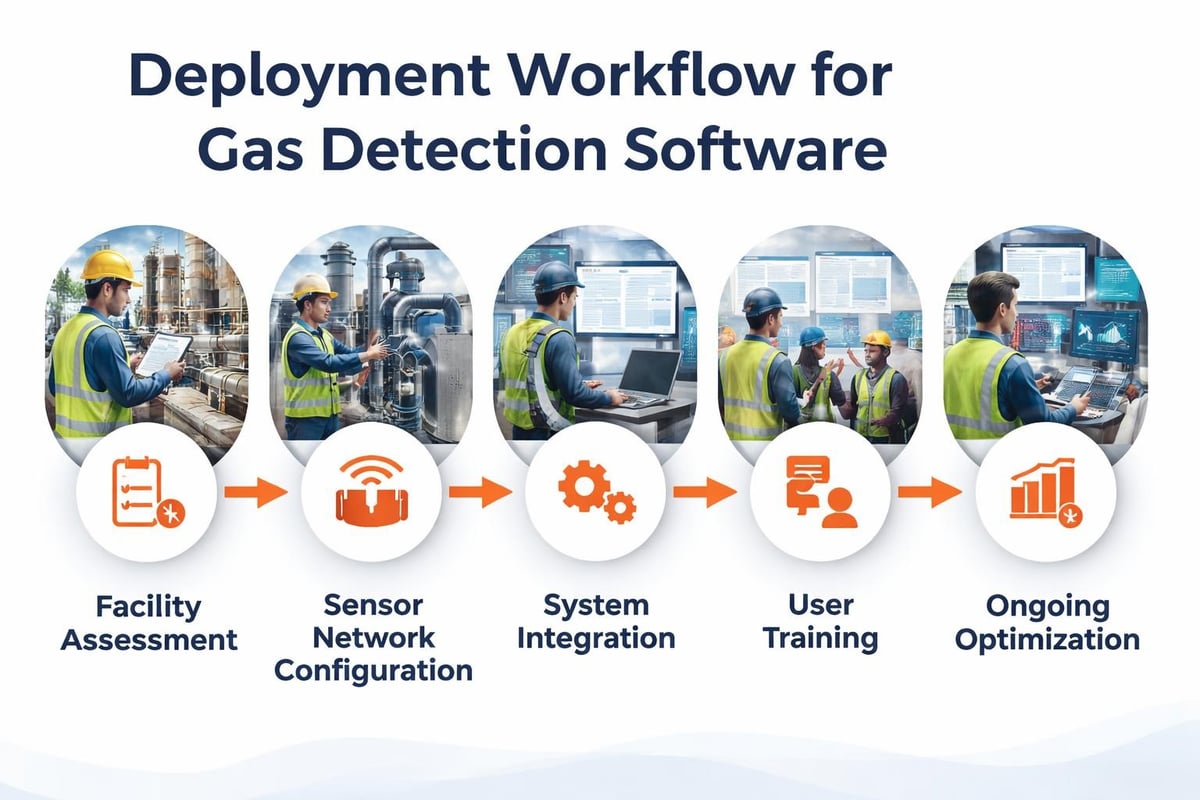
Organizations implement gas detection software through a structured process that includes requirements definition, sensor deployment, system configuration, and role-specific staff training.
- Conduct a site assessment to identify gas hazards, required sensor placement, and coverage gaps
- Define alert thresholds and escalation rules for each gas type and facility location
- Select sensor hardware compatible with the software platform’s communication protocols
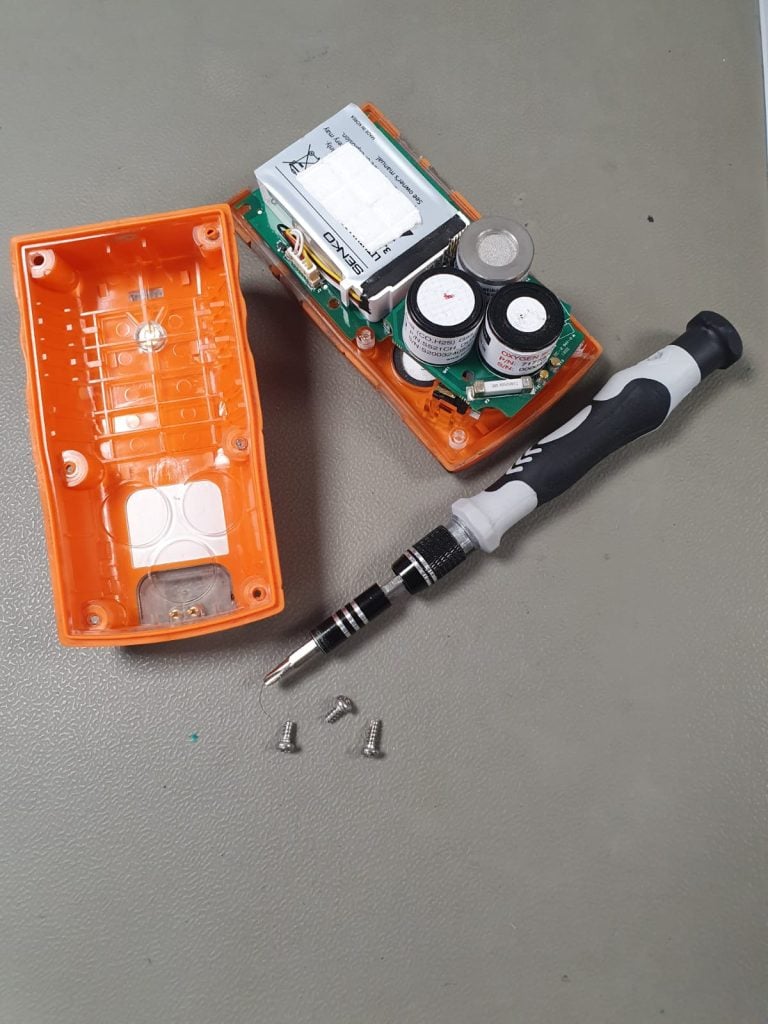
- Install fixed sensors and configure integration for portable monitoring devices
- Register each device in a centralized inventory system with serial numbers, calibration schedules, and service protocols
- Configure integration with existing building management, safety, and inventory systems using APIs or standard protocols such as Modbus and BACnet
- Train personnel by role: safety managers configure rules and analyze trends, operators monitor daily conditions, maintenance technicians service equipment, and emergency responders act on alerts
- Run a pilot period to validate alert accuracy and response workflows before full deployment
Implementation timelines vary by facility size and sensor count. Facilities with fewer than 20 sensors typically complete deployment within four to six weeks. Larger industrial sites with complex integration requirements often require three to six months, particularly when connecting to legacy building management or industrial control systems.
Integration planning deserves particular attention during implementation. Facilities typically operate several existing systems that gas detection software must connect with rather than duplicate:
- Building management systems: Coordinate ventilation and HVAC response to confirmed gas events
- Industrial control systems: Trigger automated shutdown sequences for high-risk combustible gas conditions
- Workforce tracking tools: Confirm which personnel are present in a zone when an alert triggers, supporting accurate emergency response
- Equipment registration databases: Maintain serialized device records, calibration schedules, and service history independent of the monitoring platform itself
Standard protocols such as Modbus and BACnet handle most industrial control integrations, while REST APIs typically connect gas detection software to registration databases, customer relationship systems, and reporting tools. Facilities lacking API documentation for legacy systems often require middleware solutions or custom integration adapters to bridge the gap.
What Are the Common Challenges With Gas Detection Software
Common challenges with gas detection software include data volume management, integration complexity, alert fatigue, and inconsistent calibration tracking.
- Data volume: A facility running 100 sensors at one-minute intervals generates more than five million data points monthly, requiring database architecture capable of continuous ingestion and long-term storage
- Integration complexity: Modern facilities already operate building management platforms, industrial control systems, and workforce tracking tools; gas detection software must connect to these systems rather than operate as an isolated information silo
- Alert fatigue: Poorly configured thresholds generate excessive false alarms, causing personnel to ignore or delay response to genuine hazards
- Calibration tracking gaps: Facilities without centralized device registration systems often lose track of calibration due dates across large sensor fleets, resulting in compliance violations
- Training gaps: Software delivers no safety value if operators, technicians, and emergency responders lack role-specific training on system functions
- Sensor drift: Electrochemical and catalytic sensors degrade over time, producing inaccurate readings if calibration schedules slip; software must flag sensors approaching end-of-life based on manufacturer specifications
- Multi-site consistency: Organizations operating several facilities often configure each site independently, resulting in inconsistent alert thresholds and reporting formats that complicate corporate-level compliance oversight
Common mistakes organizations make when adopting gas detection software:
- Selecting sensor hardware before confirming software compatibility
- Configuring identical alert thresholds across different gas types or facility zones
- Skipping integration planning with existing safety and inventory systems
- Underestimating data storage requirements for continuous monitoring
- Deploying the system without role-specific training for every user group
How Can Organizations Optimize Gas Detection Software Usage
Organizations optimize gas detection software usage by reviewing alert configurations regularly, maintaining accurate device registration data, and integrating monitoring data with broader safety management systems.
- Review and adjust alert thresholds quarterly based on actual incident data
- Maintain a centralized, serialized inventory of all sensors with calibration and service history
- Assign clear ownership for calibration scheduling and compliance reporting
- Integrate gas detection data with building management and industrial control systems
- Conduct periodic audits of historical data to identify sensor drift or recurring false alarms
- Standardize service protocols by device and gas type to ensure consistent calibration procedures across the fleet
Facilities that treat gas detection software as a static deployment rather than an ongoing operational system tend to accumulate configuration drift. Thresholds set during initial installation often no longer match actual facility conditions after equipment changes, process modifications, or facility expansions.
Optimization also extends to reporting workflows. Safety managers who manually compile data for monthly or quarterly regulatory submissions spend hours reconciling readings from multiple sensors and locations. Configuring automated report templates that map directly to regulatory submission formats removes this manual step and reduces the risk of transcription errors in compliance documentation.
Facilities with multiple locations benefit from standardizing configuration across sites. A corporate safety team overseeing five facilities cannot effectively compare incident rates or calibration compliance if each site configures thresholds, gas types, and reporting formats independently. Centralized configuration templates, applied consistently across locations with site-specific adjustments where genuinely required, support corporate-level oversight without sacrificing local accuracy.
What Data Security Considerations Apply to Gas Detection Software
Gas detection software handles operational data that requires access controls, encrypted transmission, and defined retention policies to meet both cybersecurity and regulatory requirements.
Continuous sensor monitoring generates a steady stream of data that must remain accurate and tamper-resistant, since regulators and insurers rely on this data during incident investigations. Key security considerations include:
- Role-based access control: Safety managers, operators, technicians, and auditors require different permission levels; operators should not be able to alter historical alert records
- Encrypted data transmission: Sensor-to-platform communication should use encrypted channels, particularly for wireless and cellular-connected devices
- Immutable audit logs: Alert acknowledgments, threshold changes, and calibration records should remain unalterable once logged, supporting regulatory audits and incident investigations
- Data retention policies: Facilities must retain monitoring records for the period specified by applicable regulations, which varies by jurisdiction and gas type
- Backup and redundancy: Safety-critical monitoring systems require redundant data storage to prevent record loss during system failures
Organizations selecting gas detection software should request documentation on data encryption standards, access control configuration, and backup procedures before deployment rather than after a compliance audit reveals a gap.
What Industries Use Gas Detection Software
Industries with gas hazard exposure use gas detection software, including oil and gas, chemical manufacturing, wastewater treatment, cold storage and refrigeration, and equipment distribution and service.
Refrigeration and Cold Storage
Facilities using ammonia refrigeration require early leak detection to prevent product contamination and to coordinate response with HVAC systems. Software in this sector integrates with food safety management platforms to document compliance during audits.
Oil and Gas
Combustible gas monitoring across processing facilities and pipelines requires continuous %LEL tracking with automated shutdown integration for high-risk conditions.
Wastewater Treatment
Hydrogen sulfide monitoring in confined spaces requires coordination between portable and fixed sensors, with strict alert escalation rules to protect personnel working in enclosed environments.
Chemical Manufacturing
Facilities producing or handling volatile compounds require multi-gas monitoring across production areas, storage zones, and loading operations. Software in this sector typically integrates with process control systems to correlate gas readings with specific production stages.
Confined Space Operations
Personnel entering tanks, vessels, or underground spaces rely on portable gas monitors that transmit readings to a central system in real time. Software supporting confined space entry programs logs entry and exit times alongside continuous gas readings, creating a documented safety record for each entry event.
Distributors and Service Providers
Organizations that service gas detection equipment for multiple end customers require registration systems capable of tracking devices across distributor, wholesale, and end-user relationships. Manufacturer-agnostic platforms allow service providers to manage mixed equipment fleets without restricting device compatibility to a single brand.
Manual Monitoring vs Gas Detection Software
| Aspect | Manual Process | Gas Detection Software |
|---|---|---|
| Monitoring | Periodic gauge checks, audible alarms only | Continuous real-time monitoring with logged readings |
| Alerting | Physical presence required to notice alarms | Automated multi-channel alerts with escalation |
| Calibration Tracking | Spreadsheets or paper logs | Centralized schedule with automated reminders |
| Compliance Reporting | Manual data compilation, hours per report | Automated report generation from logged data |
| Device History | Fragmented records across departments | Centralized service and calibration history per device |
| Incident Response | Delayed, undocumented | Timestamped, auditable response chain |
Case Example: Centralizing Calibration for a Multi-Site Service Provider
A mid-sized industrial gas detection service provider managed calibration schedules for more than 400 deployed sensors across 60 customer sites using spreadsheets and manual customer follow-up. Missed calibration deadlines created recurring compliance gaps, and technicians lacked access to service history when arriving on-site.
The provider implemented Brytend’s Device Registration & Service module to centralize equipment tracking. Each sensor was registered with its serial number, customer location, and gas-type-specific service protocol. The system generated automated reminders 60 days before calibration deadlines and produced compliance certificates immediately after service completion.
Results after implementation:
- Missed calibration deadlines decreased from an average of 12 per quarter to fewer than 2
- Technician preparation time decreased because service history was accessible before each site visit
- Certificate generation time decreased from same-day manual creation to automatic generation at service completion
The provider also gained visibility into fleet-wide calibration status through a single dashboard, replacing a process that previously required cross-referencing spreadsheets maintained by individual technicians. Customer-facing service records became accessible on demand, reducing the number of support calls related to certificate requests and service history inquiries.
This case illustrates a pattern common among gas detection service providers: monitoring software alone does not resolve calibration compliance gaps if device registration and service scheduling remain manual. Combining real-time monitoring with structured equipment lifecycle management closes that gap.
How Custom Development Extends Gas Detection Software
Custom development extends gas detection software beyond sensor monitoring into full equipment lifecycle management, addressing gaps that standard monitoring platforms leave unaddressed.
Standard gas detection platforms handle monitoring and alerting well but rarely include device registration, service protocol management, or certificate generation for serialized equipment. Organizations managing equipment across multiple customers or sites require these additional capabilities to maintain accurate compliance records at scale.
Brytend develops software solutions, including device registration and service management modules, that extend gas detection monitoring into complete equipment lifecycle tracking. The Device Registration & Service module supports bulk product imports, instrument-specific service protocols, automated service reminders, and downloadable certificate libraries, connecting the physical equipment record directly to ongoing compliance documentation.
Gas detection software continues to expand beyond real-time monitoring into integrated equipment lifecycle management. Organizations evaluating platforms should confirm that calibration tracking, device registration, and compliance reporting operate as a connected system rather than separate tools requiring manual reconciliation.
Facilities and service providers assessing their current gas detection setup should audit three questions before selecting or expanding a platform: whether monitoring data connects to a centralized, serialized device registry; whether calibration reminders trigger automatically rather than depending on manual tracking; and whether compliance reports generate directly from logged data rather than requiring manual compilation. A negative answer to any of these questions identifies a specific integration gap that custom development can address without replacing existing monitoring infrastructure.
FAQs
What is gas detection software used for?
Gas detection software is used to monitor and manage sensor data for hazardous gas exposure in facilities. It centralizes alerts, compliance reporting, and calibration tracking, ensuring workplace safety and regulatory compliance.
How does gas detection software work in real-time?
Gas detection software works by continuously polling sensors and comparing readings against safety thresholds. When a reading exceeds a limit, the software triggers alerts and logs the incident for compliance documentation.
What are the costs associated with gas detection software?
Costs for gas detection software vary widely based on features and scale, typically ranging from a few thousand to tens of thousands of dollars annually. Factors include sensor count, integration needs, and support services.
Can organizations customize gas detection software for their needs?
Yes, organizations can customize gas detection software to meet specific operational requirements. Custom development can enhance monitoring capabilities, device registration, and compliance reporting based on unique industry needs.
How long does it take to implement gas detection software?
Implementation of gas detection software can take four to six weeks for small facilities with fewer than 20 sensors, while larger sites may require three to six months due to complex integrations.
What features should be included in gas detection software?
Gas detection software should include real-time monitoring, automated alerting, calibration management, data logging, and regulatory reporting as essential features for effective operation and compliance.
Is training necessary for using gas detection software?
Yes, training is necessary for users of gas detection software. Role-specific training ensures safety managers, operators, and technicians understand how to utilize the system effectively for monitoring and compliance.